Nvidia Lands In Court Over Crypto Secret — Here Is What Investors Missed

bitcoinist2026-03-26 tarihinde yayınlandı2026-03-26 tarihinde güncellendi

Özet

Nvidia faces a certified class action lawsuit over allegations it under-disclosed crypto mining revenue linked to its gaming GPU sales during the 2017–2018 period. Investors claim the company misled them by attributing significant revenue growth to gaming rather than cryptocurrency mining, creating a "revenue gap" between internal knowledge and public statements. After Nvidia’s CFO later acknowledged a revenue shortfall due to crypto-related inventory issues, the stock fell nearly 30%. The lawsuit, now moving forward, cites internal emails suggesting management was aware the stock price was artificially sustained by misleading disclosures. The case introduces legal and financial risks for Nvidia amid its current prominence in AI.

Nvidia is facing a certified class action over alleged under‐disclosure of crypto mining revenue.

A Crypto Scandal Resurrects Just In Time For Holy Week

After years of grueling legal back and forth between the giant gaming company and the American courts, a U.S. federal judge has certified a securities-fraud class action against Nvidia and CEO Jensen Huang over alleged under‐disclosure of crypto mining revenue in 2017–2018, according to a Wednesday order from Judge Haywood S. Gilliam Jr. in a California federal court. A class certification means the case can move ahead on behalf of a broad group of shareholders (the plaintiffs), raising the legal and financial stakes for Nvidia.

Investors claim Nvidia hid how much of its “gaming” GPU sales were actually driven by cryptocurrency miners, creating “revenue gaps” between public guidance and internal reality.

A Recap Of The Legal Battle

In order to properly understand this development, we must first go back to almost a decade ago, when investors sued the American tech company for the first time in 2018. Back then, the investors argued that $1 billion in crypto-linked GPU sales were misclassified or downplayed, with internal emails suggesting management knew the stock was “held high” by these statements.

It is important to remember that this happened in the context of the 2017–2018 mining boom, when Ethereum and other coins sent demand for Nvidia GPUs surging. Despite this, the company publicly emphasized gaming as the main growth driver.

The extent of Nvidia’s risk only became clear on November 2018, when CFO Colette Kress acknowledged that gaming revenue had fallen “short of expectations” because excess inventory built up during the crypto boom was taking longer than anticipated to clear. Gaming GPU prices were slower than expected to return to normal after the “sharp crypto falloff”, she claimed.

This disclosure not only triggered a roughly 28–29% share price crash, but also forward, in 2022, a $5.5 million SEC fine over inadequate crypto-mining disclosures in fiscal 2018, which the company already paid. Bitcoinist covered the story back then.

The lawsuit was first thrown out in 2021, then brought back to life on appeal, withstanding Nvidia’s unsuccessful attempt to get the U.S. Supreme Court to shut it down, and is now advancing as a certified class action.

And Now What?

Today, plaintiffs contend that a large portion of Nvidia’s crypto-fueled sales actually ran through its GeForce gaming GPUs, with most of that income booked under the gaming division, leaving the company heavily exposed to the boom‐and‐bust swings of the crypto market. Despite that, Nvidia had long insisted that the bulk of mining-related demand was captured in a distinct line item rather than in its main gaming segment and that crypto mining was a minor contributor to its overall business.

The judge highlighted an internal email from an Nvidia vice president, describing it as especially revealing:

The Court also notes that internal company emails support its conclusion here. Just before the November 2018 disclosure, NVIDIA’s then-VP of Investor Relations and Strategic Finance opined in response to a question from Huang that one reason “the market isn’t pricing in a bigger miss” following news that AMD had one or two quarters of post-crypto channel inventory was in part “because of comments we’ve made on . . . ring-fencing the crypto impact in OEM”

The newly certified class includes investors who purchased Nvidia shares between August 10, 2017 and November 15, 2018. A case management conference is set for April 21, when the judge is expected to lay out how the litigation will proceed.

It is notable that one of NVIDIA’s own VPs expressed the view that its stock price remained high because of the same types of earlier comments that Plaintiffs are pointing to, and the Court cannot conclude that there was no price impact in the face of such evidence.

For NVDA stock traders, a live, certified class action injects headline risk into one of the market’s most crowded AI plays, and any adverse ruling or settlement could weigh on multiples in a risk‐off tape. For crypto and mining‐adjacent names, the case is a reminder that opaque revenue accounting around mining cycles can come back years later, potentially tightening disclosure standards just as the sector eyes the next bull run.
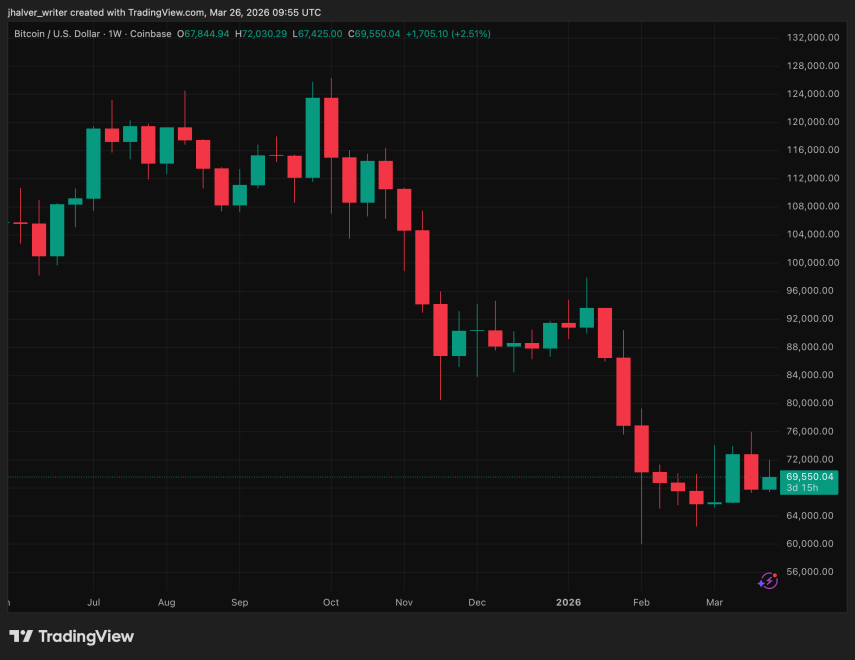
BTC’s price drops slightly after reaching $71k yesterday, trading for around $69k today. Source: BTCUSD on Tradingview

Cover image from Perplexity, BTCUSD chart from Tradingview

İlgili Sorular

QWhat is the main reason Nvidia is facing a certified class action lawsuit?

ANvidia is facing a certified class action lawsuit over alleged under-disclosure of crypto mining revenue, specifically for hiding how much of its 'gaming' GPU sales were actually driven by cryptocurrency miners during 2017-2018.

QWhat significant financial penalty did Nvidia already pay related to this issue?

ANvidia paid a $5.5 million SEC fine in 2022 over inadequate crypto-mining disclosures in fiscal 2018.

QWhat was the key consequence of Nvidia's November 2018 disclosure about its gaming revenue?

AThe November 2018 disclosure, where CFO Colette Kress acknowledged gaming revenue fell short due to excess crypto-related inventory, triggered a roughly 28-29% share price crash.

QWhat time period does the newly certified class action cover for investors?

AThe newly certified class includes investors who purchased Nvidia shares between August 10, 2017 and November 15, 2018.

QWhat did an internal email from an Nvidia VP reveal, according to the judge?

AThe judge highlighted an internal email where an Nvidia VP opined that the company's stock price remained high because of comments they had made about 'ring-fencing the crypto impact', suggesting management was aware the market was being misled.

İlgili Okumalar

Understanding CPO (Co-Packaged Optics) in One Article: Why Nvidia Is Willing to Spend $3.2 Billion on a Fiber?

NVIDIA and Corning announced a multi-year strategic partnership on May 6, 2026, with NVIDIA committing up to $3.2 billion to support Corning's U.S. expansion. This investment will triple Corning's manufacturing plants and significantly boost its optical fiber and communications production capacity. The core driver behind this massive investment is the fundamental shift from copper to optical interconnect technology within AI data centers. As GPU clusters scale, copper wires face critical limitations: severe signal attenuation over distance, high energy consumption for signal integrity, and excessive heat generation. Optical fiber, transmitting light instead of electrical signals, solves these issues with minimal loss, near-light speed, and lower power needs. The article outlines a three-stage evolution of data center interconnect: 1. **Traditional Copper Interconnects:** The mainstream solution of the 2010s, now being phased out due to scaling bottlenecks. 2. **Pluggable Optical Modules:** The current mainstream, where modules convert electrical signals to light externally. This process still introduces energy loss and latency. 3. **CPO (Co-Packaged Optics):** The next-generation technology where the optical engine is integrated directly with the GPU chip package. This drastically reduces the electrical signal travel distance to mere millimeters, slashing power consumption and latency while boosting data density. NVIDIA CEO Jensen Huang has identified CPO as an essential core technology for AI infrastructure. NVIDIA's investment signifies a strategic shift from being a buyer to actively controlling its supply chain for critical components. With demand for specialized optical fiber far outstripping supply—evidenced by soaring prices—securing long-term manufacturing capacity has become a competitive necessity. While Corning's expansion may pressure some suppliers, a projected global fiber supply gap of 5-15% over the next few years creates a significant opportunity window, particularly for Chinese manufacturers competitive in optical preforms, chips, and modules. Ultimately, NVIDIA's move is not about chasing a trend but an engineering imperative. The transition to light-based interconnects like CPO is driven by the physical limits of copper, marking a definitive step in the ongoing AI computing revolution.

marsbit16 dk önce

Understanding CPO (Co-Packaged Optics) in One Article: Why Nvidia Is Willing to Spend $3.2 Billion on a Fiber?

marsbit16 dk önce

KOL's Perspective: Why Is SOL Set to Rise from This Point?

**Summary: Why SOL is Positioned for Growth at This Level** The article argues that SOL is poised for an upward move from its current price point, citing several key factors. Primarily, SOL has just broken out of a 4-month consolidation phase. This breakout signals a return of risk appetite to the broader crypto market, as SOL is seen as a key indicator of overall crypto health. The token's ownership has reportedly shifted from short-term traders and tourists to long-term accumulators, leading to low volume. Any meaningful increase in trading activity could thus trigger significant upward momentum. Fundamental strengths include strong institutional adoption, integration with DeFi and RWAs (Real-World Assets), and the potential benefits from the Clarity Act. Despite its high volatility—having dropped 70% from its all-time high but still up 12x from its bear market low—SOL is highlighted as one of the few tokens from the last cycle to reach new highs. It boasts a robust ecosystem of applications, users, and protocols. Future catalysts include the expected influx of AI developers following the Miami Accelerate conference, which focused on AI on Solana. Furthermore, Solana is positioned as the premier chain for memecoin activity, a trend expected to continue and drive network usage and fees. The article concludes that recent price action reflects a healthy transfer to long-term holders, setting the stage for growth.

marsbit1 saat önce

KOL's Perspective: Why Is SOL Set to Rise from This Point?

marsbit1 saat önce

Those Pre-Bitcoin PoW Protocols Have Recently Been Reimplemented

This article details a recent surge in replicating pre-Bitcoin Proof-of-Work (PoW) protocols, specifically focusing on Hal Finney's 2004 RPOW (Reusable Proofs of Work). Within five days in May 2026, multiple independent builders in the Bitcoin/cypherpunk community launched projects inspired by this early electronic cash proposal. The initiative began with Fred Krueger's `rpow2.com`, a centralized but auditable system that replaced RPOW's original IBM 4758 hardware with Ed25519 signatures. Initially a faithful replica, it later adopted Bitcoin-like features (21M supply cap, difficulty adjustment) and a controversial 5.24% founder allocation. This sparked rapid forks, including `rpow4.com` which incorporated full Bitcoin parameters, a prediction market (`rpowmarket.com`), and a DEX (`rpow2swap.com`). Concurrently, Mike In Space created a prototype of Wei Dai's 1998 b-money proposal (`b-money.replit.app`), pushing the historical exploration even further back. The article contrasts these centralized, server-dependent experiments with Bitcoin's core innovation of decentralized, trustless consensus. It also highlights a parallel development: the `HASH` project on Ethereum, which uses smart contract hooks to enable a purely fair-launch, browser-mineable PoW token with 0% allocations to team or VCs. The collective activity is framed as a meme-driven, educational exploration of cypherpunk history rather than a serious financial movement, with all projects heavily disclaiming any investment value.

marsbit1 saat önce

Those Pre-Bitcoin PoW Protocols Have Recently Been Reimplemented

marsbit1 saat önce

South Korean Exchanges 'Battle' Regulators, Challenging the Boundaries of Enforcement and Legislation

South Korea's cryptocurrency industry is engaged in a rare, direct confrontation with regulators. The Financial Intelligence Unit (FIU), the primary anti-money laundering (AML) watchdog, has recently imposed heavy penalties on major exchanges like Upbit and Bithumb for alleged violations involving unregistered overseas VASPs and AML procedures. However, exchanges are now actively challenging these actions in court and through industry associations. In a significant shift, the Seoul Administrative Court ruled in favor of Upbit's operator, Dunamu, overturning part of an FIU-ordered business suspension. The court found the FIU's penalty criteria and justification insufficiently clear. Similarly, the court suspended the enforcement of a six-month business suspension against Bithumb pending a final ruling, citing potential irreversible harm to the exchange. Beyond legal battles, the industry is contesting proposed legislative amendments. The Digital Asset eXchange Alliance (DAXA) strongly opposes a draft rule that would mandate Suspicious Transaction Reports (STRs) for all crypto transfers over 10 million KRW (~$6,800). DAXA argues this "poison pill" clause violates legal principles and would overwhelm the STR system, increasing reports from 63,000 to an estimated 5.45 million annually for major exchanges, thereby crippling effective AML monitoring. This conflict highlights a structural tension in South Korea's crypto governance: comprehensive digital asset laws are still developing, while regulators rely heavily on AML enforcement. The industry's move from passive compliance to active legal and legislative challenges signifies a new phase, pressing for clearer rules and more proportionate enforcement. While short-term disputes may intensify, this clash could ultimately lead to a more mature and sustainable regulatory framework for South Korea's vibrant crypto market.

marsbit2 saat önce

South Korean Exchanges 'Battle' Regulators, Challenging the Boundaries of Enforcement and Legislation

marsbit2 saat önce

İşlemler

Spot
Futures
活动图片





