Nvidia Lands In Court Over Crypto Secret — Here Is What Investors Missed

bitcoinist2026-03-26 tarihinde yayınlandı2026-03-26 tarihinde güncellendi

Özet

Nvidia faces a certified class action lawsuit over allegations it under-disclosed crypto mining revenue linked to its gaming GPU sales during the 2017–2018 period. Investors claim the company misled them by attributing significant revenue growth to gaming rather than cryptocurrency mining, creating a "revenue gap" between internal knowledge and public statements. After Nvidia’s CFO later acknowledged a revenue shortfall due to crypto-related inventory issues, the stock fell nearly 30%. The lawsuit, now moving forward, cites internal emails suggesting management was aware the stock price was artificially sustained by misleading disclosures. The case introduces legal and financial risks for Nvidia amid its current prominence in AI.

Nvidia is facing a certified class action over alleged under‐disclosure of crypto mining revenue.

A Crypto Scandal Resurrects Just In Time For Holy Week

After years of grueling legal back and forth between the giant gaming company and the American courts, a U.S. federal judge has certified a securities-fraud class action against Nvidia and CEO Jensen Huang over alleged under‐disclosure of crypto mining revenue in 2017–2018, according to a Wednesday order from Judge Haywood S. Gilliam Jr. in a California federal court. A class certification means the case can move ahead on behalf of a broad group of shareholders (the plaintiffs), raising the legal and financial stakes for Nvidia.

Investors claim Nvidia hid how much of its “gaming” GPU sales were actually driven by cryptocurrency miners, creating “revenue gaps” between public guidance and internal reality.

A Recap Of The Legal Battle

In order to properly understand this development, we must first go back to almost a decade ago, when investors sued the American tech company for the first time in 2018. Back then, the investors argued that $1 billion in crypto-linked GPU sales were misclassified or downplayed, with internal emails suggesting management knew the stock was “held high” by these statements.

It is important to remember that this happened in the context of the 2017–2018 mining boom, when Ethereum and other coins sent demand for Nvidia GPUs surging. Despite this, the company publicly emphasized gaming as the main growth driver.

The extent of Nvidia’s risk only became clear on November 2018, when CFO Colette Kress acknowledged that gaming revenue had fallen “short of expectations” because excess inventory built up during the crypto boom was taking longer than anticipated to clear. Gaming GPU prices were slower than expected to return to normal after the “sharp crypto falloff”, she claimed.

This disclosure not only triggered a roughly 28–29% share price crash, but also forward, in 2022, a $5.5 million SEC fine over inadequate crypto-mining disclosures in fiscal 2018, which the company already paid. Bitcoinist covered the story back then.

The lawsuit was first thrown out in 2021, then brought back to life on appeal, withstanding Nvidia’s unsuccessful attempt to get the U.S. Supreme Court to shut it down, and is now advancing as a certified class action.

And Now What?

Today, plaintiffs contend that a large portion of Nvidia’s crypto-fueled sales actually ran through its GeForce gaming GPUs, with most of that income booked under the gaming division, leaving the company heavily exposed to the boom‐and‐bust swings of the crypto market. Despite that, Nvidia had long insisted that the bulk of mining-related demand was captured in a distinct line item rather than in its main gaming segment and that crypto mining was a minor contributor to its overall business.

The judge highlighted an internal email from an Nvidia vice president, describing it as especially revealing:

The Court also notes that internal company emails support its conclusion here. Just before the November 2018 disclosure, NVIDIA’s then-VP of Investor Relations and Strategic Finance opined in response to a question from Huang that one reason “the market isn’t pricing in a bigger miss” following news that AMD had one or two quarters of post-crypto channel inventory was in part “because of comments we’ve made on . . . ring-fencing the crypto impact in OEM”

The newly certified class includes investors who purchased Nvidia shares between August 10, 2017 and November 15, 2018. A case management conference is set for April 21, when the judge is expected to lay out how the litigation will proceed.

It is notable that one of NVIDIA’s own VPs expressed the view that its stock price remained high because of the same types of earlier comments that Plaintiffs are pointing to, and the Court cannot conclude that there was no price impact in the face of such evidence.

For NVDA stock traders, a live, certified class action injects headline risk into one of the market’s most crowded AI plays, and any adverse ruling or settlement could weigh on multiples in a risk‐off tape. For crypto and mining‐adjacent names, the case is a reminder that opaque revenue accounting around mining cycles can come back years later, potentially tightening disclosure standards just as the sector eyes the next bull run.
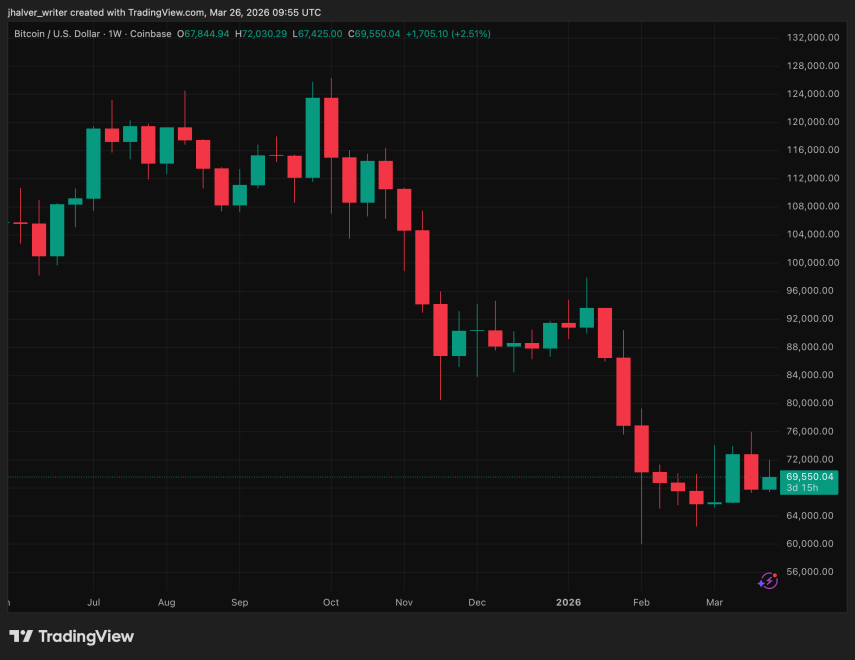
BTC’s price drops slightly after reaching $71k yesterday, trading for around $69k today. Source: BTCUSD on Tradingview

Cover image from Perplexity, BTCUSD chart from Tradingview

İlgili Sorular

QWhat is the main reason Nvidia is facing a certified class action lawsuit?

ANvidia is facing a certified class action lawsuit over alleged under-disclosure of crypto mining revenue, specifically for hiding how much of its 'gaming' GPU sales were actually driven by cryptocurrency miners during 2017-2018.

QWhat significant financial penalty did Nvidia already pay related to this issue?

ANvidia paid a $5.5 million SEC fine in 2022 over inadequate crypto-mining disclosures in fiscal 2018.

QWhat was the key consequence of Nvidia's November 2018 disclosure about its gaming revenue?

AThe November 2018 disclosure, where CFO Colette Kress acknowledged gaming revenue fell short due to excess crypto-related inventory, triggered a roughly 28-29% share price crash.

QWhat time period does the newly certified class action cover for investors?

AThe newly certified class includes investors who purchased Nvidia shares between August 10, 2017 and November 15, 2018.

QWhat did an internal email from an Nvidia VP reveal, according to the judge?

AThe judge highlighted an internal email where an Nvidia VP opined that the company's stock price remained high because of comments they had made about 'ring-fencing the crypto impact', suggesting management was aware the market was being misled.

İlgili Okumalar

What's the Connection Between Pinduoduo's Huang Zheng and Blockchain?

This text explores the unexpected connection between Pinduoduo founder Colin Huang and blockchain, as suggested in his article *Turning Capitalism Upside Down*. Huang argues Pinduoduo's core business is about managing "uncertainty." He posits that wealth flows to the rich because they absorb life's uncertainties (e.g., illness, job loss) that devastate the poor, who pay a premium for certainty through insurance or stable prices. Pinduoduo's model attempts a "reverse insurance": by aggregating consumer demand via group-buying and flash sales, it creates a large, predictable order for manufacturers. This certainty allows factories to remove risk premiums, passing savings back as lower prices, thus partially reversing the wealth flow. The key obstacle, Huang notes, is that an individual's buying intent is an unreliable promise. He then asks if blockchain is the natural solution for this "reverse insurance." The text elaborates that blockchain, through smart contracts with binding deposits, could transform casual intent into a costly-to-break, enforceable commitment. This replaces interpersonal trust with coded rules, making promises credible, pricable, and resistant to fraud. Finally, the author draws a parallel to Bitcoin, framing two paths to creating certainty: the "Pinduoduo path" of aggregating decentralized will into scale, and the "Bitcoin path" of locking rules into immutable code. Both sacrifice something—personal freedom or system flexibility—to manufacture trust and predictability.

链捕手40 dk önce

What's the Connection Between Pinduoduo's Huang Zheng and Blockchain?

链捕手40 dk önce

The Storage Magnate Who Conquered a Trillion-Dollar Kingdom, Yet Ultimately Could Not Become the Richest

**Summary:** "The Memory Magnate Who Built a Trillion-Dollar Empire, Yet Never Became the Richest" explores the journey of Zhu Yiming, founder of GigaDevice (603986) and co-founder of the soon-to-IPO ChangXin Memory Technologies (CXMT). The article positions GigaDevice, a fabless chip designer now valued at ~¥340 billion, as a prequel to the massive IDM (Integrated Device Manufacturer) venture, CXMT. Starting in 2005 with minimal capital, Zhu strategically "picked up the pieces" by focusing on niche markets like NOR Flash and microcontrollers (MCUs), areas major players were exiting. This allowed GigaDevice to grow into a diversified semiconductor company, maintaining robust profitability even during industry downturns by controlling costs. However, the piece argues that in the highly cyclical and capital-intensive memory chip industry, the fabless model has limits. True resilience and scale require the ability for "counter-cyclical expansion" – investing heavily during downturns – a tactic only possible for IDMs like Samsung or SK Hynix. This insight led Zhu to partner with the Hefei city government in 2016 to establish CXMT, an IDM focused on DRAM. Zhu's symbolic moves, like forfeiting salary and diluting his equity, were crucial in securing the massive state and bank funding needed. CXMT's equipment base is now valued even higher than that of BYD's vast auto manufacturing empire. Despite the potential for CXMT to reach a market cap of ¥1-2 trillion upon its IPO, Zhu's indirect stake in both companies is estimated below 3%, placing his personal wealth far below that of China's top billionaires. The article concludes that his strategic vision built a trillion-yuan memory landscape, but the capital structure necessary to achieve it precluded a personal fortune of similar scale.

marsbit47 dk önce

The Storage Magnate Who Conquered a Trillion-Dollar Kingdom, Yet Ultimately Could Not Become the Richest

marsbit47 dk önce

XRP Ledger Daily Fees Drop Below $400 As Network Activity Question Returns

The XRP Ledger is drawing attention as daily network fees have fallen below $400. While low fees align with XRPL's design for affordable transactions and are often seen as a strength, the metric can also serve as an indicator of network demand and paid transaction volume. This data point of around $3,100 in weekly fee burn highlights the stark contrast with higher-fee chains like Ethereum and Bitcoin. The development fuels an ongoing debate. Proponents view low fees as a sign of efficiency and accessibility, while critics may question if the network is generating sufficient high-value activity relative to its market cap and payments-focused narrative. The article cautions against overstating the finding, noting a single low-fee day does not signify network failure. It instead adds context to discussions about XRPL's usage, especially alongside Ripple's broader initiatives in stablecoins (RLUSD), AI payments, and enterprise infrastructure. The report recommends monitoring for a fee rebound, checking transaction counts for a fuller picture, and confirming the trend via native explorers like Bithomp. It frames the story within a larger market shift where on-chain data, protocol updates, and infrastructure developments are becoming crucial alongside price action. The editorial stance is to present the verified data, explain its significance for assessing network activity, and avoid hype, positioning it as part of the daily crypto conversation.

bitcoinist5 saat önce

XRP Ledger Daily Fees Drop Below $400 As Network Activity Question Returns

bitcoinist5 saat önce

İşlemler

Spot
Futures
活动图片





