Now is the Best Time to Interact with Polymarket (Exclusive Tutorial Included)

Odaily星球日报2026-03-18 tarihinde yayınlandı2026-03-18 tarihinde güncellendi

Özet

Polymarket, a prediction market platform, is currently offering an exceptional opportunity for users to earn liquidity provider (LP) rewards, particularly due to a massive $2 million subsidy program for NCAA's "March Madness" basketball tournament events. The core strategy for effective interaction is to focus on accumulating these LP rewards instead of solely trading, as a significant majority of users have never received any. To qualify, users must provide liquidity on specific, subsidized events by placing orders within a maximum spread (e.g., ±1¢) and a minimum share amount (e.g., 1000 shares). Rewards are distributed daily, but only if they exceed $1. The article provides a step-by-step guide: First, select an event with high subsidies from the Rewards page, preferably one starting later to minimize price volatility and inventory risk. For example, a game starting days later showed almost no price movement. Next, use the Split function to create equal buy and sell shares from a minimum of $1000, then place limit sell orders on both sides. It's advised to place orders slightly away from the market price (e.g., the second position) to reduce the risk of orders being filled, which would require rebalancing. Users should monitor their positions and consider withdrawing orders about one day before the event starts to avoid last-minute volatility, then potentially move funds to a later event. The author reports earning $4.31 in rewards over a few hours with minimal effort,...

Original | Odaily Planet Daily (@OdailyChina)

Author | Azuma (@azuma_eth)
Earlier this year, Odaily Planet Daily compiled an article by data analyst arise titled "Data Modeling: How to Improve the Quality of Polymarket Interactions?".

The core logic of the article is that, considering about 80% of users have never received even $1 in Polymarket liquidity (LP) subsidies, while everyone is frantically competing for trading volume, a more efficient interaction strategy is actually to do everything possible to accumulate LP rewards.

So-called "LP rewards" are real cash subsidies issued by Polymarket to improve the liquidity conditions of its platform for specific prediction markets. All reward details can be viewed in real-time on the official Rewards page (https://polymarket.com/rewards).
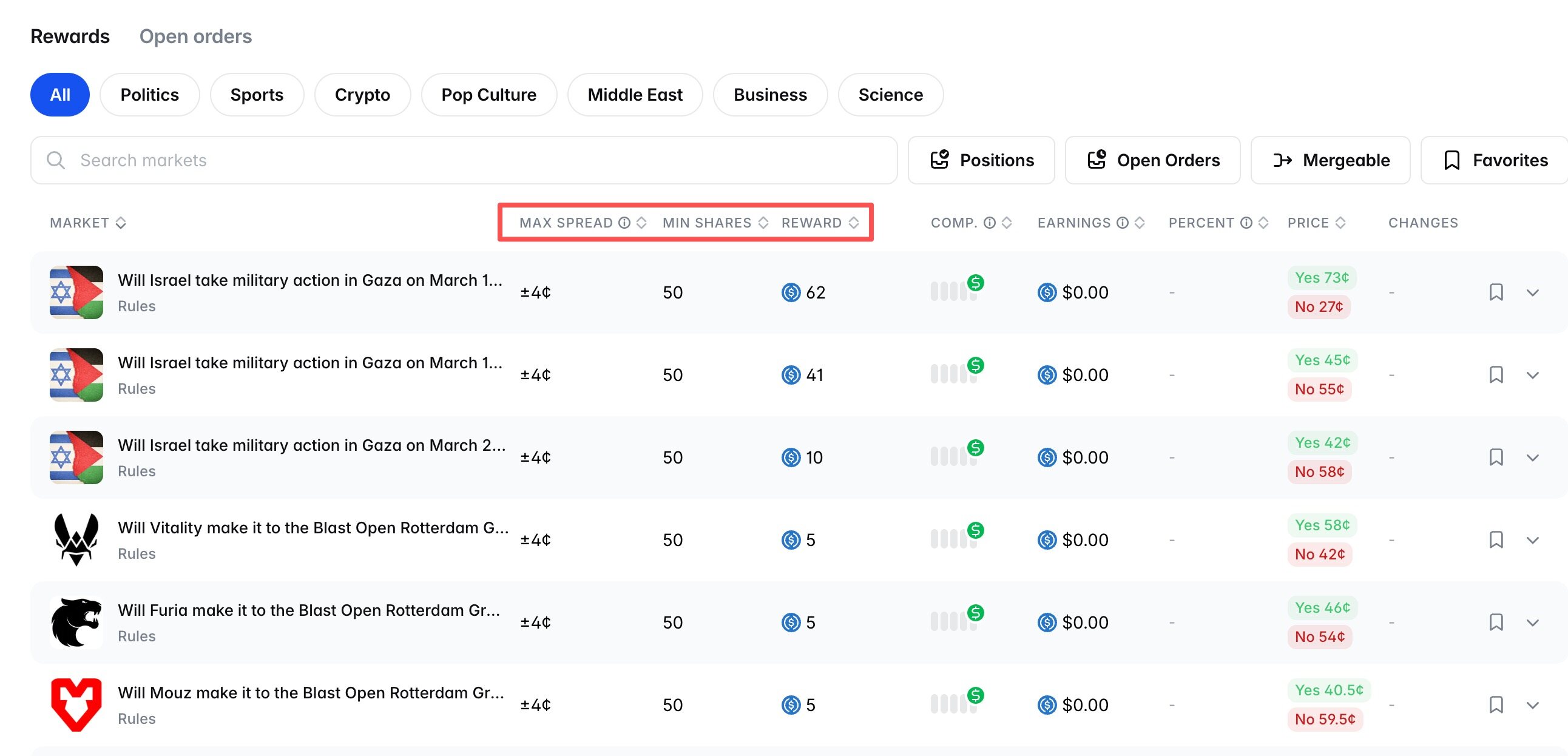
Users first need to select an event that has subsidies, then place orders for at least the specified amount (Min Shares) within the specified spread range (Max Spread) to automatically accumulate LP rewards. The closer the order price is to the market price, the higher the efficiency of earning rewards. LP rewards are distributed daily at 8:00 UTC, but only rewards of $1 or more are distributed.

Although the rules for obtaining LP rewards are not complicated, the difficulty of market making in prediction markets is inherently higher (refer to "Only One in Ten Prediction Markets Will Survive Until the End of the Year, Not an Exaggeration"). Coupled with the minimum $1 threshold for daily reward distribution, many ordinary users with limited funds find it difficult to accumulate rewards when trying to operate, and may even suffer capital losses due to inventory risk.

However, right now, Polymarket is providing an excellent opportunity window — with the arrival of the NCAA "March Madness", Polymarket has announced that it will provide $2 million in LP subsidies for related events.
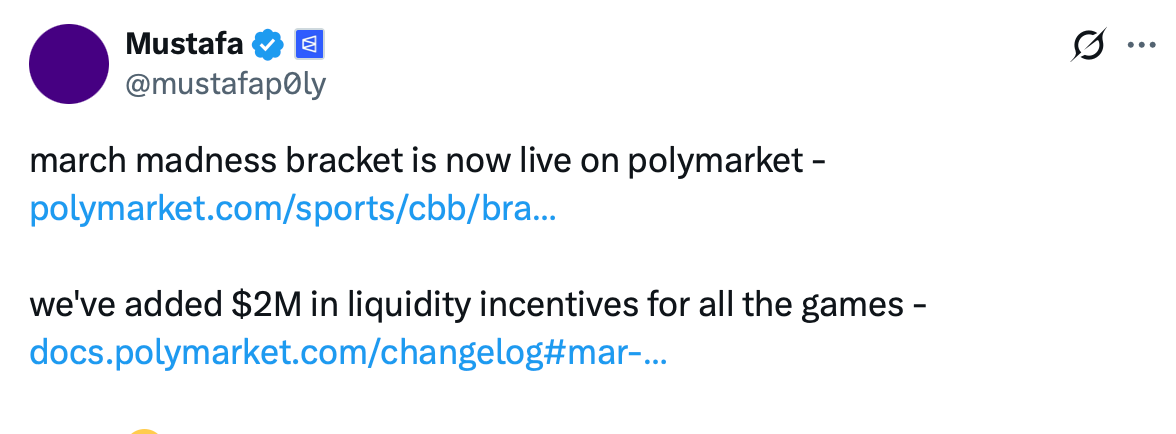
It is important to note that the total amount of LP subsidies Polymarket has distributed for all subsidized events so far is only $13 million. This $2 million+ subsidy will be concentratedly distributed for specific 63 games in less than a month — this directly means an expansion of the subsidy intensity per event, and also represents an excellent opportunity for ordinary users.

Next, Odaily Planet Daily will walk you through the process of market making for NCAA-related events step by step, and briefly mention a few points I think are worth noting.

First, open the Polymarket Rewards page, click on Reward, and you can sort all events by subsidy intensity. It's easy to see that the events with the highest subsidy intensity on Polymarket currently are all NCAA "March Madness" games. (I have been providing liquidity on Polymarket for the past few months and have never seen such a level of subsidy intensity.)
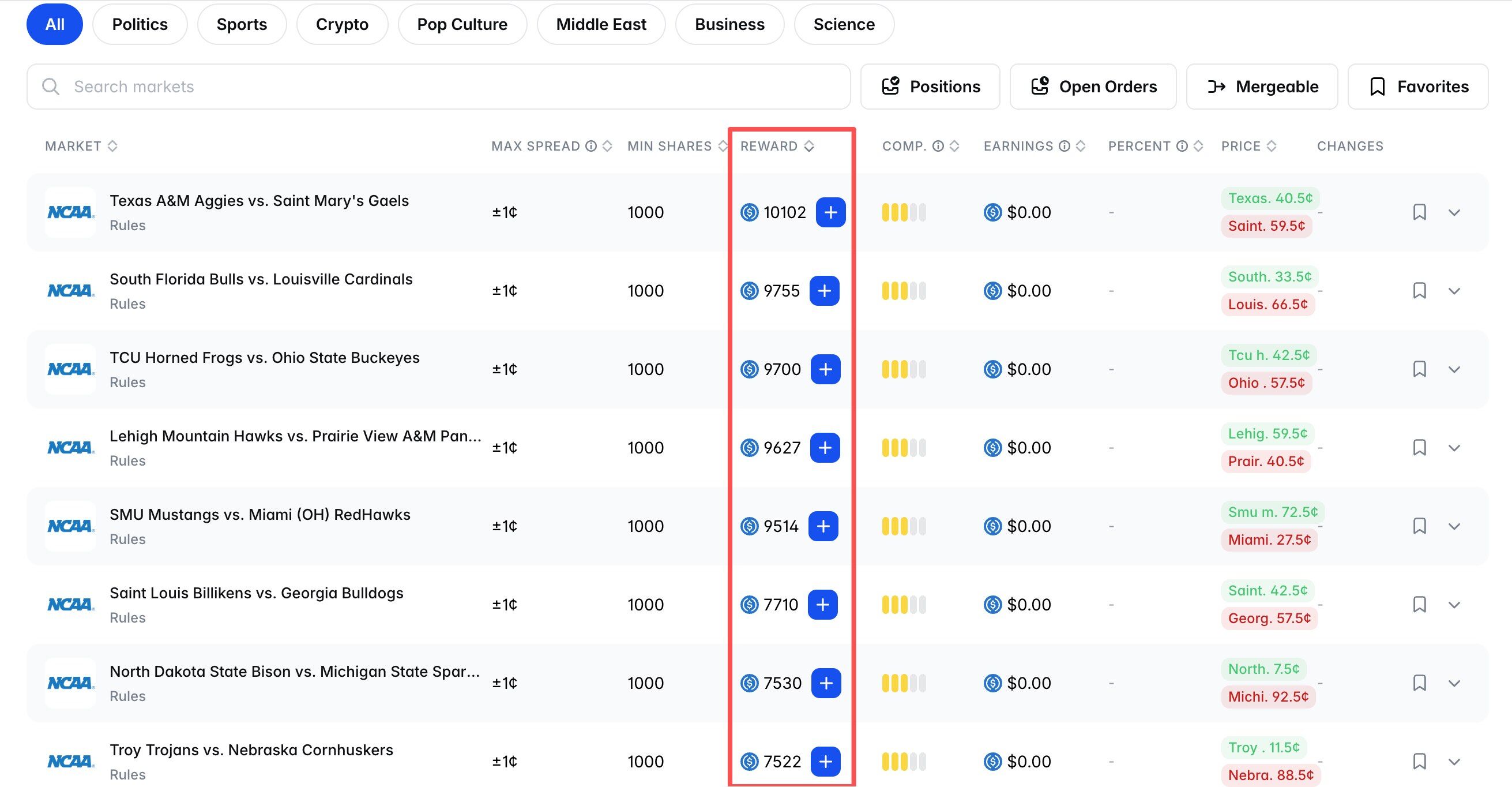
The next most important thing is choosing a pool. It should be added that there is a column called COMP (Competitive) on the right side of Rewards, which indicates the current competition status for providing liquidity in that event. Theoretically, greener is better (representing less competition), but in practice, the competition gap has basically been leveled by professional market making funds, so what you basically see is "three yellow bars", meaning the current competition status is "medium".

Here, it is more recommended to choose games that start later. For example, I chose to put funds into this game between the University of Iowa and the University of Houston on March 19th EST (March 20th Beijing time).
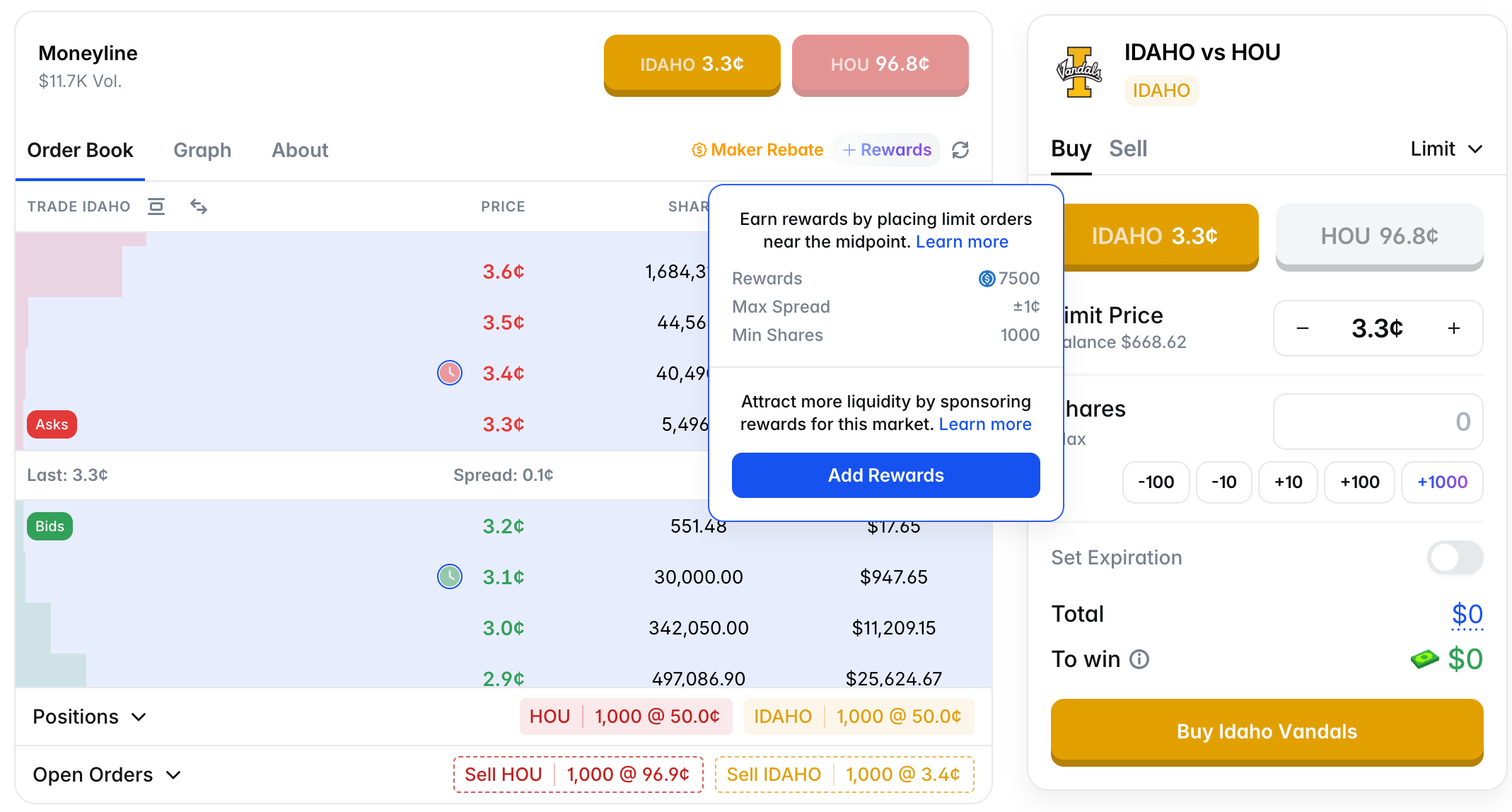
The reason later start times are better is that the trading volume peak for a single sports event on Polymarket often only arrives shortly before the game starts, and Polymarket has already started injecting subsidies. Taking this "University of Iowa vs. University of Houston" game starting the day after tomorrow as an example, the current total trading volume is only $12,000. With a certain liquidity base, lower trading volume often means smaller fluctuations — the chart below clearly shows the probability fluctuation status since Polymarket listed this game. You saw it right, it's a straight line!
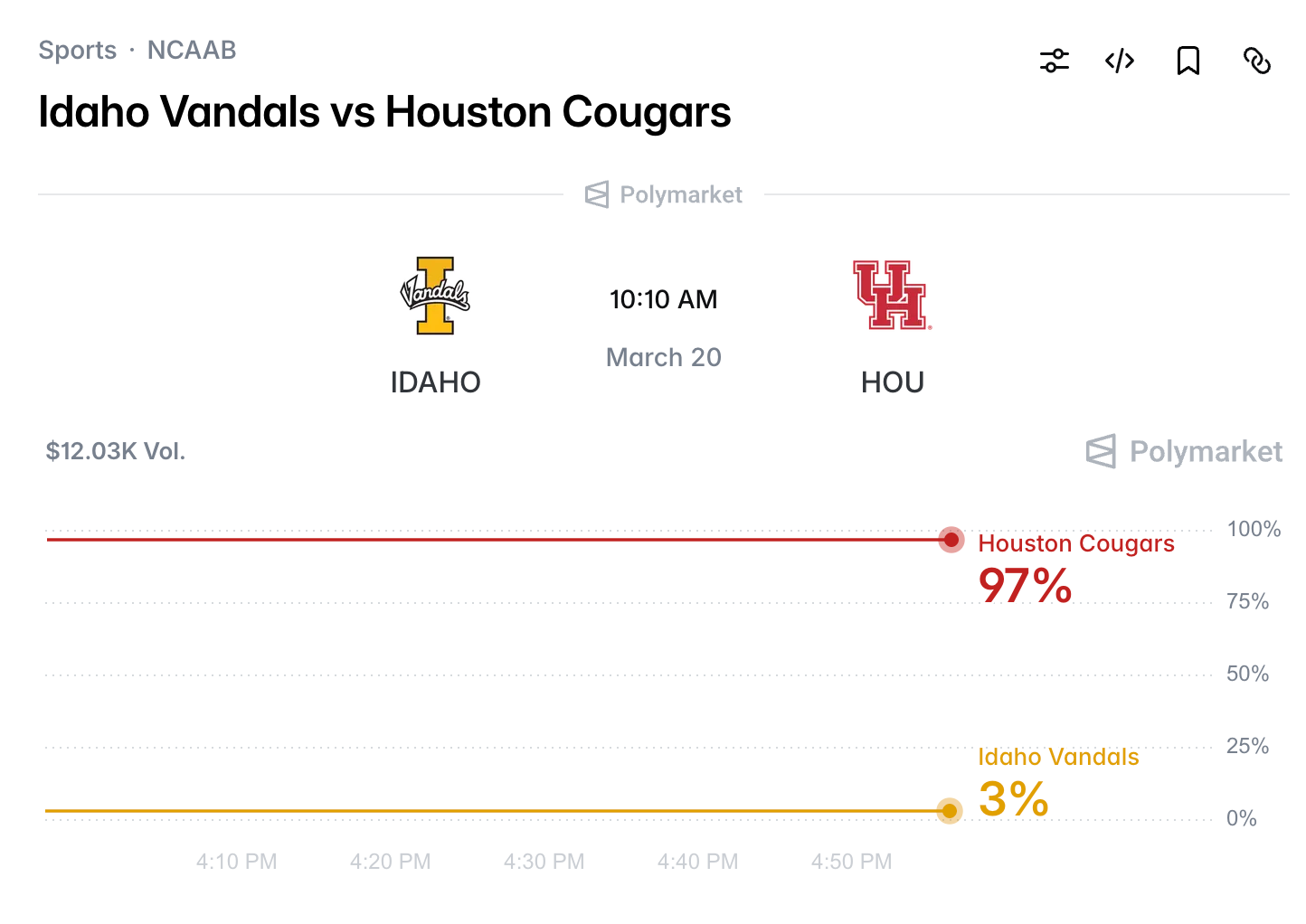
Extremely small fluctuations mean users can temporarily avoid "inventory risk", the biggest risk source in market making. Simply put, you don't have to worry too much about the price suddenly moving unilaterally, causing your one-sided orders to be filled while the market price has moved to an unfavorable direction.

After finding a suitable pool (not necessarily this one; I put funds into this one in the morning, you can look for later times), it's time to provide liquidity. Polymarket's liquidity requirements for all NCAA games are a minimum of 1000 shares, with a maximum spread not exceeding ±1¢.

Compared to placing buy orders, it is more recommended to use Polymarket's Split function to split $1000 (the minimum requirement) into equal bilateral shares (which can be reversely minted into $1000 through the Merge function), and then place sell orders on both sides.

As for the specific price points for placing orders, it depends on your own risk appetite. The closer to the market price, the higher the efficiency of earning LP rewards. But still considering inventory risk, I prefer to place orders at the "second best" price level, and then pay attention to price fluctuations, trying to ensure the orders don't get filled — if they are filled, the order amount will no longer meet the requirements, and you will need to consider how to handle the shares on the other side.

Finally, regarding the order cancellation time, it is recommended to cancel the orders about 1 day before the game starts, and then look for later games. If you are interested in continuing, you can repeat the above operation.
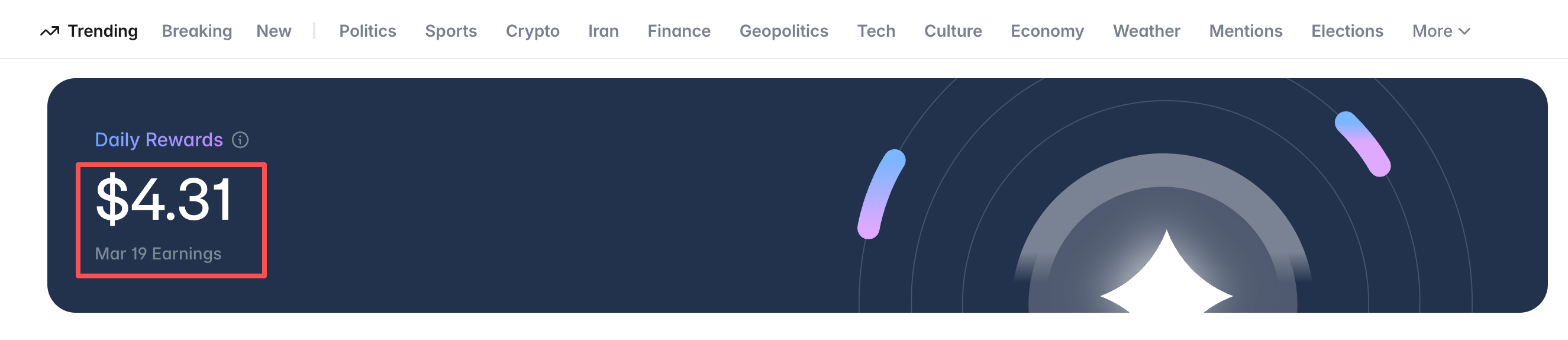
Finally, here are the data: I placed the orders around 10:00 in the morning. The probability for this game did not fluctuate at all during this period. Although I said I needed to monitor it, I didn't really do much. As of 17:00, the LP reward I have earned is $4.31 (which will be distributed tomorrow).

The profit is small change, but the key point is to enrich the interaction behavior on Polymarket. Compared to a few days ago, you might have needed to博弈 with the market in relatively low subsidy conditions. Under the current subsidy intensity and event fluctuation conditions, this operation can basically be considered brainless now.

Finally, a quick advertisement: Friends interested in prediction markets are welcome to join our TG chat group for casual discussion anytime: https://t.me/OdailySeer


İlgili Sorular

QWhat is the core strategy recommended for interacting with Polymarket to maximize rewards?

AThe core strategy is to focus on accumulating Liquidity Provider (LP) rewards rather than just trading volume, as approximately 80% of users have never received even $1 in LP subsidies.

QWhat specific event has created a prime opportunity for users to earn LP rewards on Polymarket recently?

AThe NCAA 'March Madness' tournament has created a prime opportunity, as Polymarket is providing over $2 million in LP subsidies concentrated across 63 specific games within a month.

QWhat are the two main requirements for users to start accumulating LP rewards on a subsidized event?

AUsers must place orders of at least the 'Min Shares' amount (e.g., 1000 shares for NCAA games) within the specified 'Max Spread' (e.g., ±1¢ for NCAA games) on a subsidized event.

QWhy does the article suggest choosing markets for games that start later?

AGames that start later have lower current trading volume, which often results in minimal price volatility (a nearly flat line on the chart), significantly reducing the inventory risk for liquidity providers.

QWhat specific Polymarket feature does the article recommend using to provide liquidity easily and what is the suggested action regarding order placement?

AThe article recommends using the 'Split' function to divide $1000 into equal opposing shares, then placing sell orders on both sides. It also advises placing orders at the 'second price level' from the market price to balance reward efficiency and risk, and to cancel orders about one day before the game starts.

İlgili Okumalar

In Jinjiang, Fujian, a Storage Super Unicorn Lies Quiet

In Fujian's Jinjiang, a city known for sportswear, lies a quiet semiconductor giant: Fujian Jinhua Integrated Circuit Co. (JHICC). Once a promising domestic DRAM manufacturer alongside Yangtze Memory and ChangXin Memory Technologies (CXMT), its journey was derailed in 2018 when the U.S. placed it on an Entity List and filed criminal charges for alleged trade secret theft. This halted production for years. A turning point came in February 2024 when a U.S. federal court found JHICC not guilty. However, it had lost crucial time. While CXMT soared to become a top-valued A-share company in 2024, JHICC, with an estimated valuation of 80 billion RMB, was just restarting. Its current output is primarily customized DDR4 chips, not the advanced DDR5/HBM demanded for AI, but it still benefits from the broader memory chip upcycle. JHICC's story is tied to Chen Zhengkun, a veteran engineer who left Micron to lead the venture. Founded in 2016 with state-backed funding, JHICC partnered with Taiwan's UMC to develop DRAM technology. Rapid progress was cut short by the U.S. actions, which Micron initiated, partly due to its heavy reliance on the Chinese market. Post-sanctions, Chen's team worked to rebuild the production line with reduced reliance on U.S. technology. According to its records, JHICC achieved small-scale production and revenue growth under immense pressure. It now focuses on the stable "niche" DRAM market (e.g., TVs, routers) with a monthly capacity of ~40,000 wafers, aiming for 60,000 by 2026. It holds over 1,000 patents but remains on the Entity List. For Jinjiang, investing in JHICC was a bold industrial leap. The local government provided unwavering financial and logistical support during the crisis, helping the company survive. JHICC has become the anchor for a growing local semiconductor cluster. Though its scale lags behind domestic peers, JHICC's persistence symbolizes a hard-won foothold in a global market long dominated by Samsung, SK Hynix, and Micron. Having missed one boom, it seeks a place in the new AI-driven memory supercycle.

marsbit41 dk önce

In Jinjiang, Fujian, a Storage Super Unicorn Lies Quiet

marsbit41 dk önce

Must-Watch Events Next Week|CLARITY Act Could Face Senate Vote; SpaceX, Circle to Report Earnings (8.3-8.9)

**Summary: Key Events and Developments to Watch (August 3-9)** The upcoming week is marked by significant financial disclosures, key legislative deadlines, and notable product updates. **Major Financial Events:** Several companies are scheduled to release their Q2 2026 earnings. American Bitcoin (ABTC) will report on August 3, followed by SpaceX and Hut 8 Mining Corp. on August 4, and Circle on August 5. Notably, a significant portion of SpaceX shares (up to 12% of total shares) will be unlocked on August 6 following their earnings release. **Key Legislative Deadline:** The U.S. Senate faces an August 7 deadline to secure 60 votes for the CLARITY Act, a bipartisan bill aiming to establish a federal regulatory framework for cryptocurrencies. The Senate may hold a full vote on the bill during the week. **Economic Data:** The U.S. July Non-Farm Payrolls report will be released on August 7, providing crucial labor market data. **Technology & Product Updates:** * **Shutdowns:** DeFi portfolio tracker Zapper and wallet app Ctrl Wallet will cease operations on August 3. * **Upgrades:** LayerZero will deprecate its v1 relayers on August 3. XRP Ledger's new version 3.3.0, featuring five new functions, is expected next week. * **AI:** Elon Musk announced that the advanced Grok 4.6 AI model is set for release around August 7. * **Bitcoin:** The BIP-110 forced signaling for a potential Bitcoin network change is scheduled to begin around August 8. **Other Notable Events:** Chinese robotics firm Unitree Tech has set its preliminary price inquiry for its IPO for August 5. South Korean exchange Upbit will delist AQT and AERGO tokens on August 3.

marsbit2 saat önce

Must-Watch Events Next Week|CLARITY Act Could Face Senate Vote; SpaceX, Circle to Report Earnings (8.3-8.9)

marsbit2 saat önce

İşlemler

Spot
活动图片




