Not A Threat: Stablecoin Yield Won’t Harm Banks, White House Economists Say

bitcoinist2026-04-09 tarihinde yayınlandı2026-04-09 tarihinde güncellendi

Özet

In a positive development for crypto, a White House economic study by the Council of Economic Advisers (CEA) concludes that prohibiting stablecoin yield would have a negligible impact on bank lending, particularly for community banks. The study, addressing a key debate around bills like the GENIUS Act, found that eliminating yield would boost overall bank lending by only $2.1 billion, a mere 0.02% increase. Even under worst-case assumptions requiring implausible conditions like a sixfold growth in stablecoins, the increase would be moderate. The report contradicts banking industry claims that yield-bearing stablecoins could trigger massive deposit flight, arguing a yield prohibition would do little to protect lending while denying consumers competitive returns. It also highlights that regulatory uncertainty harms banks more than the crypto industry, as it prevents investment in new technology.

In a positive development for the crypto industry, a recent study by White House economists affirmed that stablecoin yield won’t harm community banks, and its prohibition won’t have a meaningful impact on overall lending in the banking system.

Stablecoin Yield Is Not A Threat

On Wednesday, the Council of Economic Advisers (CEA) released the highly anticipated study on a key issue that has become a major point of contention between the banking and crypto industries over the past few months: stablecoin yield and its potential impact on deposit flight and bank lending.

For context, the landmark crypto legislation, the GENIUS Act, requires issuers to maintain reserves backing outstanding stablecoins on a one-to-one basis and to hold these reserves in certain assets, including US dollars, Federal Reserve notes, and short-term US Treasuries.

The bill also introduced key restrictions that prohibit issuers from offering any form of interest or yield to stablecoin holders. The banking industry has urged US lawmakers to extend the prohibition to digital asset exchanges, brokers, dealers, and related entities, which has led to prolonged debate and delay of the crypto market structure bill, also known as the CLARITY Act.

While some analysts estimate that the effect of lending in the trillions of dollars, the CEA report found that eliminating stablecoin yield would only boost bank lending by $2.1 billion, equivalent to a 0.02% increase.

Large banks would conduct 76% of this additional lending, while community banks—which have assets below $10 billion—would lend the remaining 24%. In our baseline, that adds up to $500 million in additional lending from community banks, meaning their lending rising by 0.026%.

As they noted, even under the worst-case assumptions, the CEA’s model produced only $521 billion in additional aggregate lending, corresponding to a 4.4% increase in bank loans as of Q4 2025.

Moreover, that figure would require the stablecoin market to grow sixfold as a share of deposits, all reserves to be locked in unlendable cash instead of US treasuries, and the Federal Reserve (Fed) to “abandon its current monetary framework.”

“Even under those implausible conditions, community bank lending only rises by $129 billion, corresponding to an increase of 6.7%,” the White House economists emphasized, concluding that prohibiting yield would have only a moderate impact on overall lending in the banking system.

The conditions for finding a positive welfare effect from prohibiting yield are similarly implausible. In short, a yield prohibition would do very little to protect bank lending, while forgoing the consumer benefits of competitive returns on stablecoin holdings.

Regulatory Uncertainty More Harmful Than Rewards

The CEA study directly contradicts one of the banking sector’s main arguments for banning stablecoin yield: it would mostly affect community banks. In January, Bank of America CEO Brian Moynihan told investors that the banking industry could face significant challenges if the US Congress does not prohibit interest-bearing stablecoins.

During its Q4 earnings call, the executive stated that up to $6 trillion in deposits, roughly 30% to 35% of all US commercial bank deposits, could flow out of the banking system and into the stablecoin sector, citing Treasury Department studies.

The CEO asserted that while Bank of America would not be affected by this issue, small- and medium-sized businesses would be particularly hurt, as they’re “largely lent to end consumers by the banking industry.”

Earlier this year, the Independent Community Bankers of America affirmed that offering interest on payment stablecoins could drain community bank deposits and limit credit availability for local economies.

The group asserted that allowing digital asset entities to pay interest, yield, or “rewards” on payment stablecoins would significantly reduce community banks’ ability to support local lending needs, potentially losing $1.3 trillion in deposits and $850 billion in loans.

Nonetheless, a former Commodity Futures Trading Commission (CFTC) chief, Chris Giancarlo, said in March that banks require regulatory clarity more than the crypto industry. He argued that banks will be hesitant to invest in new technology without clear rules, and their systems will eventually be obsolete.

“The banks, however, can’t afford regulatory uncertainty. Their general counselors are telling their boards, you can’t invest billions of dollars in this (...) unless you’ve got regulatory certainty. (...) The banks need this clarity because they need to build this. They need to be in the forefront, not in the rear guard of this innovation,” he stated.
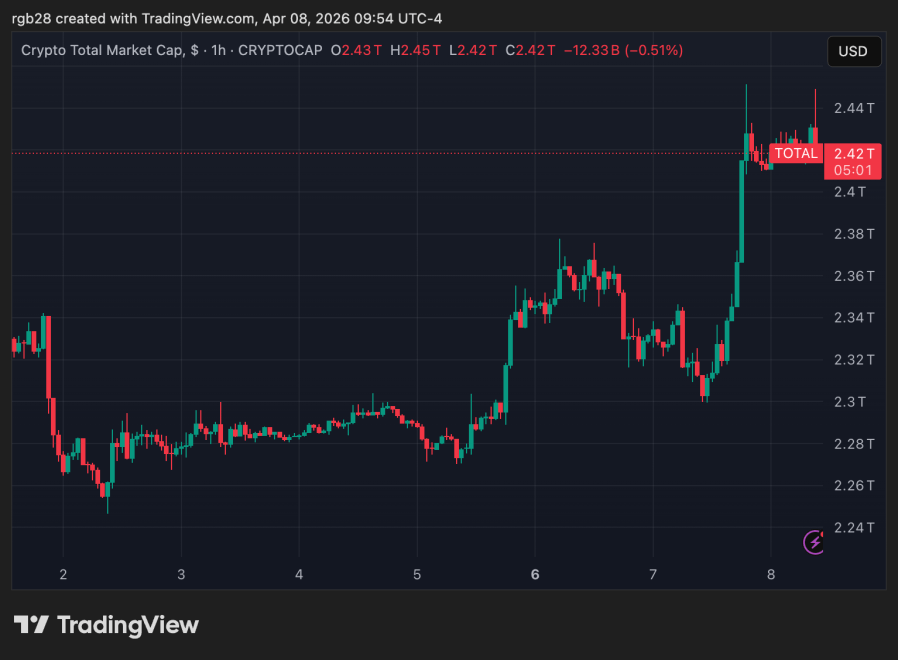
The total crypto market capitalization is at $2.42 trillion in the one-week chart. Source: TOTAL on TradingView


İlgili Sorular

QWhat was the main finding of the White House economists' study regarding stablecoin yield and bank lending?

AThe study found that eliminating stablecoin yield would only boost overall bank lending by $2.1 billion, a negligible 0.02% increase, and concluded that prohibiting yield would have only a moderate impact on the banking system.

QAccording to the CEA report, what implausible conditions would be required for a significant $521 billion increase in bank lending?

AIt would require the stablecoin market to grow sixfold as a share of deposits, all reserves to be locked in unlendable cash instead of US Treasuries, and the Federal Reserve to abandon its current monetary framework.

QWhat argument from the banking sector did the CEA study directly contradict?

AThe study contradicted the banking sector's argument that prohibiting stablecoin yield is necessary to protect community banks, showing that even under worst-case scenarios, the impact on their lending would be minimal.

QWhat did Bank of America's CEO claim could happen if interest-bearing stablecoins are not prohibited?

ACEO Brian Moynihan claimed that up to $6 trillion in deposits, roughly 30-35% of all US commercial bank deposits, could flow out of the banking system and into the stablecoin sector.

QWhat did former CFTC chief Chris Giancarlo identify as a greater need for banks than for the crypto industry?

AHe stated that banks require regulatory clarity more than the crypto industry, as they cannot afford regulatory uncertainty and need clear rules to invest billions in new technology to avoid becoming obsolete.

İlgili Okumalar

AI Agent Completely Transforms Web3 Gaming: From the Rugpull Bakery Bot Controversy to the New 2026 Agent Paradigm

This article explores how the AI Agent paradigm is fundamentally transforming Web3 gaming, moving from a disruptive force to a core, legitimized element. It begins with the controversy in the competitive baking game Rugpull Bakery, where automated scripts caused fairness issues. Instead of banning them, the developers integrated AI Agents into the official gameplay by providing technical documentation (skill.md, agent.json), marking a shift towards "Agentic Gaming." The piece outlines three primary implementation models for AI Agents in Web3 games by 2026: 1. **Autonomous Competitors & Economic Entities:** AI Agents act as independent players with unique strategies. Examples include TEN Protocol's poker agents, AI Arena's trainable NFT fighters, and Satoshi Strike Force's "Digital Athletes" trained on player data. The Somnia blockchain is highlighted as a dedicated "Agentic L1" infrastructure supporting this model at scale. 2. **Modular Infrastructure & Programmable Environments:** This model, exemplified by EVE Frontier, allows AI Agents to program game world logic itself. Using "Smart Assemblies" (e.g., Smart Turrets, Smart Gates), Agents can modify shared economic and physical rules on-chain, creating dynamic, player/AI-built worlds. The ERC-8183 standard further enables these automated entities to hire other AI services for complex tasks. 3. **Hybrid Companions & Dynamic Adaptation:** Here, AI serves as a collaborative partner. In Parallel Colony, highly autonomous AI Avatars work alongside human players who provide high-level guidance. Illuvium plans to use AI to make NPCs dynamic and responsive, creating personalized, emergent narratives for each player. The conclusion posits that Web3 gaming has reached a "post-human" inflection point. Blockchains' transparency and programmability, combined with new standards and infrastructure like Somnia, make integrating and governing AI Agents not just viable but essential. The future lies in a symbiotic digital order where players transition from manual laborers to commanders and partners of algorithmic intelligence.

marsbit42 dk önce

AI Agent Completely Transforms Web3 Gaming: From the Rugpull Bakery Bot Controversy to the New 2026 Agent Paradigm

marsbit42 dk önce

Saylor's Purchase of 1550 Bitcoin Is a Bad Trade

**Title: Saylor's Purchase of 1,550 Bitcoins Was a Bad Trade** The article critically analyzes Strategy's recent move of selling 32 bitcoins followed by a much larger purchase of 1,550 bitcoins. While appearing bullish, the author argues this trade is detrimental to MSTR shareholders. The core argument revolves around the concept of "breakeven modified Net Asset Value (mNAV)," a key metric for Strategy. To increase Bitcoin per share (BPS) for MSTR holders, Strategy must issue new shares at a premium high enough that the funds raised can buy more bitcoin than the bitcoin backing each existing share. Currently, this breakeven mNAV is estimated at 1.30. The recent trade failed on two counts: 1. The shares for the $181 million raise were issued at an mNAV *below* the 1.30 breakeven point. Selling "cheap" shares to buy bitcoin actually *reduces* BPS. 2. Only $101.3 million of the raised funds were used to buy bitcoin; the rest went to boost the company's dollar reserves. The breakeven mNAV calculation assumes *100%* of proceeds are used for bitcoin purchases. Diverting funds, even if mNAV were high, dilutes BPS. The result is an estimated 0.19% decrease in Bitcoin per share for MSTR holders. In exchange, Strategy merely extended its operational runway for its dollar reserves from ~6.3 months to 7 months. The author interprets this as Strategy prioritizing the survival and development of its STRC business over its stated core goal of increasing MSTR's BPS. This constitutes a gamble: if sacrificing MSTR value leads to improved market sentiment and a recovery in STRC's price (and thus mNAV), the whole system could work. If not, Strategy may be forced into a cycle of further diluting MSTR to stay afloat, potentially leading to deferred STRC dividends or corporate decline. The article concludes with a hope for price recovery for Bitcoin, MSTR, and STRC.

Foresight News53 dk önce

Saylor's Purchase of 1550 Bitcoin Is a Bad Trade

Foresight News53 dk önce

The AI Bear Market Lasting Two Days Is Over; Why Did Funds Buy Back Storage Stocks First?

After a severe two-day selloff in early June that erased over $1 trillion from U.S. chip stock market value, capital is flowing back first to the memory sector. The correction was not driven by a collapse in AI demand but rather a market reassessment of high expectations. Stocks like Broadcom faced selling pressure despite strong AI revenue guidance, signaling a shift in focus from who has an "AI story" to who can most rapidly translate AI demand into verifiable profits and earnings per share (EPS). Memory companies, such as Micron and SK Hynix, are leading the recovery because their EPS growth is more immediately verifiable. The AI server boom directly increases demand for high-bandwidth memory (HBM) and high-capacity server DRAM, tightening supply and driving up contract prices for conventional DRAM and NAND Flash. This price increase, coupled with a shift to higher-margin products, flows directly into near-term revenue and profitability, as evidenced in recent earnings reports. In contrast, other AI semiconductor segments like GPUs, ASICs, and optical modules, while central to the long-term AI infrastructure story, face longer and less certain paths to EPS validation. Their growth depends more on future product cycles, customer adoption timelines, and capital expenditure plans. The rebound in memory stocks highlights a market preference for assets with shorter, more transparent EPS conversion cycles following the recent de-risking phase. However, this does not negate the potential of other AI hardware segments should they provide clearer near-term order visibility. The episode has raised the validation bar for all AI-related investments.

marsbit53 dk önce

The AI Bear Market Lasting Two Days Is Over; Why Did Funds Buy Back Storage Stocks First?

marsbit53 dk önce

İşlemler

Spot
Futures

Popüler Makaleler

HOUSE Nasıl Satın Alınır

HTX.com’a hoş geldiniz! Housecoin (HOUSE) satın alma işlemlerini basit ve kullanışlı bir hâle getirdik. Adım adım açıkladığımız rehberimizi takip ederek kripto yolculuğunuza başlayın. 1. Adım: HTX Hesabınızı OluşturunHTX'te ücretsiz bir hesap açmak için e-posta adresinizi veya telefon numaranızı kullanın. Sorunsuzca kaydolun ve tüm özelliklerin kilidini açın. Hesabımı Aç2. Adım: Kripto Satın Al Bölümüne Gidin ve Ödeme Yönteminizi SeçinKredi/Banka Kartı: Visa veya Mastercard'ınızı kullanarak anında Housecoin (HOUSE) satın alın.Bakiye: Sorunsuz bir şekilde işlem yapmak için HTX hesap bakiyenizdeki fonları kullanın.Üçüncü Taraflar: Kullanımı kolaylaştırmak için Google Pay ve Apple Pay gibi popüler ödeme yöntemlerini ekledik.P2P: HTX'teki diğer kullanıcılarla doğrudan işlem yapın.Borsa Dışı (OTC): Yatırımcılar için kişiye özel hizmetler ve rekabetçi döviz kurları sunuyoruz.3. Adım: Housecoin (HOUSE) Varlıklarınızı SaklayınHousecoin (HOUSE) satın aldıktan sonra HTX hesabınızda saklayın. Alternatif olarak, blok zinciri transferi yoluyla başka bir yere gönderebilir veya diğer kripto para birimlerini takas etmek için kullanabilirsiniz.4. Adım: Housecoin (HOUSE) Varlıklarınızla İşlem YapınHTX'in spot piyasasında Housecoin (HOUSE) ile kolayca işlemler yapın.Hesabınıza erişin, işlem çiftinizi seçin, işlemlerinizi gerçekleştirin ve gerçek zamanlı olarak izleyin. Hem yeni başlayanlar hem de deneyimli yatırımcılar için kullanıcı dostu bir deneyim sunuyoruz.

343 Toplam GörüntülenmeYayınlanma 2025.04.27Güncellenme 2026.06.02

HOUSE Nasıl Satın Alınır

Tartışmalar

HTX Topluluğuna hoş geldiniz. Burada, en son platform gelişmeleri hakkında bilgi sahibi olabilir ve profesyonel piyasa görüşlerine erişebilirsiniz. Kullanıcıların HOUSE (HOUSE) fiyatı hakkındaki görüşleri aşağıda sunulmaktadır.

活动图片












