Not A Threat: Stablecoin Yield Won’t Harm Banks, White House Economists Say

bitcoinist2026-04-09 tarihinde yayınlandı2026-04-09 tarihinde güncellendi

Özet

In a positive development for crypto, a White House economic study by the Council of Economic Advisers (CEA) concludes that prohibiting stablecoin yield would have a negligible impact on bank lending, particularly for community banks. The study, addressing a key debate around bills like the GENIUS Act, found that eliminating yield would boost overall bank lending by only $2.1 billion, a mere 0.02% increase. Even under worst-case assumptions requiring implausible conditions like a sixfold growth in stablecoins, the increase would be moderate. The report contradicts banking industry claims that yield-bearing stablecoins could trigger massive deposit flight, arguing a yield prohibition would do little to protect lending while denying consumers competitive returns. It also highlights that regulatory uncertainty harms banks more than the crypto industry, as it prevents investment in new technology.

In a positive development for the crypto industry, a recent study by White House economists affirmed that stablecoin yield won’t harm community banks, and its prohibition won’t have a meaningful impact on overall lending in the banking system.

Stablecoin Yield Is Not A Threat

On Wednesday, the Council of Economic Advisers (CEA) released the highly anticipated study on a key issue that has become a major point of contention between the banking and crypto industries over the past few months: stablecoin yield and its potential impact on deposit flight and bank lending.

For context, the landmark crypto legislation, the GENIUS Act, requires issuers to maintain reserves backing outstanding stablecoins on a one-to-one basis and to hold these reserves in certain assets, including US dollars, Federal Reserve notes, and short-term US Treasuries.

The bill also introduced key restrictions that prohibit issuers from offering any form of interest or yield to stablecoin holders. The banking industry has urged US lawmakers to extend the prohibition to digital asset exchanges, brokers, dealers, and related entities, which has led to prolonged debate and delay of the crypto market structure bill, also known as the CLARITY Act.

While some analysts estimate that the effect of lending in the trillions of dollars, the CEA report found that eliminating stablecoin yield would only boost bank lending by $2.1 billion, equivalent to a 0.02% increase.

Large banks would conduct 76% of this additional lending, while community banks—which have assets below $10 billion—would lend the remaining 24%. In our baseline, that adds up to $500 million in additional lending from community banks, meaning their lending rising by 0.026%.

As they noted, even under the worst-case assumptions, the CEA’s model produced only $521 billion in additional aggregate lending, corresponding to a 4.4% increase in bank loans as of Q4 2025.

Moreover, that figure would require the stablecoin market to grow sixfold as a share of deposits, all reserves to be locked in unlendable cash instead of US treasuries, and the Federal Reserve (Fed) to “abandon its current monetary framework.”

“Even under those implausible conditions, community bank lending only rises by $129 billion, corresponding to an increase of 6.7%,” the White House economists emphasized, concluding that prohibiting yield would have only a moderate impact on overall lending in the banking system.

The conditions for finding a positive welfare effect from prohibiting yield are similarly implausible. In short, a yield prohibition would do very little to protect bank lending, while forgoing the consumer benefits of competitive returns on stablecoin holdings.

Regulatory Uncertainty More Harmful Than Rewards

The CEA study directly contradicts one of the banking sector’s main arguments for banning stablecoin yield: it would mostly affect community banks. In January, Bank of America CEO Brian Moynihan told investors that the banking industry could face significant challenges if the US Congress does not prohibit interest-bearing stablecoins.

During its Q4 earnings call, the executive stated that up to $6 trillion in deposits, roughly 30% to 35% of all US commercial bank deposits, could flow out of the banking system and into the stablecoin sector, citing Treasury Department studies.

The CEO asserted that while Bank of America would not be affected by this issue, small- and medium-sized businesses would be particularly hurt, as they’re “largely lent to end consumers by the banking industry.”

Earlier this year, the Independent Community Bankers of America affirmed that offering interest on payment stablecoins could drain community bank deposits and limit credit availability for local economies.

The group asserted that allowing digital asset entities to pay interest, yield, or “rewards” on payment stablecoins would significantly reduce community banks’ ability to support local lending needs, potentially losing $1.3 trillion in deposits and $850 billion in loans.

Nonetheless, a former Commodity Futures Trading Commission (CFTC) chief, Chris Giancarlo, said in March that banks require regulatory clarity more than the crypto industry. He argued that banks will be hesitant to invest in new technology without clear rules, and their systems will eventually be obsolete.

“The banks, however, can’t afford regulatory uncertainty. Their general counselors are telling their boards, you can’t invest billions of dollars in this (...) unless you’ve got regulatory certainty. (...) The banks need this clarity because they need to build this. They need to be in the forefront, not in the rear guard of this innovation,” he stated.
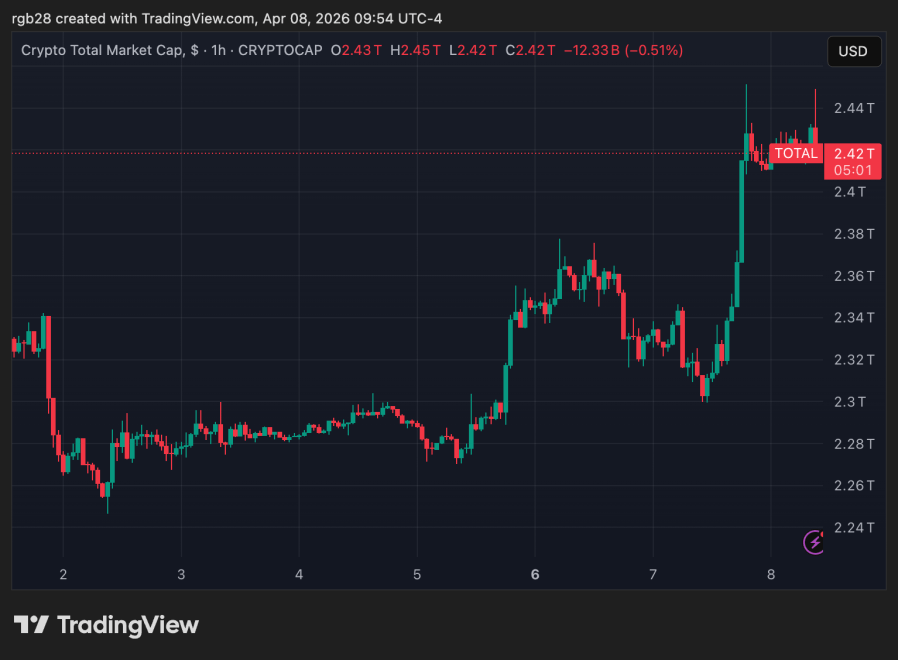
The total crypto market capitalization is at $2.42 trillion in the one-week chart. Source: TOTAL on TradingView


İlgili Sorular

QWhat was the main finding of the White House economists' study regarding stablecoin yield and bank lending?

AThe study found that eliminating stablecoin yield would only boost overall bank lending by $2.1 billion, a negligible 0.02% increase, and concluded that prohibiting yield would have only a moderate impact on the banking system.

QAccording to the CEA report, what implausible conditions would be required for a significant $521 billion increase in bank lending?

AIt would require the stablecoin market to grow sixfold as a share of deposits, all reserves to be locked in unlendable cash instead of US Treasuries, and the Federal Reserve to abandon its current monetary framework.

QWhat argument from the banking sector did the CEA study directly contradict?

AThe study contradicted the banking sector's argument that prohibiting stablecoin yield is necessary to protect community banks, showing that even under worst-case scenarios, the impact on their lending would be minimal.

QWhat did Bank of America's CEO claim could happen if interest-bearing stablecoins are not prohibited?

ACEO Brian Moynihan claimed that up to $6 trillion in deposits, roughly 30-35% of all US commercial bank deposits, could flow out of the banking system and into the stablecoin sector.

QWhat did former CFTC chief Chris Giancarlo identify as a greater need for banks than for the crypto industry?

AHe stated that banks require regulatory clarity more than the crypto industry, as they cannot afford regulatory uncertainty and need clear rules to invest billions in new technology to avoid becoming obsolete.

İlgili Okumalar

North Korean Hackers Loot $500 Million in a Single Month, Becoming the Top Threat to Crypto Security

North Korean hackers, particularly the notorious Lazarus Group and its subgroup TraderTraitor, have stolen over $500 million from cryptocurrency DeFi platforms in less than three weeks, bringing their total theft for the year to over $700 million. Recent major attacks on Drift Protocol and KelpDAO, resulting in losses of approximately $286 million and $290 million respectively, highlight a strategic shift: instead of targeting core smart contracts, attackers are now exploiting vulnerabilities in peripheral infrastructure. For instance, the KelpDAO attack involved compromising downstream RPC infrastructure used by LayerZero's decentralized validation network (DVN), allowing manipulation without breaching core cryptography. This sophisticated approach mirrors advanced corporate cyber-espionage. Additionally, North Korea has systematically infiltrated the global crypto workforce, with an estimated 100 operatives using fake identities to gain employment at blockchain companies, enabling long-term access to sensitive systems and facilitating large-scale thefts. According to Chainalysis, North Korean-linked hackers stole a record $2 billion in 2025, accounting for 60% of all global crypto theft that year. Their total historical crypto theft has reached $6.75 billion. Post-theft, they employ specialized money laundering methods, heavily relying on Chinese OTC brokers and cross-chain mixing services rather than standard decentralized exchanges. Security experts, while acknowledging the increased sophistication, emphasize that many attacks still exploit fundamental weaknesses like poor access controls and centralized operational risks. Strengthening private key management, limiting privileged access, and enhancing coordination among exchanges, analysts, and law enforcement immediately after an attack are critical to improving defense and fund recovery chances. The industry's challenge now extends beyond secure smart contracts to safeguarding operational security at the infrastructure level.

marsbit11 dk önce

North Korean Hackers Loot $500 Million in a Single Month, Becoming the Top Threat to Crypto Security

marsbit11 dk önce

Circle CEO's Seoul Visit: No Korean Won Stablecoin Issuance, But Met All Major Korean Banks

Circle CEO Jeremy Allaire's recent activities in Seoul indicate a strategic shift for the company, moving away from issuing a Korean won-backed stablecoin and instead focusing on embedding itself as a key infrastructure provider within Korea’s financial and crypto ecosystem. Despite Korea accounting for nearly 30% of global crypto trading volume—with a market characterized by high retail participation and altcoin dominance—Circle has chosen not to compete for the role of stablecoin issuer. Instead, Allaire met with major Korean banks (including Shinhan, KB, and Woori), financial groups, leading exchanges (Upbit, Bithumb, Coinone), and tech firms like Kakao. This approach reflects a broader industry transition: the core of stablecoin competition is shifting from issuance rights to systemic positioning. With Korean regulators still debating whether banks or tech companies should issue stablecoins, Circle is avoiding regulatory uncertainty by strengthening its role as a service and technology partner. The company is deepening integration with trading platforms, building connections, and promoting stablecoin infrastructure. This positions Circle to benefit regardless of which entity eventually issues a won stablecoin. Allaire also noted the potential for a Chinese yuan stablecoin in the next 3–5 years, underscoring a regional trend of stablecoins becoming more regulated and integrated with traditional finance. Ultimately, Circle’s strategy highlights that future influence in the stablecoin market will belong not necessarily to the issuers, but to the foundational infrastructure layers that enable cross-system transactions.

marsbit39 dk önce

Circle CEO's Seoul Visit: No Korean Won Stablecoin Issuance, But Met All Major Korean Banks

marsbit39 dk önce

SpaceX Ties Up with Cursor: A High-Stakes AI Gambit of 'Lock First, Acquire Later'

SpaceX has secured an option to acquire AI programming company Cursor for $60 billion, with an alternative clause requiring a $10 billion collaboration fee if the acquisition does not proceed. This structure is not merely a potential acquisition but a strategic move to control core access points in the AI era. The deal is designed as a flexible, dual-path arrangement, allowing SpaceX to either fully acquire Cursor or maintain a binding partnership through high-cost collaboration. This "option-style" approach minimizes immediate regulatory and integration risks while ensuring long-term alignment between the two companies. At its core, the transaction exchanges critical AI-era resources: SpaceX provides its Colossus supercomputing cluster—one of the world’s most powerful AI training infrastructures—while Cursor contributes its AI-native developer environment and strong product adoption. This synergy connects compute power, models, and application layers, forming a closed-loop AI capability stack. Cursor, founded in 2022, has achieved rapid growth with over $1 billion in annual revenue and widespread enterprise adoption. Its value lies in transforming software development through AI agents capable of coding, debugging, and system design—positioning it as a gateway to future software production. For SpaceX, this move is part of a broader strategy to evolve from a aerospace company into an AI infrastructure empire, integrating xAI, supercomputing, and chip manufacturing. Controlling Cursor fills a gap in its developer tooling layer, strengthening its AI narrative ahead of a potential IPO. The deal reflects a shift in AI competition from model superiority to ecosystem and entry-point control. With programming tools as a key battleground, securing developer loyalty becomes crucial for dominating the software production landscape. Risks include questions around Cursor’s valuation, technical integration challenges, and potential regulatory scrutiny. Nevertheless, the deal underscores a strategic bet: controlling both compute and software development access may redefine power dynamics in the AI-driven future.

marsbit1 saat önce

SpaceX Ties Up with Cursor: A High-Stakes AI Gambit of 'Lock First, Acquire Later'

marsbit1 saat önce

İşlemler

Spot
Futures

Popüler Makaleler

HOUSE Nasıl Satın Alınır

HTX.com’a hoş geldiniz! Housecoin (HOUSE) satın alma işlemlerini basit ve kullanışlı bir hâle getirdik. Adım adım açıkladığımız rehberimizi takip ederek kripto yolculuğunuza başlayın. 1. Adım: HTX Hesabınızı OluşturunHTX'te ücretsiz bir hesap açmak için e-posta adresinizi veya telefon numaranızı kullanın. Sorunsuzca kaydolun ve tüm özelliklerin kilidini açın. Hesabımı Aç2. Adım: Kripto Satın Al Bölümüne Gidin ve Ödeme Yönteminizi SeçinKredi/Banka Kartı: Visa veya Mastercard'ınızı kullanarak anında Housecoin (HOUSE) satın alın.Bakiye: Sorunsuz bir şekilde işlem yapmak için HTX hesap bakiyenizdeki fonları kullanın.Üçüncü Taraflar: Kullanımı kolaylaştırmak için Google Pay ve Apple Pay gibi popüler ödeme yöntemlerini ekledik.P2P: HTX'teki diğer kullanıcılarla doğrudan işlem yapın.Borsa Dışı (OTC): Yatırımcılar için kişiye özel hizmetler ve rekabetçi döviz kurları sunuyoruz.3. Adım: Housecoin (HOUSE) Varlıklarınızı SaklayınHousecoin (HOUSE) satın aldıktan sonra HTX hesabınızda saklayın. Alternatif olarak, blok zinciri transferi yoluyla başka bir yere gönderebilir veya diğer kripto para birimlerini takas etmek için kullanabilirsiniz.4. Adım: Housecoin (HOUSE) Varlıklarınızla İşlem YapınHTX'in spot piyasasında Housecoin (HOUSE) ile kolayca işlemler yapın.Hesabınıza erişin, işlem çiftinizi seçin, işlemlerinizi gerçekleştirin ve gerçek zamanlı olarak izleyin. Hem yeni başlayanlar hem de deneyimli yatırımcılar için kullanıcı dostu bir deneyim sunuyoruz.

261 Toplam GörüntülenmeYayınlanma 2025.04.27Güncellenme 2025.04.27

HOUSE Nasıl Satın Alınır

Tartışmalar

HTX Topluluğuna hoş geldiniz. Burada, en son platform gelişmeleri hakkında bilgi sahibi olabilir ve profesyonel piyasa görüşlerine erişebilirsiniz. Kullanıcıların HOUSE (HOUSE) fiyatı hakkındaki görüşleri aşağıda sunulmaktadır.

活动图片