No Holiday Break|What Have Crypto KOLs Been Talking About in the Last 24 Hours?

比推2026-02-18 tarihinde yayınlandı2026-02-18 tarihinde güncellendi

Özet

This article summarizes discussions from crypto KOLs on X (formerly Twitter) over the past 24 hours during the Chinese New Year period. Key topics include: - Reflections on the Spring Festival and the growing role of AI, especially its prominence in the Spring Festival Gala. - Kraken Exchange launching an official Chinese account, with executives greeting the community in Chinese. - An analysis of the evolution of crypto listing cycles, arguing that "narratives are dead, utility prevails." The piece discusses different eras—from early chaos, to IEOs, the rise of Airdrops, and the current balance between VCs, projects, and retail. He Yi from Binance commented on the industry’s maturation and shifting dynamics. - Market sentiment discussions, noting that in a bull market, even unrelated news is seen as positive, while in bear markets, all news is perceived negatively. Some expect Bitcoin to consolidate around $60k–$70k for a while. - Humorous community comments about Justin Sun (often referred to as "Sun Ge" or "Sun Cut"), poking fun at his reputation and anecdotal stories. The article includes multiple screenshots of tweets and disclaims that the opinions expressed are personal and not investment advice.

Dear readers, may the Year of the Horse bring you great fortune!

This Bingwu Spring Festival, we wish you: ever-rising portfolios, a mindset as steady as a galloping horse, and profits racing like a track sprint!

Let’s take a look at what KOLs in the crypto space have been hotly discussing over the past 24 hours—

Note: The following content is compiled from the X platform, representing personal opinions only. It does not represent the stance of this platform and should not be considered investment advice.

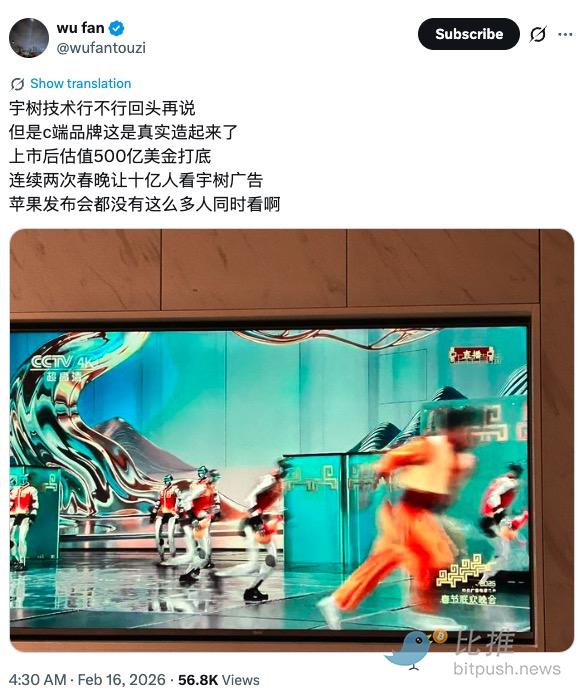
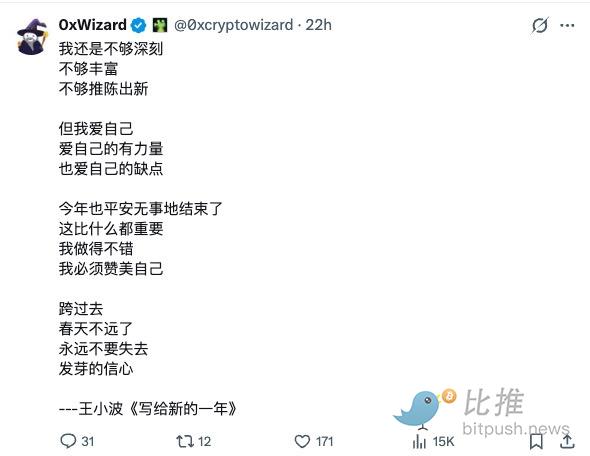
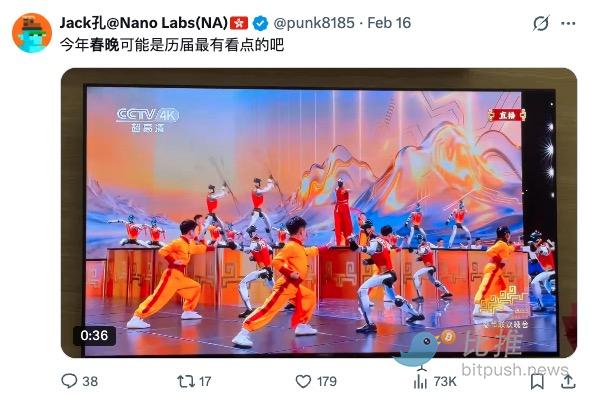
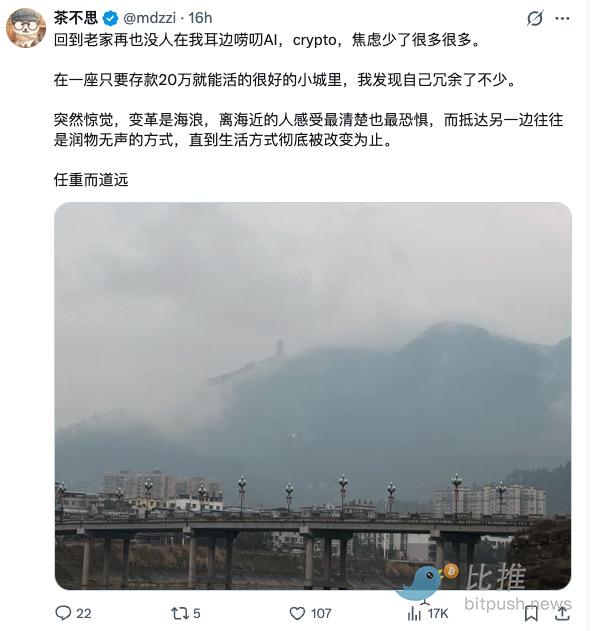
New Year Reflections, and When AI Takes Center Stage at the Spring Festival Gala
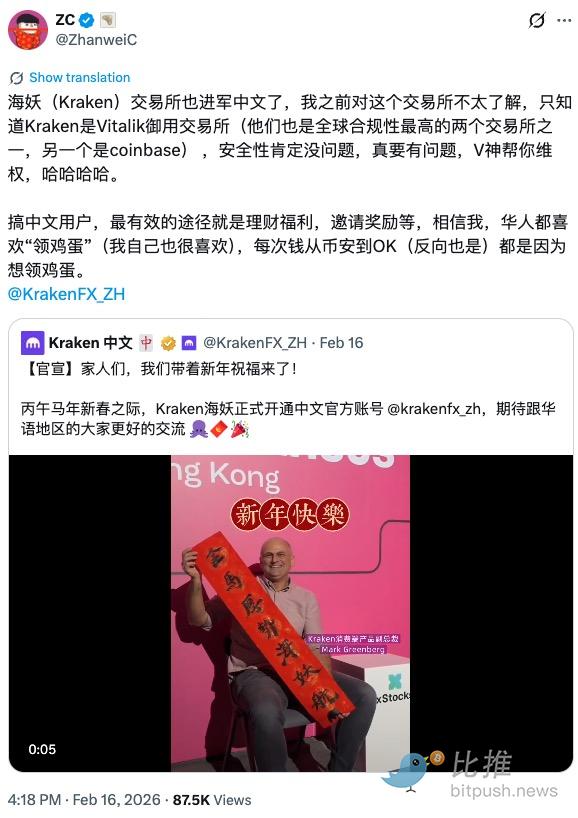
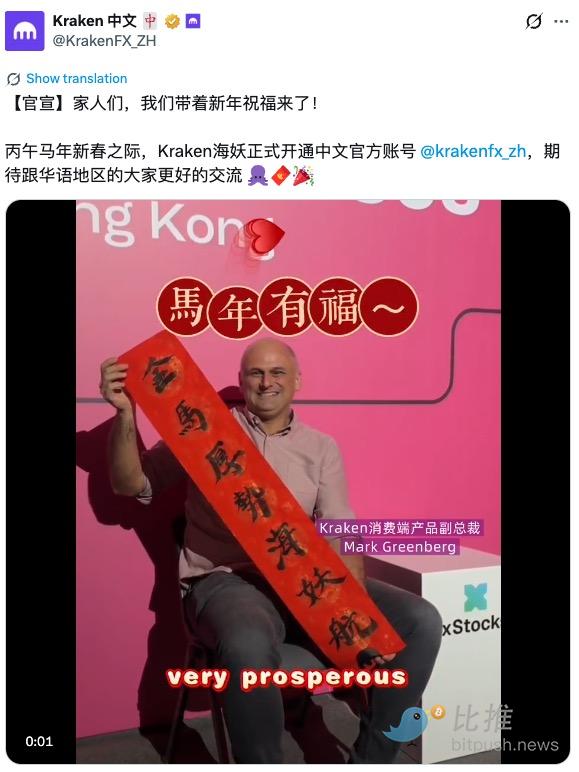
Kraken Exchange Launches Chinese Account, Executives Extend New Year Greetings in Chinese
The Evolution of Listing Cycles: “Narratives Are Dead, Utility Reigns”

Article link: https://www.bitpush.news/articles/7612622

Author’s note: “As an old-timer in crypto who’s anti-VC, this sentiment really resonates with us—do you know how long it took for the crypto community to reclaim pricing power? So today, from the perspective of a seasoned veteran, I’ve strung together these phases to help newcomers understand the journey. This is a hearty dish for you to savor during boring family visits or while traveling. It’s worth reading again and again.”

He Yi’s repost comment:

“From an exchange’s perspective, the first phase was the wild west era where many projects cashed out and left. Binance began restricting investors & project teams from unlocking tokens based on milestones or timelines.

The second IEO era emerged because liquidity was concentrated, giving Binance more leverage to advise projects on low-price TGEs to benefit retail investors, without charging listing fees—a win-win logic. Coupled with the bear market introducing longs, shorts, and leverage, this became the ‘golden age’ everyone reminisces about.

The third era saw AMMs revolutionize DEXs, the rise of VCs, and the professionalization of industry KOLs and institutions. This diluted CEXs’ pricing power and introduced compliance standards, leading to airdrops.

The fourth era is marked by further institutional professionalization among players. Exchanges evolved from early curation to CEXs integrating wallets and enabling trading of any on-chain token, giving rise to ‘the eggs every generation must claim’—Alpha, intended to balance VC & institutional, project, and retail interests.

For any emerging industry, it’s a process of feeling our way forward. Most people lack faith in the industry’s long-term prospects, hence ‘not looking long-term.’ It’s like many don’t believe we can cross this river, but only those who believe can make it to the other shore.”

Market Discussions
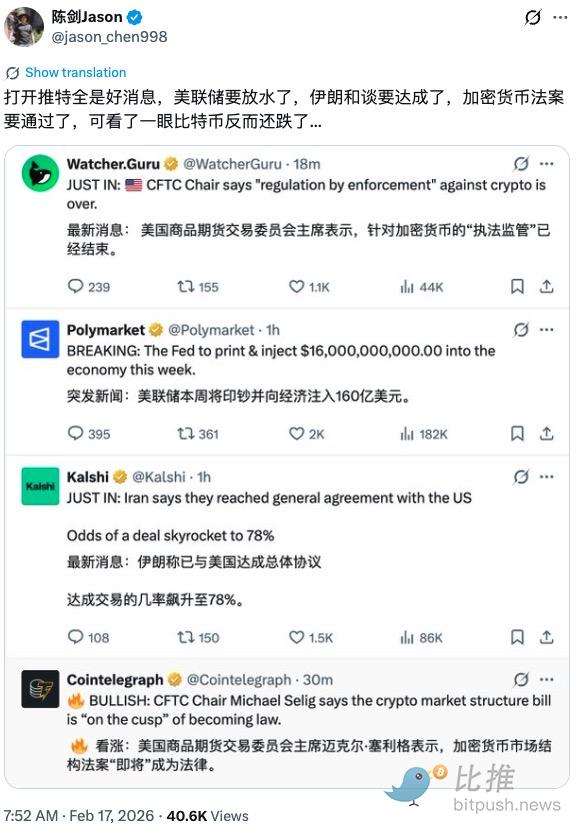
Popular replies:

In a bear market, any news is bearish; in a bull market, even unrelated news is bullish;

When Bitcoin ETFs were approved, the price didn’t rise—it actually dropped from 44k to 38k, but later hit 120k. Probably now it’ll hover around 60k-70k for a long time;

It’s these positive factors that pushed it past 70k; otherwise, it would’ve dropped to 60k already.

The Charm of “Sun Studies”

Popular replies:

A joke: you think he’s just borrowing a pen, but when you look back, your wallet’s gone too. Then Brother Sun invites you to dinner under the pretext of returning it, and you end up losing the meal on top of it;

His never-miss-a-trick nature is etched in his genes;

I heard that last time Sun Cut was interviewed in Hong Kong, he pocketed two glass cups on his way out;


Original article link: https://www.bitpush.news/articles/7612688

İlgili Sorular

QWhat is the main topic discussed by crypto KOLs in the past 24 hours according to the article?

AThe main topics include Chinese New Year reflections, AI's role in the Spring Festival Gala, Kraken Exchange opening a Chinese account and executives greeting in Chinese, the evolution of token listing cycles, market discussions, and the 'charm of Sun Studies' (referring to Sun Yuchen's influence).

QWhich exchange opened a Chinese account and had executives send New Year greetings in Chinese?

AKraken Exchange opened a Chinese account and had its executives send New Year greetings in Chinese.

QWhat is the core argument in the 'Token Listing Cycle Evolution Theory' mentioned in the article?

AThe core argument is 'Narrative is dead, utility stands,' highlighting a shift from speculative narratives to practical utility in token listings, with insights into the industry's phases from wild growth to institutional professionalism.

QHow did the community react to market discussions, as per the popular replies in the article?

AThe community noted that in a bear market, any news is seen as negative, while in a bull market, even unrelated news is perceived as positive. They also discussed Bitcoin's price consolidation around $60,000-$70,000 after ETF approval.

QWhat is the community's humorous take on 'Sun Studies' (孙学) in the article?

AThe community humorously commented on Sun Yuchen's reputation, joking that he might take advantage of situations, such as 'taking wallets' or even pocketing glass cups after an interview, reflecting his opportunistic character.

İlgili Okumalar

Annual Salary of Millions Competing for Electricians, Meta Rushes to Open Its Own Technical School

The AI boom is facing an unexpected bottleneck: a severe shortage of skilled construction workers and electricians. As tech giants like Meta, OpenAI, and Alphabet race to build massive data centers—such as OpenAI's $16 billion "Stargate" project—they are hitting a critical labor wall. The U.S. needs an estimated 130,000 more electricians, 240,000 construction workers, and 150,000 supervisors by 2030 for AI infrastructure alone, but tens of thousands of electrician jobs go unfilled each year. While AI companies offer high premiums, with electricians earning up to $280,000 annually, worker scarcity still causes massive losses—delays on a single project can cost $14.2 million per month. The complexity of building AI data centers, which require immense power (equivalent to powering hundreds of thousands of homes), sophisticated electrical systems, and advanced liquid cooling solutions, demands highly skilled technicians who are in short supply. To combat this, companies are investing heavily in training. Meta has committed $115 million to a free training school offering tuition, housing, and stipends, targeting 5,000 new workers. OpenAI is partnering with unions to secure skilled labor. These efforts are paying off, with a significant rise in Gen Z interest in trade schools over college. However, the power demands are staggering. AI data centers are driving a rapid surge in electricity consumption, projected to account for up to 12% of U.S. power use by 2028 and raising costs for consumers. Furthermore, the construction boom is project-based, leading to a potential future glut of trained workers once building peaks, which could depress wages industry-wide. The race for AI supremacy now depends as much on skilled hands as on advanced chips.

marsbit8 dk önce

Annual Salary of Millions Competing for Electricians, Meta Rushes to Open Its Own Technical School

marsbit8 dk önce

OpenAI No Longer Sells Its Most Expensive Model for Profit

OpenAI is shifting its business strategy away from promoting its most expensive, flagship models for every task. Recent price cuts—80% for GPT-5.6 Luna and 20% for Terra—signal a deeper change: the company now actively advises users that many tasks don't require the most powerful model. Instead, OpenAI recommends a tiered approach: use the high-end GPT-5.6 Sol for complex planning and analysis, then delegate execution to cheaper models like Luna. This mirrors moves by Anthropic, which recently launched Claude Opus 5 at half the price of its top model, Fable 5. Both companies are de-emphasizing flagship models as primary revenue drivers, using them instead for brand prestige and technological showcases. The industry is entering a "mass-market" phase, similar to automotive, where high-volume, cost-effective models handle daily operations and drive scale. OpenAI's price reductions are partly enabled by AI models themselves optimizing underlying code and infrastructure, creating a self-reinforcing cycle of efficiency gains and cost reduction. Competition is shifting from "who is smartest" to "who offers the best value." The goal is no longer selling individual models but fostering widespread API adoption and ecosystem lock-in. By making AI calls cheap and ubiquitous, companies like OpenAI aim to become the indispensable, utility-like infrastructure powering automated workflows—the "water and electricity" of software, quietly embedded everywhere.

marsbit8 dk önce

OpenAI No Longer Sells Its Most Expensive Model for Profit

marsbit8 dk önce

Will the Fed Definitely Raise Interest Rates in September? How Will Crypto and U.S. Stocks Withstand the Pressure?

The market's expectation for a September Fed rate hike surged dramatically in early August, jumping from under 50% to over 80% within a week. This shift followed a contentious July FOMC meeting, where a 9-3 vote to hold rates revealed growing dissent from hawkish members advocating for an immediate hike to combat persistent inflation. The primary catalyst for this repricing is rising oil prices, driven by renewed geopolitical tensions around the Strait of Hormuz, which threaten global supply. Energy costs directly influence inflation metrics, making the upcoming July CPI report (due August 12th) a critical data point. If it shows inflation reaccelerating, the probability of a September hike will solidify. For Bitcoin and crypto assets, this is typically bearish news. Bitcoin continues to behave as a high-beta, liquidity-sensitive risk asset. A rate hike raises the opportunity cost of holding non-yielding assets and could drive capital toward money markets, pressuring crypto prices in the short term. However, historical patterns suggest that if a hike is perceived as the end of a tightening cycle rather than the start, any negative price impact may be brief. U.S. stocks, particularly crypto-linked equities like Coinbase and growth-oriented tech stocks, are also vulnerable. Higher rates increase discount rates in valuation models, putting pressure on high-multiple companies. This coincides with a pivotal tech earnings season where investor focus has shifted from massive AI capital expenditure to tangible revenue and cash flow generation. Companies with negative cash flow and weak growth narratives could face heightened volatility if borrowing costs rise in September. In summary, a September Fed hike has evolved into a mainstream market scenario. Key factors to watch are oil prices, the July CPI report, and Fed communications, which will determine the final decision and its impact on volatile crypto and equity markets.

marsbit19 dk önce

Will the Fed Definitely Raise Interest Rates in September? How Will Crypto and U.S. Stocks Withstand the Pressure?

marsbit19 dk önce

İşlemler

Spot
活动图片