New York Times' Blockbuster Investigation Reignites Satoshi Nakamoto Identity Mystery, Adam Back Quickly Denies After Being Identified

marsbit2026-04-09 tarihinde yayınlandı2026-04-09 tarihinde güncellendi

Özet

The New York Times published an extensive investigation suggesting that Blockstream CEO and cryptographer Adam Back is the most plausible candidate for being Bitcoin’s pseudonymous creator, Satoshi Nakamoto. The report, by Pulitzer-winning journalist John Carreyrou, analyzed linguistic patterns, technical ideas, and historical context from decades of online archives and cryptographic mailing lists. It highlighted Back’s early work on Hashcash—a proof-of-work system used in Bitcoin—as well as his consistent advocacy for digital cash and privacy technologies since the 1990s. The investigation also pointed to stylistic similarities in writing and aligned ideological views between Back and Satoshi. However, Back quickly denied the claims, calling the evidence coincidental and statistically biased due to his high volume of posts in crypto circles. He reiterated that he is not Satoshi and argued that Satoshi’s anonymity benefits Bitcoin. The crypto community responded with skepticism; some developers criticized the report for relying on circumstantial evidence, while others accused Back of exaggerating his role in Bitcoin’s origins. Past attempts to identify Satoshi, including high-profile claims involving Dorian Nakamoto and Craig Wright, have all failed due to lack of conclusive proof. The mystery remains unsolved, and Bitcoin’s value continues to stem from global adoption rather than its creator’s identity.

Author: Nancy, PANews

The true identity of Satoshi Nakamoto remains an enigma that has persisted in the crypto world for seventeen years. Speculation surrounding this pseudonym has never ceased, with various candidates—from cryptographers to corporate founders—taking the stage, but conclusive evidence has always been lacking.

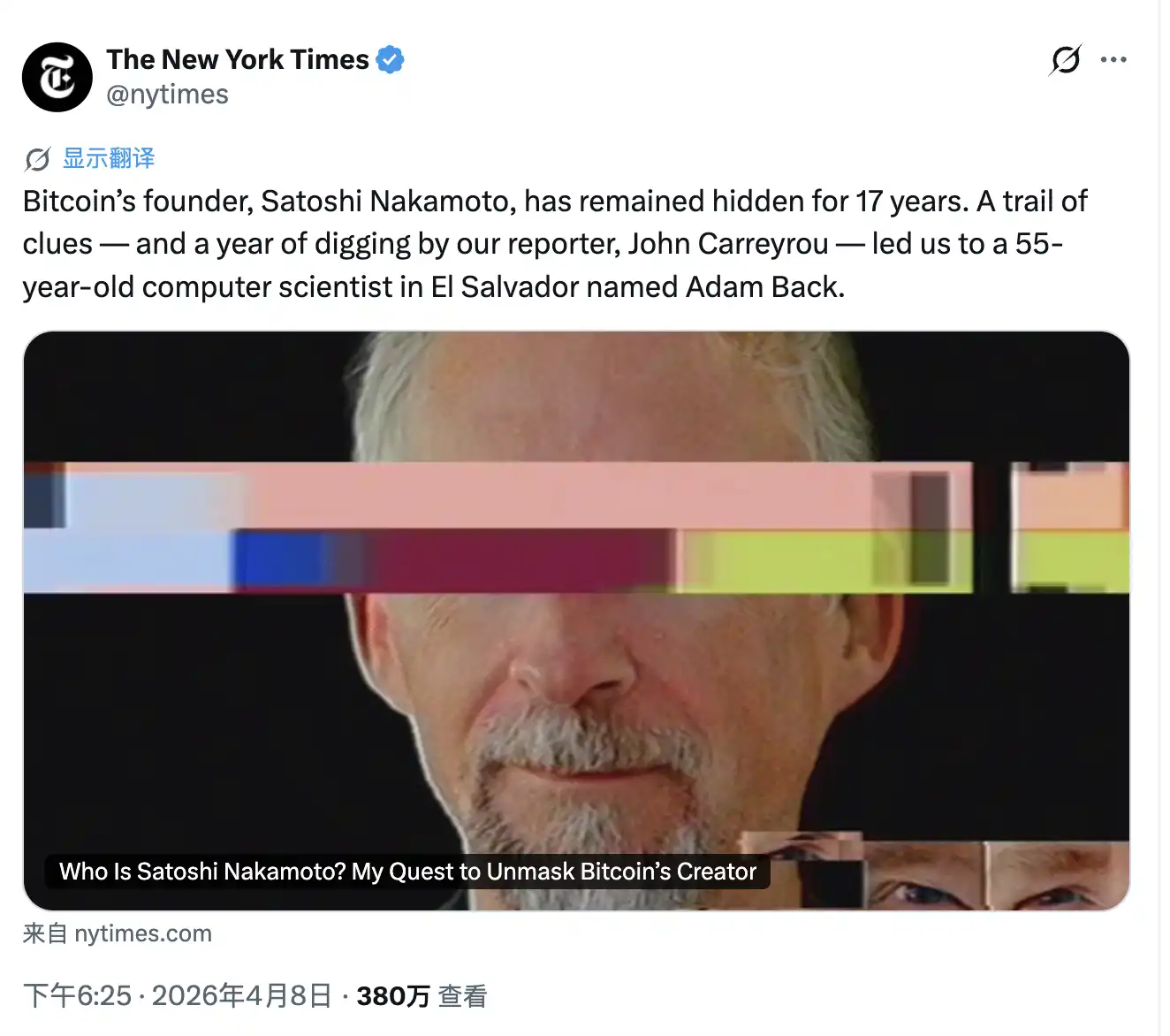
Recently, The New York Times published a lengthy investigation, conducting multi-faceted comparisons based on writing style, technical approach, and historical context, identifying Blockstream CEO Adam Back as the most compelling candidate for Satoshi Nakamoto. However, this claim was swiftly and explicitly denied by Back himself, and the related arguments have been widely questioned within the industry as unconvincing.

Satoshi Nakamoto Identity Controversy Reignited, Lengthy Investigation Identifies Adam Back

In this investigation, The New York Times reporter John Carreyrou spent over a year deeply梳理 (sorting through) decades of internet archives, cypherpunk mailing lists, and all of Satoshi Nakamoto's public texts. Through multi-dimensional cross-comparisons of writing style, technical philosophy, and historical background, he gradually narrowed down from over 34,000 potential candidates, ultimately pointing to 55-year-old British cryptographer Adam Back.
John Carreyrou is a renowned American investigative journalist, a two-time Pulitzer Prize winner, widely known for his in-depth exposure of the Theranos medical fraud, on which he based his bestselling book "Bad Blood".

The article points out that, based on resume and background, this direction is not without basis. Back is a core member of the early cypherpunk community, a group that was a crucial source of Bitcoin's ideological origins. The Times headline embedded in Bitcoin's genesis block has long been seen as a hint of a direct connection between its creator and the UK, a point that恰好 (coincides) with Back's identity. More importantly, Back has been deeply involved in discussions on anonymous communication, encryption technology, and digital cash since the 1990s. His technical background, programming ability, and cryptography expertise are highly consistent with the level demonstrated by Satoshi Nakamoto in the whitepaper and early communications.

In terms of technical conception, as early as the late 1990s, Back proposed an electronic cash设想 (concept) on mailing lists that was脱离 (separate from) the traditional banking system. Its core elements included a decentralized network, proof-of-work based on computational puzzles, control over monetary scarcity, node distribution to resist attacks, and a verification system无需 (without needing) trusted third parties. These elements almost逐一对应 (correspond one by one) with the design in the Bitcoin whitepaper a decade later. Particularly, the Hashcash mechanism invented by Back was directly adopted by Bitcoin as the foundation for mining. His suggestion to combine Hashcash with Wei Dai's b-money was precisely the technical path最终实现 (ultimately implemented) by Satoshi Nakamoto for Bitcoin. Based on this clue, the reporter believes Back is not just a participant in related fields but更像是 (more like) the original designer of Bitcoin.

On an ideological level, the article notes that both Back and Satoshi Nakamoto were deeply influenced by cypherpunk ideals, emphasizing the use of cryptography to achieve personal privacy and freedom, and leaning towards a libertarian worldview. Simultaneously, their specific modes of expression also showed consistency, for example, both viewed the traditional banking system as something that needed to be replaced and used technical means to express criticism of real-world financial crises and policies. This makes the question "why create Bitcoin" seem顺理成章 (perfectly logical) when applied to Back.

Writing style provided more detailed corroboration. The investigation found大量相似之处 (numerous similarities) between the two in word choice, grammar, and even some subtle writing habits, including the use of specific technical terms, the mixing of British and American spellings, inconsistent use of hyphens, etc. A single characteristic might not be sufficient proof, but these features appeared in groups. Particularly, unconventional hyphenated spellings like "proof-of-work" and relatively rare expressions like "partial pre-image" were used by very few in the cryptography community at the time, and Back was among them.Using AI to screen multiple mailing lists on a large scale, the candidate pool was层层压缩 (narrowed down layer by layer), leaving only Back.

Timeline comparisons further strengthened this inference. Satoshi Nakamoto was active between 2008 and 2011 before suddenly disappearing, while Back was几乎未公开参与 (almost not publicly involved in) Bitcoin discussions during this period but quickly entered the Bitcoin community after 2011, gradually becoming one of its core figures. Around 2013, when speculation about the scale of Satoshi's Bitcoin holdings began, Back also became active on key forums almost simultaneously. Even during the block size debate in 2015, an email被视为 (considered as) "Satoshi's return" had a stance and wording高度一致 (highly consistent) with Back's past views. These clues are difficult to explain完全用巧合 (entirely as coincidence).

Although Back has previously submitted emails exchanged with Satoshi Nakamoto to prove he is not the same person, the reporter believes these emails contain obvious logical contradictions. When asked to provide more crucial email metadata, Back始终未予回应 (consistently did not respond). During a face-to-face interview with the reporter, Back repeatedly denied the claims but could not provide reasonable explanations for key timeline points, showing a degree of avoidance. This defensive reaction contrasted with his usual image of technical confidence. Even in one conversation, when the reporter mentioned Satoshi's classic phrase "I'm better with code than with words," Back's response included a natural流露 (leakage) similar to "speaking as himself," which the reporter interpreted as an unconscious "slip of the tongue."

Nonetheless, the article also points out that these clues remain at the level of high correlation, not conclusive evidence. The only thing that can truly provide definitive proof remains a private key signature.

Community Skepticism Persists, Repeated Denials from the Individual

Adam Back is a renowned cryptographer and Bitcoin pioneer. Facing the identity revelation by The New York Times, Back swiftly denied it.

"I am not Satoshi Nakamoto," Back posted in response, stating that he began focusing highly on cryptography, online privacy, and the socially positive impact of electronic cash very early, thus actively participating in related applied research from around 1992, discussing electronic cash and privacy technologies on the cypherpunk mailing lists, which led to Hashcash and some other ideas. There were indeed many attempts to create decentralized electronic cash early on, but they were essentially exploring a system design similar to Bitcoin.

Back further explained that because he was very active in the cypherpunk mailing lists, posting far more than others, the probability of him leaving comments on topics like electronic cash was higher, leading investigators to更容易关联 (more easily associate) his remarks with Satoshi Nakamoto, which is merely a statistical bias. The rest of the evidence is coincidence and the result of people with similar experiences and interests using similar phrasing.

He also pointed out that Satoshi Nakamoto needed specific skills and experience to invent Bitcoin, and while he and many others were "seemingly very close to the final solution in the decade of prior design attempts, they始终未能触及核心 (ultimately failed to touch the core)." Although he doesn't know who Satoshi Nakamoto is either, this anonymous state is beneficial for Bitcoin.

In fact, this is not the first time Back has publicly denied related speculation. Back has denied it multiple times over the past few years and has tried to explain the reasons for Satoshi's choice of anonymity, stating that Bitcoin would reform money, and the risk of separating money from the state was greater. While some countries are gradually accepting Bitcoin now and regulations are becoming more open, it remains in a gray area or illegal status in some countries, so even core developers might have faced significant risks if their identities were exposed early.

Controversy surrounding the report quickly spread to the crypto community. Bitcoin Core developer Jameson Lopp stated that Satoshi cannot be caught through stylistic analysis, and it's shameful to paint such a big target on Adam's back with such weak evidence.

Crypto financial researcher FatMan则认为 (believed) Back is a role-player who exaggerates his relationship with Bitcoin through humble self-promotion, packaging a weekend project Hashcash as Bitcoin's predecessor to build influence and even raise funds. Back is not the true inventor of Bitcoin; Satoshi Nakamoto is someone else and deserves privacy, should not be publicly speculated about or exposed.

Crypto KOL Todd also raised multiple rebuttals, mainly including:

  • Satoshi Nakamoto once naturally emailed Back to ask questions; Bitcoin was not famous then, making it unlikely to be a "double act";

  • Bitcoin's code uses C++, completely different from Adam Back's programming style;

  • Although Back's company Blockstream funds Bitcoin Core developers, various commercialization operations (e.g., sidechains, hardware wallets) are inconsistent with holding a large amount of Bitcoin.

  • Back has even expressed regret for not participating in Bitcoin mining earlier, and his philosophy leans more towards value storage rather than Bitcoin's early electronic cash理念 (ideology).

  • Back tends to apply for patents, while Satoshi Nakamoto chose complete open source.

Repeated Identity Dramas Fall Flat, Still No Ironclad Evidence

The anonymous identity has added a mysterious aura to Satoshi Nakamoto that persists to this day, and the potential归属 (ownership) and movements of his approximately 1.1 million BTC (approx. $77 billion) holdings始终牵动着 (always affect) market nerves.
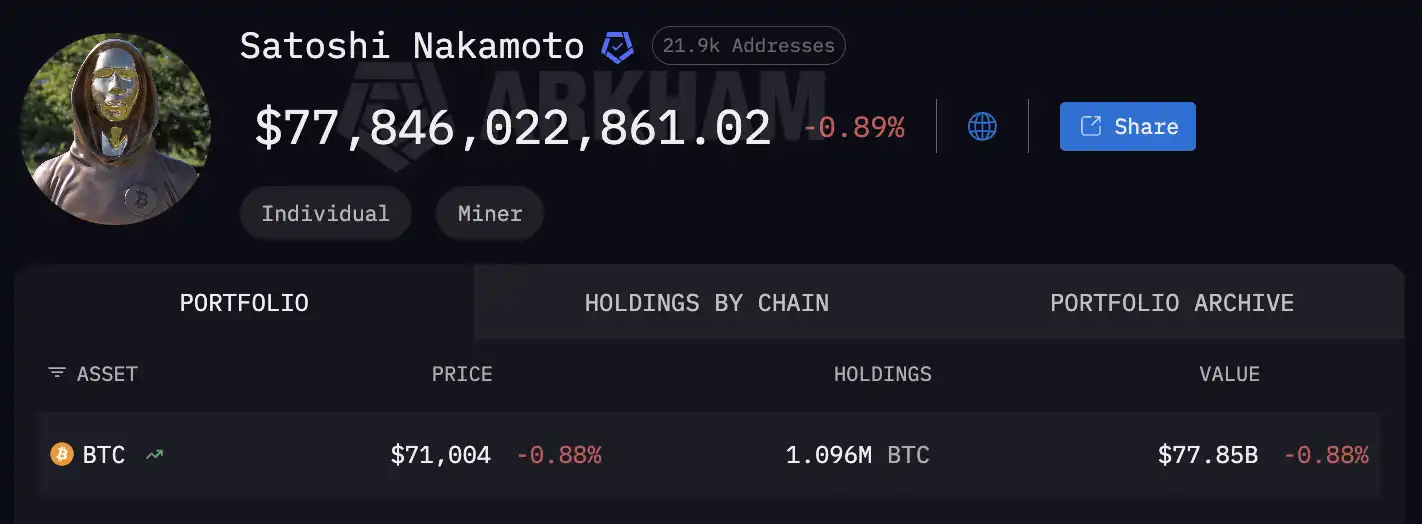
Over the past decade, speculation about this pseudonym's identity has continuously emerged.

In 2014, American Newsweek magazine identified Dorian Nakamoto, a Japanese-American physicist living in California, as Satoshi Nakamoto, attracting widespread attention. But the individual subsequently clearly denied it, stating he had no connection to Bitcoin's creation. The report was gradually debunked in subsequent investigations and caused significant trouble for his personal life.

In 2016, Australian computer scientist Craig Wright repeatedly claimed to be Satoshi Nakamoto, even applying for copyrights for the Bitcoin whitepaper and original Bitcoin code. However, the court eventually ruled Wright's claims unsubstantiated, stating that most of the evidence he submitted was forged. He was found in contempt of court and sentenced to 12 months imprisonment, suspended for two years, at the end of 2024.

In 2024, the HBO documentary "Money Electric: The Bitcoin Mystery" turned its attention to Canadian Bitcoin developer Peter Todd, sparking a new round of discussion. But Todd immediately denied the inference, calling the accusation荒谬 (absurd), and provided evidence to refute it, while laying low for a time due to security concerns. In the same year, Briton Stephen Mollah held a press conference in London claiming to be Satoshi Nakamoto but同样未能提供 (also failed to provide) verifiable evidence and was quickly驳斥 (refuted) by the community.

These attempts to reveal the identity mostly caused short-term舆论波动 (public opinion fluctuations) but ultimately failed to end the mystery with ironclad evidence. As time passes, Satoshi Nakamoto's anonymity has instead become part of Bitcoin's narrative. Today, the Bitcoin network has been operating for many years, and its value stems more from global consensus than from the founder's identity光环 (halo).


İlgili Sorular

QWhat is the main focus of The New York Times investigation regarding Satoshi Nakamoto's identity?

AThe New York Times investigation, led by journalist John Carreyrou, uses linguistic analysis, technical path comparison, and historical context to identify Blockstream CEO Adam Back as the most likely candidate for being Satoshi Nakamoto.

QHow did Adam Back respond to the allegations made in The New York Times article?

AAdam Back swiftly denied the allegations, stating he is not Satoshi Nakamoto. He attributed the correlations to statistical bias from his high volume of posts on cypherpunk mailing lists and called the evidence coincidental.

QWhat key technical concept invented by Adam Back was directly used in Bitcoin?

AAdam Back invented the Hashcash mechanism, which was directly adopted as the foundation for Bitcoin's mining process through its Proof-of-Work consensus algorithm.

QAccording to the article, what is considered the only definitive proof that could confirm someone's identity as Satoshi Nakamoto?

AThe article states that the only definitive proof that could confirm someone's identity as Satoshi Nakamoto is a cryptographic signature from the private keys associated with Satoshi's known Bitcoin addresses.

QName two other individuals who have been previously claimed or suspected to be Satoshi Nakamoto, as mentioned in the article.

ATwo other individuals previously claimed or suspected to be Satoshi Nakamoto are Dorian Nakamoto, a Japanese-American physicist, and Craig Wright, an Australian computer scientist.

İlgili Okumalar

Sequoia Dialogue with Jensen Huang: Computing Model Undergoes a 60-Year Transformation; You Won't Be Replaced by AI, But You Will Be Dimensionality-Reduced by 'Those Who Master AI'

NVIDIA founder and CEO Jensen Huang, in a conversation with Sequoia Capital's Konstantine Buhler, argues that we are witnessing the most significant computing shift in 60 years—from retrieval-based to generative computing. Instead of just storing and retrieving data, future systems will generate highly personalized content (text, images, video) on demand, powered by massive "AI factories." Huang envisions a global "intelligence network" that will envelop the planet, following the historical patterns of energy and communication grids. He outlines a five-layer investment framework: 1) Energy, 2) Chips/Computers, 3) Infrastructure (data centers), 4) AI Models, and 5) Applications. He predicts this ecosystem will reach a scale of $20 trillion annually. Crucially, Huang pushes back against fears of AI-driven job loss. He distinguishes between specific "tasks" (e.g., typing, analyzing images) and overall "jobs" (e.g., CEO, radiologist). While AI automates tasks, it increases efficiency and demand for the higher-value problem-solving aspects of professions, thus creating more jobs and "up-leveling" careers. The real risk, he asserts, is not being replaced by AI, but being outperformed by someone who effectively leverages it. He urges everyone to embrace AI as a tool for augmented capability and innovation.

marsbit23 dk önce

Sequoia Dialogue with Jensen Huang: Computing Model Undergoes a 60-Year Transformation; You Won't Be Replaced by AI, But You Will Be Dimensionality-Reduced by 'Those Who Master AI'

marsbit23 dk önce

"I Don't Need a Better Model Anymore": A Panorama of AI Users Under a Reddit Hot Post

Titled "I Don't Need a Better Model Anymore": AI User Reactions on Reddit Anthropic recently released Claude Fable 5, its first publicly available 'Mythos'-tier model, achieving 80.3% on the SWE-Bench Pro benchmark and significantly outperforming its predecessor and competitors. However, a viral Reddit post titled "Claude Fable made me realize I don't need better models anymore" highlighted a growing user sentiment of "good enough." Top comments expressed "model fatigue," with users stating that earlier models like Opus 4.5/4.8 already sufficed for their workflows. High cost was a key concern, as Fable 5's API is nearly twice the price of Opus 4.8, with users questioning the return on investment and suggesting the field has hit a plateau. The most frequent complaint targeted Fable 5's stringent safety filters. Designed to intercept high-risk requests (e.g., cybersecurity), the system was perceived as overly conservative. Users reported frequent rejections for routine security-related tasks, leading to automatic fallbacks to the older Opus model. Paying users were particularly frustrated, feeling they paid a premium for a less usable product. Dissenting voices came from users with heavy, complex tasks. For workloads like high-energy physics simulations with thousands of code lines, Fable 5's improved long-context understanding and error detection represented a significant, worthwhile leap—described as moving from a "college player to an NBA starter." The debate underscores a divergence between benchmark performance and practical utility. For most users, current models meet their needs, making further advances relevant only for extreme use-cases. The discussion also raised concerns about a potential "Public AI Freeze," where the most powerful models (like the restricted Mythos 5) remain exclusive to enterprises and governments, while public offerings stagnate. The launch presents two report cards: one of technical excellence and another of user skepticism. Fable 5's ultimate reception may depend on Anthropic's ability to refine its safety filters and justify its cost for specialized, high-demand users.

marsbit31 dk önce

"I Don't Need a Better Model Anymore": A Panorama of AI Users Under a Reddit Hot Post

marsbit31 dk önce

When AI Traffic Surpasses Humans, How Do You Prove You're Human?

With AI-generated web traffic surpassing human activity, websites face a crisis as AI agents bypass ads, avoid clicks, and scrape data without generating revenue. This disrupts the ad-based internet economy, diverting traffic and reducing site visits. In response, sites are blocking AI crawlers and deploying traps like Cloudflare's "honeypot" pages. Traditional CAPTCHAs are now ineffective against advanced AI. The focus has shifted to behavioral biometrics—analyzing unique human patterns such as cursor movement, typing rhythm, and keystroke dynamics. Companies like IBM and BioCatch use this data to distinguish humans from bots, even detecting fraud through behavioral inconsistencies. Two competing approaches aim to verify human identity centrally. Sam Altman’s World (formerly Worldcoin) uses iris scanning to create unique credentials, though it faces privacy concerns and regulatory bans. Alternatively, cryptographic zero-knowledge proofs offer anonymous verification without revealing personal data, championed by Vitalik Buterin to avoid centralized surveillance. However, both systems have flaws. Centralized solutions risk biometric data misuse, while decentralized models may be exploited through identity rental markets in economically unequal regions. Despite challenges, the author favors cryptographic methods for preserving privacy over pervasive behavioral monitoring that permanently captures and controls personal biometric data.

marsbit39 dk önce

When AI Traffic Surpasses Humans, How Do You Prove You're Human?

marsbit39 dk önce

2026 Landscape of Decentralized AI: Why is Blockchain the Inevitable "Antidote" for AI?

**The 2026 Landscape of Decentralized AI: Why Blockchain is the "Cure" AI Cannot Ignore** Decentralized AI addresses fundamental bottlenecks of centralized AI: scarce and expensive computational resources, excessive control concentration, unverifiable model outputs, and increasing difficulty in acquiring training data due to privacy and regulation. Blockchain offers a path to make intelligence open, verifiable, and economically accessible. The technical stack comprises three layers: 1. **Applications & Services**: The main crypto use cases are "Agentic Finance" (converting natural language into on-chain actions) and "Agentic Payments" for machine-to-machine commerce. Projects like Giza, Infinity Labs, Coinvest AI, and x402 (handling 173M+ transactions) are key players. 2. **Middleware**: This coordination layer enables agents to discover, identify, and transact. Notable projects include Gokite AI (specialized L1), Virtuals (an OS for the agent economy), and especially Bittensor—a network of specialized subnets forming competitive AI micro-economies. 3. **Infrastructure**: The capital-intensive layer providing raw resources. It includes decentralized compute (Akash, Render, Aethir), verifiable inference (Venice AI, OpenGradient), distributed training (Prime Intellect, Templar AI), decentralized storage (Filecoin, Walrus), and privacy/verification layers (Nillion, Arcium, Phala Network) using technologies like ZKPs, MPC, and TEEs. The outlook for 2026-2027 indicates AI demand outpacing infrastructure, with AI agents as a primary growth engine. Computation is becoming an asset class, with on-chain markets as its financial layer. Tokenomics is emerging as a structural advantage for coordinating capital, compute, and data in decentralized AI networks. While still early—with adoption uneven and revenue often trailing token incentives—projects like Bittensor, NEAR, and Virtuals demonstrate a shift from speculative narrative to a new model for coordinating intelligence.

marsbit42 dk önce

2026 Landscape of Decentralized AI: Why is Blockchain the Inevitable "Antidote" for AI?

marsbit42 dk önce

a16z Crypto Partner: Cash Flow is the Moat

Cash Flow as the Moat: A Playbook for Crypto Founders Historically, the most enduring businesses have been built by positioning themselves within the "flow of funds"—facilitating the creation and transfer of value in a network and extracting a portion of it. Cryptocurrency is the first modern technology natively built for this purpose. For startups, failing to architect products and businesses to leverage these principles means missing a major opportunity. Blockchains are inherently network businesses. Each transaction settles on a shared ledger, and every new participant strengthens the underlying network for all. Well-designed network tokens amplify this by aligning users, developers, and validators around growing the network, with value flowing back to contributors in a transparent feedback loop. This model is not new; companies from railroads and Standard Oil to Google, Meta, and AWS have thrived by inserting themselves into critical flows of value (goods, attention, compute). Financial markets make it even clearer: firms like Visa and major market makers generate immense revenue not by predicting markets but by being in the path of transactions. The combination of fund flow and network effects creates one of the most durable business structures. The high margins in traditional finance (payments, custody, lending, FX) represent prime targets. Crypto founders have the opportunity to build the next version—programmable, instant, global, and natively in the flow of funds. The frontier extends beyond finance to areas like computing/GPUs, AI training data, energy, robotics, and space—markets without entrenched intermediaries, ripe for building new, efficient value rails on programmable infrastructure. Founders should ask: Are you in the flow of funds today? Does your revenue scale 10x with the value of activity on your platform? Where in your target market are profit margins highest relative to value created? The opportunity is clear: embed your startup into the new flows of value and let the network effects accumulate.

marsbit45 dk önce

a16z Crypto Partner: Cash Flow is the Moat

marsbit45 dk önce

İşlemler

Spot
Futures
活动图片




