New Solana Vote Could Increase Daily SOL Burn to $800,000 and Slow New Token Creation

cryptonews.ru2026-08-25 tarihinde yayınlandı2026-08-25 tarihinde güncellendi

Özet

Validators on the Solana network have begun voting on three key governance proposals, two of which are set to significantly reduce the supply of SOL tokens. The voting period runs from Sunday until Thursday, around 15:30 UTC. The two supply-focused proposals are SGP-0002 and SGP-0003. SGP-0002 aims to double the annual reduction rate of new SOL issuance from 15% to 30%, accelerating the network's move towards its minimum supply level. SGP-0003 proposes a change to the transaction fee structure. Fees would be split, with a fixed portion going to the block producer and a variable portion, based on computational work, being permanently burned (destroyed). This change is projected to increase daily SOL burning from approximately 650 SOL to between 7,500 and 9,000 SOL. At Monday's prices, this represents an increase from about $61,000 to up to $846,000 burned daily. These measures of reduced issuance and increased burning are of major interest to SOL holders. The third proposal, SGP-0001, seeks to formally ratify the "Solana Constitution," a document that establishes the network's official governance framework and decision-making process. This creates a unique situation: SGP-0001 is the proposal meant to officially enact the voting system, yet the two supply proposals are being voted on using that same system before the rules governing it are fully ratified. As of early Monday, SOL was trading above $96, up 1.6% over 24 hours and 28% over the past week.

On Sunday, Solana validators began voting on three proposals, two of which involve reducing the amount of $SOL in circulation. The voting will last until Thursday, until approximately 15:30 UTC.

The outcome of the vote depends on the amount of locked $SOL used to secure the network. This gives voting power to validators, the operators managing Solana computers, and regular holders who have delegated their coins to a validator for staking on their behalf.
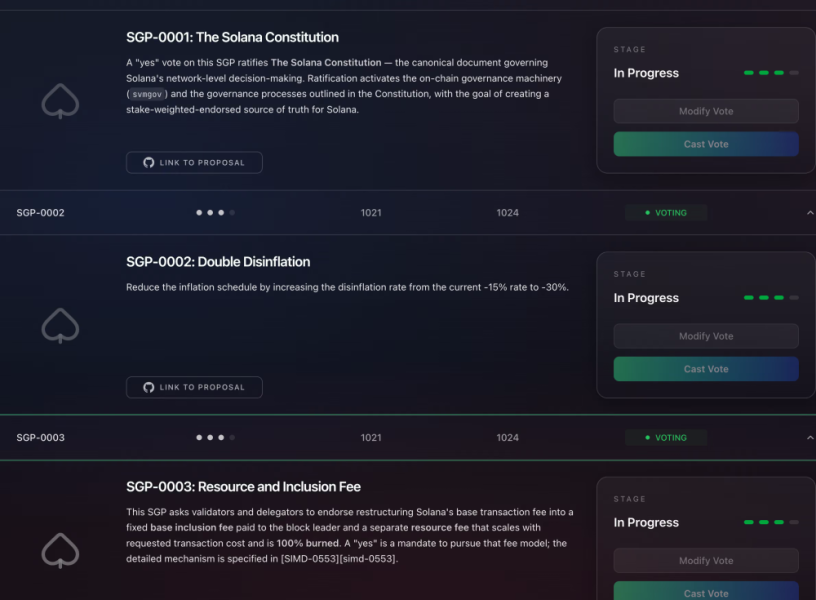
Three new proposals are being considered on the Solana validators' governance page. Source: Solana.

Two of the three proposals concern supply. SGP-0002 accelerates the pace at which the generation of new $SOL on the Solana network ceases. Currently, the network reduces the amount of $SOL created by 15% annually; this change would double that rate to 30%, allowing the minimum level to be reached faster.

SGP-0003 changes the transaction fee structure and fund distribution. The fee will be split into two parts. A fixed portion goes to the block producer, and a separate portion, the size of which depends on the computational work required for the transaction, is permanently burned.

Earlier this month, it was reported that this change would increase the daily burn from approximately 650 to 7,500-9,000 $SOL, which at Monday's price would amount to about $61,000 and $846,000 respectively.

Fewer $SOL being created and more being destroyed is why holders are paying attention, although neither proposal addresses the demand side.

The final proposal, SGP-0001, does not affect supply but ratifies a document the network calls the Solana Constitution, defining decision-making procedures and launching the software that manages these votes. Changes to Solana have so far been coordinated informally among developers and the largest operators.

All three votes are being held simultaneously, creating a strange situation. SGP-0001 is the proposal that formally establishes Solana's voting system; however, the two supply proposals are now being voted on using that same system—and the results will be tallied before it's known whether the rules governing the vote count have been ratified.

At the start of Monday, $SOL was trading above $96, up 1.6% over the past 24 hours and 28% over the past week.

end-content
İlgili Sorular

QWhat are the three governance proposals currently being voted on by Solana validators?

AThe three proposals are SGP-0001, SGP-0002, and SGP-0003. SGP-0001 ratifies the Solana Constitution and launches the governance software. SGP-0002 accelerates the reduction of new SOL issuance. SGP-0003 changes transaction fee structure and distribution.

QHow does proposal SGP-0002 aim to change the supply of SOL tokens?

ASGP-0002 aims to double the current annual reduction rate of new SOL issuance from 15% to 30%. This would slow down the creation of new SOL tokens and help the network reach its minimum supply target faster.

QWhat is the expected financial impact of proposal SGP-0003 on daily SOL burn, according to the article?

AProposal SGP-0003 is expected to increase the daily SOL burn from about 650 SOL to an estimated 7,500-9,000 SOL. Based on Monday's price, this would increase the daily burn in USD value from around $61,000 to between $750,000 and $846,000.

QWhat is the paradoxical situation created by holding all three votes simultaneously?

ASGP-0001 is the proposal that officially establishes Solana's on-chain governance system. However, the supply proposals (SGP-0002 and SGP-0003) are being voted on using this same system. The results of the supply votes will be counted before it is known if the rules governing the vote counting (the Constitution in SGP-0001) have been ratified.

QOn what basis are votes counted in Solana's governance process, as described in the article?

AVotes are counted based on the amount of staked SOL locked to secure the network. This gives voting power to validators (the operators) and to regular holders who have delegated their SOL to a validator for staking.

İlgili Okumalar

Jackson Hole Becomes a Critical Battle for U.S. Treasuries, BofA Warns: If Warsh Doesn't Signal Rate Hikes, 30-Year Yield May Surge to 5.5%

The Jackson Hole Economic Policy Symposium is shaping up as a crucial battle for the US Treasury market, with the spotlight on Federal Reserve Chair Warsh's upcoming speech. Markets view this as the most critical near-term risk event for bond yields and the US dollar. A key concern is whether Warsh will provide clear signals on the Fed's willingness to resume interest rate hikes should inflation fail to improve. American Bank warns that if he avoids offering such forward guidance, the 30-year Treasury yield could surge toward or above 5.5%, putting further downward pressure on the dollar. This heightened sensitivity stems from fragile market conditions, including the Treasury's recent increased long-end bond buybacks and a string of weaker economic data. Analysts note that Warsh has historically been resistant to providing specific policy guidance, but sustained bond market pressure may force a shift in communication strategy. The market anticipates a framework outlining potential policy responses based on incoming inflation data. Barclays economists assign over a 50% probability to Warsh delivering a hawkish message. Historically, Jackson Hole speeches have had limited lasting market impact, but analysts suggest this year could be an exception due to the unique confluence of pressures, making Warsh's credibility and clarity paramount for stabilizing expectations.

marsbit9 dk önce

Jackson Hole Becomes a Critical Battle for U.S. Treasuries, BofA Warns: If Warsh Doesn't Signal Rate Hikes, 30-Year Yield May Surge to 5.5%

marsbit9 dk önce

“Economic Outcast”: US Treasury Takes Aim at Iran's Cryptocurrency, Technology, and Gold

On August 24, 2026, the U.S. Treasury Department, under Secretary Scott Bessent, launched "Operation Economic Outcast," a major campaign targeting the financial networks of the Islamic Republic of Iran and its affiliates. The primary goal is to cut off revenue streams supporting the Iranian regime, with a specific focus on denying funding to the Islamic Revolutionary Guard Corps (IRGC). The Office of Foreign Assets Control (OFAC) activated authorities to sanction any entities, regardless of location, operating in or servicing five key Iranian economic sectors: digital assets (cryptocurrency), technology, gold, aviation, and shipping. OFAC noted Iran's increasing use of cryptocurrency to evade sanctions, including for operations linked to the IRGC and government officials. Initial measures targeted nearly 60 organizations, individuals, and vessels across multiple jurisdictions involved in procuring nuclear/missile technology, conducting cyber operations, and facilitating illicit oil sales. The U.S. State Department joined the campaign, announcing additional sanctions against Iranian military officials, intelligence entities targeting U.S. forces, and networks moving Iranian oil. Treasury warned foreign partners that they have a specific deadline to halt identified Iran-related activities, or face unilateral U.S. action. Entities facilitating sanctions evasion risk being cut off from the U.S. financial system and the dollar economy. The operation consolidates sanctions against Iran's crypto, tech, and commodity financing into a unified campaign with clear deadlines. It expands OFAC's reach to crypto brokers and payment networks handling Iranian oil. Analysis suggests crypto tools are already embedded in Iran's trade practices, as seen with capital flight from the Nobitex exchange and discussions of Bitcoin payments for Strait of Hormuz transit, indicating new OFAC powers target existing, not hypothetical, evasion channels.

cryptonews.ru24 dk önce

“Economic Outcast”: US Treasury Takes Aim at Iran's Cryptocurrency, Technology, and Gold

cryptonews.ru24 dk önce

Upbit Accelerates Token Listings: Total Trading Volume Halved, New Tokens Support Nearly 30% Share

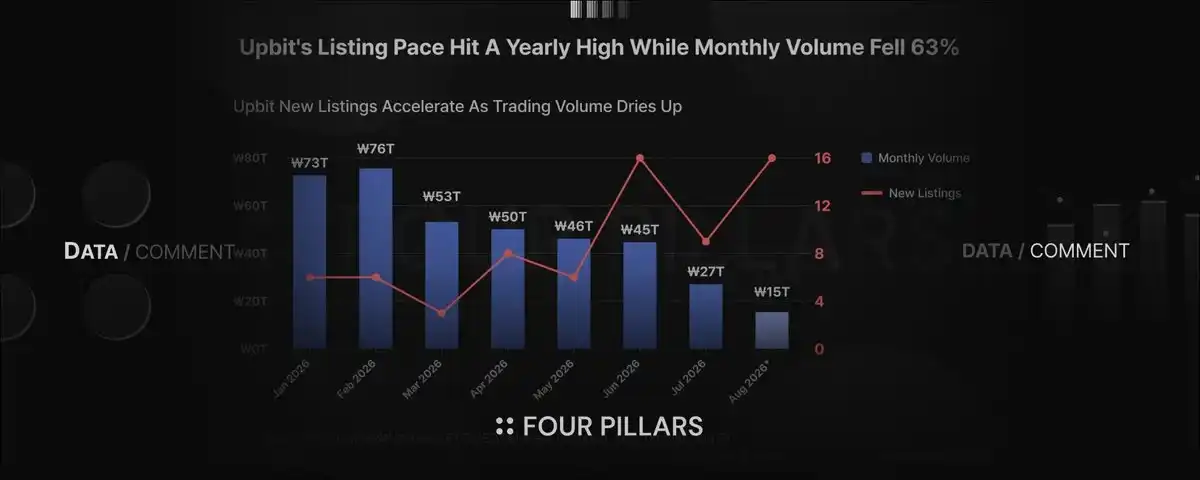
In the second half of 2026, Upbit significantly accelerated its pace of listing new cryptocurrencies, even as the overall Korean won-denominated trading market cooled rapidly. Monthly trading volume on Upbit plunged 63%, from KRW 72.7 trillion in January to KRW 27.1 trillion in July, with Bitcoin prices also falling. Contrary to the conventional logic of listing more during bull markets, Upbit intensified new listings during this downturn. New listings have become a crucial lever for Upbit to sustain trading activity in a bear market. By August, 61 new tokens listed in 2026 were collectively contributing nearly 30% of Upbit's total won trading volume, up from just 5% in January. This means roughly a quarter of the platform's fee revenue now comes from these newly listed assets. Standout performers like CHIP, RE, SLX, and CAP achieved significant individual market share shortly after listing, while new stablecoin listings contributed negligible volume. This strategy highlights a shift: the "Upbit listing premium," once a sought-after event to attract new capital, is increasingly used as a defensive tool to stabilize fee income amid shrinking overall volume. While the premium effect persists, indicating remaining genuine demand, its frequent use risks diluting the long-term strategic value and scarcity of Korean won liquidity access. Upbit's approach reflects a broader challenge for Asian centralized exchanges: relying on short-term listing tools to maintain operations during macro weakness, potentially at the cost of eroding long-term competitive foundations.

marsbit44 dk önce

Upbit Accelerates Token Listings: Total Trading Volume Halved, New Tokens Support Nearly 30% Share

marsbit44 dk önce

İşlemler

Spot
活动图片