New Protocol Tacit: The ZEC of the Bitcoin Ecosystem

marsbit2026-05-14 tarihinde yayınlandı2026-05-14 tarihinde güncellendi

Özet

The article discusses Tacit, a new privacy-focused Bitcoin asset protocol emerging after a period of relative quiet in the Bitcoin ecosystem. Unlike BRC-20 or Runes, Tacit is a "meta-protocol" where the indexer runs directly in the user's browser, removing the need for centralized servers. Its key innovation is enabling privacy for token amounts on the Bitcoin mainnet. Tacit employs cryptographic techniques like Pedersen Commitments and Bulletproofs to conceal transaction amounts while proving conservation of funds. It uses Mimblewimble-style signatures to prevent inflation and ECDH encryption to ensure only senders and receivers can decrypt real amounts. This makes it a native "privacy coin" for Bitcoin, albeit one that hides amounts but not the direction of fund flows between addresses. The protocol, developed by ross.wei (known for Ethereum's ZAMM), has rapidly evolved since its May 7 launch. It now supports fair launches, a marketplace, token swaps, and a novel mixer similar to Tornado Cash but without relying on smart contracts. However, this privacy comes at a cost, with transaction fees estimated to be about 10 times higher than Runes. Future plans include privacy-wrapping native Bitcoin (cBTC), implementing silent receipts, and hiding the token type in transfers. The main token, $TAC, has gained traction with a market cap around $4 million. Positioned between simpler token standards and complex solutions like RGB, Tacit represents a significant and innovative step ...

The Bitcoin ecosystem had been forgotten for a long time. Especially after Magic Eden, once the largest Bitcoin ecosystem marketplace, stopped supporting the Bitcoin ecosystem and discontinued its Magic Eden Wallet service, it gave players who hadn't paid attention to the Bitcoin ecosystem for a while a feeling that "the Bitcoin ecosystem is over."

However, not only are veteran Bitcoin infrastructure projects like UniSat and Xverse still working hard, but after Magic Eden, marketplaces like SatFlow and ord.net have also filled the gap. Recently, the emergence of a new Bitcoin asset protocol has brought the Bitcoin ecosystem back into the spotlight.

This new protocol is called Tacit.

What is Tacit?

First, we need to classify Tacit into the "meta-protocol" category like BRC-20 and Runes, which rely on indexers to handle asset confirmation. If there's any difference, it's that Tacit's indexer runs directly in the user's browser, eliminating the need to trust any centralized server (indexer). As long as two computers run the same code and view the same Bitcoin blockchain data, they will arrive at the same balance results.

Tacit's unique aspect is that it is a new Bitcoin asset protocol focused on "privacy." Many players promoting this new protocol directly use analogies like "ZEC on Bitcoin." This has some merit but isn't entirely accurate, because Tacit's hiding capability only applies to the *amount* of tokens (including the total supply amount specified during new token deployment and the specific amount of each transfer), not to the on-chain address graph.

In other words, Tacit hides the *amount* of fund flow, but not the *direction* of fund flow.

Nevertheless, it is still a native privacy asset protocol on the Bitcoin mainnet. Let's use a simple analogy to explain how it achieves this on the Bitcoin mainnet.

An ordinary Bitcoin transaction is like a transparent ledger; everyone can see a transaction and how much money is involved. Tacit, on the other hand, is like putting the transaction into a "black box" (a Pedersen commitment).

People can still see that this transaction occurred. Although they cannot see the amount, you can prove to everyone that "the money I put in plus the money I take out balances the books."

Pedersen commitments and Bulletproofs are used to hide the transaction amount while proving to the entire network that you haven't fabricated tokens out of thin air (e.g., proving the transferred amount is not negative and the total is conserved).

Mimblewimble-style signatures prove that the outgoing amount equals the incoming amount, ensuring tokens cannot be maliciously inflated.

When the sender transfers tokens to the receiver, the amount information is encrypted using ECDH and written onto the blockchain. Only the sender and receiver can decrypt and see the real amount using their private keys; to others, this data is just gibberish.

Finally, the indexer built into the dApp (the user's browser) reads the data on the Bitcoin chain, independently verifies the aforementioned cryptographic proofs, and thereby calculates your real balance.

Since its launch on May 7th, developer ross.wei (@z0r0zzz) has been updating quickly. Currently, Tacit already supports fair launches, has a marketplace, supports token swaps, and even has a mixer.
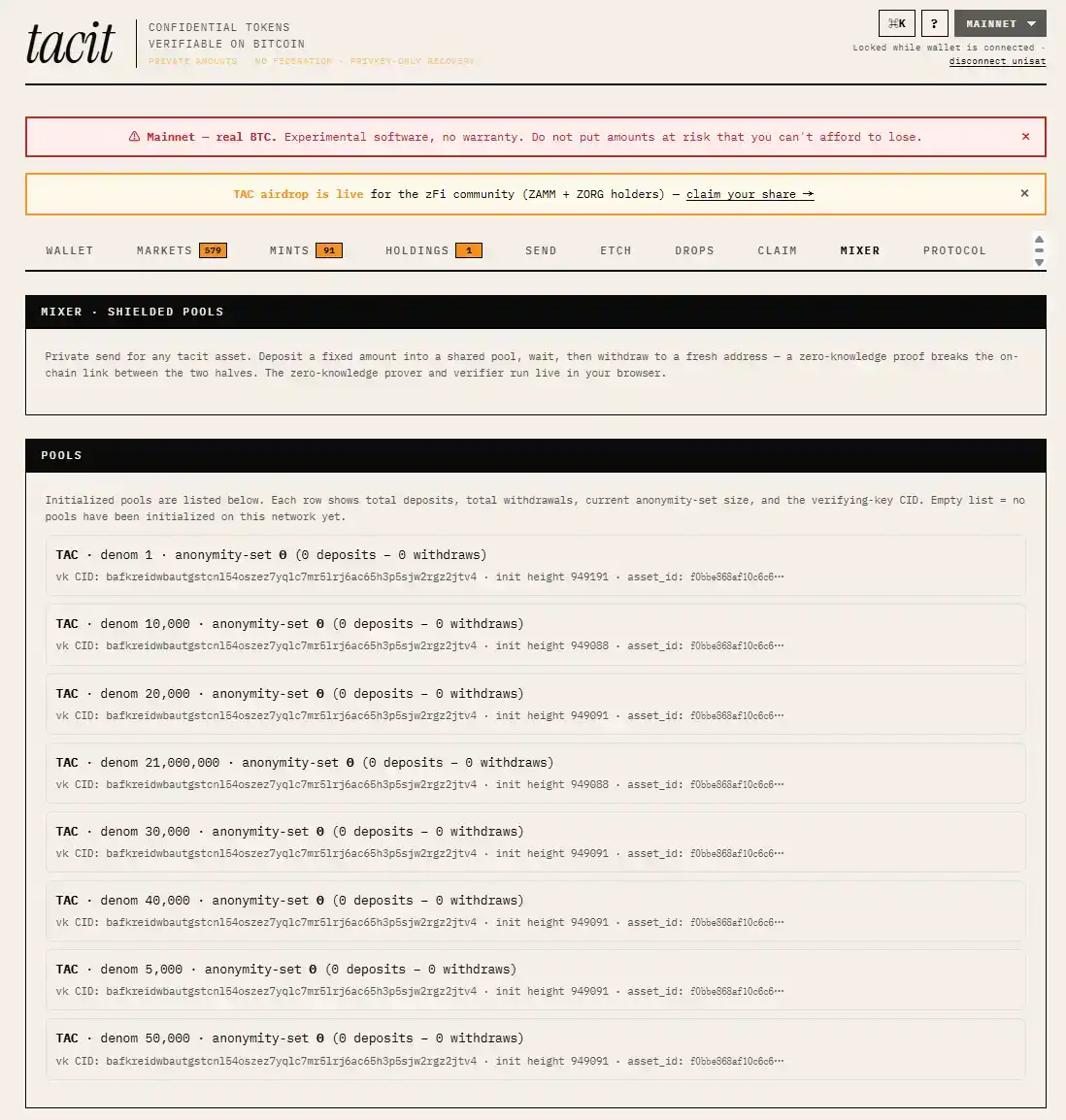
This mixer is somewhat similar to Tornado Cash—the more people deposit, the higher the privacy (harder to identify which addresses in the pool correspond). However, Tacit's mixer does not rely on smart contracts. It embeds the deposit proof in the Taproot transaction note, and the zero-knowledge proof for withdrawals is handled by the indexer in the browser.

It's even slightly stronger than Tornado Cash in some aspects because Tornado Cash cannot hide the amount being mixed. However, Tacit's mixer cannot mix native Bitcoin because hiding the mixing amount itself requires first wrapping the Bitcoin.

Of course, privacy comes at a cost. According to the GitHub documentation, due to the larger witness data required for hiding, the transfer cost corresponds to a mainnet fee rate of approximately 10 sat/vB, meaning each transfer costs about 25,000-30,000 sat, roughly 10 times the cost of a Runes transfer.

Who Built Tacit?

Developer ross.wei (@z0r0zzz) is a relatively well-known developer in the Ethereum ecosystem. He previously developed ZAMM, which uses a single contract for creating new tokens, managing LPs, farming, and swaps, significantly improving gas efficiency and user experience.

$ZAMM was also a notable project on Ethereum in the past, reaching a market cap in the tens of millions of dollars and receiving a retweet from crypto KOL Ansem.

Tacit isn't something he suddenly created on a whim; he has been interested in Bitcoin technology for a while. This new protocol has also garnered attention from Messari Enterprise Research Manager @AvgJoesCrypto.
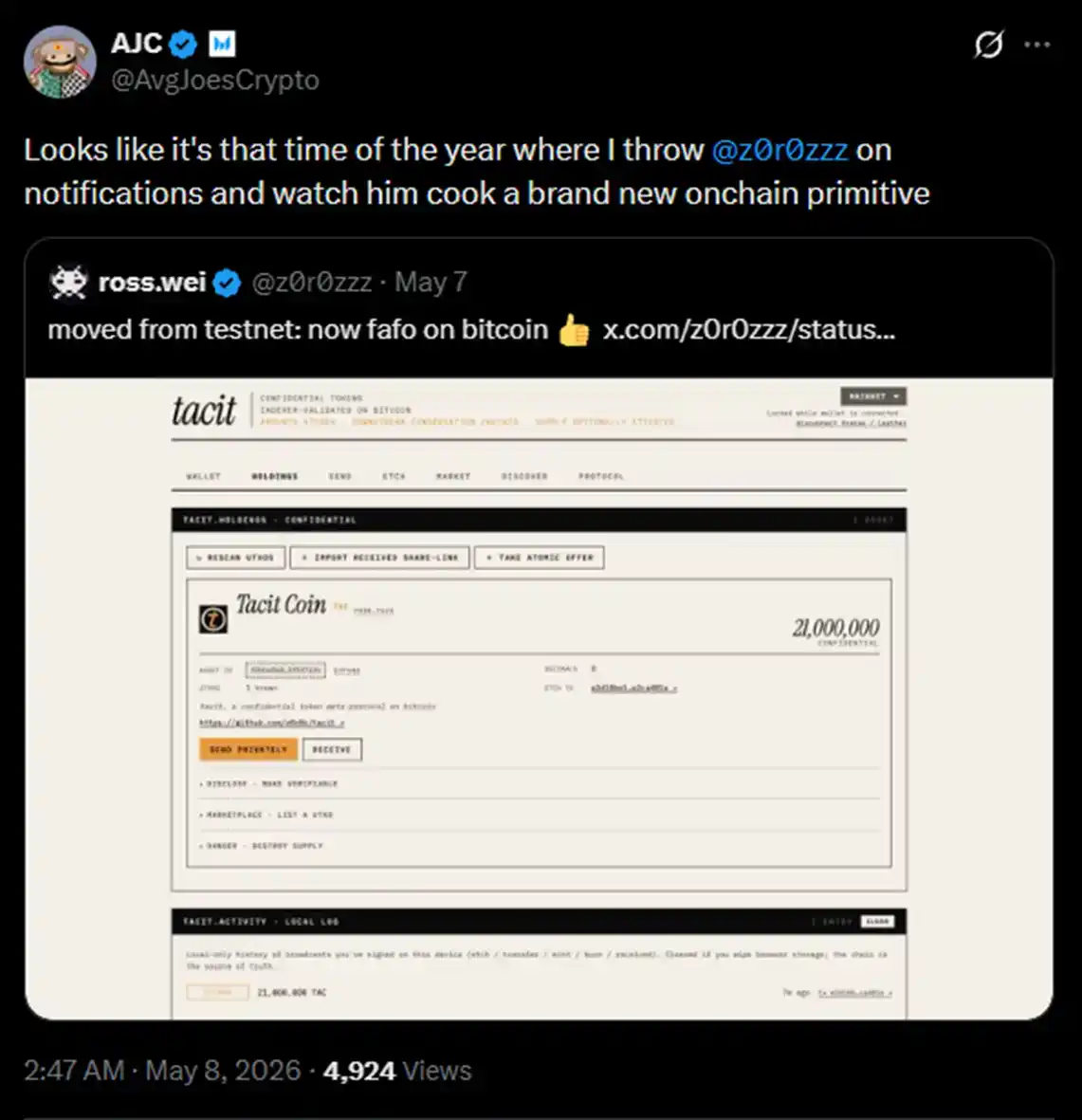
In the future, the author also plans to implement privacy-wrapped native Bitcoin (cBTC), silent receiving (generating a new one-time address for each receiving transaction), and hiding the type of currency being transferred.

Relevant Assets

Currently, the token with the highest trading volume is $TAC. This token was deployed by the protocol author himself and was airdropped not long ago based on holdings of the $ZORG staking token from the Ethereum-based $ZAMM. Its current market cap is approximately $4 million, making it the undisputed leader.

The first token launched via fair launch is $FAIR, though trading for this token is not yet available on the marketplace.

Conclusion

This is indeed an innovative Bitcoin asset protocol. Compared to BRC-20 and Runes, it has already implemented amount privacy and plans to achieve more. Compared to RGB, Taproot Assets, and Liquid CT, it doesn't rely on off-chain client-side proofs or exist as a sidechain; it operates entirely using on-chain data.

After repurposing its own protocol components to create a mixer, it has also addressed the hiding of the on-chain address graph.

Although the usage cost is relatively high, this is truly a refreshing and eye-catching innovation not seen in the Bitcoin ecosystem for a long time.


İlgili Sorular

QWhat is the main characteristic that differentiates the new Bitcoin asset protocol Tacit from protocols like BRC-20 and Runes?

ATacit is a privacy-focused Bitcoin asset protocol. Its primary differentiating characteristic is that it can hide the amount of tokens in transactions (including the total supply defined at deployment and the specific amount in each transfer), while protocols like BRC-20 and Runes have transparent ledgers. However, Tacit does not hide the direction of fund flows (i.e., the address graph).

QHow does Tacit achieve transaction amount privacy on the Bitcoin mainnet according to the article?

ATacit uses a combination of cryptographic techniques: Pedersen commitments and Bulletproofs to hide the transaction amount while proving to the network that no tokens are fraudulently created (e.g., proving amounts are non-negative and conserved). Mimblewimble-style signatures prove that the output amount equals the input amount, preventing malicious inflation. The actual amount information is encrypted using ECDH and written on-chain, decryptable only by the sender and receiver with their private keys.

QWho is the developer behind the Tacit protocol, and what is their background mentioned in the article?

AThe developer behind Tacit is ross.wei (@z0r0zzz). He is a well-known Ethereum developer who previously created ZAMM, a project that reached a multi-million dollar market cap and gained attention from crypto KOLs like Ansem. His interest in Bitcoin technology led to the development of Tacit.

QWhat is the current primary token associated with the Tacit protocol, and how was it distributed?

AThe primary token is $TAC. It was deployed by the protocol author and recently airdropped to holders of $ZORG, the staking token of the Ethereum-based $ZAMM project. Its current market capitalization is approximately $4 million.

QWhat are some of the planned future features for the Tacit protocol as mentioned in the article?

APlanned future features for Tacit include: privacy encapsulation for native Bitcoin (cBTC), silent receiving (generating a new one-time address for each incoming transaction), and hiding the type of token being transferred.

İlgili Okumalar

Blocked Its Own Treasure, WeChat AI Steps Up

Tencent's stock surged over 10% on June 2nd amid reports that WeChat, with 1.43 billion monthly users, is finalizing tests for a native AI Agent. The reported feature, accessible by swiping right from the main interface, allows users to issue commands in natural language. The AI then decomposes tasks and automatically calls upon relevant Mini Programs within WeChat to complete actions like ordering food, booking tickets, or making payments, creating a closed-loop service execution system. This strategic shift follows the internal conflict and subsequent "blocking" of Tencent's standalone AI app, Yuanbao, by WeChat for violating sharing rules during a 2026 Spring Festival promotion. The incident highlighted a lack of internal consensus and exposed the weakness of competing in the standalone AI assistant arena against rivals like ByteDance's Doubao (345M MAU) and Alibaba's Qianwen. The new WeChat AI Agent aims to leverage WeChat's unique assets—its massive user base, standardized Mini Program APIs, WeChat Pay, and identity system—to move from simple content generation to actual task execution. Analysts note this changes the competitive landscape from model benchmarks to which AI can connect to more real-world services. However, success depends on key variables: the capability of Tencent's underlying Hunyuan model, managing massive inference costs, and redesigning incentives for Mini Program developers whose traffic might be bypassed. The move is seen as an attempt to keep user service intent within WeChat's ecosystem as AI begins to redefine how users access services.

marsbit30 dk önce

Blocked Its Own Treasure, WeChat AI Steps Up

marsbit30 dk önce

ByteDance Adopts Arm CPUs, Jensen Huang: So Sad I Didn't Buy Arm

**Summary:** At Computex 2026, Arm CEO Rene Haas announced that ByteDance and Oracle have adopted Arm's self-designed Arm AGI data center CPU. The company expects significant revenue growth from this product, projecting $20 billion in demand for the 2027/2028 fiscal years. Haas noted that restricting AI-capable CPUs from the US to China is nearly impossible due to their widespread applications. Arm's stock has surged dramatically this year, notably rising 16% after NVIDIA's Arm-based Vera CPU and RTX Spark announcements. A highlight was the informal, humorous on-stage conversation between Haas and NVIDIA CEO Jensen Huang. Huang joked about NVIDIA's failed attempt to acquire Arm and playfully lamented selling his Arm shares. Both executives showed a clear sense of camaraderie and shared regret over the missed merger. Key technical topics were discussed: 1. **AI PC Design:** Huang explained NVIDIA's RTX Spark superchip (with a 20-core Arm CPU) is designed for future AI agents that will autonomously run and use tools on PCs, blending local and cloud processing. 2. **Agent vs. OS:** Huang emphasized the operating system remains crucial, as AI agents rely on its APIs and tools to function. 3. **Growth Constraints:** He identified the shift to "useful AI" that generates profitable tokens as a primary driver for immense, almost limitless, computational demand. Haas outlined Arm's strategy across PC and data centers. For PCs, Arm collaborates with partners like NVIDIA and MediaTek, offering its compute subsystem (CSS) for custom SoCs. In data centers, its Arm AGI CPU (built on TSMC's 3nm process) has gained major partners including OpenAI, Meta, and now ByteDance and Oracle. Arm presented a multi-year roadmap for its in-house CPU line. The article concludes that while GPUs dominated the AI training race, the explosion of AI agents is shifting significant focus to CPUs for inference, state management, and tool orchestration. The industry is trending towards vertical integration, with companies like cloud providers designing chips and chip/IP firms offering full solutions, all competing to deliver more efficient computing per watt.

marsbit50 dk önce

ByteDance Adopts Arm CPUs, Jensen Huang: So Sad I Didn't Buy Arm

marsbit50 dk önce

New Wall Street Play: Yen Shorts Still Adding, But Japan Stocks Don't Rely on Carry Trade Unwinding

On June 3rd, USD/JPY hit 160.44, its highest level since July 2024, while the Nikkei 225 surged past 68,000 points. Contrary to popular narratives of an imminent "carry trade unwind" akin to August 2024, data reveals a more complex picture. Speculative net short positions in yen futures have actually increased, reaching -114,667 contracts by late May, suggesting traders are doubling down rather than retreating. Meanwhile, Japan's Finance Ministry conducted its largest-ever single-round FX intervention (11.73 trillion yen) in April-May but failed to hold the 160 yen line. The Nikkei's rally is not driven by carry trade dynamics. Foreign investors are aggressively buying Japanese stocks, with net purchases in 2026 running nearly 16 times higher than 2025 levels. This inflow is concentrated in AI and semiconductor-related stocks like SoftBank and Socionext, fueled by positive sector outlooks, rather than being a flight from unwinding yen shorts. Furthermore, the Nikkei has continued climbing despite the Bank of Japan's (BOJ) rate hikes to 0.75%. This disconnect exists because the current equity boom is fueled by AI-driven foreign investment, not reliant on cheap yen funding. However, this relationship remains fragile. Should the BOJ hike rates further (e.g., to 1.0%) while dollar weakness increases carry trade costs, the trajectories of the yen and Japanese stocks could reconverge, potentially triggering volatility.

marsbit54 dk önce

New Wall Street Play: Yen Shorts Still Adding, But Japan Stocks Don't Rely on Carry Trade Unwinding

marsbit54 dk önce

Broadcom's Q3 Guidance Misses Expectations by $12 Billion, After-Hours Trading Plummets Over 13%, AI Narrative "Cooling"?

On June 3, Broadcom released record Q2 FY26 results with revenue of $22.19B, up 48% YoY, and AI chip sales of $10.8B, up 143%. Adjusted EPS of $2.44 beat estimates. However, its Q3 AI semiconductor revenue guidance of $16B, while up over 200% YoY, fell roughly $1.2B (7%) short of analyst consensus expectations of $17.2B. This miss, coupled with slightly weaker-than-expected software revenue, triggered a severe market reaction. CEO Hock Tan maintained the FY26 AI revenue outlook of over $100B but did not raise it, disappointing investors who had priced in more robust growth. The stock plummeted over 13% in after-hours trading, erasing roughly $270B in market cap. The sell-off extended to peers like Marvell. A key concern for markets, particularly for Chinese optical module suppliers, was Tan's comment that the contribution of AI networking (e.g., Ethernet switches, optical interconnect chips) to AI revenue, currently near 40%, is expected to normalize to around 30% over time, signaling a potential peak in growth for that segment. Despite the guidance shortfall, Tan reiterated that AI demand remains "insatiable" and reaffirmed the long-term target of exceeding $100B in AI revenue by FY27. The reaction highlights the heightened sensitivity and premium valuation placed on AI-exposed stocks, where anything less than stellar guidance can prompt significant profit-taking. The broader question is whether this represents a cooling AI narrative or a correction in overstretched valuations.

marsbit54 dk önce

Broadcom's Q3 Guidance Misses Expectations by $12 Billion, After-Hours Trading Plummets Over 13%, AI Narrative "Cooling"?

marsbit54 dk önce

İşlemler

Spot
Futures

Popüler Makaleler

ZEC Nasıl Satın Alınır

HTX.com’a hoş geldiniz! Zcash (ZEC) satın alma işlemlerini basit ve kullanışlı bir hâle getirdik. Adım adım açıkladığımız rehberimizi takip ederek kripto yolculuğunuza başlayın. 1. Adım: HTX Hesabınızı OluşturunHTX'te ücretsiz bir hesap açmak için e-posta adresinizi veya telefon numaranızı kullanın. Sorunsuzca kaydolun ve tüm özelliklerin kilidini açın. Hesabımı Aç2. Adım: Kripto Satın Al Bölümüne Gidin ve Ödeme Yönteminizi SeçinKredi/Banka Kartı: Visa veya Mastercard'ınızı kullanarak anında Zcash (ZEC) satın alın.Bakiye: Sorunsuz bir şekilde işlem yapmak için HTX hesap bakiyenizdeki fonları kullanın.Üçüncü Taraflar: Kullanımı kolaylaştırmak için Google Pay ve Apple Pay gibi popüler ödeme yöntemlerini ekledik.P2P: HTX'teki diğer kullanıcılarla doğrudan işlem yapın.Borsa Dışı (OTC): Yatırımcılar için kişiye özel hizmetler ve rekabetçi döviz kurları sunuyoruz.3. Adım: Zcash (ZEC) Varlıklarınızı SaklayınZcash (ZEC) satın aldıktan sonra HTX hesabınızda saklayın. Alternatif olarak, blok zinciri transferi yoluyla başka bir yere gönderebilir veya diğer kripto para birimlerini takas etmek için kullanabilirsiniz.4. Adım: Zcash (ZEC) Varlıklarınızla İşlem YapınHTX'in spot piyasasında Zcash (ZEC) ile kolayca işlemler yapın.Hesabınıza erişin, işlem çiftinizi seçin, işlemlerinizi gerçekleştirin ve gerçek zamanlı olarak izleyin. Hem yeni başlayanlar hem de deneyimli yatırımcılar için kullanıcı dostu bir deneyim sunuyoruz.

552 Toplam GörüntülenmeYayınlanma 2024.12.12Güncellenme 2026.06.02

ZEC Nasıl Satın Alınır

Tartışmalar

HTX Topluluğuna hoş geldiniz. Burada, en son platform gelişmeleri hakkında bilgi sahibi olabilir ve profesyonel piyasa görüşlerine erişebilirsiniz. Kullanıcıların ZEC (ZEC) fiyatı hakkındaki görüşleri aşağıda sunulmaktadır.

活动图片