New Paradigms and Investment Logic in the Era of AI+Web3

marsbit2026-05-21 tarihinde yayınlandı2026-05-21 tarihinde güncellendi

Özet

In the era of AI+Web3, a venture capital firm shares insights from reviewing numerous projects. The AI industry is seen as still early-stage, structured in a "seven-layer matrix" from power infrastructure to AI agents. Investment timing is crucial, especially in cyclical sectors like AI data centers. The integration of AI and Crypto is deemed essential for two reasons: 1) AI agents require "financial sovereignty" for micro, high-frequency, machine-to-machine transactions, and 2) blockchain provides trust and auditability to address AI "hallucinations" and ensure transparency. The core investment principle is "honesty." Teams must be genuine, not hastily assembled, and products must be substantiated by real metrics, not just flashy demos. Projects built on honesty are valued for long-term success over short-term hype. Looking ahead, the most underestimated opportunity for 2026 is the deep fusion of AI, blockchain, and entertainment. While most investment focuses on B2B infrastructure like payments and decentralized computing (DePIN), the future lies in consumer applications. As AI automates most human labor, society will shift towards leisure, creating massive demand for high-quality entertainment. AI can power immersive experiences (e.g., NPCs with autonomous consciousness in games), while blockchain secures digital ownership and economic systems. This convergence could unlock tremendous value in user time and capital within virtual worlds. *Disclaimer: The content represe...

In recent years, the AI concept has been everywhere, with large models and decentralized technology intertwining, creating a dizzying array of developments. As a VC firm, we have reviewed hundreds of crossover projects and want to share some hard truths — including the real cycle of the AI industry, why AI cannot do without Crypto, and what we value most and are most wary of when evaluating projects.

Note: The content of this article is excerpted from the roundtable discussion "AI+Web3-The Real Revolution" at the "AI + Bitcoin, the Next-Gen Revolution - BTC Vegas Side Event" held on April 28th.


I. The "Seven-Layer Matrix" and Investment Cycle of the AI Industry

Although giants like OpenAI, Anthropic, and Google are currently riding high and seem poised to dominate everything, our research indicates that the entire AI industry is still in a very early stage.

Being in an early stage doesn't mean one can invest blindly now, especially in overheated areas like AI hardware manufacturing, which require cooler heads. In our view, the AI industry chain can be broken down from bottom to top into seven different layers, and how to invest money in each layer is completely different:

• Layer Seven: AI Agents

• Layer Six: Token Optimization

• Layer Five: Token Distribution

• Layer Four: Large Language Models

• Layer Three: GPUs

• Layer Two: AI Data Centers

• Layer One: Power Infrastructure
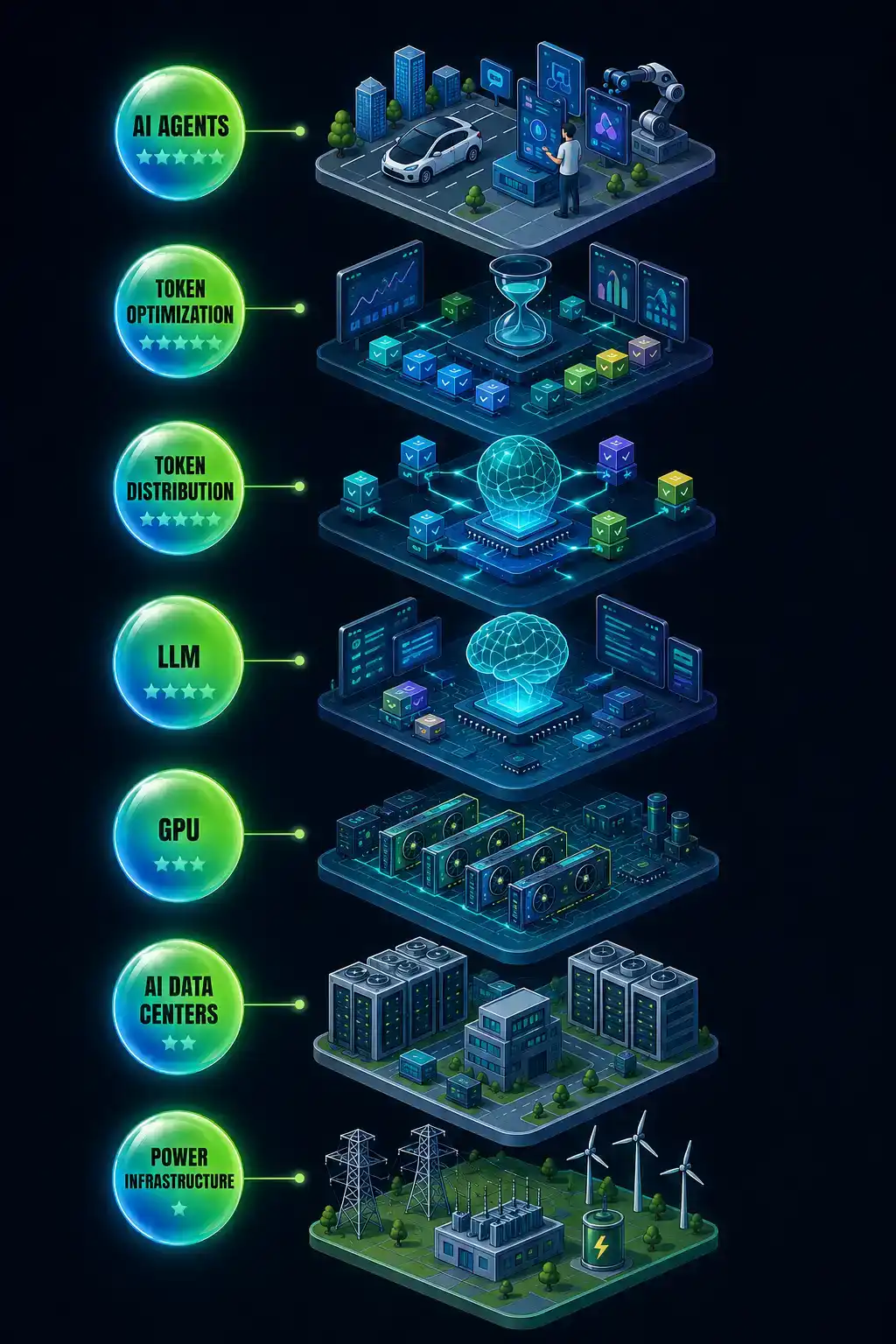
Take Layer Two, AI Data Centers, as an example. This is a typical cyclical industry. Over the past two years, global capital has been frantically buying land, building facilities, and expanding with heavy assets. However, there is a time lag between when this capacity is built, powered up, and actually brought to market. Based on our observations, this massive wave of capacity is likely to come online around 2028.

This means that if people are still single-mindedly pouring money into traditional data centers next year or even now, they will likely run headfirst into severe oversupply when everyone opens for business around 2028. Rents and returns will plummet, and capital that jumps in late will have a tough time. Therefore, aligning with the cycle and timing correctly is key.

Back in 2024, we believed there was a significant opportunity in the AI computing power layer, particularly in the crossover area of using Web3 methods for computing power scheduling. So, we focused a lot of effort and capital there. Currently, an AI computing power infrastructure company in which we are a major shareholder is in the final stages of preparing for a Nasdaq listing.

II. Why Are AI and Crypto Inseparable?

Many people often ask: Why does AI need Crypto when Web2's large models are already so powerful? In our view, this is not a forced concept mashup. Rather, there are two things that traditional Web2 cannot solve as AI advances:

1. In the Near Term: Payment — AI Agents Need Their Own "Financial Sovereignty"

Traditional bank cards, PayPal, or gateway payments are all designed for "humans," with an extremely cumbersome identity verification and centralized settlement process. But the transaction model for future AI Agents collaborating with each other is completely different.

Their interactions often involve extremely micro-amounts (e.g., spending $0.0001 to buy a few seconds of computing power), ultra-high frequency, and continuous transactions. If they go through traditional channels like Visa, the fees could exceed the transaction amount. More importantly is the issue of "payment sovereignty": AI Agents have autonomous execution capabilities. As they evolve to a certain level, they will inevitably need to own and have absolute control over their own wallet accounts, rather than forever relying on human physical bank cards or worrying about having their API accounts shut down by centralized giants at any moment. Cryptocurrency payments on the blockchain are currently the only technological means that allows machines to settle autonomously with each other.

2. In the Long Term: Trust — Guarding Against Hallucinations and Credible Audits

Everyone using large models now knows they sometimes fabricate things, the so-called "hallucination rate." In the traditional Web2 black box, when an AI provides a wrong or biased answer, it's difficult for humans to investigate: Is this a random technical hallucination, or is the centralized giant behind it intentionally manipulating the algorithm, poisoning data, or deceiving people?

This creates a hard need for blockchain. Pushing key AI operational data, prompt records, and call paths onto the chain in real-time can create an immutable, traceable, and auditable evidence storage system. This isn't just about defining data property rights; it's a reliable path for humans to supervise and verify whether AI behavior is compliant in the future.

III. Investing in Projects: Using "Honesty" as the Measuring Stick

Every year, we see thousands of business plans for AI + Web3. After reviewing so many stories, the core screening principle we've settled on is actually just two words: Honesty. This sounds like simple common sense, but in the current浮躁 industry, it might be the rarest quality. We break down honesty into two levels:

1. The Team Must Be Honest — Reject Packaging and Patchwork

The resumes of founders and core teams must have no falsification or excessive boasting. In the industry today, we often see hastily assembled teams. To catch a bull market or chase a trend, they forcefully slap together labels like "big company scientist" or "prestigious school background," but there's zero internal team chemistry. Such projects often fall apart at the first sign of a technical bottleneck or market adjustment. A team that can truly succeed needs complementary skills, and the founder's background must be genuine — someone who is earnest about building something.

2. The Product Must Be Honest — Reject PPT-Driven Hype and False Metrics

What a product can actually achieve, how its user data looks — these must be supported by tangible underlying metrics like code and node counts. We've seen too many projects that simply wrap an OpenAI API on the frontend, change the interface, and then dare to claim in their PPT that they are an "autonomous native large model," using a fake demo to fool investors. On the product level, one must be realistic, able to genuinely solve problems.

In the capital markets, dishonest projects driven by hype and fabrication might, in the short term, inflate their valuations highly in secondary markets or exchanges through fancy financial engineering. But because there's no real underlying business supporting them, once the bubble bursts, their ultimate fate is inevitably to go to zero.

Conversely, projects that work diligently and honestly might seem slower initially because they disdain hype and fraud, perhaps even appearing a bit笨 in the eyes of some speculative capital. But because they have a solid foundation, they can often go the distance. In investing, slow is fast. These long-lasting projects are the ones we are willing to invest in and support strategically.

IV. The Most Underestimated Opportunity in 2026: The Ultimate Fusion of AI + Blockchain + Entertainment

Finally, regarding future opportunities that everyone hasn't yet noticed or that are severely underestimated. Based on our research, what we're most excited about is actually the deep integration of AI + Blockchain + Entertainment.

Currently, most market capital is focused on relatively hardcore, dry B2B infrastructure like AI payments and decentralized computing (DePIN). These tracks are important, but the competition is too fierce. People are overlooking the consumer end, which is best at attracting mass users and retaining capital.

Our observation and logic are as follows: As large models and Agents mature, AI, as an efficient labor force, will inevitably replace the vast majority of repetitive white-collar and blue-collar human jobs in the future. When productivity becomes extremely abundant and material costs are extremely low, human society will undergo a fundamental transformation — most people won't need to work forced jobs just to make ends meet. At that time, the demand for吃喝玩乐 will explode. Where will human time and energy go? High-quality entertainment is an inevitable destination.

Future entertainment should fully integrate AI.

Take gaming as an example. Every NPC in the game could have autonomous consciousness, with their own memories, personalities, and social relationships. When players enter the game, they no longer face a repeater bot, but a "living person" who develops emotions based on your actions and words, and might even spontaneously conduct transactions with you on-chain. The integration of AI will lead to a qualitative leap in the freedom and enjoyment of games.

And blockchain's role here is "property rights": it defines land ownership, the uniqueness of rare items in this virtual world, and uses Tokens to establish economic order.

When people no longer need to work in reality and pour a large amount of time, energy, and even assets into such a fun, AI-driven virtual world where assets belong to the players themselves, the commercial value unleashed within will be terrifying. We are currently actively looking for pioneers in this direction. This could be the next narrative that ignites the entire industry.

Disclaimer: The content of this report represents only the author's and the institution's industry research views. It is intended for industry discussion only and does not constitute any investment advice.


İlgili Sorular

QAccording to the article, what are the seven layers of the AI industry from bottom to top, and which layer is considered a typical cyclical industry?

AAccording to the article, the seven layers of the AI industry from bottom to top are: First layer: Power infrastructure; Second layer: AI data centers; Third layer: GPU; Fourth layer: Large language models; Fifth layer: Token distribution; Sixth layer: Token optimization; Seventh layer: AI agents. The second layer, AI data centers, is identified as a typical cyclical industry, with concerns about a potential supply glut around 2028 due to a time lag in bringing new capacity online.

QThe article argues that AI and Crypto are inseparable. What are the two key reasons provided for this, focusing on immediate and long-term needs?

AThe article provides two key reasons why AI and Crypto are inseparable. The immediate need is for payments: AI Agents require their own 'financial sovereignty' for micro, high-frequency, continuous transactions between machines, which traditional payment systems are ill-suited for. The long-term need is for trust: Blockchain provides a solution for auditing and verification, creating an immutable record to track AI data, prompts, and execution paths. This helps distinguish between technical 'hallucinations' and potential deliberate manipulation by centralized entities, ensuring accountability.

QWhat is the core principle the VC firm uses to filter AI+Web3 projects, and how is this principle broken down into two specific aspects?

AThe core principle the VC firm uses to filter AI+Web3 projects is 'honesty'. This principle is broken down into two specific aspects: 1. Team Honesty: Rejecting packaging and fabrication. Founders and core teams must have genuine, non-exaggerated backgrounds, and the team must be cohesive rather than hastily assembled. 2. Product Honesty: Rejecting PPT-driven pitches and fake metrics. The product's capabilities must be supported by real underlying code, node counts, and other tangible indicators, not just superficial demos built on third-party APIs.

QWhat future opportunity does the article identify as the most underestimated for 2026, and what is the core logic behind this prediction?

AThe article identifies 'AI + blockchain + entertainment deep fusion' as the most underestimated opportunity for 2026. The core logic is that as AI matures and automates most repetitive human labor, society will shift towards a post-scarcity model where basic needs are met. Consequently, human time and energy will increasingly flow towards high-quality entertainment. The fusion of AI (to create dynamic, intelligent game worlds and NPCs), blockchain (to establish ownership and economic order for virtual assets), and entertainment will unlock massive commercial value as people invest their time and assets into these immersive, player-owned virtual worlds.

QIn the context of AI Agent payments, what specific problem does blockchain-based cryptocurrency solve that traditional payment systems cannot?

ABlockchain-based cryptocurrency solves the problem of enabling autonomous, micro-value, and high-frequency transactions between AI Agents. Traditional payment systems like Visa, PayPal, or bank cards are designed for humans, involving cumbersome identity verification and centralized清算 (settlement) processes with high relative fees for tiny transactions. Cryptocurrency allows machines to have their own sovereign wallets, enabling direct, efficient, and permissionless清算 between agents without relying on human-controlled accounts or facing risks like API bans from centralized platforms.

İlgili Okumalar

Seeking Alpha's Hot Article: Why Might the U.S. Stock Market Crash in June?

In a recent Seeking Alpha article, financial professor and analyst Damir Tokic argues that the US stock market may be poised for a significant crash in June 2026. The core thesis centers on a "mega-bubble" in equities, particularly within the technology sector, which has driven the S&P 500 to near-record valuations, with a Shiller P/E ratio exceeding 40—a level comparable to the 2000 dot-com bubble. Tokic identifies two primary catalysts for a potential collapse. First, he points to unsustainable market exuberance fueled by what he terms the "Trump Stimulus"—massive AI capital expenditure by tech giants, which he believes is politically driven and cannot last. Second, and more urgently, he highlights the escalating Iran war as a critical threat. The ongoing closure of the Strait of Hormuz has created a severe global energy supply crunch. Strategic petroleum reserves are projected to hit critically low operational levels by June, potentially causing oil prices to spike above $200 per barrel and triggering a severe, supply-driven inflationary shock. This scenario, Tokic warns, would force the Federal Reserve's hand. Despite currently maintaining a dovish bias, the Fed would likely be compelled to officially pivot to a hawkish stance at its June FOMC meeting to combat soaring inflation and bond yields. He contends that such a shift—or even a failure to act, which would destroy Fed credibility—could be the trigger that punctures the market bubble. The resulting downturn, he concludes, could rival the bear markets of 2000 and 2008, advising investors to prepare for a major correction.

marsbit16 dk önce

Seeking Alpha's Hot Article: Why Might the U.S. Stock Market Crash in June?

marsbit16 dk önce

AI PC Battle: Bet on the Toll Booth, Not the Camp

**Title:** The AI PC Battle: Don't Bet on Sides, Bet on the Tollbooth **Summary:** The AI PC competition is moving beyond simple "x86 vs. Arm" narratives. The core investment thesis should focus on identifying which players can sustain margins, cash flow, and pricing power throughout the upgrade cycle, rather than backing a particular architecture. The opportunity is analyzed in three layers: 1. **The Advanced Foundry Tollbooth:** TSMC is positioned to collect "tolls" regardless of which chip designer wins, due to its dominant ~70% share in advanced semiconductor manufacturing, which is essential for high-end AI PC chips. 2. **Compute & Platform Spillover:** AMD represents an offensive in the x86 CPU+GPU space, while NVIDIA leverages its GPU and CUDA software stack dominance. Both benefit from the demand for increased local AI compute. 3. **Architecture Diffusion & Turnaround Plays:** ARM and Intel offer potential for significant upside (elasticity), but investments here require stricter discipline due to higher execution risks and competitive challenges. The industry is transitioning from concept to shipment validation. While short-term forecasts for AI PC adoption have been revised down slightly due to tariffs and procurement delays, the long-term trend towards AI becoming a standard PC feature remains intact. The key driver for upgrade cycles will be whether compelling enterprise applications (e.g., privacy-sensitive computing, low-latency inference) emerge beyond consumer-focused features like meeting summarization. Investment strategy should prioritize companies with platform-level advantages and recurring revenue streams. TSMC offers high certainty as the foundational tollbooth. AMD presents a strong offensive play within the established ecosystem. ARM and Intel are higher-risk, higher-potential-reward turnaround bets. The report cautions against chasing short-term hype and emphasizes a disciplined, long-term approach focused on buying ecosystem strength and cash-flow certainty after market enthusiasm subsides. **Key Risks:** Underwhelming AI PC applications slowing upgrade cycles; slow improvement in Windows on Arm compatibility; macro/tariff impacts on PC demand; potential advanced node supply-demand mismatches affecting TSMC; high overall AI sector valuations making stocks vulnerable to a risk-off shift in markets.

marsbit31 dk önce

AI PC Battle: Bet on the Toll Booth, Not the Camp

marsbit31 dk önce

Ten-Thousand-Word Analysis: From $10 to $290, MRVL Wins the Entire AI Era by 'Not Making GPUs'

Marvell Technology's stock price surged from under $10 in 2016 to a record $290 in June 2026, fueled not by making GPUs, but by dominating AI infrastructure connectivity. This analysis argues the market misvalues MRVL as merely a smaller Broadcom in custom AI chips, overlooking its true, unique position. Marvell's core strength lies in enabling high-speed data flow for AI clusters through three interconnected businesses. First, it holds a commanding ~70% market share in high-speed optical DSPs (essential for data center light modules), a deep-moat business with accelerating growth. Second, its custom AI chip design business serves hyperscalers like AWS, Microsoft, and Google, with a significant revenue pipeline despite lower margins. Third, stable cash flows come from Ethernet switch chips and enterprise storage controllers. Together, they form a full-stack "AI data movement" platform. CEO Matt Murphy's transformative leadership since 2016, involving strategic divestments, key acquisitions (like Inphi for optical DSPs), and securing long-term agreements with major cloud providers, repositioned the company. A pivotal $2 billion strategic investment from NVIDIA in 2026 underscored Marvell's critical role in the AI ecosystem, particularly through collaborations like NVLink Fusion. While Marvell faces risks—including client concentration (losing the Amazon Trainium3 design), lower-margin business mix, competitive threats, insider selling, and complex supply chains—its fundamentals remain strong. The optical interconnect moat is widening with the acquisition of Celestial AI (photonics fabric), and financial metrics show accelerating revenue growth and operating leverage. With a PEG ratio suggesting undervaluation relative to its growth, the thesis is that the market undervalues Marvell's monopolistic position in AI "plumbing" while overemphasizing its competitive custom chip segment. The story transcends investing, symbolizing how in any complex system—from the internet to AI—the value of "connection" ultimately surpasses that of individual "nodes."

marsbit1 saat önce

Ten-Thousand-Word Analysis: From $10 to $290, MRVL Wins the Entire AI Era by 'Not Making GPUs'

marsbit1 saat önce

AI Relay Stations Spark Heated Debate on Zhihu: Behind Cheap Tokens, What Are Users Really Worried About?

A discussion on Zhihu about "AI relay stations" shifted the niche developer topic of "cheap tokens" into broader user awareness. Users moved beyond simply questioning the legitimacy of these services to focus on practical concerns: Where do cheap tokens truly come from? Is the model being accessed the real one? Can relay stations see prompts, code, and API keys? For occasional users, are the risks worth it? The core debate centered less on price and more on trust. A primary worry is model authenticity—the risk of "model swapping," where users paying for a premium model might be routed to a cheaper one, creating an information asymmetry. Others argued that cost comparisons matter; while cheaper than official pay-as-you-go APIs, relay stations may not be the lowest-cost option versus subscriptions, domestic models, or free tiers, making user needs assessment crucial. Speculation about token sources ranged from legitimate bulk discounts to gray-area methods like account sharing or exploiting regional pricing. This opacity makes risk assessment difficult for users. Data security emerged as a critical concern, especially for enterprise use. When processing sensitive information like code, contracts, or client data, the inability to verify a relay station's data handling, retention, or access policies poses significant compliance and confidentiality risks. The evolving consensus suggests relay stations can be used cautiously for low-sensitivity, disposable tasks (e.g., summarizing public info, simple translation). However, they should not be the default for sensitive, professional, or production workflows involving proprietary data, Agents, or automated systems. Recommendations include avoiding large prepayments, not relying on a single service, using test prompts to monitor quality, anonymizing data where possible, and keeping official channels as backups. Ultimately, the discussion framed tokens not just as a billing unit but as a measure of real cost encompassing price, model integrity, data security, and service stability. The popularity of relay stations highlights user demand for affordable access, but the debate underscores a key trade-off: the savings from cheap tokens may come at the price of trust, transparency, and control over one's data and AI experience.

marsbit1 saat önce

AI Relay Stations Spark Heated Debate on Zhihu: Behind Cheap Tokens, What Are Users Really Worried About?

marsbit1 saat önce

İşlemler

Spot
Futures

Popüler Makaleler

ERA Nasıl Satın Alınır

HTX.com’a hoş geldiniz! Caldera (ERA) satın alma işlemlerini basit ve kullanışlı bir hâle getirdik. Adım adım açıkladığımız rehberimizi takip ederek kripto yolculuğunuza başlayın. 1. Adım: HTX Hesabınızı OluşturunHTX'te ücretsiz bir hesap açmak için e-posta adresinizi veya telefon numaranızı kullanın. Sorunsuzca kaydolun ve tüm özelliklerin kilidini açın. Hesabımı Aç2. Adım: Kripto Satın Al Bölümüne Gidin ve Ödeme Yönteminizi SeçinKredi/Banka Kartı: Visa veya Mastercard'ınızı kullanarak anında Caldera (ERA) satın alın.Bakiye: Sorunsuz bir şekilde işlem yapmak için HTX hesap bakiyenizdeki fonları kullanın.Üçüncü Taraflar: Kullanımı kolaylaştırmak için Google Pay ve Apple Pay gibi popüler ödeme yöntemlerini ekledik.P2P: HTX'teki diğer kullanıcılarla doğrudan işlem yapın.Borsa Dışı (OTC): Yatırımcılar için kişiye özel hizmetler ve rekabetçi döviz kurları sunuyoruz.3. Adım: Caldera (ERA) Varlıklarınızı SaklayınCaldera (ERA) satın aldıktan sonra HTX hesabınızda saklayın. Alternatif olarak, blok zinciri transferi yoluyla başka bir yere gönderebilir veya diğer kripto para birimlerini takas etmek için kullanabilirsiniz.4. Adım: Caldera (ERA) Varlıklarınızla İşlem YapınHTX'in spot piyasasında Caldera (ERA) ile kolayca işlemler yapın.Hesabınıza erişin, işlem çiftinizi seçin, işlemlerinizi gerçekleştirin ve gerçek zamanlı olarak izleyin. Hem yeni başlayanlar hem de deneyimli yatırımcılar için kullanıcı dostu bir deneyim sunuyoruz.

475 Toplam GörüntülenmeYayınlanma 2025.07.17Güncellenme 2026.06.02

ERA Nasıl Satın Alınır

Tartışmalar

HTX Topluluğuna hoş geldiniz. Burada, en son platform gelişmeleri hakkında bilgi sahibi olabilir ve profesyonel piyasa görüşlerine erişebilirsiniz. Kullanıcıların ERA (ERA) fiyatı hakkındaki görüşleri aşağıda sunulmaktadır.

活动图片