New Coinbase report points to ‘broken’ traditional finance system: Armstrong

cointelegraph2025-12-17 tarihinde yayınlandı2025-12-17 tarihinde güncellendi

Özet

Coinbase CEO Brian Armstrong states that the traditional financial system is broken, pushing younger investors toward alternative assets like crypto. According to Coinbase’s "State of Crypto" report, Gen Z and millennial investors allocate 25% of their portfolios to non-traditional assets—three times more than older generations. They trade more frequently, use higher-risk strategies like margin trading, and show strong interest in 24/7 markets and crypto derivatives. Nearly 75% believe it's harder to build wealth through traditional means, and many see crypto as a key opportunity. They also rely more on self-directed research and social media for investment cues rather than traditional advisors.

Coinbase CEO Brian Armstrong says we already know the traditional financial system is broken. Younger people increasingly feel “locked out of the old wealth ladder,” and seek alternative assets like crypto.

The numbers in Coinbase’s latest “State of Crypto” report back him up. The study, run by Ipsos in the fourth quarter, finds Gen Z and millennial investors are trading more often, taking more risk, and putting a much bigger slice of their portfolios into crypto and other non‐traditional assets than older generations.​

Portfolio allocation and trading behavior

The survey of 4,350 US adults shows stock ownership is roughly the same across age groups (47% of younger investors versus 50% of older ones), but portfolio composition looks radically different.

Related: Standard Chartered, Coinbase deepen alliance to build institutional crypto infrastructure

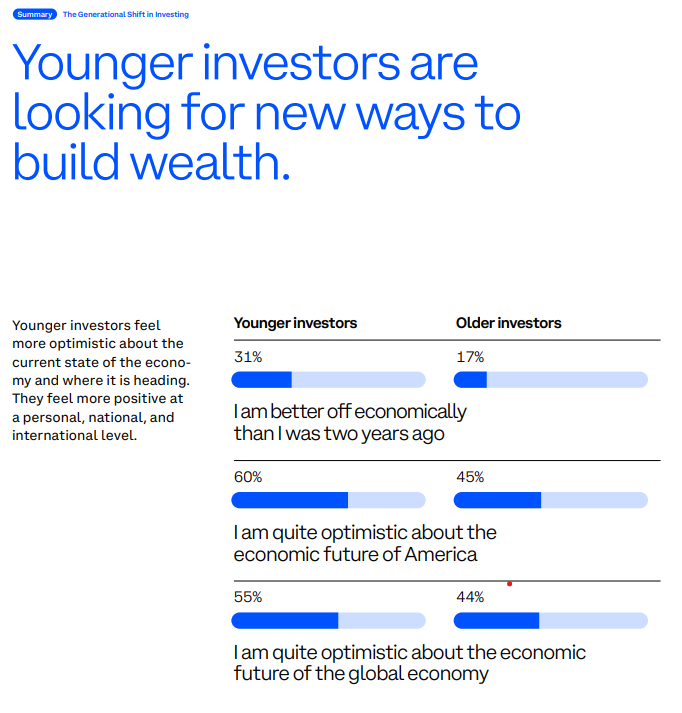
Younger investors say 25% of their holdings sit in non‐traditional assets such as crypto, derivatives, and private investments, three times the 8% reported by older investors, or boomers.

Four in five younger respondents say they’re willing to try new investment opportunities before others do, and 84% say they want platforms that offer a wider range of assets beyond traditional stocks.​

Younger investors seek new ways to build wealth. Source: Coinbase

Trading behavior is diverging just as sharply. Nearly 3 in 10 younger investors say they make a trade at least once a week, compared with 10% of older investors.

They are also far more likely to lean on high‐octane strategies. Of the respondents, 19% report using margin to boost upside, versus 8% of older investors, while 26% say they seek higher returns via high‐risk investments, compared with 18% among older cohorts.

Demand for “always‐on” markets is clear as well, with 63% of younger investors expressing interest in 24/7 stock market access, alongside strong interest in crypto derivatives, leverage, and DeFi lending.​

Related: The next era of crypto belongs to decentralized markets

Upside outside legacy channels

The report suggests this is as much about access as attitude. Almost three‐quarters of younger adults (73%) believe it is harder for their generation to build wealth through traditional means, compared with 57% of older respondents.

While 47% of younger investors own stocks, they are twice as likely as older investors to already own crypto, and 4 in 5 agree that cryptocurrency gives their generation more financial opportunities than they would otherwise have.

Around 70% say they personally know someone who has made “a lot of money” trading crypto, reinforcing the sense that upside lies outside legacy channels.​

Related: Etsy witches can apparently turn you into a crypto millionaire for $73

A rise in copy and social trading

Where they get their cues from is shifting, too. Younger investors are much more likely to describe themselves as self‐directed, to trust their own research over a traditional adviser, and to look to TikTok, Reddit, YouTube, podcasts, and friends for ideas rather than just financial planners.

Two‐thirds say they would engage in copy or social trading on friends’ or prominent traders’ accounts if they could, versus less than a third of older investors.​

Armstrong framed the findings as evidence that the existing system “isn’t working” for the youth and they are gravitating toward non‐traditional assets because those are the only venues that match their expectations for access and upside.

For product builders, the data points to a future where risk‐tiered offerings and round‐the‐clock markets will be central to serving the next generation of retail investors.


İlgili Okumalar

TechFlow Intelligence Bureau: Chip Stocks Lose Trillions in a Single Day, Bitcoin Falls Below $60,000, US-Iran Conflict Escalates

**Daily Tech & Markets Roundup: AI Advances, Market Turmoil, and Geopolitical Tensions** **AI / LLMs**: Anthropic's internal report on AI self-improvement sparked serious discussions about Recursive Self-Improvement (RSI). Meanwhile, debate continues on AI coding tools after Claude was accused of introducing bugs into the rsync codebase. In positive news, DeepSeek V4 Flash impressed in local deployment tests, and GitHub Copilot now supports custom endpoints for local models. A surprising research turn suggests removing chain-of-thought prompting can sometimes improve LLM performance. **Crypto / Web3**: Bitcoin plunged below $60,000, with its RSI hitting levels last seen during the COVID-19 crash, driven by strong U.S. jobs data reviving interest rate hike fears. Discussions highlight Ethereum DeFi's continued lack of a smooth consumer payment layer. **Chips / Hardware**: Chip stocks suffered a massive sell-off, with the Philadelphia Semiconductor Index posting its worst single-day drop in six years, erasing over a trillion dollars in value. Marvell, Micron, AMD, and Intel were among the biggest losers. **Tech Companies**: A leaked Microsoft document revealing goals to make Copilot "addictive" drew criticism. LinkedIn founder Reid Hoffman left Microsoft's board to focus full-time on his AI agent startup, Manus. Google was revealed to be paying SpaceX $920 million monthly for AI training compute. **Markets & Macro**: A blowout U.S. jobs report (172k vs. 80k expected) crushed hopes for near-term rate cuts, sending Treasury yields soaring and triggering a broad market sell-off. CEOs from Kraft, McDonald's, and Whirlpool simultaneously warned U.S. consumers are exhausting their savings. **Geopolitics**: U.S.-Iran tensions escalated with missile/drone interceptions and U.S. strikes on Iranian radar sites, keeping the critical Strait of Hormuz largely closed since late February and posing ongoing oil supply risks. **The Bottom Line**: The strong jobs data acted as a single trigger for correlated sell-offs across equities, crypto, and chips. Underlying the volatility is a stark contradiction between robust employment data and warnings of consumer weakness, alongside geopolitical risks that could reignite inflation, leaving markets to price in a fraught macro outlook with no clear "soft landing" path.

marsbit2 saat önce

TechFlow Intelligence Bureau: Chip Stocks Lose Trillions in a Single Day, Bitcoin Falls Below $60,000, US-Iran Conflict Escalates

marsbit2 saat önce

It Took Me a Year to See the Bitter Truth About Agent Payments

After a year building infrastructure for the Agent economy, engaging with major players like Stripe, Visa, and Coinbase, the author shares a sobering analysis of the current state of Agent payments. The core finding is a stark lack of genuine, immediate demand across most envisioned use cases. The article breaks down four key market segments: 1. **Agent-to-Merchant (Consumer Shopping):** For most product categories (e.g., clothing, electronics), conversational AI shopping is a step backwards from visual e-commerce interfaces. While agents excel at understanding needs, they can't replace side-by-side product comparison. Real merchant interest is defensive "Agent Engine Optimization," not driven by current customer demand. Potential exists for high-frequency, low-decision purchases (like food delivery) or navigating complex store UIs, but these require massive B2C distribution channels dominated by giants like Amazon. 2. **Agent-to-API (Developer Services):** Developers already have subscriptions and billing relationships for APIs (compute, data). Prepaid balances solve micro-payment issues for low transaction volumes. A deeper structural problem is that major SaaS vendors' business models rely on enterprise contracts, resisting granular pay-per-call pricing. While protocols like MPP and x402 serve the long tail of niche services, this market is small and developers are historically low-willingness-to-pay. 3. **Agent-to-Agent:** This remains largely theoretical with minimal transaction volume. While it represents a long-term bet on a fundamentally new transaction infrastructure (sub-second, micro-penny to million-dollar, multi-party settlements), it does not constitute a present market. 4. **Agent-to-Finance:** This is the only category with existing, paying demand. Integrating AI into financial workflows (trading, portfolio management) is a natural evolution and enables new capabilities like autonomous rebalancing. However, competition favors established, regulated institutions. The "real problem" is not moving money between agents, but the broader challenge of **coordination**—orchestrating work between agents and humans, verifying outcomes, and settling results. Payment is just one component of settlement, which is itself part of coordination. Companies that solve the coordination layer will subsume payment, not the other way around. While well-funded incumbents build defensively for a long-term future, startups must find where the market is today—which, for the author's team, lies outside these four categories in an area of real, growing, and underserved activity.

marsbit3 saat önce

It Took Me a Year to See the Bitter Truth About Agent Payments

marsbit3 saat önce

It Took Me a Year to See the Hard Truth About Agent Payments

**Title: It Took Me a Year to See the Hard Truth About Agent Payments** Over the past year, I've worked on infrastructure for the Agent economy, engaging with major players like Stripe, Visa, Coinbase, and numerous startups. The findings reveal a stark reality: genuine, widespread demand for Agent-based payments does not yet exist. **Key Observations:** * **Agent-to-Merchant (Shopping):** The user experience for AI shopping often falls short, especially for visual product discovery. While AI excels at understanding needs, conversational interfaces can't yet replace browsing and comparing multiple products visually. Current merchant interest is largely defensive ("Agent Engine Optimization") for a future that hasn't arrived. High-frequency, low-friction purchases (like food delivery) are potential fits, but lack open APIs and face high AI inference costs. Simpler, more affordable, or cross-language interactions for complex UIs are a niche opportunity but require massive consumer distribution to scale. * **Agent-to-API (Developer Tools):** Developer payment needs for APIs (computing, data, models) are already met through subscriptions and prepaid credits. The core challenge is not payment friction but supplier economics: most large SaaS providers prefer enterprise contracts over micropayments for API calls. Protocols like MPP and x402 suit the long-tail of smaller services but cater to a developer market historically reluctant to pay for these tools. Major infrastructure needs at the top of the stack are already being addressed. * **Agent-to-Agent (Machine Commerce):** This is a long-term vision with almost no current transaction volume. While a future with high-speed, high-frequency, multi-party machine-to-machine transactions would require novel infrastructure, it remains theoretical. The market is not here yet. * **Agent-to-Finance:** This is the only category with clear, present demand. Financial professionals and DeFi users already pay for tools, and AI augmentation is a natural evolution. Autonomous AI agents can enable entirely new financial strategies. However, competition is fierce from established, regulated incumbents who can more easily layer AI onto their existing products. **The Core Insight:** Companies, especially giants with long time horizons, are building defensively for a potential future of mass machine commerce. For them, early investment is a low-cost hedge. For startups, the current market reality is different. The primary challenge isn't just moving money between agents (payments). The larger, unsolved problem is **orchestration** – coordinating work between agents and humans, verifying outcomes, and then settling. Payment is just a part of settlement, which is just a part of orchestration. Companies that solve the orchestration problem will subsume payments, not the other way around. After a year of building, we see the real, growing, and underserved market opportunity lies in this broader domain of orchestration.

链捕手3 saat önce

It Took Me a Year to See the Hard Truth About Agent Payments

链捕手3 saat önce

İşlemler

Spot
Futures

Popüler Makaleler

G Nasıl Satın Alınır

HTX.com’a hoş geldiniz! Gravity (G) satın alma işlemlerini basit ve kullanışlı bir hâle getirdik. Adım adım açıkladığımız rehberimizi takip ederek kripto yolculuğunuza başlayın. 1. Adım: HTX Hesabınızı OluşturunHTX'te ücretsiz bir hesap açmak için e-posta adresinizi veya telefon numaranızı kullanın. Sorunsuzca kaydolun ve tüm özelliklerin kilidini açın. Hesabımı Aç2. Adım: Kripto Satın Al Bölümüne Gidin ve Ödeme Yönteminizi SeçinKredi/Banka Kartı: Visa veya Mastercard'ınızı kullanarak anında Gravity (G) satın alın.Bakiye: Sorunsuz bir şekilde işlem yapmak için HTX hesap bakiyenizdeki fonları kullanın.Üçüncü Taraflar: Kullanımı kolaylaştırmak için Google Pay ve Apple Pay gibi popüler ödeme yöntemlerini ekledik.P2P: HTX'teki diğer kullanıcılarla doğrudan işlem yapın.Borsa Dışı (OTC): Yatırımcılar için kişiye özel hizmetler ve rekabetçi döviz kurları sunuyoruz.3. Adım: Gravity (G) Varlıklarınızı SaklayınGravity (G) satın aldıktan sonra HTX hesabınızda saklayın. Alternatif olarak, blok zinciri transferi yoluyla başka bir yere gönderebilir veya diğer kripto para birimlerini takas etmek için kullanabilirsiniz.4. Adım: Gravity (G) Varlıklarınızla İşlem YapınHTX'in spot piyasasında Gravity (G) ile kolayca işlemler yapın.Hesabınıza erişin, işlem çiftinizi seçin, işlemlerinizi gerçekleştirin ve gerçek zamanlı olarak izleyin. Hem yeni başlayanlar hem de deneyimli yatırımcılar için kullanıcı dostu bir deneyim sunuyoruz.

451 Toplam GörüntülenmeYayınlanma 2024.12.10Güncellenme 2026.06.02

G Nasıl Satın Alınır

@G Nedir

Graphite Ağı, $@G: Geleneksel Finans ve Web3 Arasında Köprü Kurma Graphite Ağı, $@G'ye Giriş Kripto para birimleri ve web3 projeleriyle dolu canlı dünyada, Graphite Ağı yeniliğin bir simgesi olarak ortaya çıkıyor. Yerel token'ı $@G ile bu Katman-1, Yetki Kanıtı (PoA) blok zinciri, geleneksel finans (TradFi) ile hızla gelişen Web3 ekosistemi arasındaki boşluğu kapatmak için tasarlanmıştır. Dijital para birimleri popülerlik kazandıkça, Graphite Ağı güvenlik, uyum ve hız önceliği olan bir blok zinciri platformu sunmayı hedefliyor ve kendisini güven ve hesap verebilirliğin bir kolaylaştırıcısı olarak tanıtıyor. Graphite Ağı, $@G Nedir? Graphite Ağı, yalnızca başka bir blok zinciri projesi değildir; dijital finans alanında merkeziyetsizlik, güvenlik ve kullanıcı hesap verebilirliğinin nasıl algılandığını yeniden tanımlamayı amaçlamaktadır. Proje, bir dizi ayırt edici özellik sunmaktadır: İtibara Dayalı Blok Zinciri: Graphite Ağı, entegre Müşterinizi Tanıyın (KYC) doğrulama ve puanlama mekanizmaları ile güçlendirilmiş bir kullanıcı başına bir hesap politikası uygular. Bu tasarım, kullanıcı gizliliği ile şeffaflık arasında bir denge sağlar; bu, günümüz dijital dünyasında finansal işlemlerin kritik bir yönüdür. Giriş Noktası Düğüm Geliri: Ağ, kullanıcıları giriş noktası düğümleri kurmaya teşvik eder ve operatörlerin ağ işlemlerinden ödüller kazanmasını sağlar. Bu gelir modeli yalnızca kullanıcı katılımını artırmakla kalmaz, aynı zamanda ağ sağlığını ve merkeziyetsizliği de güçlendirir. EVM Uyumluluğu: Ethereum uyumlu sanal makine (VM) ile Graphite Ağı, mevcut Solidity merkeziyetsiz uygulamaların (dApps) ve akıllı sözleşmelerin sorunsuz entegrasyonunu sağlar ve geliştiricilerin kapsamlı değişiklikler yapmadan yeteneklerinden yararlanmalarını davet eder. KYC Entegrasyonu: Uyumun en önemli olduğu bir çağda, çoklu doğrulama katmanları ile entegre KYC çerçevesi, zorunlu katılım olmaksızın finansal işlemler üzerindeki kontrolü artırır ve kullanıcı özerkliği için bir örnek teşkil eder. Graphite Ağı, $@G'nin Yaratıcısı Kimdir? Graphite Ağı, Graphite Vakfı'nın çabalarıyla doğmuştur; bu, Graphite Ağı'nın geliştirilmesi, bakımı ve evrimine adanmış kar amacı gütmeyen bir kuruluştur. Vakfın taahhüdü, projenin güvenli ve sürdürülebilir bir blok zinciri ortamı yaratma vizyonunu vurgular ve gerçek kullanıcı katılımı ile uyum odaklıdır. Graphite Ağı, $@G'nin Yatırımcıları Kimlerdir? Şu anda, Graphite Ağı girişimini destekleyen belirli yatırımcılar hakkında sınırlı bilgi bulunmaktadır. Kurucu kuruluş olan Graphite Vakfı, projenin büyümesini teşvik etmek için bağımsız olarak çalışmakta ve uyumlu ve erişilebilir bir blok zinciri platformu vizyonuna uygun ortaklıklar aramaktadır. Graphite Ağı, $@G Nasıl Çalışır? Graphite Ağı'nın işletimi, yüksek verimlilik ile merkeziyetsizlik arasında etkileyici bir denge kuran benzersiz Yetki Kanıtı konsensüs mekanizmasına dayanır. İşleyişini tanımlayan çeşitli bileşenlere bakalım: Taşıma Düğümleri: Giriş noktası düğümleri olarak hizmet eden bu düğümler, ekosistem için kritik öneme sahiptir. Operatörler, ağdan geçen işlemlerden gelir elde edebilir; bu, bireysel kullanıcıları güçlendirirken ağın merkeziyetsizliğini de artırır. Yetkili Düğümler: Graphite Ağı'nın kalbinde, sağlam KYC doğrulaması ve teknik değerlendirmeleri içeren titiz uyum testlerinden geçen temel doğrulayıcılar bulunmaktadır. Bu güven katmanı, ağ içindeki işlemlerin yüksek bir bütünlük seviyesini korumasını sağlamak için gereklidir. Ticker Sistemi: Graphite Ağı, sarılmış token'ları için @G olarak adlandırılan ayırt edici bir ticker sistemi kullanır. Bu özellik, varlık entegrasyonunda netliği artırarak kullanıcı işlemlerini anlaşılır ve basit hale getirir. Graphite Ağı'nın yenilikçi yaklaşımı, dijital finansın kritik sorunlarını ele almakta önemli bir adım olarak yansıyor ve daha fazla kullanıcının geleneksel finans biçimlerinden merkeziyetsiz uygulamalar dünyasına geçiş yapmasıyla gelecekte kendini olumlu bir şekilde konumlandırıyor. Graphite Ağı, $@G'nin Zaman Çizelgesi Graphite Ağı'nın ilerlemesini ve kilometre taşlarını anlamak için zaman çizelgesindeki önemli olayları gözden geçirmek faydalıdır: 2021: Graphite Vakfı tarafından Graphite Ağı'nın kuruluşu, uyum ve kullanıcı güçlendirmeye odaklanan blok zinciri geliştirme alanında yeni bir bölümün başlangıcını işaret eder. Ana Gelişmeler: Lansmanının ardından, giriş noktası düğüm geliri, itibara dayalı modelin kurulması, entegre KYC doğrulaması ve EVM uyumluluğunun sağlanması, projede önemli ilerlemeleri temsil eder. Son Faaliyetler: Graphite Vakfı'nın sürekli gelişim ve bakım çabaları, ağ özelliklerini artırmaya ve ekosistemin büyümesini teşvik etmeye odaklanarak sürdürülebilirlik ve yenilik için uzun vadeli bir taahhüt göstermektedir. Ek Anahtar Noktalar Temel bileşenlerinin ötesinde, Graphite Ağı, kullanılabilirliğini artıran birkaç araç ve özellik içermektedir: Graphite Cüzdanı: Kullanıcıların Ethereum uyumlu zincirler üzerindeki çeşitli ağ özelliklerine ve uygulamalarına erişimini kolaylaştıran kullanıcı dostu bir Chrome uzantısıdır. Graphite Köprüsü: Bu araç, Graphite varlıklarının farklı ağlar arasında sorunsuz bir şekilde transfer edilmesini sağlar ve entegre ve birlikte çalışabilir bir ekosistem oluşturur. Graphite Explorer: Ekosistem içinde temel bir araç olarak hizmet veren bu özellik, kullanıcıların akıllı sözleşme kaynak kodunu görüntülemesine ve doğrulamasına, işlemleri takip etmesine ve diğer önemli bilgileri gerçek zamanlı olarak keşfetmesine olanak tanır. Graphite Testnet: Proje, geliştiricilere ana ağ dağıtımından önce stabilite ve ölçeklenebilirliği sağlama imkanı sunan sağlam bir test ortamı sağlar. Bu girişim, yalnızca geliştiricileri güçlendirmekle kalmaz, aynı zamanda tüm ağın güvenilirliğini artırır. Sonuç Graphite Ağı, yerel token'ı $@G ile birlikte, geleneksel finans ile en son blok zinciri teknolojisi arasında köprü kurma yolunda önemli bir adımı temsil etmektedir. Güvenlik, uyum ve merkeziyetsizlik odaklı bu yenilikçi platform, Web3 dönemine geçişte liderlik yapmaya hazırdır. Kullanıcı katılımı arttıkça ve daha fazla proje yeteneklerinden yararlandıkça, Graphite Ağı hızla gelişen dijital manzaraya kalıcı katkılarda bulunmaya hazırlanıyor. Sonuç olarak, Graphite Ağı, yenilikçi düşüncenin modern finans ve teknolojinin artan talepleriyle buluştuğunda nelerin başarılabileceğinin bir kanıtıdır. Dünya merkeziyetsiz finansın potansiyelini keşfederken, Graphite Ağı bu alanda dikkate değer bir oyuncu olmaya devam edecektir.

8 Toplam GörüntülenmeYayınlanma 2025.01.06Güncellenme 2025.01.06

@G Nedir

Tartışmalar

HTX Topluluğuna hoş geldiniz. Burada, en son platform gelişmeleri hakkında bilgi sahibi olabilir ve profesyonel piyasa görüşlerine erişebilirsiniz. Kullanıcıların G (G) fiyatı hakkındaki görüşleri aşağıda sunulmaktadır.

活动图片