‘Never Skip a Leg Day’: The Mantra to Break the Crypto Downturn?

bitcoinist2026-02-05 tarihinde yayınlandı2026-02-05 tarihinde güncellendi

Özet

The article "‘Never Skip a Leg Day’: The Mantra to Break the Crypto Downturn?" draws a parallel between Bitcoin's current market consolidation and the disciplined effort of a gym workout. It suggests that Bitcoin ($BTC) is in a necessary accumulation phase, with technical indicators like a flag pattern and RSI pointing toward a potential breakout toward $80K–$85K by year-end, supported by macroeconomic shifts and renewed institutional ETF inflows. Meanwhile, the piece highlights Maxi Doge ($MAXI), a presale project embracing the "never skip a leg day" ethos, targeting leverage traders with a high-risk, high-reward model. Having raised over $4.5M, it appeals to those seeking volatility amid Bitcoin’s foundational build-up. The analysis includes bullish, base, and bearish scenarios for Bitcoin, while emphasizing that cryptocurrency investments carry significant risk.

‘Never skip a leg day’ a key mantra for gym goers and $MAXI enthusiasts alike, but it may hold the key to a $BTC resurgence.

The crypto market has felt like a grueling gym session lately. Lots of sweat, heavy lifting, sideways grinding, but very little visible flexion. For Bitcoin ($BTC), this consolidation phase (often agonizing for retail traders addicted to ‘up only’ charts) resembles the necessary pain of ‘never skipping a leg day.’

Simple physics: You don’t get the explosive vertical jump without first enduring the squats.

This downturn marked by choppy price action around $70K, seems to be reaching a breaking point. Macroeconomic pivots, specifically the Federal Reserve’s shift toward rate cuts, combined with renewed institutional flows into Spot ETFs, suggest the accumulation phase is maturing.
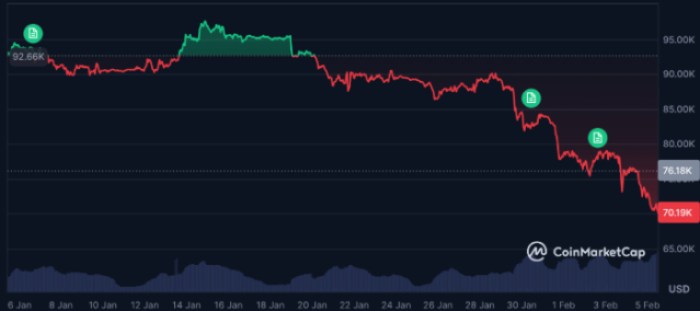
We could be entering a period of structural ‘muscle building’ which could propel Bitcoin toward the $80K mark by year-end.

That market structure creates a dual narrative. While Bitcoin builds the foundation, capital is rotating into high-beta assets that thrive on this exact ‘grindset’ culture. This dynamic has spotlighted presale projects like Maxi Doge ($MAXI), which literally adopts the ‘never skip leg day’ ethos as a core tenet of its leverage-trading community.

START PUMPING AND BUY YOUR $MAXI NOW

Bitcoin Technicals: Building the Base for a Vertical Move

Bitcoin is currently compressing within a classic flag pattern. That technical setup usually resolves in a continuation of the broader uptrend. Data from trading desks indicates the ‘pain point’ for shorts is building above $72K. A decisive breakout there would validate the leg day thesis, confirming the quiet accumulation was just energy storage for the next expansion.

Plus, the Relative Strength Index (RSI) on daily charts is teetering back to neutral territory. That implies ample room for a move to $85K (or higher) without hitting immediate overbought conditions.

But can it actually deliver? The ‘skip leg day’ risk remains. If Bitcoin fails to hold local support during a macroeconomic shock, the thesis is invalidated, likely sending prices to retest a lower demand zone. Yet, with ETF inflows returning to net-positive territory, the base case leans bullish.

Scenario Watch:
Bull Case: A high-volume close above $73.7K triggers a squeeze to $85K.
Base Case: Continued chop between $64K and $71K.
Bear Case: Loss of $58K support opens the door to $52K.

Maxi Doge: The Asset That Literally Never Skips Leg Day

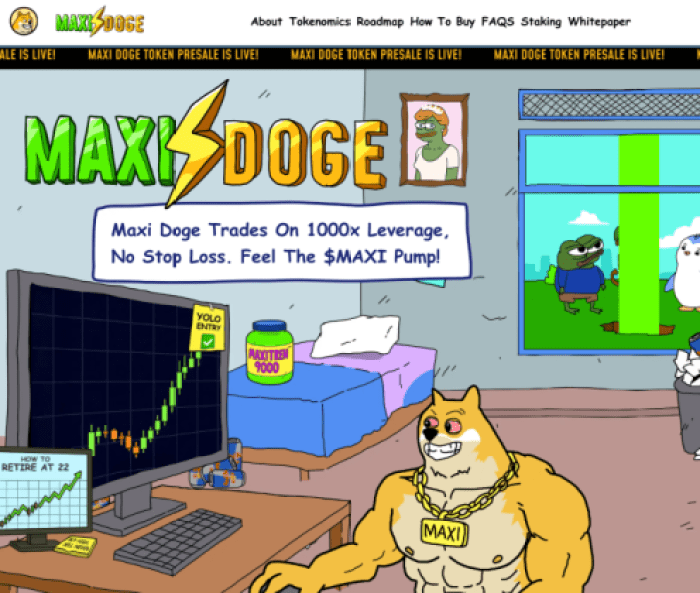
While Bitcoin handles the heavy institutional lifting, the retail market is hunting for volatility in assets that embody the aggressive spirit of the bull run. Enter Maxi Doge ($MAXI). This project has turned the ‘never skip leg day’ meme into a financialized culture for leverage traders.

Unlike standard meme coins that rely on passive holding, Maxi Doge targets the high-octane trading demographic. Think of it as the ‘gym bro’ of the crypto world, a 240-lb canine juggernaut designed for those who view 1000X leverage not as a risk, but as a lifestyle. The project plans to back this ethos with holder-only trading competitions and a ‘Maxi Fund’ treasury to support liquidity.
Smart money is already positioning. On-chain data shows 2 whale wallets bought $314K, signaling high-conviction positioning from deep-pocketed investors.

$MAXI’s presale performance reflects this appetite for high-energy assets. It has already raised over $4.5M, with tokens currently priced at $0.0002802. To entice you further, it also offers staking rewards, currently around 68%.

For investors, $MAXI offers a dynamic staking model where rewards are planned to drop daily, keeping with the ‘gains’ theme. However, like any high-leverage environment, the risks are distinct. Regulatory shifts or a failure in community retention could stall momentum.

But for now, as Bitcoin builds strength, Maxi Doge ($MAXI) looks like the spotter ready to capitalize on the pump.

BUY YOUR $MAXI FROM THE OFFICIAL PRESALE PAGE

This article is not financial advice. Cryptocurrency markets are volatile and carry significant risk. Readers should conduct their own independent research and consult with financial professionals before making any investment decisions.


İlgili Sorular

QWhat is the main mantra mentioned in the article and how is it applied to both fitness and the crypto market?

AThe main mantra is 'Never skip a leg day,' which is a key principle for gym goers. In the crypto context, it symbolizes the necessary, often painful, consolidation or accumulation phase (like Bitcoin's recent price consolidation) that builds a strong foundation for future explosive growth, similar to how leg muscles are built for a powerful vertical jump.

QAccording to the article, what are the key factors suggesting that Bitcoin's accumulation phase is maturing and could lead to a rise to $80K?

AThe key factors are macroeconomic pivots, specifically the Federal Reserve's shift toward interest rate cuts, combined with renewed institutional capital flowing into Spot Bitcoin ETFs. These elements suggest the accumulation phase is ending and could propel Bitcoin toward $80K by year-end.

QWhat is the technical setup for Bitcoin's price, and what are the potential price scenarios outlined in the article?

ABitcoin is compressing within a classic flag pattern, which typically resolves with a continuation of the uptrend. The potential scenarios are: Bull Case - a high-volume close above $73.7K triggers a squeeze to $85K; Base Case - continued choppy trading between $64K and $71K; Bear Case - a loss of $58K support opens the door to a drop to $52K.

QHow does the project Maxi Doge ($MAXI) embody the 'never skip a leg day' ethos, and what is its target audience?

AMaxi Doge embodies the ethos by targeting the high-octane, high-leverage trading demographic, turning the meme into a financialized culture. Its target audience is leverage traders who view 1000X leverage as a lifestyle, not just a risk, akin to the 'gym bro' mentality in the crypto world.

QWhat are some of the features and current performance metrics mentioned for the Maxi Doge ($MAXI) presale?

AThe presale has raised over $4.5 million, with tokens priced at $0.0002802. It offers staking rewards currently around 68% and features a dynamic staking model where rewards are planned to drop daily. On-chain data also shows significant whale activity, with two wallets buying $314K worth of tokens.

İlgili Okumalar

Agent Race Ends, Super Workbench Takes Over

The era of fragmented AI agents is ending. Over the past month, China's tech giants—Tencent, Alibaba, and ByteDance—have simultaneously shifted strategy: instead of launching new, standalone AI agents, they are consolidating their various agent projects into unified "super workbenches." Tencent integrated its QClaw teams into WorkBuddy, a strategic product hailed as a potential third flagship after QQ and WeChat. Alibaba is merging its QoderWork, Wukong, and MuleRun agents into a new "Qianwen Office" platform under DingTalk's leadership. ByteDance rebranded its TRAE SOLO coding agent to TRAE Work, signaling a broader focus on workflow collaboration. This convergence marks a pivotal industry consensus. The initial exploration phase, where companies rapidly built numerous overlapping agents for different scenarios, proved costly and inefficient. With open-source tools eroding technical barriers, competition has shifted from agent creation to resource consolidation and cost control. Historically, platform wars are won not by creating more products, but by simplifying them—as seen with browsers unifying web access and super-apps consolidating services. Now, the "super workbench" aims to become the unified AI entry point for work. This reflects a deeper market realization: the primary audience for AI is no longer just programmers (a market in the tens of millions) but all knowledge workers (a market of billions). The real opportunity lies in augmenting everyday tasks—managing emails, documents, data, and meetings—across the entire workday. The core battleground is becoming control over the primary AI entry point that employees use daily. Tencent's WorkBuddy leverages WeChat and Tencent Docs; Alibaba's Qianwen Office taps into DingTalk's organizational data; ByteDance's TRAE Work integrates with Feishu's workflows. Whoever owns this "super workbench" gains strategic control over orchestrating enterprise data and APIs. This shift is redefining enterprise software. Traditional SaaS applications, valued for their user interfaces, will recede into the background. Their core functionalities will be exposed as standardized "Skills" or APIs for the super workbench's agents to invoke. Software value will shift from selling user seats to charging based on API calls and outcomes delivered. The evolution of agents is moving through clear stages: first as novel standalone products, then as consolidated primary work entry points, and finally as pervasive, invisible capabilities embedded into the digital fabric. The recent moves by major tech firms signal the transition from the first stage into the second, accelerating toward the third. In the end, the most successful agent technology may become invisible—like electricity or the HTTP protocol—a fundamental, unnamed infrastructure powering work itself.

marsbit17 dk önce

Agent Race Ends, Super Workbench Takes Over

marsbit17 dk önce

Michael Saylor: 110 Reasons to Oppose BIP-110

Michael Saylor presents 110 arguments against Bitcoin Improvement Proposal (BIP) 110, a soft fork aimed at restricting certain non-monetary data storage uses (like inscriptions) on the Bitcoin blockchain. He acknowledges the proponents' valid concerns—such as node costs, fee pressure, and preserving Bitcoin's monetary focus—but fundamentally disagrees with the proposed solution. Saylor argues that BIP 110 represents a dangerous precedent of using consensus rules to enforce value judgments on transaction validity, moving away from Bitcoin's core principles of neutrality and permissionless innovation. His key objections are organized into eleven categories: 1) It violates neutrality and hard consensus by banning currently valid transactions. 2) It fails to meet the high burden of proof required for a consensus change, lacking concrete data on the alleged crisis. 3) Its seven bundled technical restrictions are overly broad, targeting generic script functionalities and blocking future upgrade paths. 4) It sacrifices compatibility and future optionality by closing off designed upgrade hooks. 5) Its temporary rules add significant complexity (grandfathering, expiry states) without sufficient justification. 6) The economic and security impacts, particularly on miner revenue and fee markets, are uncertain and unmodeled. 7) Superior, market-based tools (fee markets, relay/mining policies) already exist to manage blockchain load. 8) It stifles innovation by creating a chilling effect for developers. 9) Its modified activation mechanism (55% threshold, forced signaling) is aggressive and risks network splits. 10) The precedent it sets—using consensus to suppress disliked but legal uses—is more dangerous than the problem it aims to solve. 11) A better path exists: improving measurements, refining resource-based policies, and allowing market forces to work. Saylor concludes that Bitcoin's strength lies in its neutral rules, open markets, and hard consensus. Changing these foundational elements to target specific use cases is an unnecessary and risky "iatrogenic" intervention. He advocates for guarding Bitcoin's neutrality rather than acting as its redeemer.

marsbit33 dk önce

Michael Saylor: 110 Reasons to Oppose BIP-110

marsbit33 dk önce

İşlemler

Spot
活动图片

