Netting $2.4 Million: These 9 Insider Addresses Knew the US-Iran War Best

marsbit2026-05-25 tarihinde yayınlandı2026-05-25 tarihinde güncellendi

Özet

On May 18th, Bubblemaps investigators disclosed the discovery of nine highly correlated anonymous accounts on Polymarket that netted over $2.4 million from prediction markets tied to US military actions, with a 98% win rate. The accounts focused almost exclusively on the 2026 US-Iran conflict, placing bets with uncanny precision days before key events like the "Operation Epic Fury" strike on February 28th, which eliminated Iran's Supreme Leader. Bubblemaps' analysis linked four core accounts—each profiting around $400k—and five others through synchronized timing, transaction patterns, and fund flows. The money moved through shared wallet networks, suggesting professional obfuscation. This case is six times larger than the earlier prosecution of US Army Sergeant Gannon Van Dyke for insider trading on Polymarket. While platforms like Polymarket have established AI monitoring and explicit rules against trading on stolen or confidential information, the incident has spurred controversial "insider copy-trading" services that help users follow high-success accounts, raising new regulatory questions.

Written by: Mahe, Foresight News

On May 18, Nicolas Vaiman, founder of Bubblemaps, and lead investigator Deebs (a pseudonym used by a former U.S. military officer for safety reasons) disclosed to the public: they discovered nine highly correlated anonymous accounts on Polymarket that collectively netted over $2.4 million from prediction markets related to U.S. military actions, with a winning rate as high as 98%.
Bubblemaps provided a detailed analysis of these accounts on Twitter. They almost exclusively bet on military events related to the US-Iran conflict in 2026, with timing so precise it was chilling—often placing bets just days before key actions occurred, and favoring long-odds, low-probability options.

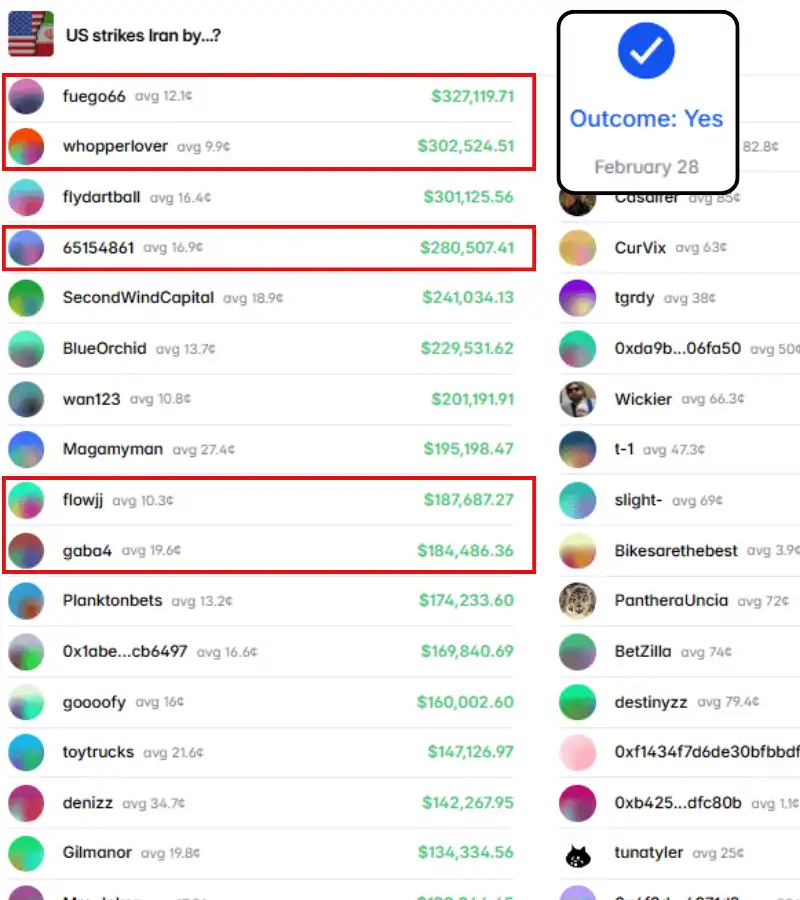
This wasn't simply "good luck." After visualizing the trades in the "Will the US strike Iran for the first time before February 28?" market on Polymarket, Bubblemaps discovered a massive pink cluster previously unmentioned on the X platform.
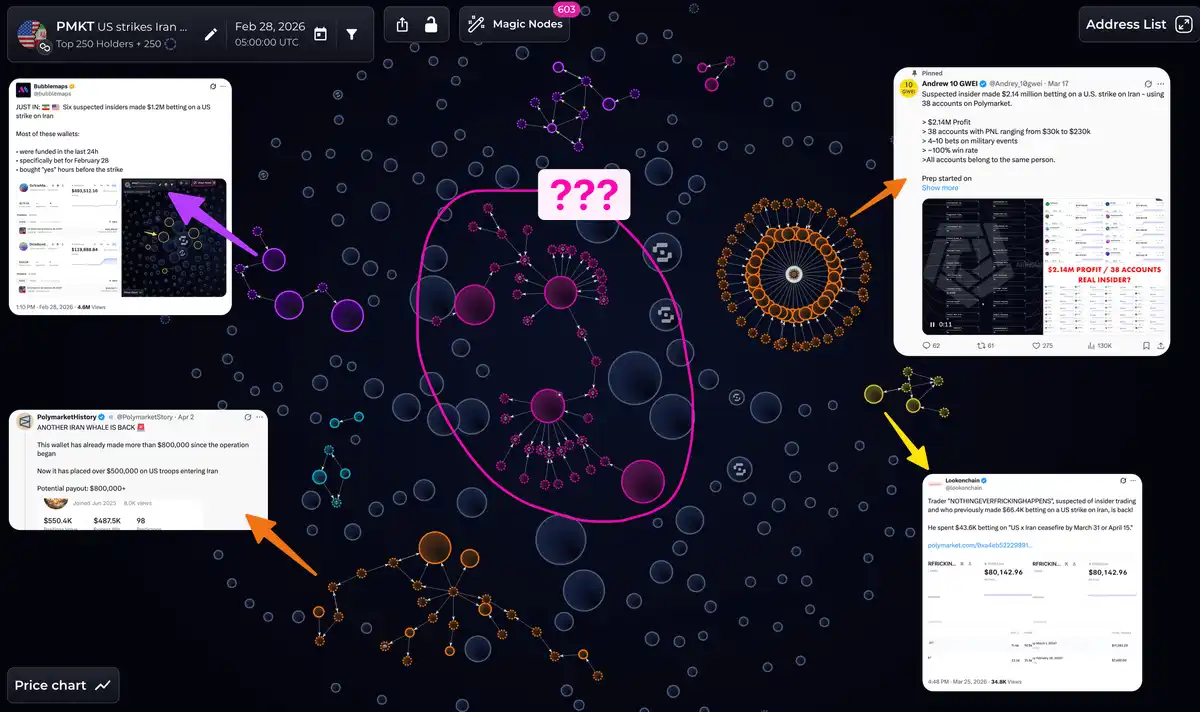
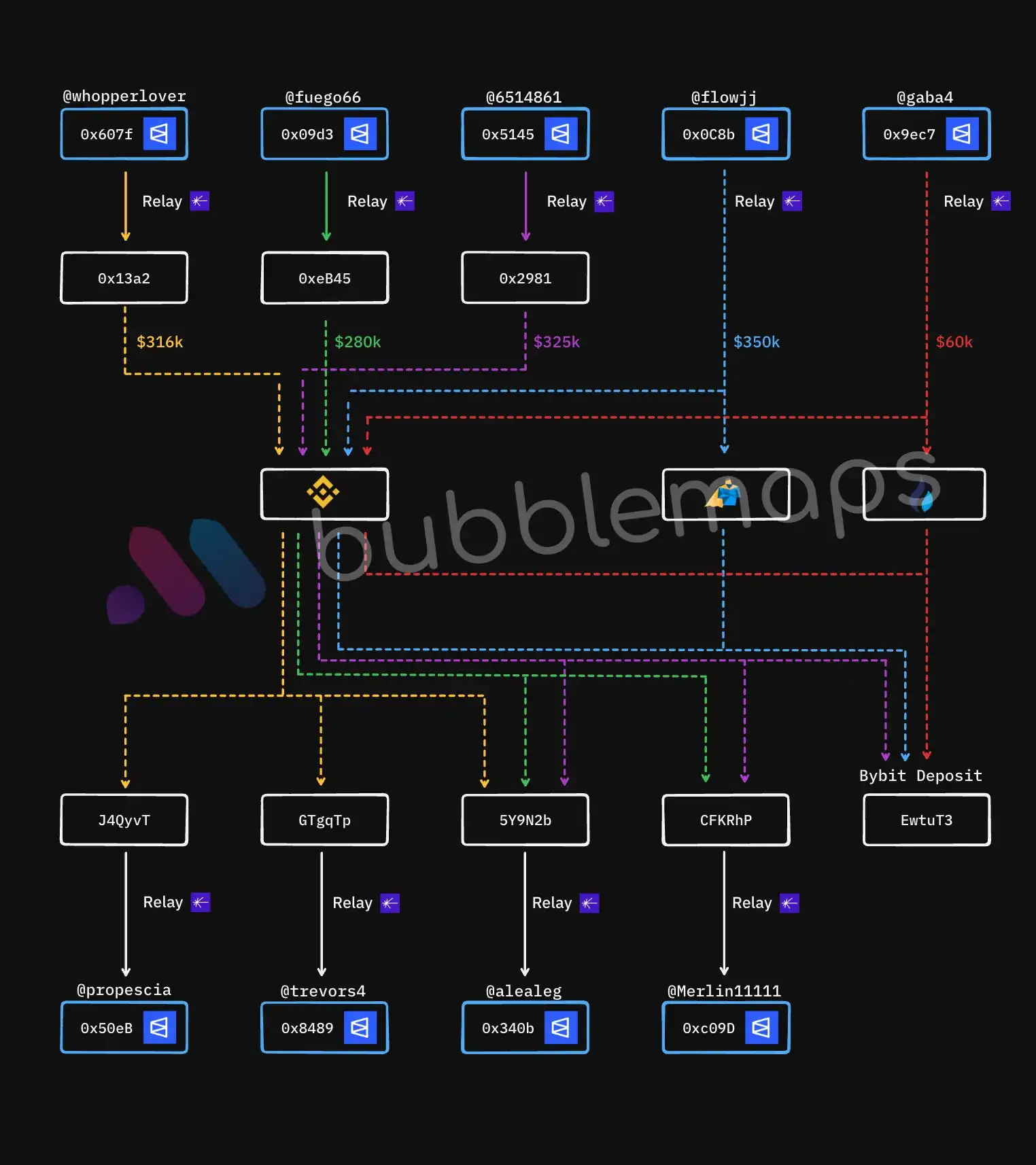
Further investigation linked the initial 4 accounts to another 5 through identical time windows, trade sizes, and fund flow paths. The nine accounts followed highly consistent funding paths: funds were transferred via centralized exchanges into a shared wallet network within an extremely short timeframe, with suspected use of professional services to hide traces.

4 Core Accounts Each Earned $400,000

In the early morning of February 28, 2026, the United States and Israel launched large-scale joint strikes codenamed "Operation Epic Fury" and "Lion's Roar." US-Israeli forces conducted nearly 900 strikes against Iran within 12 hours, targeting nuclear facilities, missile bases, military command centers, and hideouts of senior leaders. Iran's Supreme Leader Ali Khamenei and several of his family members, along with senior commanders of the Revolutionary Guard Corps, were killed in the initial strikes.

As early as the day of the February 28 strikes, Bubblemaps had publicly flagged six "fresh" accounts. Most of these accounts were created and funded within 24 hours before the strike, accurately betting on "the US will strike Iran before February 28," collectively netting about $1 million (some reports said $1.2 million). At the time, market odds were extremely low, yet these accounts heavily bet on them. Bubblemaps called it "suspected insider trading."

Five months later, the nine-account cluster they discovered was larger and had a higher win rate.
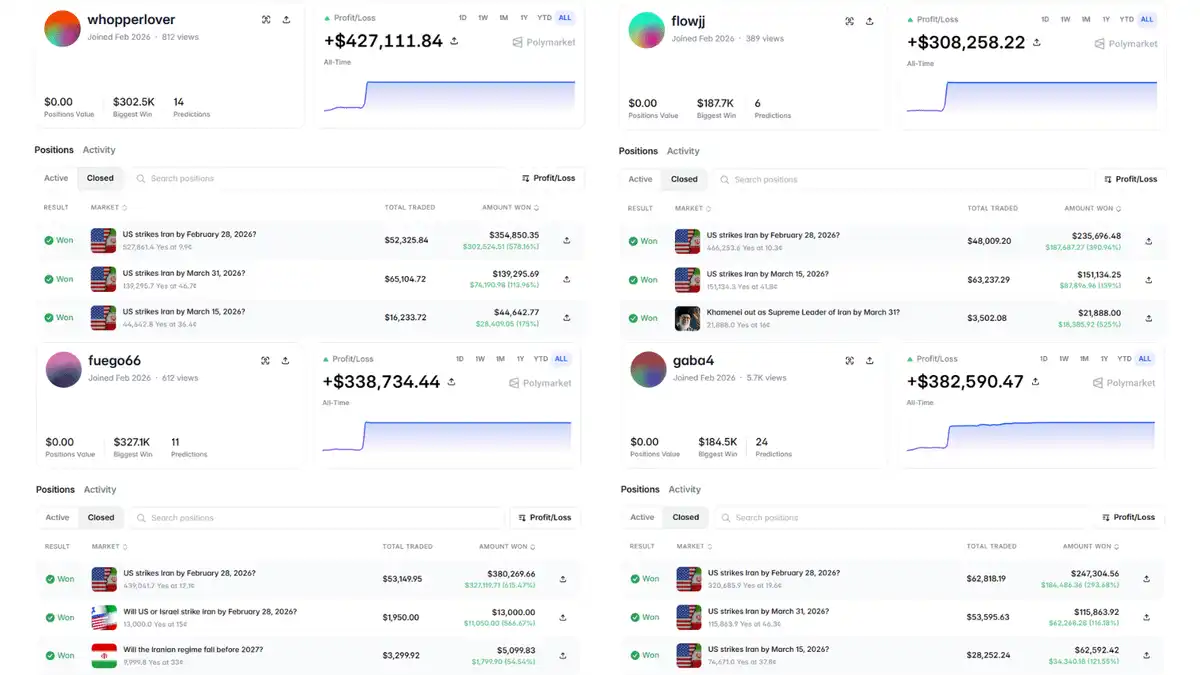
The four core accounts were created a few days before February 28, each earning about $400,000; the subsequent five accounts were linked through fund flows and trade overlaps. The nine accounts placed over 80 bets, almost all on US military actions: the first strike on February 28, the specific timing of Khamenei's elimination, the announcement of a ceasefire agreement, etc. They even placed bets spread across multiple dates to maximize gains, while occasionally placing one or two small losing bets (like on February 20), likely as cover.
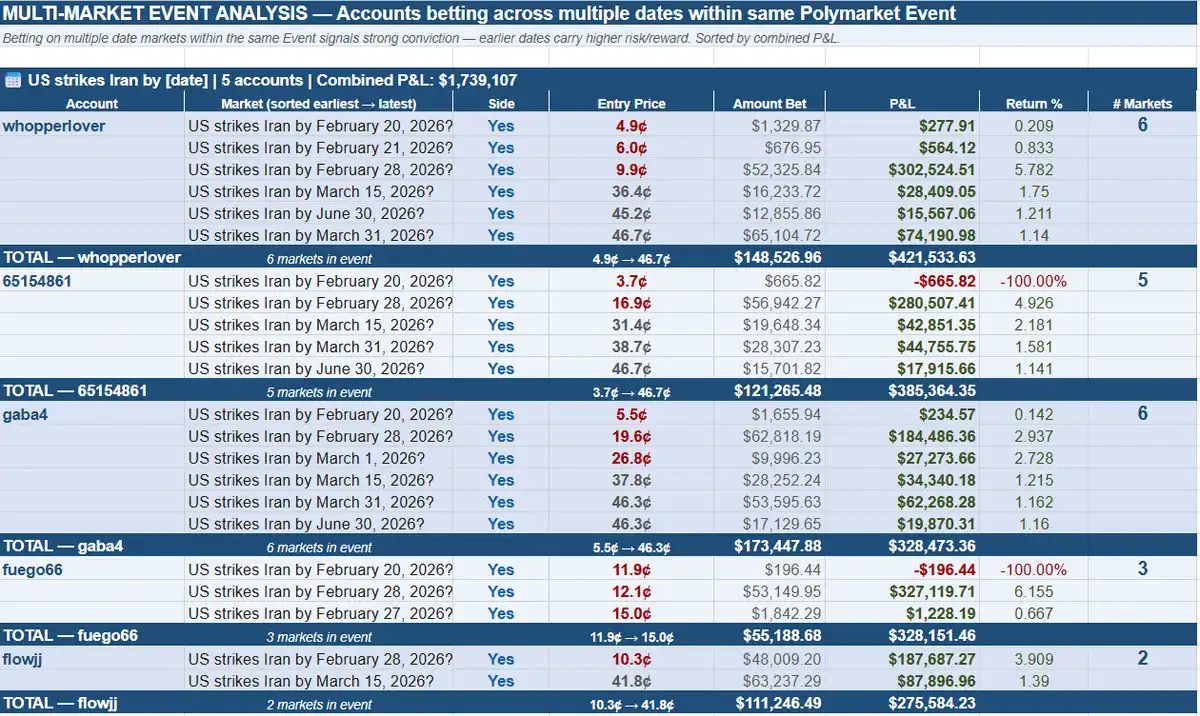
Bubblemaps listed the nine Polymarket wallet addresses (including 0x09d3273fa76282ce09f4f35a87d6f087c05f4e84, etc.), emphasizing that these accounts have long dominated the profit/loss leaderboards. Funds ultimately flowed to a shared wallet network, showing signs of professionalized money laundering or service use.
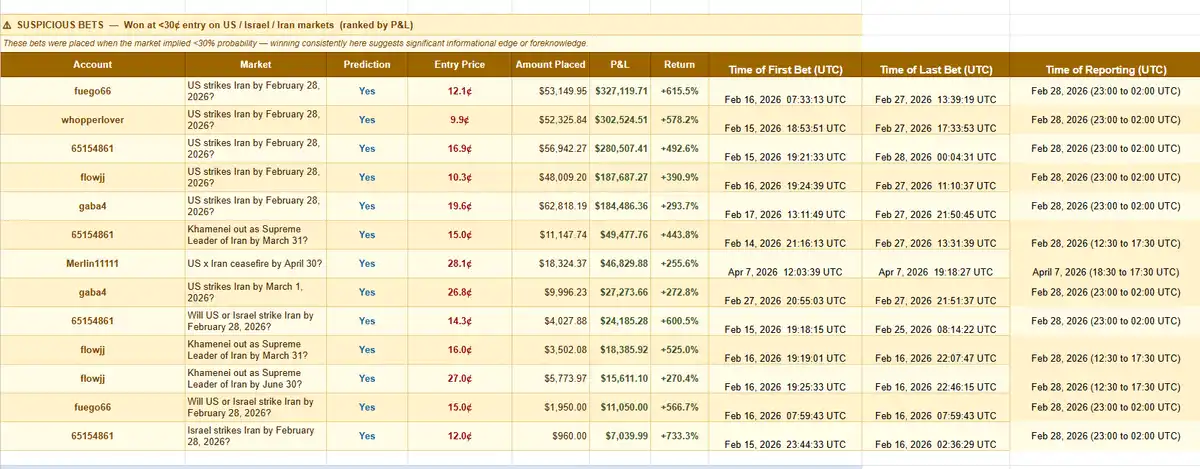
Vaiman stated bluntly: "Luck cannot explain these numbers." Deebs added that potential insider sources are numerous—government officials, military planners, intelligence analysts, even family members of military personnel.
Earlier this year, US Army Staff Sergeant Gannon Ken Van Dyke was charged with using classified intelligence to bet on special operations in Venezuela on Polymarket, investing $34,000 to profit $400,000 before quickly withdrawing funds and attempting to delete the account. Polymarket cooperated closely with law enforcement, ultimately leading to the prosecution. The Van Dyke case is seen as a landmark case for insider trading in prediction markets.

This nine-account cluster's profit is six times that amount, with a higher win rate, and is entirely concentrated on US-Iran military events.
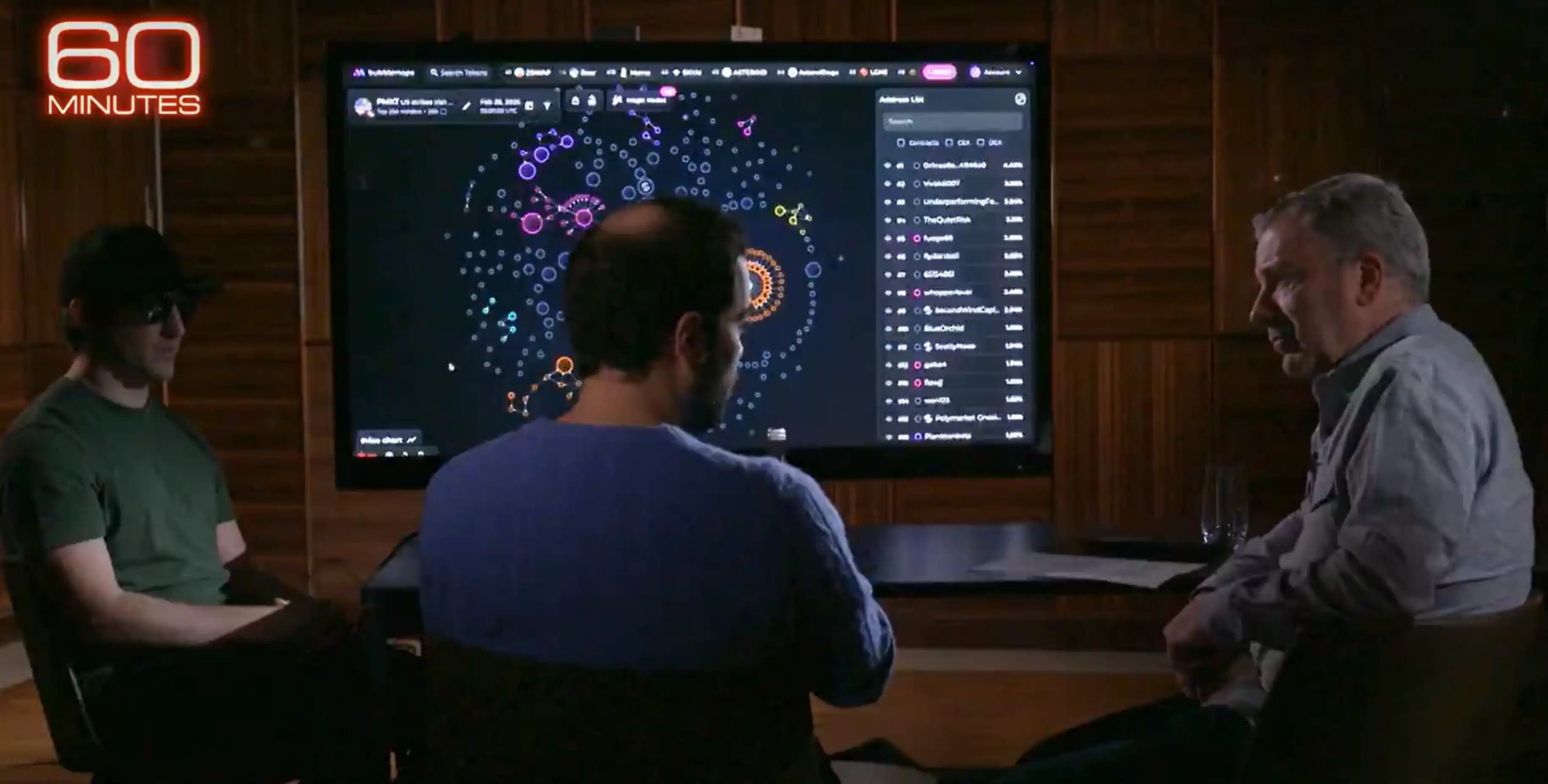
Bubblemaps exclusively shared the investigation with "60 Minutes." The segment aired on the evening of May 17, garnering significant attention. The CBS report noted that Polymarket has established AI monitoring and blockchain forensics systems, reporting suspicious activities to law enforcement authorities once detected, and emphasized that "insider trading is not welcome on the platform."

As of publication, Bubblemaps has not directly linked the nine accounts to any specific entity or government agency, stating only that "the correlation and near-perfect win rate raise serious suspicions."

Fighting Insider Trading vs. Copying Insider Trading

Insider trading makes many market participants feel the game is unfair. Prediction market platforms, including Kalshi and Polymarket, are taking more measures to combat it.

In late March this year, Polymarket updated its market integrity rules for its DeFi platform and its US exchange regulated by the U.S. Commodity Futures Trading Commission (CFTC). The updated rules clarify three core prohibited insider trading behaviors:

  • Trading using stolen confidential information—Participants may not trade any contracts if they possess confidential information about the outcome or likely outcome of an underlying event, and using that information would breach a pre-existing duty of trust or confidence owed to another person or entity.
  • Prohibition on trading using illegal insider tips—Participants may not trade using confidential information provided to them by another person, if the information was provided by someone who owed a pre-existing duty of trust or confidence to another, and the participant knows or has reason to know that the person providing the information themselves would be prohibited from trading on it.
  • Trading by those able to influence the outcome—Participants may not trade any contracts if they have authority or influence sufficient to affect the outcome of the underlying event.

However, rules always have loopholes. Since insider trading cannot be completely eradicated, some ill-intentioned so-called "insider copy-trading projects" have also sparked controversy. These applications compile trading accounts with abnormally high win rates for users, or flag suspiciously timed, abnormally sized trades, helping users copy these trades with one click.

Kreo's selling point is helping users "find insider traders before others." Polycool directly posts a "Polymarket Insider Trading Guide" on its website, stating "This isn't the stock market, betting with non-public information won't land you in jail, the rules for decentralized prediction markets are completely different."

A question then arises: does copying trades from insider trading addresses constitute a violation?

There has been no official response yet.

However, so-called "insider copy-trading platforms" like PolyGUN and Polycule have suffered hacker attacks this year, incurring losses ranging from tens of thousands to hundreds of thousands of dollars.


İlgili Sorular

QWhat did Bubblemaps investigators discover about a group of anonymous accounts on Polymarket?

ABubblemaps investigators discovered nine highly correlated anonymous accounts that collectively netted over $2.4 million from prediction markets related to US military actions, with a win rate of 98%. They were primarily focused on US-Iran conflict events in 2026.

QAccording to the article, what characteristics made the trading activity of these nine accounts highly suspicious?

AThe accounts were highly suspicious because they placed bets almost exclusively on US-Iran military events, their timing was unnervingly precise (often days before key actions), they preferred low-odds, long-term options, and they used shared wallet networks and professional services to obscure fund flows.

QWhat is the name of the US soldier mentioned in the article who was charged for insider trading on Polymarket, and what was his profit?

AThe US soldier mentioned is US Army Staff Sergeant Gannon Ken Van Dyke. He was charged for using classified intelligence to bet on a Venezuelan special operations event on Polymarket, investing $34,000 and making a profit of $400,000.

QWhat are the three core types of prohibited insider trading behaviors outlined in Polymarket's updated market integrity rules?

AThe three core prohibited behaviors are: 1) Trading using stolen confidential information. 2) Trading using illegal insider information provided by someone who breached a duty of trust. 3) Trading by individuals who have the authority or influence to affect the outcome of the event.

QWhat controversial practice related to potential insider trading has emerged on prediction market platforms according to the article?

AThe controversial practice is the emergence of 'insider copy-trading' platforms or applications. These services identify accounts with suspiciously high win rates or anomalous trades, allowing users to copy their bets, essentially attempting to profit from potential insider information.

İlgili Okumalar

GitHub, Transfixed by AI

On the night of February 9th, GitHub suffered a major outage caused by a simple configuration change—reducing a cache refresh interval from 12 to 2 hours—that triggered a cascade of failures. This was not an isolated event, but part of a broader pattern. In early 2026, GitHub experienced at least 8 major incidents, failing to meet its promised 99.9% availability. These outages stemmed from structural issues: explosive growth in load, tight service coupling, and insufficient protection against abnormal traffic. This unprecedented load is driven by AI Agents. In 2025, GitHub handled ~1 billion commits. By 2026, weekly commits reached 275 million, projecting to ~14 billion for the year—a 14x increase. AI tools like Claude Code now contribute 4.5% of all public repository commits, with weekly submissions surging 25x in just three months. AI-generated pull requests jumped from 4 million to 17 million per month in half a year. Unlike human developers, AI Agents work continuously, generating commits at a scale that overwhelms infrastructure designed for human rhythms. The surge also shattered GitHub's business model. Copilot's flat-rate pricing, based on assisting human developers, became unsustainable as Agentic AI sessions consumed resources worth hundreds of dollars for a few dollars in fees. In response, GitHub imposed usage limits and, by June 1st, shifted to a pay-per-use "AI Credits" system. Facing this new reality, GitHub realized a 10x scaling plan was insufficient. It announced a need to *redesign* its architecture for 30x current scale—decoupling services, adding fault isolation, and improving change management to prevent cascading failures. Other platforms like Stripe and AWS are facing similar challenges with AI Agents. Fundamentally, GitHub is transitioning from a human collaboration platform to an "exhaust pipe" for automated AI workflows. Its detailed post-mortem reports aim to maintain trust during this turbulent rebuild. The February outage was not just a technical glitch, but a signal of the software industry's entry into a new, AI-driven era.

marsbit16 dk önce

GitHub, Transfixed by AI

marsbit16 dk önce

Both Suffer Massive Losses Exceeding $90 Billion, Which Is in Greater Peril: Strategy or Bitmine?

Facing massive paper losses exceeding $90 billion each amidst a sharp market downturn, "Digital Asset Treasury" (DAT) giants Strategy and Bitmine find themselves in a precarious position, but with different underlying risks. Strategy, heavily invested in Bitcoin (BTC), faces significant financial strain. Its strategy relies heavily on debt, including convertible notes and preferred stock (STRC) requiring substantial dividend payments. With its cash reserves dwindling and BTC offering no staking yield for cash flow, Strategy's high leverage makes it vulnerable. A continued price decline could force asset sales to meet obligations, potentially creating a negative feedback loop. Its market value has already fallen sharply. In contrast, Bitmine, an Ethereum (ETH) holder, appears on firmer financial ground. It primarily funds its purchases through equity offerings (like ATM programs), avoiding debt pressure. It also generates income by staking a large portion of its ETH holdings. While not immune to market drops and shareholder dilution concerns, Bitmine maintains more flexibility, recently announcing a new preferred share offering to raise further capital. The core divergence lies in their financing: Bitmine uses equity (investor money), while Strategy uses debt (borrowed money). Consequently, Bitmine currently faces less immediate liquidity pressure than Strategy, which must navigate the dual challenge of servicing debt/dividends and a declining core asset (BTC) price.

marsbit23 dk önce

Both Suffer Massive Losses Exceeding $90 Billion, Which Is in Greater Peril: Strategy or Bitmine?

marsbit23 dk önce

Where the AI Bubble Really Is: Which Layer of Players Are Naked

AI Bubble: Where It Really Is and Who's Swimming Naked This analysis dissects the AI industry not as a single entity but as a five-layer pyramid, arguing that bubbles are concentrated in specific tiers, not uniformly distributed. **Key Distinction from the 2000 Dot-com Bubble:** Unlike 2000, where companies had stock prices before revenue, today's leading AI players have massive, contract-backed revenue driving their valuations. Core infrastructure demand is real, with every GPU running at full capacity for paying customers. **The Five-Layer Pyramid & Bubble Assessment:** * **L0 (Fab/Manufacturing) & Top L4 (Leading AI Apps): NO BUBBLE.** Companies like TSMC, NVIDIA, major cloud providers (Microsoft, Google, Meta, Amazon), and top AI labs have real revenues and orders. Supply is tightly constrained by TSMC's disciplined capacity control and physical limits like power/land for data centers, preventing a supply glut. * **L1 (Memory): BATTLEGROUND.** Sky-high HBM margins could signal a new structural cycle or a classic "boom before bust." The oligopoly of three major players may enforce supply discipline, making this a high-stakes bet. * **L2 (Interconnect/Optical Modules): BUBBLE TERRITORY.** Companies like Lumentum and AAOI have seen stock surges (4-10x) far outpacing revenue growth. This hardware segment has lower physical barriers to expansion than fabs, allowing speculation. It mirrors the 2000 bubble's epicenter—optics. * **L3 (Infrastructure/"GPU Landlords"): VULNERABLE.** GPU leasing companies profit from the current compute shortage but own no long-term moat. Their business model relies on a temporary bottleneck that will ease as big tech expands and new tech (e.g., potential space-based data centers) emerges. * **L4 Long Tail (VC-backed Startups): STRONG BUBBLE SIGNALS.** VC funding concentration in AI is twice that of the 1999 peak. Many startups with little revenue use the valuation logic of successful giants to justify their own, creating high risk of a "valuation crunch" when funding dries up. **Critical Risks to Monitor:** 1. **GPU Depreciation & Accounting:** Companies extending the assumed useful life of GPUs artificially boost profits. The true economic life depends on future generational leaps from NVIDIA. 2. **"GPU Credit" & Off-Balance-Sheet Leverage:** Emerging structures where shell companies borrow to buy GPUs and lease them out (with chipmakers sometimes investing) move debt off major balance sheets. This echoes the "vendor financing" of 2000 and the securitization risks of 2008, though currently small-scale. 3. **TSMC Abandoning Caution:** If the primary supply bottleneck (TSMC's conservative capacity planning) breaks, runaway supply could trigger a bust. 4. **Algorithmic Efficiency Breakthrough:** A major leap in software efficiency could drastically reduce the need for raw compute hardware, undermining the investment thesis. **Conclusion:** The AI boom is expensive and has frothy areas, but its core is underpinned by real demand and physical supply constraints. The bubble risk is layered: most present in optical components, GPU leasing, and the long-tail startup ecosystem, while the foundational chip manufacturing and leading application layers remain relatively solid—for now.

marsbit36 dk önce

Where the AI Bubble Really Is: Which Layer of Players Are Naked

marsbit36 dk önce

İşlemler

Spot
Futures

Popüler Makaleler

WAR Nasıl Satın Alınır

HTX.com’a hoş geldiniz! WAR (WAR) satın alma işlemlerini basit ve kullanışlı bir hâle getirdik. Adım adım açıkladığımız rehberimizi takip ederek kripto yolculuğunuza başlayın. 1. Adım: HTX Hesabınızı OluşturunHTX'te ücretsiz bir hesap açmak için e-posta adresinizi veya telefon numaranızı kullanın. Sorunsuzca kaydolun ve tüm özelliklerin kilidini açın. Hesabımı Aç2. Adım: Kripto Satın Al Bölümüne Gidin ve Ödeme Yönteminizi SeçinKredi/Banka Kartı: Visa veya Mastercard'ınızı kullanarak anında WAR (WAR) satın alın.Bakiye: Sorunsuz bir şekilde işlem yapmak için HTX hesap bakiyenizdeki fonları kullanın.Üçüncü Taraflar: Kullanımı kolaylaştırmak için Google Pay ve Apple Pay gibi popüler ödeme yöntemlerini ekledik.P2P: HTX'teki diğer kullanıcılarla doğrudan işlem yapın.Borsa Dışı (OTC): Yatırımcılar için kişiye özel hizmetler ve rekabetçi döviz kurları sunuyoruz.3. Adım: WAR (WAR) Varlıklarınızı SaklayınWAR (WAR) satın aldıktan sonra HTX hesabınızda saklayın. Alternatif olarak, blok zinciri transferi yoluyla başka bir yere gönderebilir veya diğer kripto para birimlerini takas etmek için kullanabilirsiniz.4. Adım: WAR (WAR) Varlıklarınızla İşlem YapınHTX'in spot piyasasında WAR (WAR) ile kolayca işlemler yapın.Hesabınıza erişin, işlem çiftinizi seçin, işlemlerinizi gerçekleştirin ve gerçek zamanlı olarak izleyin. Hem yeni başlayanlar hem de deneyimli yatırımcılar için kullanıcı dostu bir deneyim sunuyoruz.

217 Toplam GörüntülenmeYayınlanma 2024.12.11Güncellenme 2026.06.02

WAR Nasıl Satın Alınır

Tartışmalar

HTX Topluluğuna hoş geldiniz. Burada, en son platform gelişmeleri hakkında bilgi sahibi olabilir ve profesyonel piyasa görüşlerine erişebilirsiniz. Kullanıcıların WAR (WAR) fiyatı hakkındaki görüşleri aşağıda sunulmaktadır.

活动图片












