Nearly $300 Million Aimed at U.S. Midterm Elections, Tether Executive Takes Helm of Crypto Industry's Second-Largest Political Fund

marsbit2026-04-03 tarihinde yayınlandı2026-04-03 tarihinde güncellendi

Özet

A crypto super PAC named Fellowship, which claims to have raised over $100 million but has reported zero spending to the FEC, has appointed Jesse Spiro, Tether’s VP of Regulatory Affairs, as its chairman. This marks the first official public link between Tether and the PAC, despite earlier denials. Meanwhile, another major crypto PAC, Fairshake—backed by Coinbase, Ripple, and a16z—has amassed $193 million and has already spent over $8.6 million in Illinois primary races. Combined, the two PACs control nearly $300 million aimed at influencing the November midterm elections. The move comes as the crypto industry faces a critical legislative battle over the CLARITY Act, currently stalled in the Senate. A key point of contention is whether stablecoins can pay yields to users—a issue directly affecting Tether, the issuer of the world’s largest stablecoin, USDT. A recent Senate proposal would ban passive yield but allow transaction-based rewards, a compromise the industry finds too restrictive. With the White House’s top crypto advocate departing and the legislative window narrowing, Tether’s heightened political engagement signals a strategic push to shape regulation and protect its business interests through financial influence.

Deep Tide Guide: Fellowship, a crypto super PAC that was established seven months ago and claimed to have raised over $100 million but has yet to spend a single dollar, announced on Wednesday the appointment of Jesse Spiro, Vice President of Regulatory Affairs at Tether US, as its chairman. This marks the first official and public connection between Tether and the PAC. Meanwhile, another major crypto PAC, Fairshake, has amassed a war chest of $193 million. Combined, the two PACs are targeting the November midterm elections with nearly $300 million in political funds, while legislative battles over stablecoin yields in Congress remain unresolved.

The political arms race in the crypto industry is escalating.

According to a Cointelegraph report on April 1, Fellowship PAC announced on Wednesday that Jesse Spiro, Vice President of Regulatory Affairs at Tether US, will assume the role of chairman, leading the organization's next phase of expansion. The first list of endorsed candidates will be announced in the coming days. Fellowship is a super PAC founded in August 2025, which claimed last September that it had raised "over $100 million" from unnamed donors aligned with the crypto industry.

Spiro stated in a declaration: "This is a critical moment for American innovation. We have the opportunity to ensure that the United States continues to be the global hub for builders, entrepreneurs, and technological progress. Fellowship PAC is committed to supporting leaders who understand what is at stake and are willing to take action."
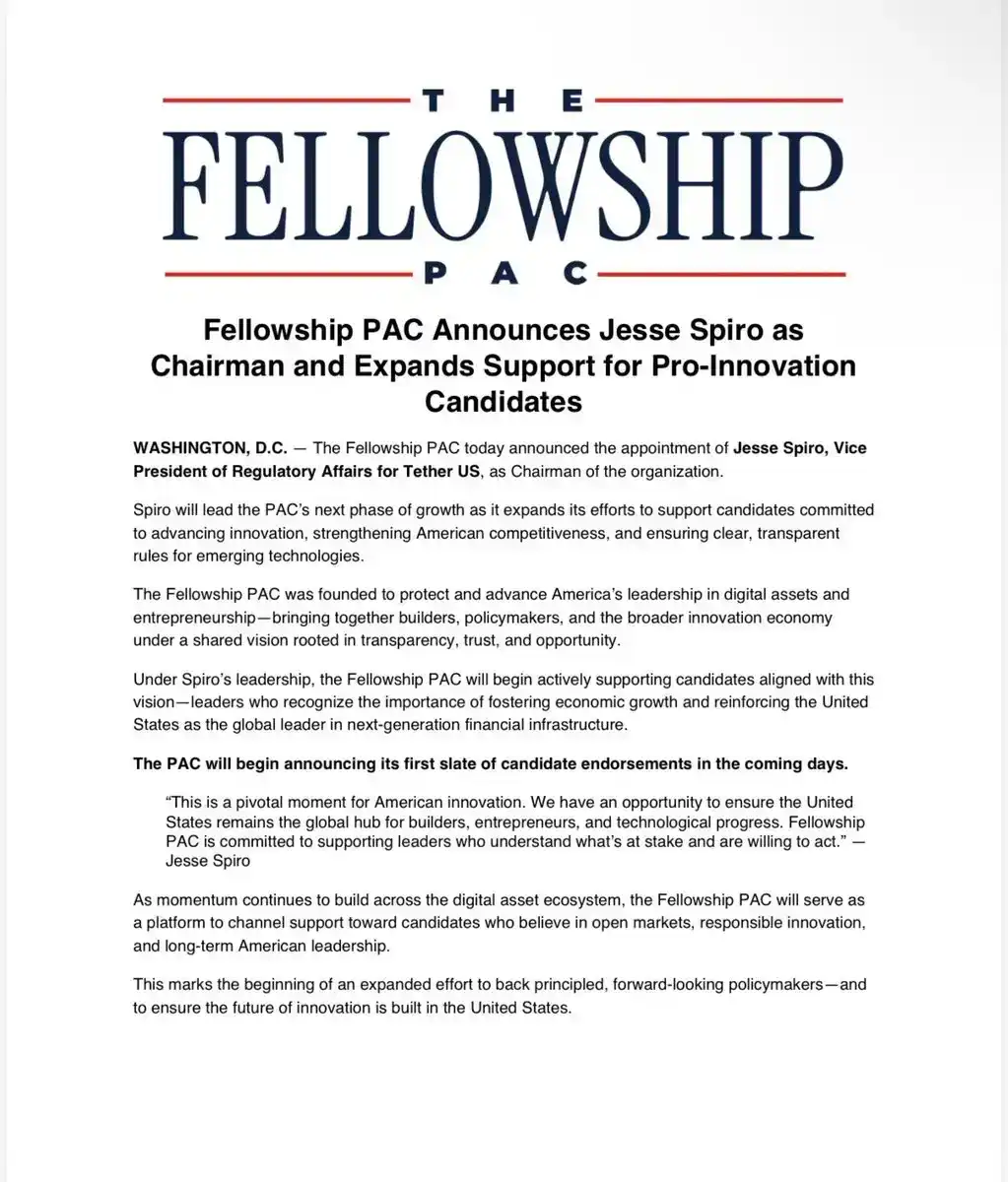
From 'Denying Ties' to 'Executive Leadership': Tether's Relationship with Fellowship Comes to Light

Since its high-profile debut last September, the identity of Fellowship PAC's backers has been one of the industry's biggest mysteries.

At its inception, the PAC did not disclose any management, donors, or key employees. Early reports listed Tether as an expected supporter, but Tether International subsequently formally denied any connection to the PAC. According to a CoinDesk report in February, a Tether International spokesperson explicitly stated that "Tether International has no affiliation whatsoever with Fellowship."

But FEC records tell a different story. Fellowship's registered treasurer, Mitchell Nobel, is an executive at Cantor Fitzgerald, the custodian institution managing Tether's multi-billion dollar reserves. The PAC's registered address is in Bethesda, Maryland.

Now, with a current Tether US executive officially taking the helm as PAC chairman, the previous rumors have finally solidified into public record. According to BeInCrypto, this marks the first formal, public connection between Fellowship PAC and Tether officially.

Spiro joined Tether in 2024 as Head of Government Affairs. Prior to that, he was responsible for blockchain and digital asset regulatory relations at PayPal and held a leadership role in government affairs at the on-chain analytics company Chainalysis.

$100 Million 'War Chest' Yet to Fire a Single Shot, FEC Records Show Zero Expenditures

Despite Fellowship's assertion of holding $100 million in funds, FEC records show that as of December 31 last year, the PAC reported no donation income or expenditures. Since last September's announcement, Fellowship has only made three public statements on platform X, operating almost "invisibly."

This contrast has raised widespread questions. CoinDesk's investigative report on February 25 pointed out that Fellowship had "never shown up" in its seven months of existence, with its promised $100 million showing no trace in Federal Election Commission disclosures.

Spiro's appointment is seen as a signal of Fellowship's return to the public eye from its period of dormancy. The PAC stated it will announce its first endorsements of candidates in the coming days, with just over seven months remaining until the November midterm elections.

Bo Hines, Executive Director of the White House Digital Asset Advisory Council, expressed support for the appointment on platform X, posting: "The fight for American innovation needs serious advocates. Looking forward to seeing leaders who truly understand the stakes get elected."

Crypto PAC Arms Race: Fairshake Holds $193 Million, Already Spent $8.6 Million in Illinois

Fellowship is not the crypto industry's only political funding machine. The Fairshake PAC and its affiliated organizations, backed by Coinbase, Ripple, and a16z, reported holding $193 million in cash as of January this year, making it the crypto industry's largest super PAC by funding size.

Fairshake has already begun taking action. According to Cointelegraph, the PAC and its affiliates have spent approximately $8.6 million on a congressional race in Illinois, six times its spending in the state in 2024. In the Illinois primary in March, some candidates supported by Fairshake did not win, but there is still a seven-month window until the midterm elections.
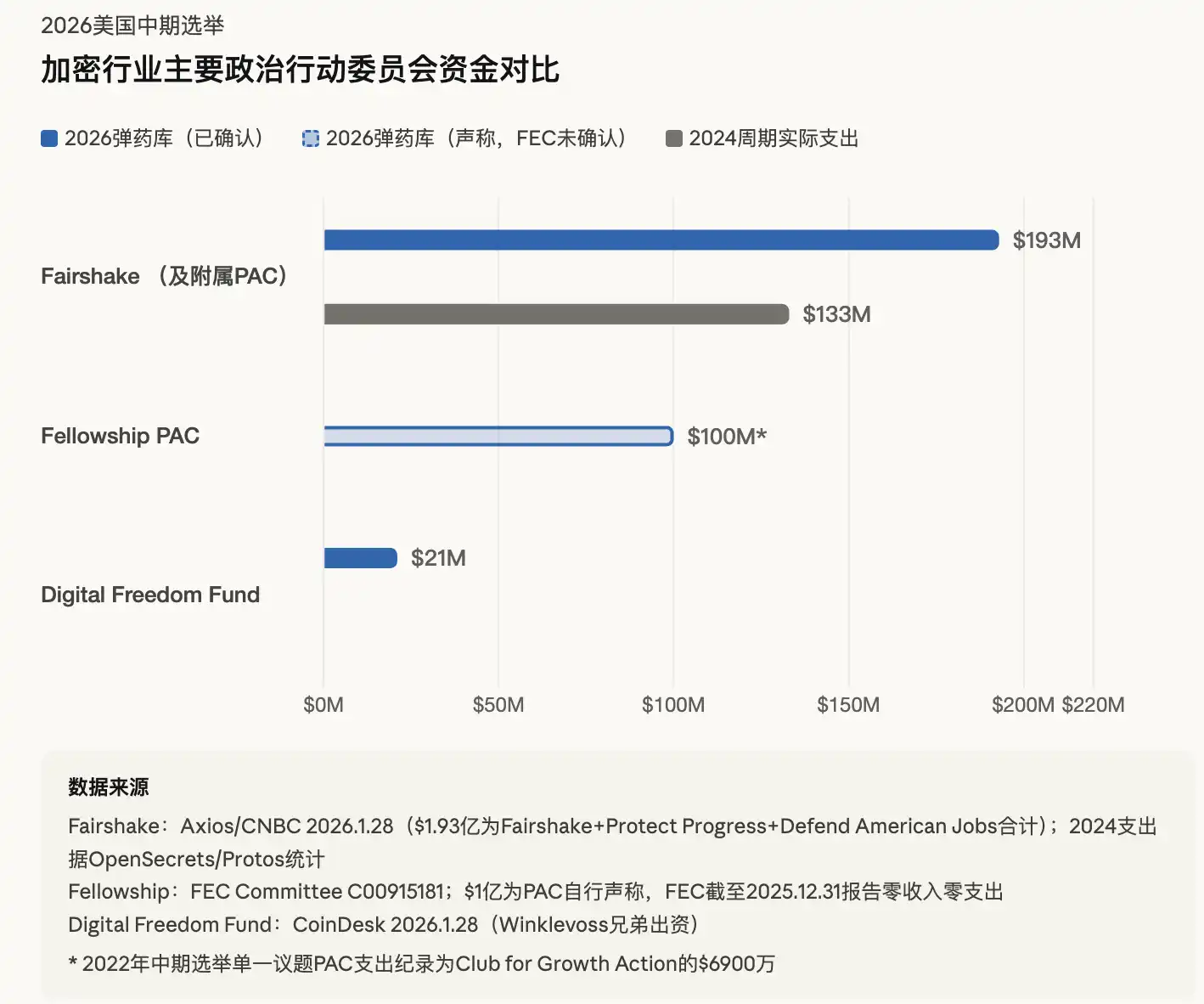
During the 2024 election cycle, Fairshake spent over $130 million on media placements, with the majority of the more than 50 candidates it supported successfully elected. According to statistics from the non-profit oversight organization Public Citizen, nearly half of the corporate money flowing into the 2024 elections came from the crypto industry.

Now, with the combined war chest of nearly $300 million from Fellowship and Fairshake, plus other political donation forces in the crypto industry, the 2026 midterm elections are expected to set a new record for industry political spending.

Legislative Battle: Stablecoin Yield Dispute Stalls CLARITY Act, Tether's Interests at Stake

Spiro's appointment is not coincidental in its timing. The Clarity Act for Digital Asset Markets (CLARITY Act), the crypto industry's core legislative priority, is currently stalled in the Senate, with one of the contentious points being stablecoin yields, which directly impacts Tether's business model.

The CLARITY Act passed the House of Representatives in July 2025 by a vote of 294 to 134 and passed review in the Senate Agriculture Committee in January this year. However, at the Senate Banking Committee level, a fierce battle is underway between the banking industry and the crypto industry over whether stablecoins can pay yields to users.

On March 20, Senators Thom Tillis and Angela Alsobrooks reached a principled compromise on stablecoin yields: prohibiting passive yield payments based on holding balances, but allowing reward programs based on transaction activity. According to CoinDesk, after crypto industry representatives reviewed the latest text behind closed doors on Capitol Hill on March 23, they found the language too narrow and ambiguous. Coinbase has stated twice that it does not support the current draft.

The markup in the Senate Banking Committee is currently scheduled for after the Easter recess in late April. Senator Bernie Moreno warned that if the bill does not advance by May, crypto legislation may not receive serious consideration again during the midterm election cycle.

Compounding the issue, the White House AI and Crypto Tsar, David Sacks, confirmed on March 26 that his 130-day term had expired and the administration would not appoint a successor. The crypto industry's most critical legislative sprint will proceed without its chief advocate in the White House.

Tether's USDT is the world's largest stablecoin, with a market cap of approximately $184 billion, but it is not available to U.S. residents. Tether launched a compliant stablecoin for the U.S. market, USAT, last year. The final outcome of the stablecoin yield provisions will directly determine the operating space for Tether and its competitors in the U.S. market.

Against this backdrop, by having an executive assume the chairmanship of the PAC, Tether is pushing its political influence building from behind the scenes to the forefront, sending a clear signal: during the critical window of legislative博弈 (game/struggle), using political funds to protect industry interests.


Trend Kriptolar

İlgili Sorular

QWho was appointed as the new chairman of the crypto super PAC Fellowship, and what is his role at Tether?

AJesse Spiro, the Regulatory Affairs Vice President of Tether US, was appointed as the chairman of Fellowship PAC.

QHow much combined political funding do Fellowship and Fairshake PACs have for the midterm elections, and what are their reported amounts?

AFellowship and Fairshake PACs have a combined nearly $300 million in political funds, with Fellowship claiming over $100 million and Fairshake holding $193 million.

QWhat discrepancy was reported regarding Fellowship PAC's fundraising claims and FEC records?

AFellowship PAC claimed to have raised over $100 million, but FEC records showed zero reported donations or expenditures as of December 31.

QWhat is the key legislative issue affecting stablecoins like Tether's USDT, and what is the compromise proposed in the CLARITY Act?

AThe key issue is whether stablecoins can pay yields to users. The proposed compromise in the CLARITY Act prohibits passive yield based on holdings but allows reward programs based on transaction activity.

QWhy is Jesse Spiro's appointment significant for Tether and the crypto industry's political strategy?

AIt marks the first formal, public link between Tether and Fellowship PAC, signaling Tether's move to openly influence politics during a critical legislative period for crypto regulations, particularly affecting stablecoin operations.

İlgili Okumalar

In Conversation with Ray Dalio: We Are Currently in an AI Bubble, with 1% of My Portfolio in Bitcoin

Ray Dalio, founder of Bridgewater Associates, warns in an interview that the current AI boom shows classic bubble characteristics, which could lead to significant economic downturns as seen in past cycles like 1929 or 2000. He explains that speculative enthusiasm, fueled by debt and overvaluation, often precedes a crash when rising rates or taxation force asset sales, causing widespread losses and recession. Dalio also outlines his "Big Cycle" theory, describing an approximate 80-year pattern where widening wealth gaps, massive government deficits, and shifting geopolitical power (like China's rise) create internal conflict and global instability. He emphasizes that we are in a late-cycle, transitional phase where traditional powers like the US and UK face decline. For personal wealth protection, Dalio advises diversification beyond cash into assets like stocks, bonds, real estate, and particularly gold, which he prefers over Bitcoin. While he holds about 1% of his portfolio in Bitcoin as a non-printable hard asset, he views gold as more secure from technological or governmental threats. Regarding AI's impact, Dalio believes it will disproportionately benefit capital owners, worsening inequality by replacing both physical and cognitive labor. He suggests that human intuition and emotional intelligence, combined with AI, will be key for future workers. On taxation, Dalio argues that wealth taxes are impractical and risk triggering asset sell-offs, reducing productive investment. He points to the UK as a cautionary example of debt, low productivity, and political strife. Geopolitically, Dalio foresees a more regionalized world, with the US showing weakness in prolonged conflicts like with Iran, akin to past imperial declines. The ideal outcome, he suggests, is coexisting powerful blocs (e.g., Americas, China-Asia Pacific) without major war.

marsbit3 saat önce

In Conversation with Ray Dalio: We Are Currently in an AI Bubble, with 1% of My Portfolio in Bitcoin

marsbit3 saat önce

Daily 7.2 Trillion KRW: Foreign Capital's Record Net Buying on Friday! Wall Street Says Headwinds for Korean Stock Fund Flows Have Subsided

South Korean stock market sees a dramatic shift in fund flows. On July 31, foreign investors made a record net purchase of approximately KRW 7.2 trillion in KOSPI stocks, marking a fundamental reversal from the persistent large-scale net outflows seen in previous months. This contributed to a significant narrowing of foreign net selling in July to KRW 9.8 trillion, down sharply from KRW 48.4 trillion in June and KRW 44.5 trillion in May. Simultaneously, domestic institutional pressure eased. South Korean pension funds and asset managers turned to a net buying position in July, purchasing KRW 1.0 trillion worth of KOSPI shares, contrasting with net sales in May and June. Market volatility is expected to be dampened by new financial regulations. Effective July 31, the Financial Services Commission tightened access for retail investors to single-stock leveraged ETFs by raising the minimum cash deposit requirement. Trading volumes for these products subsequently dropped to about 50% of their monthly average. Citigroup Research maintains its year-end KOSPI target of 10,000 points. The firm cites several supportive factors: the substantial easing of headwinds from capital outflows, a robust fundamental outlook for the semiconductor sector, historically low market valuations, strong economic fundamentals, and the potential for policy support from financial authorities if needed.

marsbit3 saat önce

Daily 7.2 Trillion KRW: Foreign Capital's Record Net Buying on Friday! Wall Street Says Headwinds for Korean Stock Fund Flows Have Subsided

marsbit3 saat önce

Thanks to Dice Rolls, Bitcoin Keys Are Stored Offline, But Not Everyone Will Do It

The article discusses using dice rolls to generate secure Bitcoin wallet seeds, providing entropy independent of potentially flawed hardware random number generators. It explains that each fair dice roll offers about 2.585 bits of entropy, with around 50 rolls needed for a standard 12-word seed phrase and 99+ recommended for higher security. This method gained attention after a vulnerability was revealed in some Coldcard hardware wallets, where a faulty firmware RNG (dating back to 2021) compromised generated keys. The analysis notes that while a dice-generated main seed was safe from this specific flaw, other Coldcard functions (like creating paper wallets, backup keys, or passwords) could still be vulnerable if they used the defective RNG. The piece argues that while dice-based entropy is technically robust, the manual process is error-prone, tedious, and unrealistic for most new users, who might make mistakes in recording or inputting rolls. It concludes that while manual entropy generation should remain an option for advanced users, the long-term goal is to develop reliable, user-friendly hardware and software that securely generates randomness without requiring specialized knowledge. Coldcard users are advised to check their firmware version and replace any secondary secrets (like paper wallet keys) created with vulnerable devices, while also considering multi-signature setups with devices from different manufacturers for added security.

cryptonews.ru8 saat önce

Thanks to Dice Rolls, Bitcoin Keys Are Stored Offline, But Not Everyone Will Do It

cryptonews.ru8 saat önce

İşlemler

Spot

Popüler Makaleler

SUPER Nasıl Satın Alınır

HTX.com’a hoş geldiniz! SuperFarm (SUPER) satın alma işlemlerini basit ve kullanışlı bir hâle getirdik. Adım adım açıkladığımız rehberimizi takip ederek kripto yolculuğunuza başlayın. 1. Adım: HTX Hesabınızı OluşturunHTX'te ücretsiz bir hesap açmak için e-posta adresinizi veya telefon numaranızı kullanın. Sorunsuzca kaydolun ve tüm özelliklerin kilidini açın. Hesabımı Aç2. Adım: Kripto Satın Al Bölümüne Gidin ve Ödeme Yönteminizi SeçinKredi/Banka Kartı: Visa veya Mastercard'ınızı kullanarak anında SuperFarm (SUPER) satın alın.Bakiye: Sorunsuz bir şekilde işlem yapmak için HTX hesap bakiyenizdeki fonları kullanın.Üçüncü Taraflar: Kullanımı kolaylaştırmak için Google Pay ve Apple Pay gibi popüler ödeme yöntemlerini ekledik.P2P: HTX'teki diğer kullanıcılarla doğrudan işlem yapın.Borsa Dışı (OTC): Yatırımcılar için kişiye özel hizmetler ve rekabetçi döviz kurları sunuyoruz.3. Adım: SuperFarm (SUPER) Varlıklarınızı SaklayınSuperFarm (SUPER) satın aldıktan sonra HTX hesabınızda saklayın. Alternatif olarak, blok zinciri transferi yoluyla başka bir yere gönderebilir veya diğer kripto para birimlerini takas etmek için kullanabilirsiniz.4. Adım: SuperFarm (SUPER) Varlıklarınızla İşlem YapınHTX'in spot piyasasında SuperFarm (SUPER) ile kolayca işlemler yapın.Hesabınıza erişin, işlem çiftinizi seçin, işlemlerinizi gerçekleştirin ve gerçek zamanlı olarak izleyin. Hem yeni başlayanlar hem de deneyimli yatırımcılar için kullanıcı dostu bir deneyim sunuyoruz.

225 Toplam GörüntülenmeYayınlanma 2024.12.11Güncellenme 2026.06.02

SUPER Nasıl Satın Alınır

Tartışmalar

HTX Topluluğuna hoş geldiniz. Burada, en son platform gelişmeleri hakkında bilgi sahibi olabilir ve profesyonel piyasa görüşlerine erişebilirsiniz. Kullanıcıların SUPER (SUPER) fiyatı hakkındaki görüşleri aşağıda sunulmaktadır.

活动图片












