Nearly $300 Million Aimed at U.S. Midterm Elections, Tether Executive Takes Helm of Crypto Industry's Second-Largest Political Fund

marsbit2026-04-03 tarihinde yayınlandı2026-04-03 tarihinde güncellendi

Özet

A crypto super PAC named Fellowship, which claims to have raised over $100 million but has reported zero spending to the FEC, has appointed Jesse Spiro, Tether’s VP of Regulatory Affairs, as its chairman. This marks the first official public link between Tether and the PAC, despite earlier denials. Meanwhile, another major crypto PAC, Fairshake—backed by Coinbase, Ripple, and a16z—has amassed $193 million and has already spent over $8.6 million in Illinois primary races. Combined, the two PACs control nearly $300 million aimed at influencing the November midterm elections. The move comes as the crypto industry faces a critical legislative battle over the CLARITY Act, currently stalled in the Senate. A key point of contention is whether stablecoins can pay yields to users—a issue directly affecting Tether, the issuer of the world’s largest stablecoin, USDT. A recent Senate proposal would ban passive yield but allow transaction-based rewards, a compromise the industry finds too restrictive. With the White House’s top crypto advocate departing and the legislative window narrowing, Tether’s heightened political engagement signals a strategic push to shape regulation and protect its business interests through financial influence.

Deep Tide Guide: Fellowship, a crypto super PAC that was established seven months ago and claimed to have raised over $100 million but has yet to spend a single dollar, announced on Wednesday the appointment of Jesse Spiro, Vice President of Regulatory Affairs at Tether US, as its chairman. This marks the first official and public connection between Tether and the PAC. Meanwhile, another major crypto PAC, Fairshake, has amassed a war chest of $193 million. Combined, the two PACs are targeting the November midterm elections with nearly $300 million in political funds, while legislative battles over stablecoin yields in Congress remain unresolved.

The political arms race in the crypto industry is escalating.

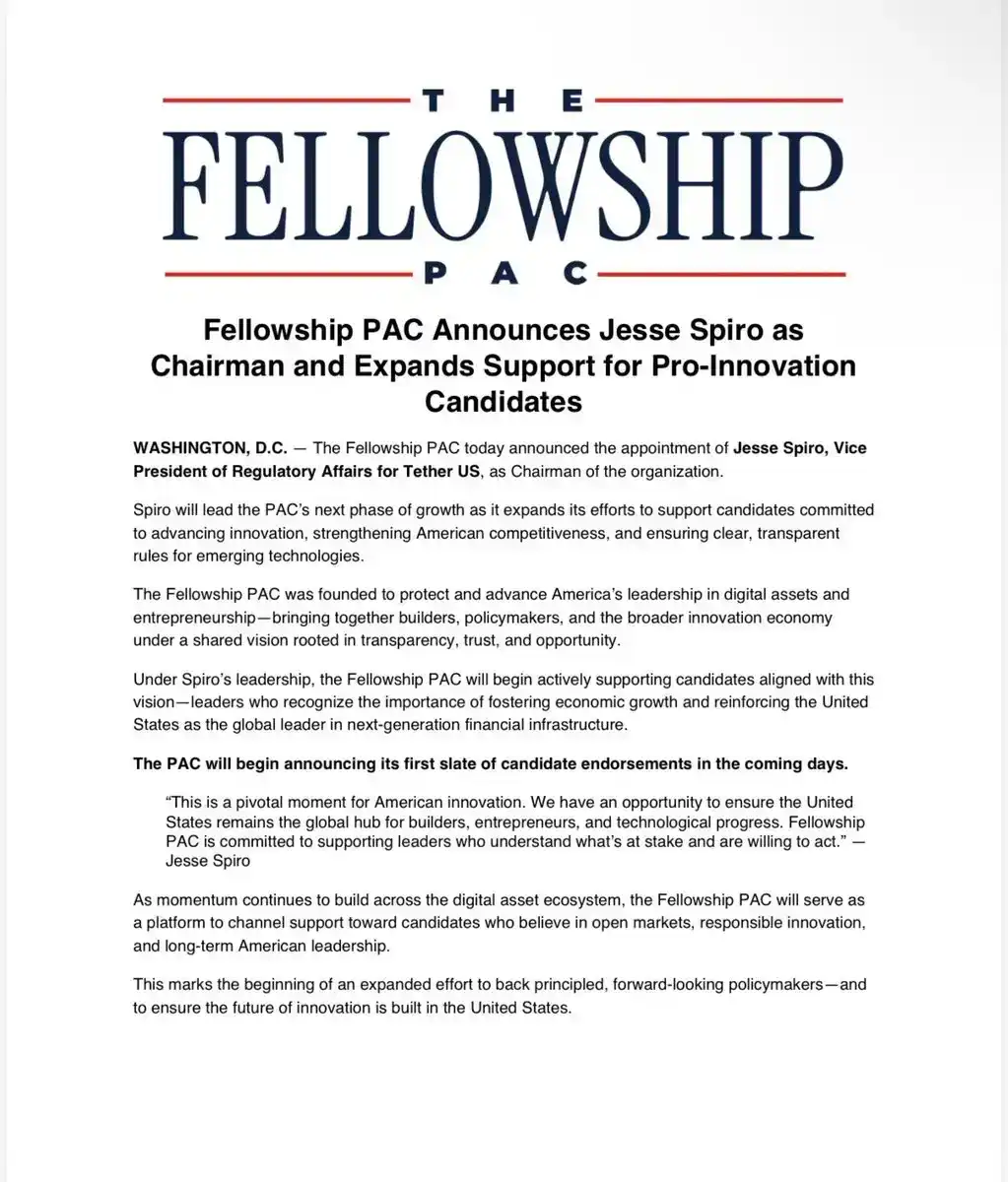
According to a Cointelegraph report on April 1, Fellowship PAC announced on Wednesday that Jesse Spiro, Vice President of Regulatory Affairs at Tether US, will assume the role of chairman, leading the organization's next phase of expansion. The first list of endorsed candidates will be announced in the coming days. Fellowship is a super PAC founded in August 2025, which claimed last September that it had raised "over $100 million" from unnamed donors aligned with the crypto industry.

Spiro stated in a declaration: "This is a critical moment for American innovation. We have the opportunity to ensure that the United States continues to be the global hub for builders, entrepreneurs, and technological progress. Fellowship PAC is committed to supporting leaders who understand what is at stake and are willing to take action."
From 'Denying Ties' to 'Executive Leadership': Tether's Relationship with Fellowship Comes to Light

Since its high-profile debut last September, the identity of Fellowship PAC's backers has been one of the industry's biggest mysteries.

At its inception, the PAC did not disclose any management, donors, or key employees. Early reports listed Tether as an expected supporter, but Tether International subsequently formally denied any connection to the PAC. According to a CoinDesk report in February, a Tether International spokesperson explicitly stated that "Tether International has no affiliation whatsoever with Fellowship."

But FEC records tell a different story. Fellowship's registered treasurer, Mitchell Nobel, is an executive at Cantor Fitzgerald, the custodian institution managing Tether's multi-billion dollar reserves. The PAC's registered address is in Bethesda, Maryland.

Now, with a current Tether US executive officially taking the helm as PAC chairman, the previous rumors have finally solidified into public record. According to BeInCrypto, this marks the first formal, public connection between Fellowship PAC and Tether officially.

Spiro joined Tether in 2024 as Head of Government Affairs. Prior to that, he was responsible for blockchain and digital asset regulatory relations at PayPal and held a leadership role in government affairs at the on-chain analytics company Chainalysis.

$100 Million 'War Chest' Yet to Fire a Single Shot, FEC Records Show Zero Expenditures

Despite Fellowship's assertion of holding $100 million in funds, FEC records show that as of December 31 last year, the PAC reported no donation income or expenditures. Since last September's announcement, Fellowship has only made three public statements on platform X, operating almost "invisibly."

This contrast has raised widespread questions. CoinDesk's investigative report on February 25 pointed out that Fellowship had "never shown up" in its seven months of existence, with its promised $100 million showing no trace in Federal Election Commission disclosures.

Spiro's appointment is seen as a signal of Fellowship's return to the public eye from its period of dormancy. The PAC stated it will announce its first endorsements of candidates in the coming days, with just over seven months remaining until the November midterm elections.

Bo Hines, Executive Director of the White House Digital Asset Advisory Council, expressed support for the appointment on platform X, posting: "The fight for American innovation needs serious advocates. Looking forward to seeing leaders who truly understand the stakes get elected."

Crypto PAC Arms Race: Fairshake Holds $193 Million, Already Spent $8.6 Million in Illinois

Fellowship is not the crypto industry's only political funding machine. The Fairshake PAC and its affiliated organizations, backed by Coinbase, Ripple, and a16z, reported holding $193 million in cash as of January this year, making it the crypto industry's largest super PAC by funding size.

Fairshake has already begun taking action. According to Cointelegraph, the PAC and its affiliates have spent approximately $8.6 million on a congressional race in Illinois, six times its spending in the state in 2024. In the Illinois primary in March, some candidates supported by Fairshake did not win, but there is still a seven-month window until the midterm elections.
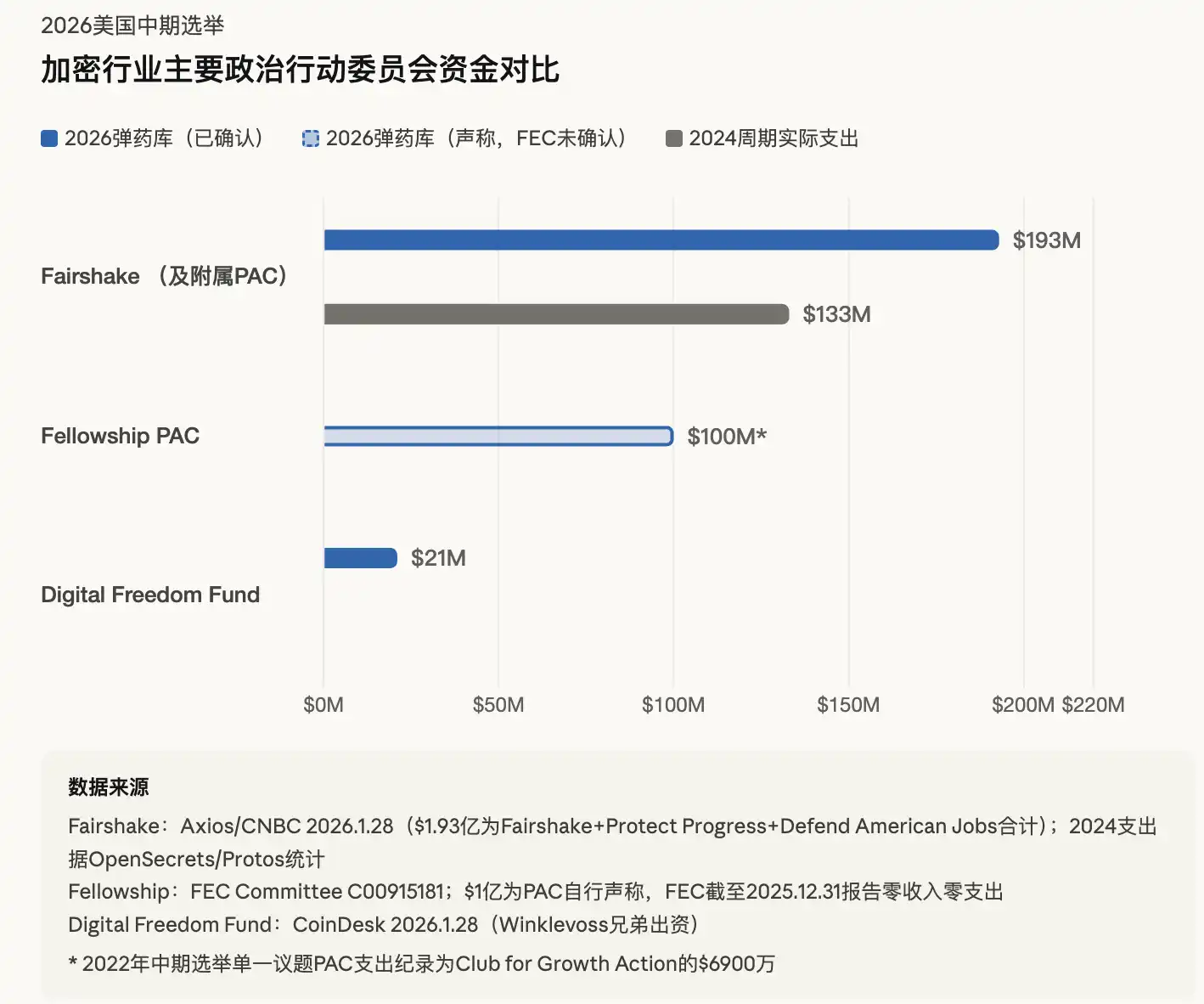
During the 2024 election cycle, Fairshake spent over $130 million on media placements, with the majority of the more than 50 candidates it supported successfully elected. According to statistics from the non-profit oversight organization Public Citizen, nearly half of the corporate money flowing into the 2024 elections came from the crypto industry.

Now, with the combined war chest of nearly $300 million from Fellowship and Fairshake, plus other political donation forces in the crypto industry, the 2026 midterm elections are expected to set a new record for industry political spending.

Legislative Battle: Stablecoin Yield Dispute Stalls CLARITY Act, Tether's Interests at Stake

Spiro's appointment is not coincidental in its timing. The Clarity Act for Digital Asset Markets (CLARITY Act), the crypto industry's core legislative priority, is currently stalled in the Senate, with one of the contentious points being stablecoin yields, which directly impacts Tether's business model.

The CLARITY Act passed the House of Representatives in July 2025 by a vote of 294 to 134 and passed review in the Senate Agriculture Committee in January this year. However, at the Senate Banking Committee level, a fierce battle is underway between the banking industry and the crypto industry over whether stablecoins can pay yields to users.

On March 20, Senators Thom Tillis and Angela Alsobrooks reached a principled compromise on stablecoin yields: prohibiting passive yield payments based on holding balances, but allowing reward programs based on transaction activity. According to CoinDesk, after crypto industry representatives reviewed the latest text behind closed doors on Capitol Hill on March 23, they found the language too narrow and ambiguous. Coinbase has stated twice that it does not support the current draft.

The markup in the Senate Banking Committee is currently scheduled for after the Easter recess in late April. Senator Bernie Moreno warned that if the bill does not advance by May, crypto legislation may not receive serious consideration again during the midterm election cycle.

Compounding the issue, the White House AI and Crypto Tsar, David Sacks, confirmed on March 26 that his 130-day term had expired and the administration would not appoint a successor. The crypto industry's most critical legislative sprint will proceed without its chief advocate in the White House.

Tether's USDT is the world's largest stablecoin, with a market cap of approximately $184 billion, but it is not available to U.S. residents. Tether launched a compliant stablecoin for the U.S. market, USAT, last year. The final outcome of the stablecoin yield provisions will directly determine the operating space for Tether and its competitors in the U.S. market.

Against this backdrop, by having an executive assume the chairmanship of the PAC, Tether is pushing its political influence building from behind the scenes to the forefront, sending a clear signal: during the critical window of legislative博弈 (game/struggle), using political funds to protect industry interests.


Trend Kriptolar

İlgili Sorular

QWho was appointed as the new chairman of the crypto super PAC Fellowship, and what is his role at Tether?

AJesse Spiro, the Regulatory Affairs Vice President of Tether US, was appointed as the chairman of Fellowship PAC.

QHow much combined political funding do Fellowship and Fairshake PACs have for the midterm elections, and what are their reported amounts?

AFellowship and Fairshake PACs have a combined nearly $300 million in political funds, with Fellowship claiming over $100 million and Fairshake holding $193 million.

QWhat discrepancy was reported regarding Fellowship PAC's fundraising claims and FEC records?

AFellowship PAC claimed to have raised over $100 million, but FEC records showed zero reported donations or expenditures as of December 31.

QWhat is the key legislative issue affecting stablecoins like Tether's USDT, and what is the compromise proposed in the CLARITY Act?

AThe key issue is whether stablecoins can pay yields to users. The proposed compromise in the CLARITY Act prohibits passive yield based on holdings but allows reward programs based on transaction activity.

QWhy is Jesse Spiro's appointment significant for Tether and the crypto industry's political strategy?

AIt marks the first formal, public link between Tether and Fellowship PAC, signaling Tether's move to openly influence politics during a critical legislative period for crypto regulations, particularly affecting stablecoin operations.

İlgili Okumalar

Only 153 Venture Capital Firms Invested in July: Is the Crypto VC Industry Experiencing a 'Mass Extinction'?

In July 2026, only 153 unique venture capital firms participated in disclosed crypto funding rounds, marking the lowest monthly count since November 2020. This figure represents an 87% decline from the peak of 1,177 firms in 2022. Overall, the first seven months of 2026 saw crypto projects raise approximately $11.78 billion across 481 rounds. This crypto VC contraction contrasts sharply with the broader venture capital landscape, where global VC investment reached a record $560.4 billion in H1 2026, heavily fueled by major AI company financings. This shift in capital allocation has drawn funds away from the crypto sector. Within crypto, funding is highly concentrated. Trading platforms, prediction markets, and payment sectors absorbed 53% of the total capital. While early-stage deals remain frequent, the largest sums flow to a few late-stage rounds and mergers & acquisitions, which surged to $7.23 billion in Q2 2026. The market is consolidating around top funds like a16z crypto and Dragonfly, which successfully raised new multi-billion dollar funds, while many smaller firms have retreated. Analysts describe this as a "great extinction" for crypto VCs, where capital is becoming more selective, favoring proven business models and assets over early-stage speculation. This raises the bar for project quality, funding efficiency, and viable exit paths.

marsbit16 dk önce

Only 153 Venture Capital Firms Invested in July: Is the Crypto VC Industry Experiencing a 'Mass Extinction'?

marsbit16 dk önce

Strategy's Loss in the Second Quarter Reaches $8.22 Billion Amid Bitcoin Decline

Strategy, the largest corporate holder of Bitcoin, reported a net loss of $8.22 billion for the second quarter. This loss was primarily driven by an $8.32 billion unrealized loss on its Bitcoin holdings due to a decline in the asset's price during the period. Despite these paper losses, the company increased its Bitcoin holdings to 843,775 BTC, a 25% growth since the start of the year. As part of a new monetization strategy, Strategy sold approximately $218.4 million worth of Bitcoin, mainly to fund dividends for preferred shareholders, with $216 million of that sold after Q2 ended. The company also built a $3.75 billion cash reserve, which it claims is sufficient to cover over two years of dividend and interest payments, aiming to insulate itself from Bitcoin's volatility while meeting obligations. Following the earnings release, Strategy's stock (MSTR) rose 4.7% in regular trading but corrected slightly after-hours. This pattern reflects how the company's accounting results are heavily tied to Bitcoin's price swings, even as its long-term strategy remains unchanged. The report indicates that Strategy is maintaining its core strategy of accumulating Bitcoin while building a financial buffer. This quarterly loss follows a recognizable pattern, with the company posting significant unrealized losses in previous quarters (e.g., $12.4 billion in Q4 2025 and ~$12.5 billion in Q1 2026) due to fair-value accounting. A key technical shift is its new monetization program, which introduces periodic selling pressure on the market, transitioning Strategy from a pure accumulator to a participant that occasionally adds supply. A critical question remains: how long can the cash reserve cover dividend obligations if a Bitcoin price downturn persists beyond two years?

cryptonews.ru36 dk önce

Strategy's Loss in the Second Quarter Reaches $8.22 Billion Amid Bitcoin Decline

cryptonews.ru36 dk önce

Will Terrorist Durov Ban Russian Officials?

Telegram founder Pavel Durov publicly reacted to being labeled a "terrorist" by Russian authorities, stating the designation came after he refused demands for mass surveillance and censorship on the platform. In a Telegram post, he highlighted that this status formally bans him from "publishing information online." Durov concluded with a statement widely circulated: Russian officials "clearly don't understand who can ban whom on the internet." This remark suggests Durov could potentially restrict official Russian government and officials' channels on Telegram, which continue to operate on the platform despite its formal blocking in Russia. The situation parallels previous, slow-moving state directives, like switching officials to domestic cars, contrasted with the current push to migrate all government communication to the Russian-made messenger MAX by 2030. However, reports indicate many officials still use Telegram via workarounds, fearing surveillance on MAX, while alternatives like BiP and KakaoTalk recently became inaccessible in Russia without a VPN. Durov has not specified any immediate actions against state channels. His statement is an initial response, with further developments depending on the authorities' reaction. The dynamic differs from 2020 when Russian regulators lifted a block on Telegram; now, Durov implies control from within the platform itself over the official accounts that persisted through that earlier blockade.

cryptonews.ru36 dk önce

Will Terrorist Durov Ban Russian Officials?

cryptonews.ru36 dk önce

DeepSeek V4 Official Version Arrives, New Capabilities Emerge, Value-for-Money King Enters the Fray

On July 31st, DeepSeek officially launched the public API beta for its DeepSeek-V4-Flash model. A key highlight is its performance on multiple Agent benchmark tests, reportedly nearing or even surpassing the level of the V4-Pro preview version from three months ago. Notably, the Flash model achieves this with significantly smaller scale (130B active parameters vs. Pro's 490B), suggesting that post-training optimization and data quality may be as crucial as raw model size. DeepSeek emphasized that the V4-Flash-0731 uses the same model architecture and size as its preview version, with improvements attributed solely to "re-trained post-training." The update also marks the official debut of DeepSeek's self-developed Agent framework, "Harness." The move signals DeepSeek's strategic push to position its cost-effective Flash model as a competitive base for Agent applications—scenarios requiring autonomous planning, tool usage, and complex task execution—where inference speed and cost are critical. By natively supporting OpenAI's Responses API format and adapting for code-generation scenarios, DeepSeek aims not just to be a cheaper alternative but to establish its own ecosystem in the Agent era. This release follows DeepSeek's record-breaking ~$50 billion fundraising round roughly two months prior, underscoring market confidence in its technology and commercialization prospects. The company is reportedly preparing for another funding round at a valuation of approximately $71 billion. The Flash model's advancement represents a step in fulfilling the high expectations that come with this valuation, setting the stage for the impending release of the V4-Pro official version and intensifying competition in the global Agent landscape.

marsbit40 dk önce

DeepSeek V4 Official Version Arrives, New Capabilities Emerge, Value-for-Money King Enters the Fray

marsbit40 dk önce

İşlemler

Spot

Popüler Makaleler

SUPER Nasıl Satın Alınır

HTX.com’a hoş geldiniz! SuperFarm (SUPER) satın alma işlemlerini basit ve kullanışlı bir hâle getirdik. Adım adım açıkladığımız rehberimizi takip ederek kripto yolculuğunuza başlayın. 1. Adım: HTX Hesabınızı OluşturunHTX'te ücretsiz bir hesap açmak için e-posta adresinizi veya telefon numaranızı kullanın. Sorunsuzca kaydolun ve tüm özelliklerin kilidini açın. Hesabımı Aç2. Adım: Kripto Satın Al Bölümüne Gidin ve Ödeme Yönteminizi SeçinKredi/Banka Kartı: Visa veya Mastercard'ınızı kullanarak anında SuperFarm (SUPER) satın alın.Bakiye: Sorunsuz bir şekilde işlem yapmak için HTX hesap bakiyenizdeki fonları kullanın.Üçüncü Taraflar: Kullanımı kolaylaştırmak için Google Pay ve Apple Pay gibi popüler ödeme yöntemlerini ekledik.P2P: HTX'teki diğer kullanıcılarla doğrudan işlem yapın.Borsa Dışı (OTC): Yatırımcılar için kişiye özel hizmetler ve rekabetçi döviz kurları sunuyoruz.3. Adım: SuperFarm (SUPER) Varlıklarınızı SaklayınSuperFarm (SUPER) satın aldıktan sonra HTX hesabınızda saklayın. Alternatif olarak, blok zinciri transferi yoluyla başka bir yere gönderebilir veya diğer kripto para birimlerini takas etmek için kullanabilirsiniz.4. Adım: SuperFarm (SUPER) Varlıklarınızla İşlem YapınHTX'in spot piyasasında SuperFarm (SUPER) ile kolayca işlemler yapın.Hesabınıza erişin, işlem çiftinizi seçin, işlemlerinizi gerçekleştirin ve gerçek zamanlı olarak izleyin. Hem yeni başlayanlar hem de deneyimli yatırımcılar için kullanıcı dostu bir deneyim sunuyoruz.

225 Toplam GörüntülenmeYayınlanma 2024.12.11Güncellenme 2026.06.02

SUPER Nasıl Satın Alınır

Tartışmalar

HTX Topluluğuna hoş geldiniz. Burada, en son platform gelişmeleri hakkında bilgi sahibi olabilir ve profesyonel piyasa görüşlerine erişebilirsiniz. Kullanıcıların SUPER (SUPER) fiyatı hakkındaki görüşleri aşağıda sunulmaktadır.

活动图片