National-Level Players Enter the Game: Deciphering the Escalation and Transformation of Crypto Crime in 2025

marsbit2026-01-12 tarihinde yayınlandı2026-01-12 tarihinde güncellendi

Özet

In 2025, state-level involvement in cryptocurrency-related activities has significantly increased, marking a new phase in the maturation of illicit on-chain ecosystems. Illicit addresses received at least $154 billion, a 162% year-over-year surge, largely driven by a 694% increase in transactions involving sanctioned entities. Even excluding these, 2025 was a record year for crypto crime, with growth across most illegal categories. Stablecoins now dominate illicit transactions, accounting for 84% of the total. Nation-state threats were particularly prominent: North Korean hackers stole $2 billion, including a historic $1.5 billion attack on Bybit. Russia launched the ruble-backed A7A5 token, which saw $93.3 billion in transactions within a year, facilitating large-scale sanctions evasion. Iranian proxy networks and China-based money laundering networks also expanded their operations, offering specialized services like fraud, terror financing, and sanctions avoidance. The rise of full-stack illicit infrastructure providers has enabled both criminals and state actors to conduct malicious activities more effectively. Moreover, the connection between crypto crime and real-world violence is growing, with increased use in human trafficking and violent coercion attacks. Despite these challenges, illicit activity still represents less than 1% of all traceable cryptocurrency transaction volume. Collaboration among law enforcement, regulators, and crypto businesses remains crucial t...

Authored by: Chainalysis

Compiled by: Chopper, Foresight News

In 2025, we observed a significant increase in state-level cryptocurrency-related activities, marking a new mature phase in the development of the illegal on-chain ecosystem. Over the past few years, the professionalization within the crypto crime sphere has deepened; illicit organizations have established large-scale on-chain infrastructure to support transnational criminal networks in procuring goods and services and laundering crypto crime proceeds. Against this backdrop, national governments have also begun to engage in this domain, leveraging these mature professional service providers on one hand, and building their own customized infrastructure on the other, to evade sanctions on a large scale. As governments tap into this illicit cryptocurrency supply chain originally built for cybercriminals and organized crime groups, government agencies, compliance, and security teams now face severe challenges in terms of consumer protection and national security.
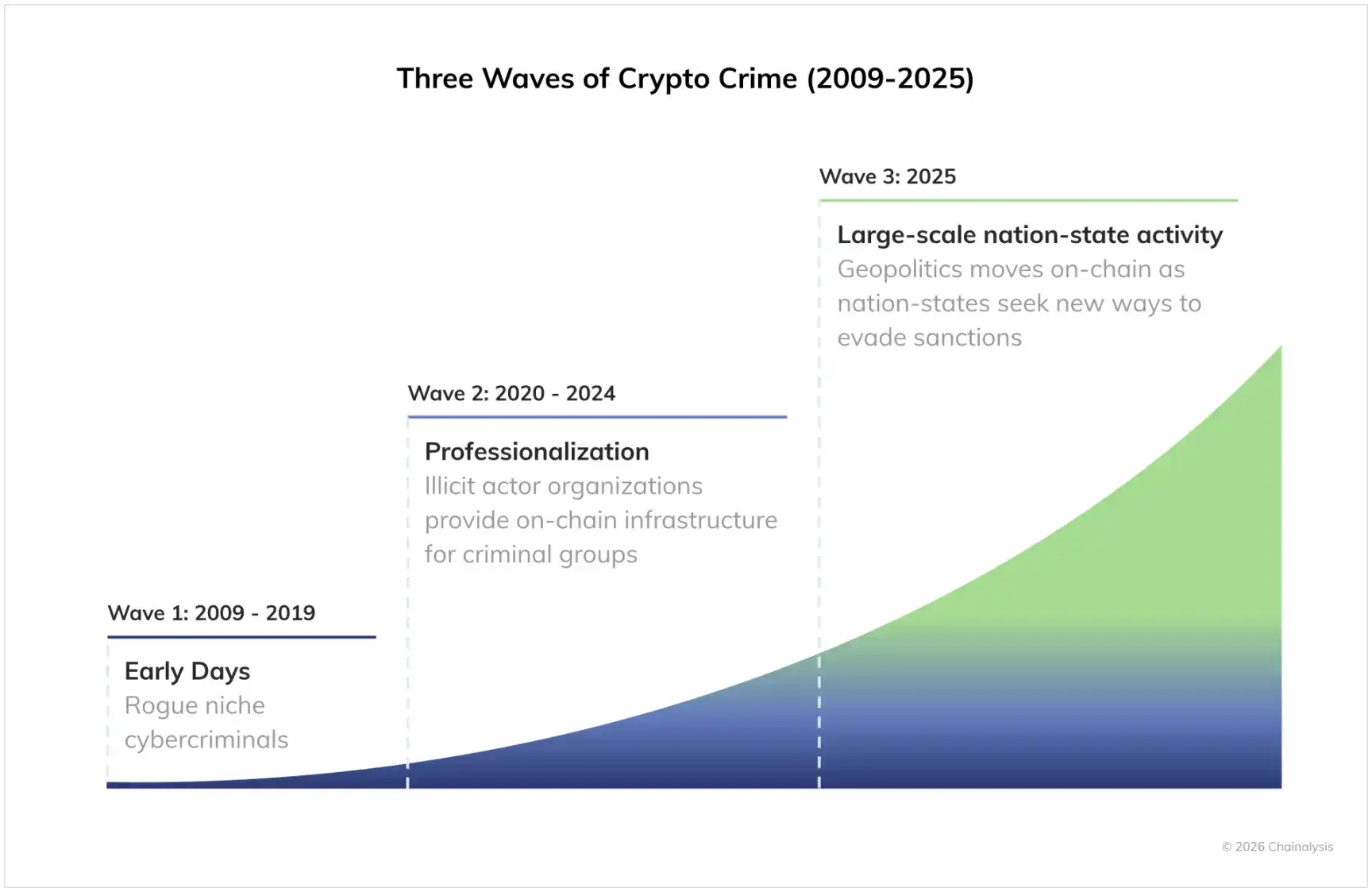
What are the specific on-chain manifestations of these developments and other industry changes? Next, we will analyze them by combining data and macro trends.
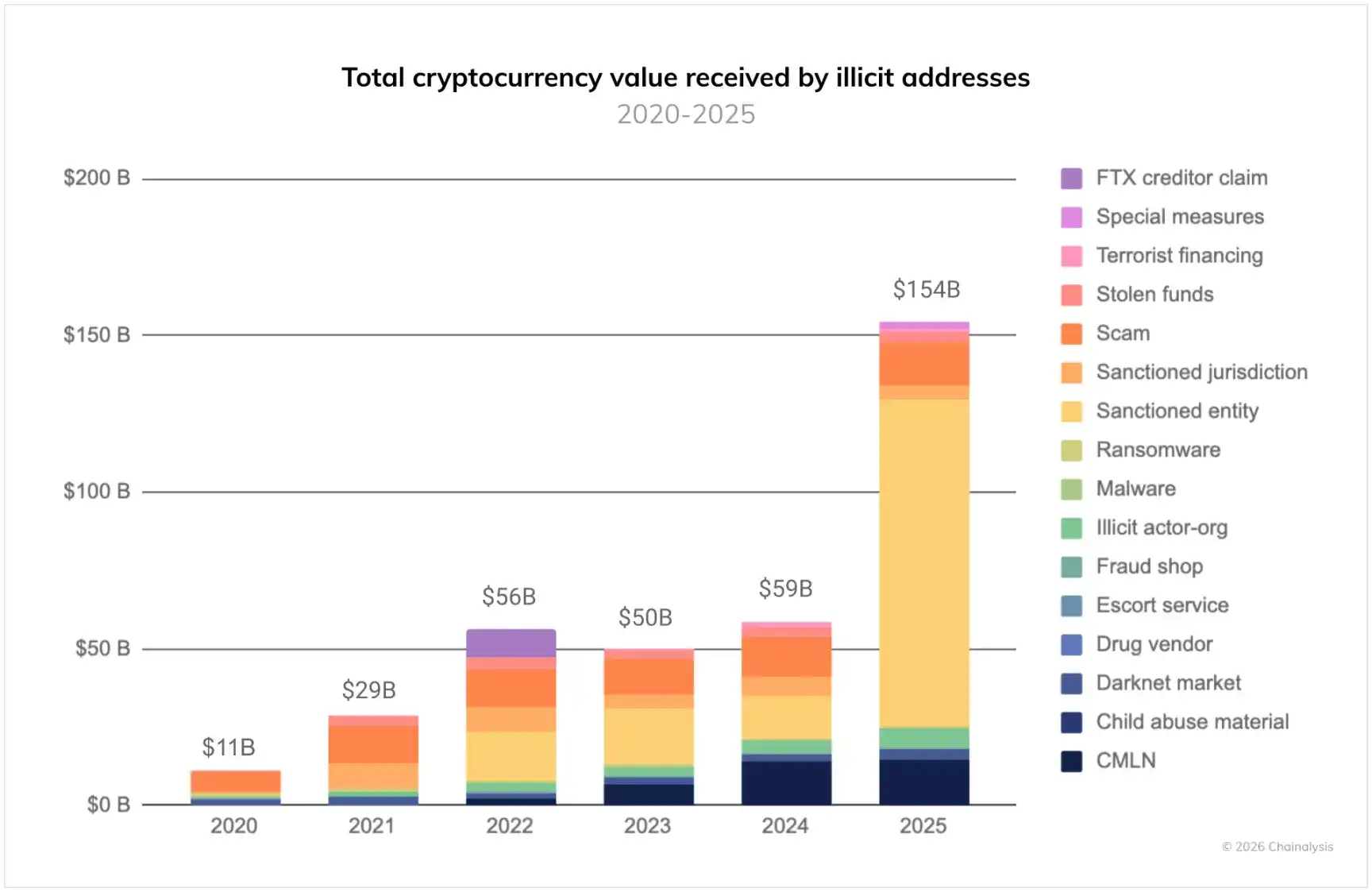
According to our monitoring data, the scale of funds flowing into illicit cryptocurrency addresses in 2025 reached at least $154 billion, a sharp increase of 162% year-on-year. This growth was primarily driven by a surge in fund inflows to sanctioned entities, which soared by 694% year-on-year. However, even excluding the growth from sanctioned entities, 2025 still stands as a record year for crypto crime, as the vast majority of illicit activity categories saw growth.

Nevertheless, the scale of these illicit transactions still pales in comparison to the overall cryptocurrency economy, where legitimate transactions remain the mainstay. We estimate that although the proportion of illicit transactions in the total traceable cryptocurrency transaction volume in 2025 increased slightly compared to 2024, it remained below 1%.

As shown in the figure below, we also observed a continuing shift in the types of assets involved in crypto crime.
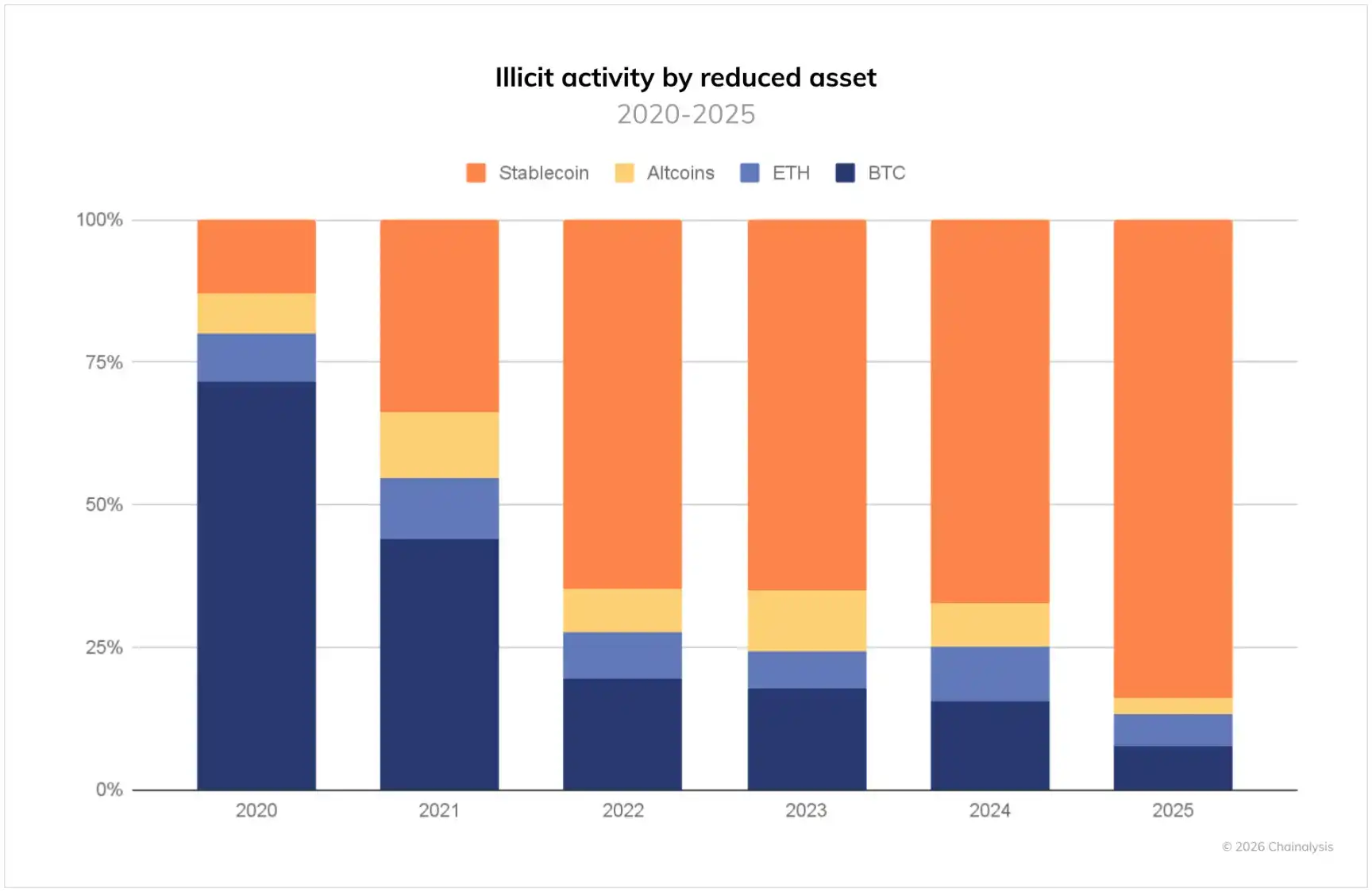
Over the past few years, stablecoins have gradually become the dominant asset for illicit transactions, currently accounting for 84% of the total illicit transaction volume. This trend aligns with the overall development characteristics of the cryptocurrency ecosystem: with advantages such as convenience for cross-border transfers, low volatility, and wide application scenarios, the share of stablecoins in the entire cryptocurrency transaction volume continues to expand.

The following sections will delve into the core trends that defined the crypto crime landscape in 2025, trends that will remain important to watch in the future.

National-Level Threats Drive Transaction Volume: North Korean Thefts Hit Record High, Russian A7A5 Token Facilitates Large-Scale Sanction Evasion

In 2025, stolen funds remained a major threat to the cryptocurrency ecosystem, with North Korean-linked hacker groups alone stealing $2 billion. This figure was primarily driven by several highly destructive large-scale hacking incidents, the most notable being the attack on the Bybit exchange in February. The incident involved nearly $1.5 billion, making it the largest digital asset theft in the history of cryptocurrency. Although North Korean hackers have long been a major force threatening the cryptocurrency ecosystem, the past year saw record highs both in the amount stolen and in the sophistication of their intrusion and money laundering methods.

Particularly noteworthy is that the scale of on-chain activities by national governments reached unprecedented levels in 2025. Russia introduced relevant legislation in 2024 to promote the use of cryptocurrency to evade sanctions, and this measure was formally implemented in February 2025. The country launched the ruble-backed token A7A5, which saw its transaction volume exceed $93.3 billion in less than a year since its launch.

Meanwhile, over the past few years, Iran's proxy networks have conducted money laundering, illegal oil trading, and procurement of weapons and bulk commodities on-chain through identifiable wallet addresses already on sanctions lists, with a cumulative transaction volume exceeding $2 billion. Despite multiple military strikes, Iran-backed terrorist groups such as Hezbollah, Hamas, and the Houthis continue to use cryptocurrency on an unprecedented scale.

In 2025, Chinese money laundering networks emerged as a dominant force in the illicit on-chain ecosystem. These organizations operate with sophisticated models, significantly driving the diversification and professionalization of crypto crime, offering specialized criminal services including "money laundering services." Building on early illegal operation models like "Huiyin Guarantee," these networks have established full-service criminal enterprises, covering areas such as fraud, scams, laundering proceeds from North Korean hacker thefts, sanction evasion, and terrorism financing.

Full-Stack Illicit Infrastructure Providers Fuel Malicious Cyber Activities

While national governments are increasing their use of cryptocurrency, traditional cybercrime remains rampant: ransomware operators, child sexual abuse and cybercrime platforms, malware distributors, scammers, and illicit marketplaces still rely on vast support networks to maintain operations. Illicit actors and national governments are increasingly dependent on full-stack on-chain infrastructure providers, including domain registrars, secure and reliable hosting services, and other technical infrastructure that can be used for malicious cyber activities.

These infrastructure providers have evolved into comprehensive infrastructure platforms capable of resisting platform takedowns, abuse complaints, and sanction enforcement. As the scale of these services continues to expand, they are likely to become a key force driving economic crime and state-backed entities to broaden the scope of their malicious cyber activities.

Growing Correlation Between Cryptocurrency and Violent Crime

In the perception of many, crypto crime is still confined to the virtual world. The masterminds are merely anonymous figures hiding behind keyboards, not translating into real-world threats. But in reality, the link between on-chain activities and violent crime is deepening. Human trafficking rings are increasingly using cryptocurrency for transactions; at the same time, disturbingly, there has been a significant rise in cases of violent coercion attacks, where criminals use violence to force victims to transfer crypto assets, and such assaults often occur during peak cryptocurrency price periods.

Looking ahead, collaboration between law enforcement agencies, regulatory bodies, and cryptocurrency companies will be key to addressing these complex, evolving, and interconnected threats. Although the proportion of illicit transactions within legitimate cryptocurrency trading volume remains limited, maintaining the integrity and security of the cryptocurrency ecosystem has never been more important.


İlgili Sorular

QWhat was the total value of illicit cryptocurrency transactions in 2025, and what was the primary driver of this growth?

AThe total value of illicit cryptocurrency transactions in 2025 reached at least $154 billion, a 162% year-over-year increase. This growth was primarily driven by a massive 694% surge in transaction volume from sanctioned entities.

QWhich asset type has become the dominant medium for illicit transactions and what percentage of the total illicit volume does it represent?

AStablecoins have become the dominant asset for illicit transactions, representing 84% of the total illicit transaction volume.

QWhat significant role did nation-states play in the 2025 crypto crime landscape, according to the article?

ANation-states played a significant role, with activities reaching unprecedented levels. This included North Korean hackers stealing a record $2 billion, Russia launching the A7A5 token to facilitate large-scale sanctions evasion (with nearly $93.3 billion in volume), and Iran's proxy networks laundering over $2 billion for activities like illegal oil trading and weapons procurement.

QWhat new concerning trend is emerging regarding the connection between cryptocurrency and real-world violence?

AA concerning trend is the increasing connection between on-chain activity and violent crime. This includes human trafficking syndicates using crypto for transactions and a significant rise in violent coercion attacks, where victims are physically forced to transfer crypto assets, often during periods of peak cryptocurrency prices.

QWhat is the role of 'full-stack illicit infrastructure providers' in the current crypto crime ecosystem?

AFull-stack illicit infrastructure providers offer comprehensive services to both criminals and nation-states. They have evolved into resilient platforms that can withstand takedowns, abuse complaints, and sanctions enforcement. Their services include domain registration, secure hosting, and other technical infrastructure for malicious cyber activity, making them a critical force in enabling economic crime and state-sponsored operations.

İlgili Okumalar

From South Korea to the United States: Blue-Collar Jobs Are Becoming Increasingly Popular, Thanks to AI

AI is reshaping the labor market's value proposition. The traditional four-year college degree is losing its appeal as a guaranteed career path, while skilled blue-collar trades like electricians, welders, and plumbers are experiencing historic demand and wage premiums. This shift is driven by dual pressures: AI's displacement of certain white-collar roles and a booming need for physical infrastructure and data center construction. Data confirms the trend. In the U.S., vocational school revenue surged, and a significant portion of recent layoffs are AI-related. Surveys show a majority of Gen Z adults plan to pursue blue-collar work, citing better job security against AI automation. Vocational education interest has exploded recently. Experts cite a psychological shift as younger generations seek tangible, AI-resistant careers and avoid high student debt. In many cases, salaries for skilled trades now match or exceed those requiring a bachelor's degree. In South Korea, semiconductor vocational high schools boast near-total employment, with graduates securing high-paying roles at companies like Samsung. The shortage is structural, exacerbated by a retiring baby boomer workforce and massive infrastructure projects. Companies like JPMorgan Chase, Meta, and Lowe's are investing heavily in training programs. However, overcoming historical stigma and a "perception gap" around trade careers remains a key challenge to closing the talent gap.

marsbit22 dk önce

From South Korea to the United States: Blue-Collar Jobs Are Becoming Increasingly Popular, Thanks to AI

marsbit22 dk önce

Qualcomm: AI Hype Subsides, When Will Smartphones Emerge from the Gloom?

Qualcomm reported its Q3 FY2026 results (ending June 2026), with revenue of $9.95B, down 4% YoY but above expectations. Gross margin declined to 53.1%, pressured by rising costs across manufacturing and memory. Key business segments showed mixed performance: Handset revenue fell 19.6% YoY to $5.09B, dragged by an 11% decline in non-Apple Android shipments and weaker high-end mix. Conversely, Automotive revenue surged 61% to $1.59B, and IoT grew 9% to $1.83B. Core operating profit dropped 41% YoY due to margin compression and higher expenses. Management's Q4 FY2026 guidance projects revenue of $9.7B-$10.5B, in line with consensus, but Non-GAAP EPS guidance of $2.05-$2.25 fell short of expectations. Amidst persistent weakness in its core handset market, Qualcomm is pursuing growth in AI, focusing on Edge AI (smartphones, PCs, automotive) and Data Center AI. Its data center strategy includes four pillars: AI accelerators (e.g., AI200), commercial CPUs (Dragonfly C1000), custom silicon, and connectivity solutions. While these initiatives initially boosted its stock, concerns over AI capital expenditure sustainability have since erased those gains. The company targets $5B in data center revenue for FY2027 and $15B for FY2029. The report concludes that with the traditional handset business still under pressure, the data center opportunity is currently viewed as a longer-term option, and a more conservative valuation based on core operations may be warranted until AI contributions materialize.

marsbit26 dk önce

Qualcomm: AI Hype Subsides, When Will Smartphones Emerge from the Gloom?

marsbit26 dk önce

From TPU to Self-Evolving Agents: How Jeff Dean Predicts the Next Step in AI

At the 2026 YC Startup School, Jeff Dean outlined his vision for AI's next phase, shifting focus from simply scaling models to building intelligent, autonomous systems. He believes AI's progress is no longer just about creating smarter models, but about integrating them into systems capable of long-term, iterative work, automated experimentation, and continuous learning. This evolution moves the competition from "who has the bigger model" to "who can best organize intelligence." Dean suggests AI capabilities are now comparable to a junior engineer, enabling the automation of complex workflows. However, the true challenge and opportunity lie in managing these AI "workers" at scale. He emphasizes the importance of **context engineering**—structuring tools, memory, and feedback loops—over raw model power. For startups, this means building deep expertise in niche domains where general models currently fail (near 0-1% success rates), leveraging proprietary data, specialized tools, and domain-specific evaluators. A recurring theme is re-examining fundamental constraints. Dean's past work, like moving Google's search index to memory or creating the TPU, stemmed from questioning outdated assumptions about hardware and cost. He sees similar inflection points today, particularly in **specialized inference hardware** to drastically reduce latency and energy consumption for real-time Agent operation. Notably, he points out that in modern AI systems, the dominant cost is often not computation but **data movement**. Reliable, long-running Agents require robust system design, borrowing concepts from distributed computing like checkpointing, state management, and parallel exploration to handle failures and maintain progress over days or weeks. As AI automates execution, the scarcest human skills will shift to **defining clear specifications**, **judging what problems are worth solving** (taste), and designing effective feedback loops. Ultimately, Dean's framework prioritizes understanding the problem deeply, identifying the true bottlenecks, and systematically building closed-loop systems where AI can not only perform tasks but also improve AI itself.

marsbit26 dk önce

From TPU to Self-Evolving Agents: How Jeff Dean Predicts the Next Step in AI

marsbit26 dk önce

İşlemler

Spot
活动图片




