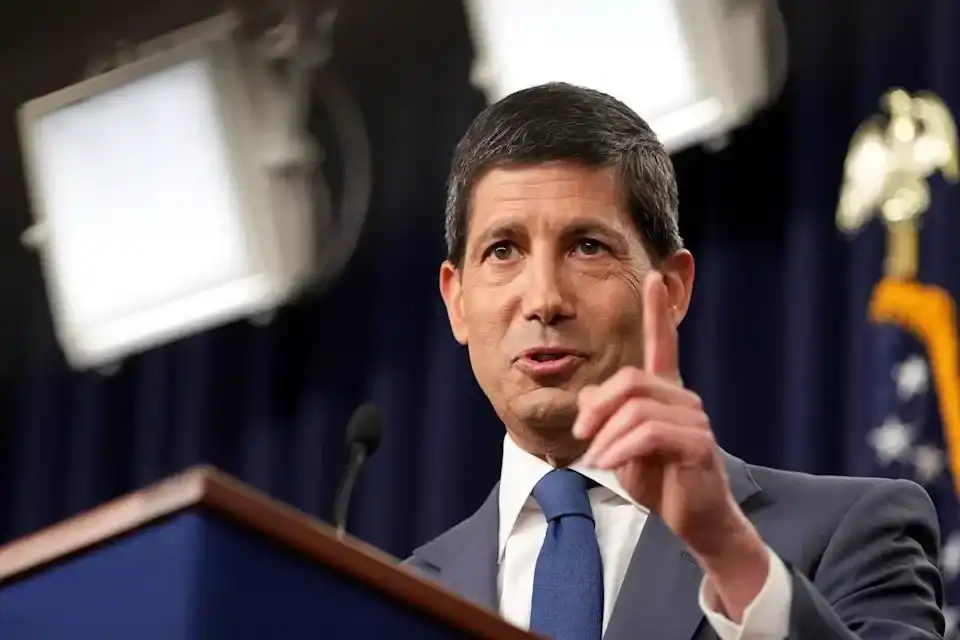
Narrowest-Ever Margin to 'Pass': US Senate Confirms Warsh as Federal Reserve Chair

marsbit2026-05-14 tarihinde yayınlandı2026-05-14 tarihinde güncellendi

Özet

On May 13, the U.S. Senate confirmed Kevin Warsh as the new Federal Reserve Chair in a historically narrow vote of 54-45, largely along party lines. This marks the slimmest confirmation margin since 1977. Warsh, a former Fed governor known for hawkish views, will succeed Chair Jerome Powell on May 14 amid a politically charged environment. His tenure begins as the Fed faces resurgent inflation, with recent CPI and PPI data exceeding expectations, and mounting pressure from the Trump administration for interest rate cuts. Warsh has pledged to maintain the Fed's independence despite these political overtures. His first major test will be the June FOMC meeting, where he must navigate conflicting demands between cooling inflation and political calls for monetary easing, all while working to restore market confidence in the central bank's non-partisan credibility.

On Wednesday, Eastern Time, the U.S. Senate formally confirmed former Federal Reserve Governor Kevin Warsh as the Federal Reserve Chair following a full floor vote. While the Senate's confirmation was expected, the vote saw Warsh receiving support from senators only by a narrow margin.

The vote on Warsh's nomination for Fed Chair was almost entirely along party lines, with the nomination receiving 54 'yes' votes and 45 'no' votes—a mere 9-vote difference. Among the supporters, 53 were Republican senators. Only one Democrat, Senator John Fetterman of Pennsylvania, defected to vote in favor.

According to media statistics, based on this vote result, this confirmation vote is the "narrowest margin" for any Federal Reserve Chair since the U.S. Congress in 1977 required that the Fed Chair nomination be confirmed by the Senate. Compared to Warsh, previous Fed Chair nominees were all confirmed by the Senate with significantly larger margins.

Current Fed Chair Powell won at least 80 votes in favor during his two-term confirmations. Powell's predecessor, Yellen, was confirmed in 2014 with a vote of 56 in favor and only 26 against, with many senators absent from that vote due to poor weather.

Powell's term as Fed Chair is scheduled to end this Friday, May 15th. Following the Senate confirmation, Warsh will officially take over on May 14th, beginning a four-year term as Chair. In a vote on Tuesday, the Senate had already confirmed Warsh for a 14-year term as a Federal Reserve Governor.

Warsh undoubtedly faces thorny monetary policy decisions upon taking office. Earlier this week, following the release of hotter-than-expected U.S. April CPI data, Nick Timiraos, known as the "new Fed whisperer," pointed out that the CPI report means rate cuts are no longer a story for 2026, and Trump, who nominated Warsh, has already expressed a strong desire for the Fed to cut rates. Warsh is heading for trouble.

Before the Senate vote results were announced, on Wednesday, Timiraos further noted that the market was strongly signaling that the 2024-2025 rate-cutting cycle had ended.

He highlighted a market development: the yield on the two-year Treasury note rose to its highest level since June of last year during Wednesday's trading session. The Fed's policy rate in June of last year was 75 basis points higher than it is now.

Media reports indicate that a growing number of Fed officials believe the central bank should clearly signal that its next interest rate move could be either a hike or a cut. This means that if Warsh attempts to push for rate cuts that other officials view as lacking justification, he will face strong resistance.

Taking Office Under the Shadow of 'Politicization': Fed Independence Faces Unprecedented Scrutiny

The reason Warsh's confirmation process garnered such attention is not just because of the close vote, but also because it occurred against the backdrop of escalating controversy over the politicization of U.S. monetary policy.

Over the past few months, U.S. President Trump has continuously and publicly pressured the Fed to cut rates. Since taking office last year, he has repeatedly criticized Powell for acting "too slowly" on rate cuts and frequently hinted at wanting the Fed to be more cooperative with the White House's economic agenda.

Facing these questions, Warsh emphasized during his confirmation hearing that he made no policy promises to Trump, would absolutely not be Trump's puppet, and pledged to uphold the Fed's monetary policy independence.

However, the market widely believes that the relationship between the Fed and the White House will enter a more sensitive phase after Warsh takes office.

It is noteworthy that although Powell is stepping down as Fed Chair, he still plans to retain his position as a Federal Reserve Governor. This means that for some time, the Fed's internal dynamics may feature two different styles and policy philosophies simultaneously.

Warsh: From Hawk to Moderate

The 56-year-old Warsh is not an "outsider."

He served as a Federal Reserve Governor from 2006 to 2011, one of the youngest governors at the time, and participated in core decision-making during the 2008 global financial crisis. Since then, he has been active on Wall Street and in academia, having worked at the Duquesne Family Office and served as a research fellow at Stanford University's Hoover Institution.

Compared to Powell, Warsh's monetary policy philosophy leans more "hawkish."

He has long criticized the Fed for maintaining ultra-loose policy for too long after the pandemic, believing it directly fueled inflation in subsequent years. He has also repeatedly advocated for reducing the Fed's balance sheet, decreasing the use of "forward guidance" on future rate paths, and pushing the Fed to "return to a more traditional central bank role."

However, the market has also noted that Warsh's recent public statements on interest rates have been more moderate than in the past, which some Democratic lawmakers view as a move towards Trump's dovish stance.

Warsh's Top Challenge: Inflation Reheating

The most immediate challenge facing Warsh is the resurgence of U.S. inflationary pressures.

CPI and PPI data for April released this week show that energy prices and geopolitical risks are pushing inflation higher again. U.S. CPI rose 3.8% year-over-year in April, while PPI rose 6% year-over-year, marking the largest increases in nearly three years and over three years, respectively.

At the same time, escalating Middle East tensions, risks in the Strait of Hormuz, and surging oil prices are adding further imported inflationary pressure.

This means that while the Trump administration hopes to push for rate cuts to stimulate economic growth, the real inflationary environment may not permit the Fed to pivot quickly to easing.

In other words, Warsh may face a dilemma right at the start of his term: the "White House wants rate cuts" versus "economic data doesn't support rate cuts."

Another Major Challenge: How to Allay Market Concerns Over Fed Credibility

Beyond the pure interest rate decision, a deeper issue lies in whether the market still believes in the Fed's independence.

Over the past year, political attacks on the Fed have escalated significantly—from the controversy over White House pressure to cut rates, to the Justice Department investigating the Fed headquarters renovation project, to some Republicans publicly calling for Powell's resignation—all raising concerns that the central bank's independence is being eroded.

Warsh's almost purely partisan confirmation process itself reinforces such concerns.

In contrast, Powell previously received over 80 Senate votes in favor in both of his confirmations for Fed Chair; Yellen also secured 56 votes in favor when confirmed in 2014.

Analysts believe that in the future, Warsh will not only need to formulate monetary policy but will also need to rebuild market trust in the Fed as being "apolitical."

June Meeting May Bring 'Debut Storm'

Warsh's first major test after taking office will likely be the monetary policy meeting of the Federal Open Market Committee (FOMC) scheduled for June 16-17.

Currently, divisions within the Fed over whether the next move should be a rate hike, a hold, or a cut have notably widened.

On one hand, U.S. economic growth is beginning to slow; on the other hand, inflation and oil prices are rising again.

The market currently widely expects that the Fed may not cut rates this year, but the Trump administration clearly does not accept this outlook.

Therefore, Warsh's first policy meeting will not only determine the direction of interest rates but will also serve as the first pressure test for the market to observe whether he leans more towards "political compromise" or "central bank independence."

İlgili Sorular

QBy what margin was Kevin Warsh confirmed as Federal Reserve Chair by the Senate, and why is this notable?

AKevin Warsh was confirmed by a vote of 54 to 45, a margin of just 9 votes. This is notable as it is the narrowest margin of confirmation for a Fed Chair since 1977, when Senate confirmation became required.

QWhat potential challenge regarding monetary policy is Warsh expected to face immediately upon taking office?

AWarsh is expected to face the difficult challenge of navigating potential pressure from the White House to cut interest rates while confronting economic data, such as recently hot inflation figures, that may not justify a swift move to monetary easing.

QWhy has Kevin Warsh's confirmation process raised particular concerns about the Federal Reserve's independence?

AHis confirmation process raised concerns because the vote was almost strictly along party lines and occurred against a backdrop of heightened political pressure on the Fed from the White House to cut rates, fueling fears of increasing politicization of monetary policy.

QHow does Kevin Warsh's past monetary policy stance compare to that of his predecessor, Jerome Powell?

AHistorically, Warsh has been considered more of a monetary policy 'hawk' compared to Powell. He has criticized the Fed's prolonged post-pandemic easy policy for fueling inflation and advocated for a return to a more traditional central bank role, though his recent rhetoric has softened.

QWhat is seen as a key early test for Chair Warsh after he takes office?

AA key early test will be the Federal Open Market Committee (FOMC) meeting in June. This meeting will be closely watched to see how he navigates internal Fed divisions and external political pressure on interest rate decisions, serving as an initial gauge of his commitment to central bank independence.

İlgili Okumalar

Navigating the World of Event Trading: Top 5 Prediction Markets for Every Type of User

The prediction market industry has grown significantly, with trading volumes exceeding $20 billion monthly by mid-2026, driven by sports, politics, and macroeconomics. Success now depends heavily on platform choice and execution logistics. This guide compares five leading networks: **Polymarket**: A high-volume, decentralized platform on Polygon, using USDC for international and crypto-native users. It offers diverse markets but lacks built-in risk tools. **Kalshi**: A CFTC-regulated U.S. exchange for institutional traders, using direct fiat. It leads in regulated volume, especially for major sports and economic events, but has limited contract listings. **Outpoll**: A CeDeFi platform for advanced traders, focusing on professional tools. It uniquely features built-in stop-loss/take-profit orders, 0.1% fees, and full API support, with settlement in USDC. **OG Predictive**: A CFTC-regulated, sports-focused platform from Crypto.com. It offers granular player props and a flat fee structure, appealing to long-term position traders. **Manifold Markets**: A play-money, no-KYC platform for casual users and developers. It allows user-generated markets on any topic with zero fees, serving as a sandbox for strategy testing. Key differentiators include regulatory models (regulated vs. decentralized), funding (fiat vs. crypto), order types, risk management features, API access, and mobile support. The conclusion emphasizes that in today's event trading, profitability hinges not just on accurate predictions but on optimizing execution through platform infrastructure, liquidity, fees, and risk tools.

TheNewsCrypto9 dk önce

Navigating the World of Event Trading: Top 5 Prediction Markets for Every Type of User

TheNewsCrypto9 dk önce

Why Are Large-Scale Crypto Conferences No Longer Glamorous?

Why Are Major Crypto Conferences Losing Their Allure? A growing sense of fatigue surrounds large in-person crypto conferences, with many founders and investors now avoiding events they would never have missed just two years ago. While complaints cite declining ROI and information quality, the root causes are more structural. Crypto, global from inception, once relied on these mega-conferences as neutral hubs for essential face-to-face connections. However, their core value has been fragmented. High-quality participants—developers, investors—have largely migrated to smaller, private side-events, leaving main stages for repetitive content already shared online. The main conference often just becomes the excuse for being in the same city, with attendees scrambling between exclusive dinners and micro-events. While these intimate gatherings offer signal-rich conversations, they lose the "serendipitous encounters" of large conferences and can create insular echo chambers, especially as talent concentrates in hubs like New York. Meanwhile, invite-only, high-caliber summits are rising, offering quality and scale but at the cost of accessibility and crypto's early egalitarian ethos. This shift isn't unique to crypto; AI events in San Francisco show a similar trend. The perception of higher-value interactions drives core groups towards smaller, private settings, potentially creating a vicious cycle that drains larger events of their vitality. Yet, a more optimistic view exists. The apparent decline of crypto-centric events may signal industry maturation. Leading projects are now focused outward—on stablecoins for traditional finance, consumer-facing digital banks, or real-world assets. Crypto topics are increasingly integrated into mainstream finance and tech conferences. Just as dedicated "internet conferences" faded, dedicated crypto summits may become redundant as the technology embeds into every sector. The future likely holds far fewer large, inward-looking crypto conferences. The industry has moved past needing frequent self-congratulatory gatherings. True growth lies in engaging with the broader economy. This evolution towards private networking and mainstream integration, for better or worse, is a mark of the industry coming of age.

marsbit21 dk önce

Why Are Large-Scale Crypto Conferences No Longer Glamorous?

marsbit21 dk önce

Coin & Stock Compass: Global Listed Companies Net Sold $85.45 Million in BTC Last Week, Strategy's Dollar Reserves Scale Up to $3 Billion (July 14)

Global Public Companies Net Sell $85.45 Million in BTC; Strategy's Dollar Reserves Hit $3 Billion (July 14) Last week saw a significant net sell-off of Bitcoin by global public companies, excluding miners, totaling $85.45 million—a 908.42% decrease from the prior week. Major buyers like Strategy (formerly MicroStrategy) and Japan's Metaplanet were notably absent from the market. However, two companies, Brazil's OrangeBTC and asset manager Strive, made purchases, adding 8 and 18 BTC, respectively. The aggregate BTC holdings of tracked public companies now stand at 1,139,635 BTC, valued at approximately $71.38 billion and representing 5.7% of Bitcoin's circulating market cap. In corporate updates, Strategy announced its dollar reserves have grown by $450 million to reach $3 billion, while its BTC holdings remain at 843,775 coins. Hyperscale Data increased its BTC reserves past 1,000 coins. Strategy will report its Q2 2026 financial results on July 30. Mining firm Cleanspark added 454 BTC, bringing its total to 13,924 BTC. Conversely, BitFuFu sold 184 BTC, Bitdeer maintained zero net BTC holdings after selling its weekly production, and Empery Digital sold 1,400 BTC to fund an AI data center project and repay debt. Overall, public companies purchased 110,000 BTC in Q2 2026, 1.8 times the volume of the previous two quarters combined. In other cryptocurrency-related corporate news, Ethereum treasury company Bitmine increased its ETH holdings by 27,801 coins, with total staked ETH exceeding 4.9 million. Solana-focused company DFDV transferred daily operations of its meme coin DONT to an independent team. BNB treasury company BNB Plus was delisted from Nasdaq for failing to meet the $1 minimum bid price and moved to trade on the OTCQB market under the symbol BNBX. The broader equity markets showed mixed signals. Bank of America warned that bullish investor positioning indicated a potential pullback risk for stocks. In contrast, Morgan Stanley predicted the ongoing earnings season could broaden market gains beyond tech giants. Specific regional highlights included continued foreign investor outflows from South Korean stocks, pressure on US equities, and the upcoming IPO of Chinese memory chip maker ChangXin Memory. Most crypto-linked stocks remained in a downtrend.

marsbit34 dk önce

Coin & Stock Compass: Global Listed Companies Net Sold $85.45 Million in BTC Last Week, Strategy's Dollar Reserves Scale Up to $3 Billion (July 14)

marsbit34 dk önce

Why Are Major Crypto Conferences Losing Their Luster?

Why Are Major Crypto Conferences Losing Their Appeal? A growing sense of fatigue surrounds large-scale offline crypto conferences. Participants complain of declining returns and less substantial information, but the root cause is deeper. Initially, these global summits were vital for a decentralized industry without a physical hub, enabling crucial face-to-face connections. However, the value of large main-stage events has been eroded. High-quality developers and investors have migrated to exclusive, invitation-only side events and private dinners. While these offer focused networking, they lose the "serendipitous encounters" of larger gatherings and can create elitist barriers, contradicting crypto's open ethos. This fragmentation triggers a vicious cycle: as key people leave main events, their value diminishes further. Simultaneously, the industry's focus is shifting outward. Leading crypto firms are now engaging with traditional finance and real-world applications like stablecoins, digital banking, and prediction markets. Consequently, crypto-specific topics are increasingly integrated into mainstream financial conferences, making dedicated crypto summits potentially redundant. Looking ahead, the frequency of top-tier crypto conferences will likely decrease significantly. The industry has moved past its inward-looking phase. The migration of quality discourse to private settings and the push for mainstream adoption, while diluting the large conference model, are ultimately signs of the sector's maturation.

Foresight News46 dk önce

Why Are Major Crypto Conferences Losing Their Luster?

Foresight News46 dk önce

İşlemler

Spot
活动图片