Moscow Exchange Set to Launch $XRP Indices and Futures Contracts

bitcoinist2026-02-03 tarihinde yayınlandı2026-02-03 tarihinde güncellendi

Özet

The Moscow Exchange (MOEX), Russia's largest financial marketplace, is preparing to launch indices and futures contracts for XRP, marking a significant shift in the country's approach to digital assets. This move is seen as a pragmatic step toward using cryptocurrencies for cross-border liquidity outside the SWIFT system, particularly given XRP's institutional settlement utility. The introduction of futures will allow Russian institutional investors to hedge crypto exposure without direct token ownership. In contrast, the retail market is showing increased interest in high-risk, high-reward projects like Maxi Doge ($MAXI), an Ethereum-based token that promotes a high-leverage trading culture. It features gamified trading competitions and a staking system offering 68% APY to incentivize long-term holding. The project has raised $4.5M in its presale, targeting traders seeking aggressive returns in the current bull market.

Sanctions evasion and digital asset adoption have reached a critical flashpoint in Russia.

The Moscow Exchange (MOEX), the country’s largest financial marketplace, is reportedly finalizing the infrastructure to launch indices and futures contracts for $XRP, according to local media outlet RBC. That milestone marks a sharp pivot from the Kremlin’s historical skepticism regarding cryptocurrencies.

It signals a pragmatic shift toward assets that facilitate cross-border liquidity outside the SWIFT system.

Why $XRP? It’s long been positioned by Ripple Labs as a bridge currency for institutional settlement. (The irony of a U.S.-based blockchain firm becoming a liquidity rail for a sanctioned economy isn’t lost on anyone.)

The introduction of futures contracts on MOEX allows domestic institutional investors to hedge exposure to crypto assets without holding the underlying tokens directly, a massive step for integrating digital assets into the broader Russian economy. The choice of $XRP over other altcoins stems from its speed and established utility in global banking pilots.

While Bitcoin remains the primary store of value, $XRP’s lower transaction costs and sub-second finality make it a more attractive vehicle for the high-frequency nature of futures trading. The move effectively institutionalizes volatility, transforming what was once a speculative retail playground into a regulated derivative market.

But while institutions build compliant rails for $XRP, the retail sector is looking elsewhere. Traders are gravitating toward assets that embody the raw, unbridled energy of the current bull cycle. As traditional finance adopts crypto utility, the ‘degen’ economy is doubling down on high-leverage culture, seeking projects that mirror the relentless grind of market speculation. Projects like Maxi Doge ($MAXI).

Maxi Doge brings ‘Leverage King’ Culture to Ethereum

As the Moscow Exchange prepares to formalize crypto trading for the elite, the retail market is witnessing the rise of Maxi Doge ($MAXI), a project that arguably captures the current market zeitgeist better than any institutional derivative. Built on the Ethereum network, Maxi Doge positions itself as the ‘heavier,’ more aggressive cousin to the original Dogecoin, specifically targeting traders who live for high-leverage environments.
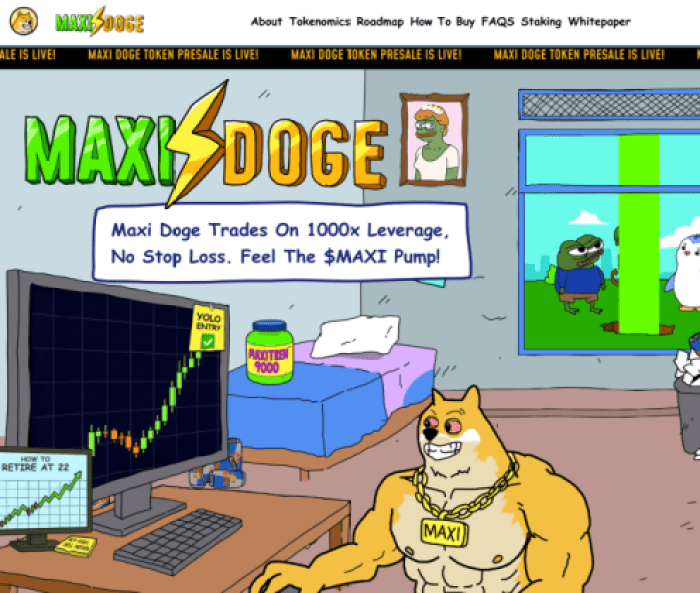
The project plans to differentiate itself through a gamified ‘Leverage King’ culture. Rather than relying solely on passive holding, Maxi Doge integrates holder-only trading competitions where participants vie for leaderboard rewards. It’s a shift that transforms the community from passive spectators into active participants.

This answers a specific behavioral shift in the market: retail traders aren’t satisfied with slow gains anymore; they’re seeking outsized returns and the social validation that comes with high-stakes trading.

By gamifying the grind of the bull market, Maxi Doge creates a sticky ecosystem that rewards conviction, a stark contrast to the sterile, regulated environment being built by traditional exchanges like MOEX.

FIND OUT MORE IN OUR ‘WHAT IS MAXI DOGE?’ GUIDE

Presale Momentum and Dynamic Staking Rewards

While the narrative drives the community, the numbers underpinning Maxi Doge reveal a financial structure designed for sustainability. The project has moved well beyond the conceptual phase, with the official presale already raising $4.5M.

This capital injection is being directed toward the ‘Maxi Fund’ treasury, which supports liquidity provision and future partnership developments (potentially even integrations with futures platforms down the line).

At the current presale price of $0.0002802, the token offers an accessible entry point for retail investors who missed the early days of legacy meme coins. But frankly, the protocol’s staking mechanism is where the long-term value proposition becomes clear.

Maxi Doge employs a dynamic APY system (currently offering 68% rewards), planning to distribute rewards daily from a dedicated 5% staking allocation pool. This smart contract-governed distribution is designed to incentivize lock-ups for up to one year, reducing circulating supply pressure while rewarding those with the ‘diamond hands’ mentality the project espouses.

The security of the ERC-20 standard provides the technical backbone, but the economic model is distinctively modern. By combining the viral appeal of ‘gym bro’ humor, ‘Never skip leg-day, never skip a pump,’ with hard-coded financial incentives, Maxi Doge attempts to solve the liquidity flight often seen in meme tokens.

It creates a feedback loop where staking reduces sell pressure, potentially amplifying price action when market volatility spikes.

BUY $MAXI NOW FROM ITS OFFICIAL PRESALE SITE.

The content provided in this article is for informational purposes only and does not constitute financial advice. Cryptocurrency markets, including derivatives on the Moscow Exchange and meme tokens like Maxi Doge, are highly volatile and carry significant risk. Always conduct your own due diligence before investing.


İlgili Sorular

QWhat is the Moscow Exchange planning to launch for $XRP, and why is this significant?

AThe Moscow Exchange is finalizing the infrastructure to launch indices and futures contracts for $XRP. This is significant because it marks a major shift from Russia's historical skepticism of cryptocurrencies and represents a pragmatic move toward using digital assets for cross-border liquidity outside the SWIFT system.

QAccording to the article, what are the two main reasons $XRP was chosen over other altcoins for this initiative?

A$XRP was chosen for its speed and its established utility in global banking pilots, making it more attractive for the high-frequency nature of futures trading due to its lower transaction costs and sub-second finality.

QHow does the article contrast the institutional adoption of $XRP with the current trend in the retail crypto market?

AThe article contrasts the institutional, compliant rails being built for $XRP with the retail trend of gravitating towards high-leverage, speculative projects like Maxi Doge ($MAXI), which embodies the 'degen' economy and raw energy of the current bull cycle.

QWhat is the core concept behind Maxi Doge's 'Leverage King' culture?

AMaxi Doge's 'Leverage King' culture is a gamified system that features holder-only trading competitions where participants compete for leaderboard rewards, transforming the community from passive holders into active participants seeking outsized returns and social validation.

QWhat are two key features of Maxi Doge's ($MAXI) financial structure mentioned in the article?

ATwo key features are its dynamic APY staking system (currently 68%), which rewards users daily from a dedicated pool to incentivize long-term lock-ups, and its 'Maxi Fund' treasury, which uses presale funds to support liquidity and future development.

İlgili Okumalar

2026 New Policy Interpretation: The "Mutual Pursuit" of Intelligent Agents and AI Terminals, and the Three Major Value Reconstructions in the AIoT Industry

In May 2026, China's national ministries released two pivotal policy documents that jointly establish a strategic "dual-track" framework for the AIoT industry. The "Intelligent Agent Standardized Application and Innovation Development Implementation Opinions" defines the "soul"—positioning intelligent agents as core AI products. The "Artificial Intelligence Terminal Intelligence Grading" national standard defines the "body"—establishing a four-tier capability ladder (L1 to L4) for AI hardware. This synchronized policy approach is globally unique, moving beyond market-led (US) or risk-focused (EU) models. It frames AIoT as a new type of "intelligent infrastructure," comparable to electricity or the internet in historical significance. The core analysis identifies a value evolution from IoT 1.0 (connection) to AIoT 4.0 (collaboration, represented by the forward-looking L4 level). This "L4" signifies a paradigm shift: from users operating tools to delegating tasks to agent-like devices ("Intelligent Action of All Things"). The article outlines three strategic paths for companies: becoming Standard Definers, Scenario Integrators (focusing on 19 specified application areas), or Infrastructure Builders. A critical 18-24 month window is identified for strategic positioning. A "Four Levers" strategy is proposed: leveraging Standards (L-level certification), leveraging Scenarios (deep vertical focus), leveraging Open Source (for cost reduction and ecosystem influence), and leveraging Momentum (engaging in global protocol ecosystems). In conclusion, these policies are a starting gun for a decade-long industrial transformation, shifting the industry narrative from "Intelligent Connection of All Things" to "Intelligent Action of All Things," with companies needing to choose their赛道and execution strategy decisively.

marsbit43 dk önce

2026 New Policy Interpretation: The "Mutual Pursuit" of Intelligent Agents and AI Terminals, and the Three Major Value Reconstructions in the AIoT Industry

marsbit43 dk önce

Splashing Out 27 Billion Yuan, OpenAI Establishes New Company to Accelerate AI Deployment

On May 11th, OpenAI announced the formation of a new company, "OpenAI Deployment Company," with an initial investment of over $4 billion (approximately 27.2 billion RMB). This venture aims to help businesses build and deploy AI solutions. OpenAI is also acquiring the AI consulting firm Toromo to rapidly scale the deployment company's capabilities. This new entity, majority-owned by OpenAI, brings together 19 investment, consulting, and system integration partners, led by TPG with co-lead founding partners including Advent International, Bain Capital, and Brookfield. OpenAI's Chief Revenue Officer, Denise Dresser, stated that while AI is becoming increasingly capable, the current challenge lies in integrating these systems into core business infrastructure and workflows. The deployment company is designed to bridge this gap and translate AI capabilities into operational impact. This move comes as OpenAI emphasizes the next competitive phase will depend on the efficiency of deploying AI in real business scenarios. The company reports over 1 million businesses already use its products and APIs. OpenAI is significantly increasing its investments in computing power, with co-founder Greg Brockman stating the company expects to spend $50 billion on compute this year, a dramatic increase from $3 million in 2017. The announcement follows OpenAI's recent completion of a record $122 billion funding round in late March, led by Amazon, Nvidia, and SoftBank, valuing the company at $852 billion post-money. Major strategic investors committed $110 billion as a base for this round. Concurrently, OpenAI is advancing its core model development. It has shifted focus from its Sora video generator to developing advanced robotics and AI models that interact with the physical world. It has also begun allowing select users access to a new model specialized in identifying software vulnerabilities and is reportedly preparing to launch an enhanced image generation model in the coming weeks. According to reports citing founder Sam Altman, OpenAI is considering an IPO as early as 2027, with a potential valuation around $1 trillion.

marsbit59 dk önce

Splashing Out 27 Billion Yuan, OpenAI Establishes New Company to Accelerate AI Deployment

marsbit59 dk önce

İşlemler

Spot
Futures
活动图片




