Morning Post | Trump Media Group Releases Q1 Financial Report; Top Three DeFi Applications Return Nearly $100 Million in Revenue to Token Holders in 30 Days; Michael Saylor Shares Bitcoin Tracker Info Again

链捕手2026-05-11 tarihinde yayınlandı2026-05-11 tarihinde güncellendi

Özet

**Title: Daily Briefing | Trump Media Group Releases Q1 Report; Top 3 DeFi Apps Return Nearly $100M to Token Holders; Michael Saylor Signals Potential Bitcoin Buy** **Summary:** Key developments in the past 24 hours include: * **Economic Outlook:** Goldman Sachs has pushed back its forecast for the next two Federal Reserve interest rate cuts to December 2026 and March 2027, citing persistent inflationary pressures from energy costs. This delayed timeline is expected to tighten liquidity flow into risk assets, including cryptocurrencies. * **DeFi & Revenue:** Data from DefiLlama shows that three leading DeFi applications—Hyperliquid, Pump.fun, and EdgeX—collectively distributed $96.3 million in revenue to their token holders over the last 30 days. This trend highlights a shift in the crypto community's focus towards real protocol earnings and sustainable economic models. * **Corporate Bitcoin Moves:** Michael Saylor, founder of MicroStrategy (note: referred to as 'Strategy' in the text, likely a typographical error), has signaled potential upcoming Bitcoin purchases by posting a "Bitcoin Tracker" update, following a pattern that typically precedes the company's official disclosure of new acquisitions. * **Market Integrity:** Prediction market platform Polymarket announced updates to address platform issues, including identifying and banning clusters of accounts involved in "ghost-fill" activities and implementing measures to prevent bulk account creation. * **Regu...

Compiled by: ChainCatcher


Key Updates:

  • Trump Media Group Q1 Report: Approximately $400 Million Unrealized Loss on BTC and Other Crypto Asset Investments
  • Michael Saylor Shares Bitcoin Tracker Info Again, May Disclose Acquisition Data Next Week
  • Bank of England Governor: Stablecoin Regulation Could Trigger Tussle Between US and International Regulators
  • Data: Top Three DeFi Applications Return Nearly $100 Million in Revenue to Token Holders in 30 Days
  • Strategy CEO Clarifies Bitcoin Sale Conditions: Will Only Sell When Beneficial to Shareholders
  • Bank of England Governor: Stablecoin Regulation Could Trigger Tussle Between US and International Regulators

What significant events occurred in the past 24 hours?

Goldman Sachs Delays Fed Rate Cut Forecasts to December 2026, Citing Inflation Pressure

ChainCatcher News, Goldman Sachs has postponed its forecast for the next two Fed rate cuts to December 2026 and March 2027. The report points out that energy cost pass-through could keep core Personal Consumption Expenditures (PCE) inflation around 3% for all of 2026, above the Fed's 2% target. Previously, the International Monetary Fund (IMF) also predicted core PCE wouldn't return to 2% until early 2027 at the earliest.

Goldman Sachs US economists believe that cooling monthly data and a weakening labor market must precede rate cuts. On April 29, the Fed maintained the federal funds rate at 3.50% to 3.75%, a meeting that saw four dissenting votes, the most since 1992. According to CME FedWatch data, the market probability of rates remaining unchanged at the June 17 meeting is 93.4%. Lindsay Rosner of Goldman Sachs Asset Management previously stated that hawks might prevail at the June FOMC meeting. For the crypto market, delayed rate cuts tighten liquidity flowing into risk assets, and a stronger dollar tends to suppress crypto asset valuations.

Data: Top Three DeFi Applications Return Nearly $100 Million in Revenue to Token Holders in 30 Days

ChainCatcher News, According to DefiLlama data, three relatively active DeFi applications—Hyperliquid, EdgeX, and Pump.fun—collectively distributed $96.3 million in revenue to token holders over the past 30 days. Hyperliquid led with $50.95 million, returning all revenue directly to holders with zero incentive spending; Pump.fun returned $22.09 million to holders from its $38.81 million total revenue; EdgeX distributed $23.26 million from its $8.26 million protocol revenue, indicating it may have utilized reserves or other income sources.

Annualized data shows Hyperliquid generated $946 million in revenue over the past year, Pump.fun $481 million, and EdgeX $236 million. This trend reflects the crypto community's shift from focusing on trading volume to actual revenue. Yearn.Finance founder Andre Cronje noted that DeFi in 2026 is no longer just a speculative venue but is becoming the backend infrastructure for the on-chain economy, with a stablecoin market of $320 billion, decentralized exchange monthly spot trading volume exceeding $160 billion, and perpetual contract DEX monthly trading volume reaching $540 billion.

Michael Saylor Shares Bitcoin Tracker Info Again, May Disclose Acquisition Data Next Week

ChainCatcher News, Strategy founder Michael Saylor has again shared information related to the Bitcoin Tracker.

Based on previous patterns, Strategy has always disclosed Bitcoin acquisition information the day after such related messages are posted.

Polymarket: Identified and Banned Multiple 'Ghost-Fill' Account Clusters, Will Strengthen Ban Mechanism

ChainCatcher News, Polymarket announced the latest progress on feature updates, including the rollout of latency spam mitigation measures to ensure order placement and cancellation operations, fixing the "insufficient balance/authorization" error, with another core issue affecting limit buy orders expected to be resolved in the coming days.

Additionally, Polymarket stated it has identified and banned multiple "ghost-fill" account clusters. The relevant accounts were all created before the deposit wallet system went live. Any account exhibiting "ghost-fill" behavior will be identified and banned, and the deposit wallet system will also prevent violators from mass-creating new accounts. More updates to resolve previous legacy issues will be released in the coming week.

South Korean National Tax Service Pilots Delegating Seized Virtual Assets to Private Custodian Management for First Time

ChainCatcher News, According to News1, the South Korean National Tax Service is piloting the delegation of seized virtual assets to private crypto custody institutions for safekeeping and management for the first time, with the trial planned to run until the end of this year.

Major South Korean custody institutions such as KODA, KDAC, Hecto WalletOne, BDACS, and InfiniteBlock are preparing to participate. Although the pilot project's budget is only about $5,800, the industry believes gaining a reference case as a "South Korean National Tax Service project" holds symbolic significance.

Meme Hot List

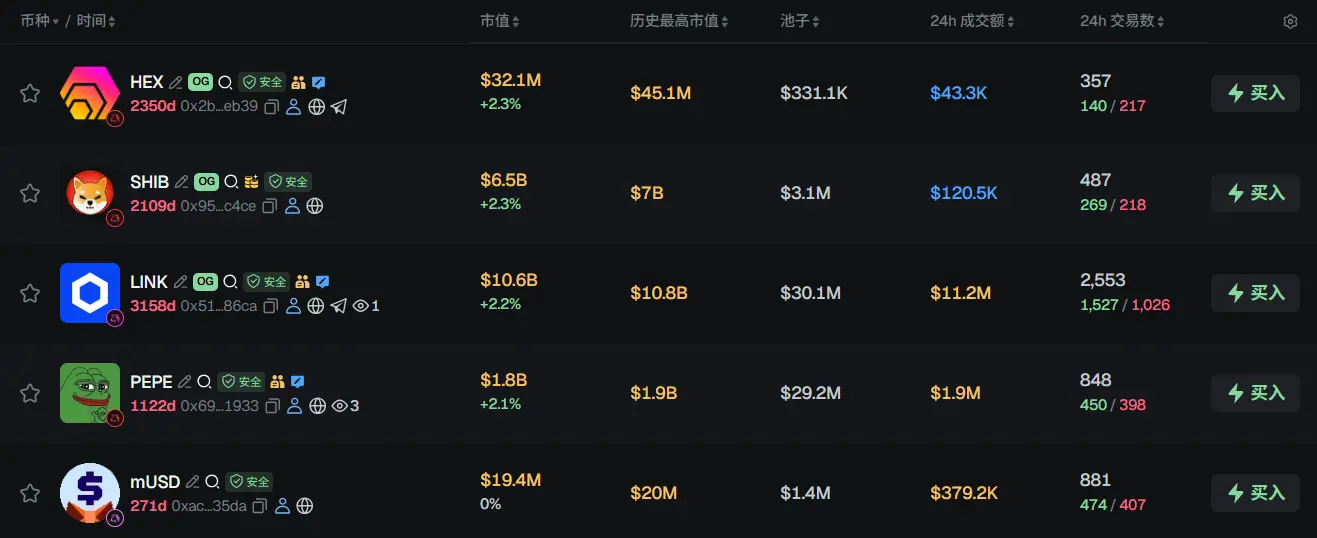
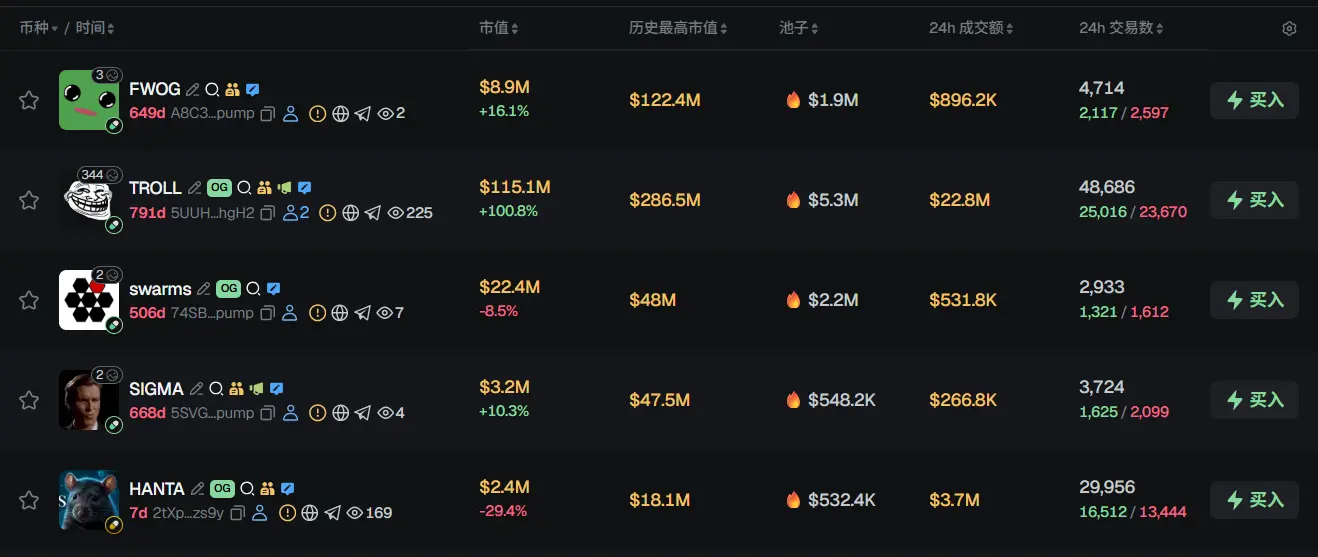
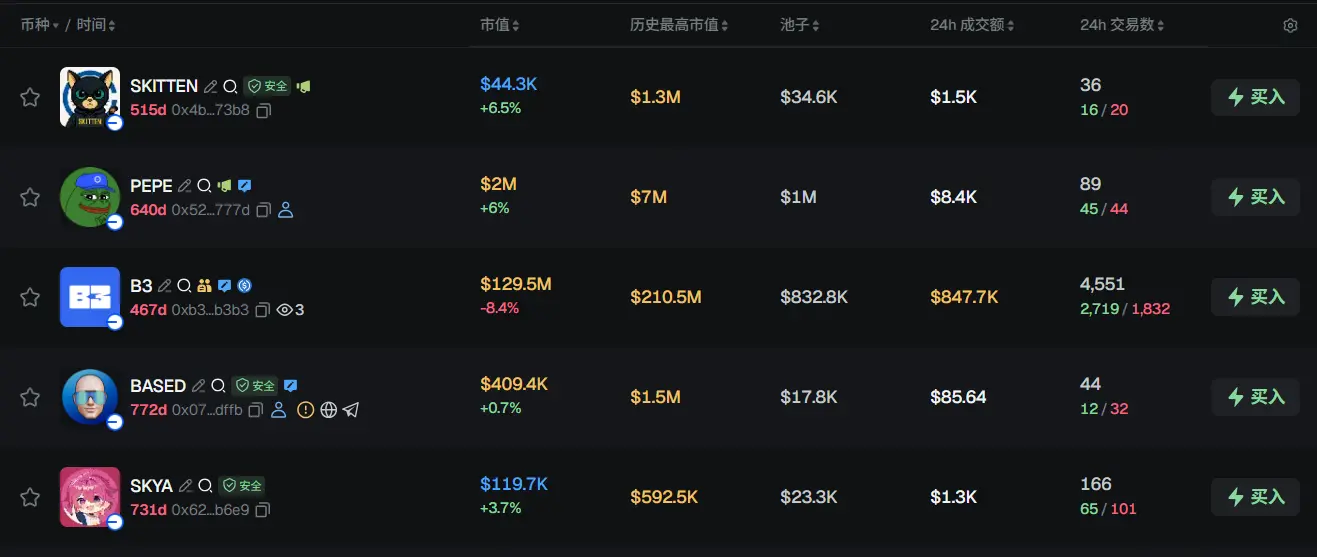
According to data from meme token tracking and analysis platform GMGN, as of 09:00 on May 11, 2026,

The top five trending ETH tokens over the past 24h are: HEX, SHIB, LINK, PEPE, mUSD
The top five trending Solana tokens over the past 24h are: FWOG, TROLL, swarms, SIGMA, HANTA
The top five trending Base tokens over the past 24h are: SKITTEN, PEPE, B3, BASED, SKYA
Which great articles are worth reading from the past 24 hours?

İlgili Sorular

QWhat was the reported net loss on BTC and other crypto asset investments for Trump Media Group in its Q1 financial report?

ATrump Media Group reported an unrealized loss of approximately $4 billion on its BTC and other crypto asset investments in its Q1 financial report.

QAccording to the article, which three DeFi applications returned nearly $1 billion in revenue to token holders in the past 30 days?

AAccording to DefiLlama data, Hyperliquid, EdgeX, and Pump.fun returned a combined $963 million in revenue to token holders over the past 30 days.

QWhat specific event does the article suggest typically follows Michael Saylor's release of Bitcoin Tracker information, based on previous patterns?

ABased on previous patterns, following Michael Saylor's release of Bitcoin Tracker information, MicroStrategy typically discloses its bitcoin acquisition data the next day. The article suggests next week may see such a disclosure.

QWhat major reason did Goldman Sachs give for pushing back its forecast of the Federal Reserve's next two interest rate cuts to December 2026 and March 2027?

AGoldman Sachs cited persistent inflation pressure as the main reason, noting that energy cost pass-throughs could keep core PCE inflation around 3% throughout 2026, which is above the Fed's 2% target.

QWhat is a key trend highlighted by Yearn.Finance founder Andre Cronje regarding the current state of DeFi (Decentralized Finance) in 2026?

AAndre Cronje highlighted that DeFi in 2026 is no longer just a venue for speculation but is evolving into the backend infrastructure for the on-chain economy, with significant market sizes such as a $3.2 trillion stablecoin market.

İlgili Okumalar

The Shutdown of Claude Mythos Revealed the True Cost of Renting AI to Me

The sudden shutdown of Claude Mythos this week starkly highlights a critical, often overlooked risk for founders: when your core capability relies entirely on someone else's platform, your fate is not in your own hands. The key question becomes: who truly owns the intelligence your product depends on? For years, the debate around open-source models focused on cost. Now, the evidence is clear: fine-tuned open-source models can achieve frontier-level quality for specific, mission-critical tasks at a fraction of the cost. However, the deeper issue is control. Relying on a third-party API is like renting; it works until the landlord changes the rules, raises the rent, or asks you to leave—as Mythos experienced. The lesson is not to stop using frontier models—they are incredible infrastructure. The goal is ownership. Ownership means starting with a powerful open-source model and shaping it around what makes your company unique: your data, workflows, domain expertise, and definition of "good." Over time, the model becomes less generic and more reflective of your business, creating durable value. The optimistic conclusion is that AI's future doesn't hinge on one superior model. There is no single frontier. The frontier includes proprietary models, models fine-tuned on company-specific knowledge, specialized models for narrow problems, and intelligent routers orchestrating model ensembles. The most interesting development is not models getting smarter, but intelligence becoming increasingly customizable. The winning companies will be those that transform intelligence into a unique, owned asset. Looking ahead, the vision is not one model dominating all, but many teams owning the part of the frontier that matters most to them.

marsbit3 dk önce

The Shutdown of Claude Mythos Revealed the True Cost of Renting AI to Me

marsbit3 dk önce

Tiger Research: U.S. Strategic Bitcoin Reserve - Should the Market Be Happy or Disappointed?

Tiger Research analyzes the evolution of U.S. legislative efforts regarding a strategic Bitcoin reserve, concluding the market impact is limited in the short term but potentially positive long-term. The core event was a March 2025 executive order by former President Trump, which designated confiscated Bitcoin as a strategic reserve and promised not to sell existing holdings (approx. 190k BTC). As it contained no mandate to purchase new Bitcoin, the market reacted negatively, with prices dropping 5.7%. Legislative history shows a significant retreat from initial ambitions. The 2024 "BITCOIN Act" proposed mandatory purchases of 1 million BTC over five years. Reintroduced in 2025, it stalled due to high fiscal costs, concerns over dollar hegemony, and opposition from the Treasury Secretary. The current frontrunner, the 2026 "American Retirement and Monetary Advancement (ARMA) Act," is a compromise. It lacks any purchase requirement, instead focusing on consolidating existing government-held Bitcoin and legally prohibiting its sale for at least 20 years. While ARMA has higher passage odds due to bipartisan support and no purchase mandate, its immediate market effect is neutral. It eliminates potential government selling pressure but creates no new demand. The long-term significance is that formally establishing Bitcoin as a national reserve asset in law could later reignite debates on mandatory purchases. Therefore, the path to a government buyer is longer than initially priced by the market, but the directional narrative remains intact.

marsbit6 dk önce

Tiger Research: U.S. Strategic Bitcoin Reserve - Should the Market Be Happy or Disappointed?

marsbit6 dk önce

US Stock Market Trend (June 16): SpaceX Rises 42% in Two Days, New Fed Chairman Takes Office Today

**U.S. Stocks Trend (June 16): SpaceX Soars 42% in Two Days, New Fed Chair Takes Office Today** Markets surged on Monday following former President Trump's social media announcement of a completed U.S.-Iran deal to reopen the Strait of Hormuz, pending a June 19 signing. The news triggered a broad risk-on rally: oil prices crashed, tech stocks soared, bond yields fell, and defensive sectors lagged. **Market Performance:** The Nasdaq jumped 3.07%, led by semiconductor stocks like Micron (+9.2%). The S&P 500 gained 1.65%, and the Dow rose 0.92% to a record high. However, the Russell 2000 small-cap index underperformed (+0.72%). SpaceX continued its hot streak, rising another 5% pre-market after disclosures of large buys by an Australian billionaire and Cathie Wood's ARK. Boeing also rallied on the transportation optimism. Conversely, energy stocks like Chevron fell over 3% on the oil price plunge, with other defensive sectors also selling off. The day's action showed a clear rotation of funds from energy/defensive plays into AI and tech narratives. **Macro & Outlook:** The VIX fear index fell 8.37%. Treasury yields declined, and WTI crude dropped over 5%. Attention now shifts to a packed schedule: the Bank of Japan is widely expected to hike rates to 1.0% on Tuesday. The Fed's June meeting concludes Wednesday, marking new Chair Wash's debut. While rates are expected to hold, his tone on stubborn inflation and the "dot plot" will be crucial for gauging the 2024 rate path. The formal Iran deal signing is set for Friday. **Trend Perspective:** While the peace deal is a genuine positive, Monday's explosive rally may have gotten ahead of itself, pricing in a swift resolution to inflation concerns. The shortened trading week faces a triple test: BoJ tightening, the Fed's policy stance, and deal implementation details. Tech and semiconductors, which led the surge, remain vulnerable to any disappointment from these key events. The real price discovery begins with the central banks' communications this week.

marsbit27 dk önce

US Stock Market Trend (June 16): SpaceX Rises 42% in Two Days, New Fed Chairman Takes Office Today

marsbit27 dk önce

Xiaohongshu's Second Great Voyage, This Time Sailing Towards AI

Xiaohongshu's Second Voyage: Navigating Towards AI Since ChatGPT's emergence, Xiaohongshu's founder Mao Wenchao has been acutely aware of AI's potential threat, recognizing that the life advice people seek from chatbots overlaps directly with his platform's core business. Founded in 2013 as a PDF shopping guide for Chinese tourists, Xiaohongshu evolved into a massive community where millions share authentic, personal experiences—from product reviews to travel tips. This vast repository of "I've tried this" human judgment became its most valuable asset. However, the rise of AI, which delivers instant answers, challenges the very need for users to sift through numerous personal notes. Fearing its treasure trove of lived experience could become mere training data for others, Xiaohongshu is proactively adapting. In 2026, it established a dedicated AI division (Dots), launched RED Skill to turn user experiences into usable AI tools, and acquired the AI search product "Diandian." Its investments now extend to AI firms like MiniMax and hardware startups, moving upstream to address needs before they even become search queries. The platform's commercialization strategy is also evolving. With a newly acquired payment license and tools like the AIPS model to track consumer decision journeys, Xiaohongshu aims to seamlessly integrate recommendations with transactions, embedding commerce within AI-generated answers. Yet, a critical tension remains. While building smarter machines to organize and leverage its human experiences, Xiaohongshu must prevent AI from drowning out the authentic, flawed, and trustworthy "I've tried this" voices that built its community. Its core challenge is to harness AI's power without letting the map—the machine's perfect, synthesized answer—replace the territory of genuine human experience. This balance between technological advancement and preserving human trust defines its current journey and its future.

marsbit1 saat önce

Xiaohongshu's Second Great Voyage, This Time Sailing Towards AI

marsbit1 saat önce

İşlemler

Spot
Futures
活动图片