Morgan Stanley Remains Bullish on SK Hynix and Samsung, Memory Market to Shift in Q4

marsbit2026-08-07 tarihinde yayınlandı2026-08-07 tarihinde güncellendi

Özet

Morgan Stanley maintains its bullish outlook on SK Hynix and Samsung Electronics, keeping their target prices at 2.6 million won and 381,000 won respectively. The report expects the memory industry to transition into a late-cycle phase by Q4 2026, as price growth decelerates. Despite this, three key factors underpin the positive view: continued upward revisions in AI capital expenditure, improved earnings visibility from long-term agreements (LTAs), and recent valuation pullbacks reflecting cycle-top concerns. While DRAM and NAND contract prices are still rising, their quarterly growth rates have peaked and are slowing. AI-related demand remains robust, prompting major cloud providers to forecast continued supply tightness into 2027. LTAs with key customers provide some downside protection but do not fully lock in future profits. High current DRAM margins near 90% could attract new supply, posing a long-term risk. The report highlights potential challenges from rising channel inventory, new capacity coming online, and expansion by Chinese manufacturers. Ultimately, the high target prices hinge on AI demand extending the profitability cycle and LTAs mitigating volatility, with future performance depending on these factors holding through potential price corrections post-2028.

In its Asia Tech report 'Memory – A Small Wrinkle' released on August 6, Morgan Stanley continues to be optimistic about leading Korean memory chipmakers, maintaining its price targets for SK Hynix and Samsung Electronics. The price target for SK Hynix is set at 2.6 million Korean won, and for Samsung Electronics common stock at 381,000 Korean won. Based on the benchmark stock price used in the research report, these imply potential upside of approximately 74% and 65%, respectively.

Such a high implied upside does not mean Morgan Stanley believes memory prices will continue to rise at their previous pace. On the contrary, the report already observes narrowing price increases, rising channel inventory, and new production capacity gradually entering the market. It judges that the memory industry will transition into the late stage of the cycle in the fourth quarter of 2026.

Morgan Stanley remains bullish, primarily betting on three key themes: continued upward revisions in AI capital expenditure, improved profit visibility due to long-term supply agreements, and the recent pullback in memory stock valuations, which already reflects some concerns about a cyclical peak.

Earnings forecasts also reflect this caution. Morgan Stanley raised its 2026 EPS forecast for SK Hynix by 13%, mainly due to including a one-time investment gain of KRW 63.27 trillion in Q2. However, its 2026 operating profit forecast was lowered by 7%. The 2026 EPS forecast for Samsung Electronics was cut by 10%, mainly reflecting weaker consumer businesses such as smartphones.

The adjustments to earnings forecasts for both companies for 2027-2028 are relatively minor. Based on the revised forecasts in the report, SK Hynix's 2027 EPS is expected to grow by about 25%, and Samsung Electronics' by about 49%, roughly corresponding to the report's stated range of 25% to 50%.

Prices Still Rising, But the Memory Cycle Begins to Decelerate

Product price increases have been the most direct driver behind the recent memory stock rally. AI server demand has boosted demand for HBM, server DRAM, and enterprise SSDs, while capacity expansion has struggled to keep pace, driving significant price increases for DRAM and NAND.

Citing TrendForce data, Morgan Stanley notes that the sequential increase in overall DRAM and NAND contract prices peaked in Q1 2026 at 96% and 88%, respectively. It is expected to be 61% and 58% in Q2, but forecasts fall to 16% and 13% in Q3, and further to 6% and 3% in Q4.

The report's latest channel checks indicate early Q3 DRAM contract price settlements are up about 15% sequentially, slightly below the previous expectation of 20%. NAND contract prices are up about 20%. PC DRAM contract prices are expected to rise 15% to 20% sequentially in Q3, a significant slowdown from the 45% to 50% increase in Q2.

Therefore, a more accurate description is not that 'memory prices have peaked,' but that prices are still rising, albeit at a decelerating pace. Morgan Stanley expects the industry to gradually transition into the late stage of the cycle by Q4 2026. At that point, the operating leverage from price increases will weaken, and the potential for further earnings beats will also decrease.

It is important to note that the slowdown in price increases may not be entirely due to improved supply. The report points out that the slowdown in price increases for some consumer DRAM is partly because buyers are nearing their cost tolerance limits. Meanwhile, demand from AI-related customers remains robust, and suppliers are shifting some consumer-grade capacity to products like enterprise SSDs.
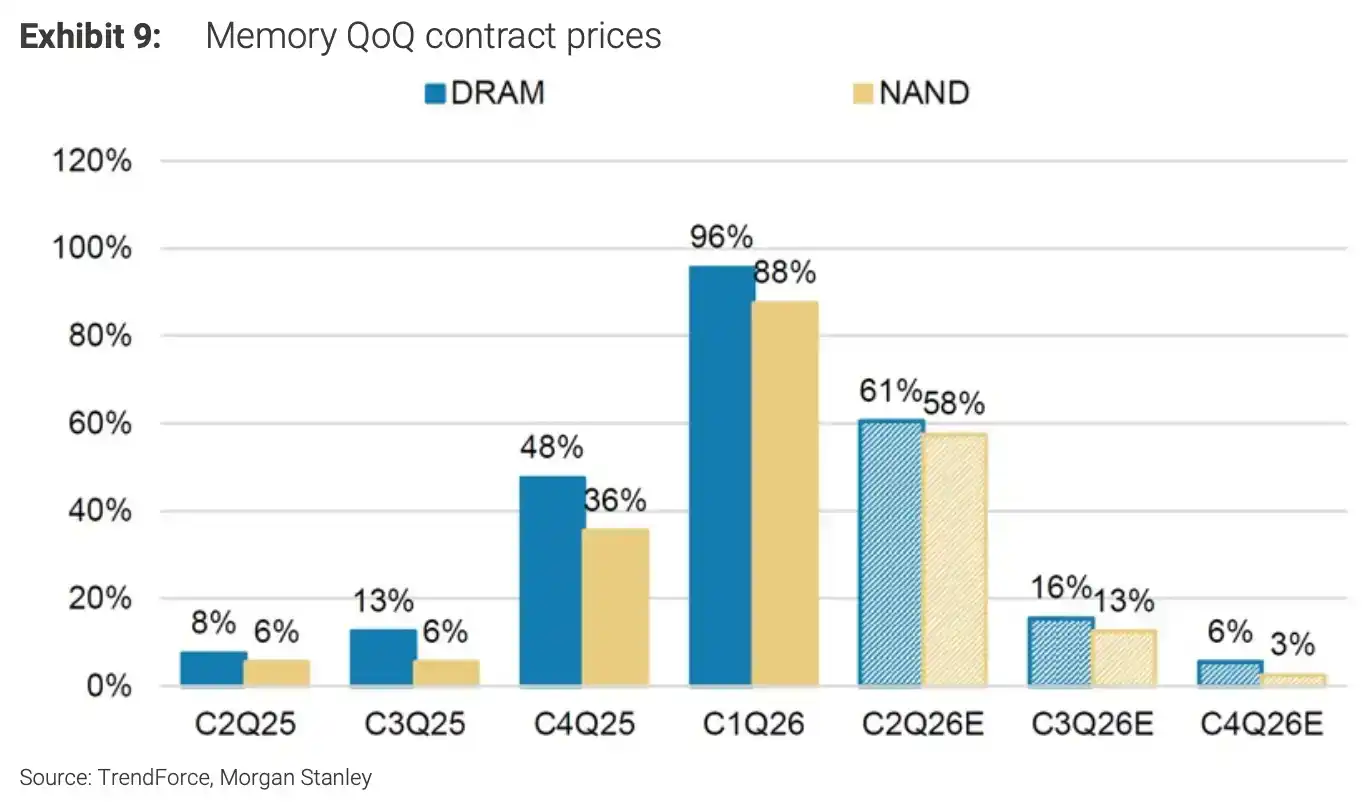
Sequential Change in Memory Contract Prices. Sequential increases in DRAM and NAND contract prices are declining quarter-over-quarter from their peaks.

AI Computing Power Still in Short Supply, Cloud Capex Continues to Be Revised Upwards

The first theme supporting Morgan Stanley's continued bullish view is that AI data center computing power demand is still not fully satisfied.

The report cites earnings reports and management commentary from four major US cloud providers. It states that Alphabet and Microsoft's cloud computing demand still exceeds their internal available capacity; Amazon expects capacity to remain insufficient in 2026, with a significant portion of 2027 capacity already booked; Meta anticipates industry computing power supply will remain tight for the foreseeable future.

This information does not prove that all AI investments will ultimately achieve expected returns, but it at least indicates that major cloud providers have not significantly scaled back infrastructure construction. Therefore, Morgan Stanley's cloud capital expenditure tracking model has raised its 2027 year-on-year growth forecast from 14% a month ago to 29%.

This is crucial for memory manufacturers. AI servers require not only GPUs but also HBM, server DRAM, and enterprise SSDs. As long as cloud providers continue to build data centers, memory demand will not be entirely dictated by the traditional consumer electronics cycle of PCs and smartphones.

However, 'structural AI demand' and 'cyclical price adjustments' can coexist. Morgan Stanley's core judgment is precisely that: AI demand may prolong the profit cycle for memory companies but will not eliminate memory price and inventory cycles entirely.
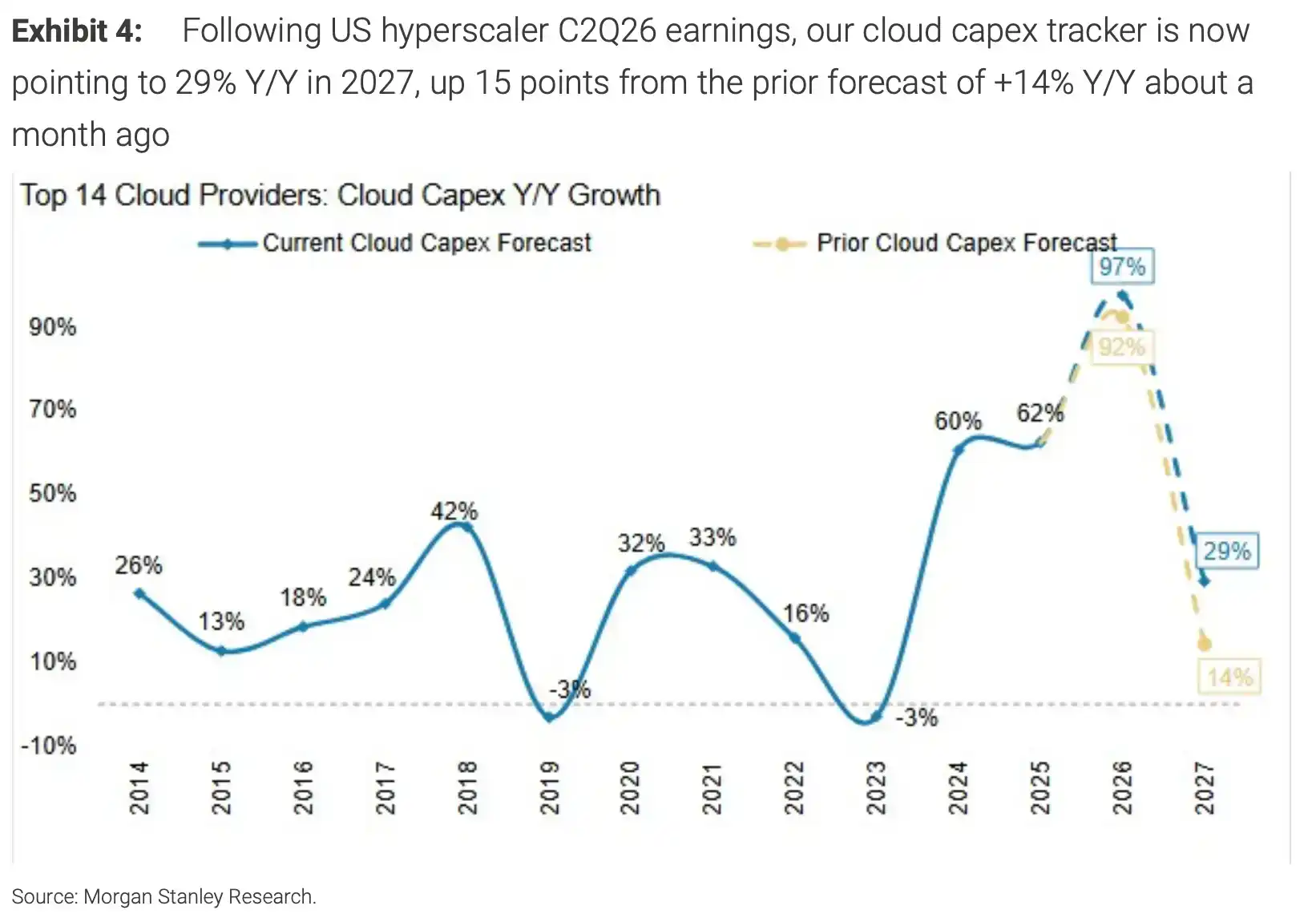
Cloud Provider Capital Expenditure Growth Forecasts. The chart shows the 2027 cloud capex growth forecast being revised up from 14% to 29%.

Long-Term Agreements Improve Order Visibility, But Cannot Lock in Future Profits

The second source of support comes from Long-Term Agreements (LTAs). Compared to traditional quarterly purchasing, multi-year contracts can help suppliers lock in some demand in advance and plan capacity and capital expenditures accordingly.

SK Hynix's official Q2 earnings announcement shows the company has completed LTA negotiations with about 10 key customers and continues discussions with others. Morgan Stanley further summarizes the company's earnings call, stating these agreements typically last about five years, but terms and pricing mechanisms vary by customer and product. Some agreements include deposits, and prices also adjust with market fluctuations.

SK Hynix did not disclose the specific proportion of capacity or revenue covered by LTAs, stating only that it aims to keep agreements at an 'appropriate level' to improve downside protection while reserving capacity for new demand. Therefore, it is not appropriate to describe its LTAs as having already locked in most future revenue.

The specific terms for Samsung Electronics mainly come from Morgan Stanley's summary of its Q2 earnings call. According to the report, Samsung plans to cover 60% to 70% of its capacity with long-term agreements, has reached agreements with five global large-scale data center customers, and has another five in final negotiations. The agreements use a rolling five-year structure, require prepayments from customers, and set price floors for some mainstream products.

The report's table listing potential clients like AWS, Microsoft, Google, Meta, and Oracle is clearly marked as based on media reports and should not be written as officially confirmed counterparties by Samsung.

The significance of LTAs lies mainly in improving demand visibility, supporting capacity investment, and reducing some price volatility, not in completely locking in future profits. The coverage, duration, price adjustment mechanisms, and default protections vary across contracts. If AI construction slows, product specifications change, or market prices adjust significantly, the protection these agreements can provide has limits.
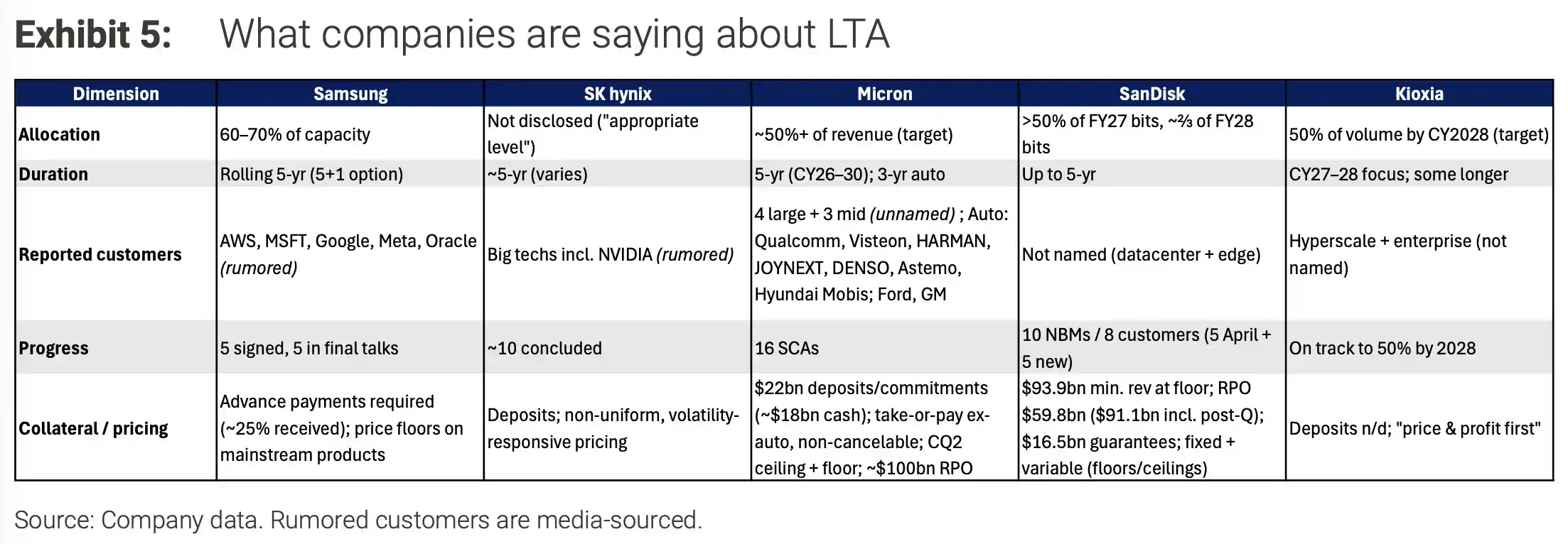
Comparison of LTA Among Major Memory Manufacturers. The chart compares the LTA coverage, duration, and pricing arrangements of Samsung, SK Hynix, Micron, SanDisk, and Kioxia.

High Price Target Bets on Extended Cycle; New Supply to Determine Upside

The market has already begun pricing in a slowdown in memory earnings growth. Morgan Stanley notes that the forward 12-month P/E ratio for DRAM-related stocks typically leads forward 12-month EPS by about two months. Recent valuations have declined significantly, reflecting investors pricing in lower earnings growth.

This also explains why memory companies' current strong earnings may not lead to continued synchronous stock price increases. Investor focus is shifting from 2026 profits to the sustainability in 2027-2028: whether AI capex can continue growing, whether LTAs can withstand a downturn, and whether prices can hold after new capacity comes online.

High profits themselves attract supply. Morgan Stanley points out that current DRAM gross margins, nearing 90%, are at historically abnormal highs. If high returns incentivize leading manufacturers to accelerate expansion or attract new suppliers, current margins may revert toward their long-term averages.

Here, it's important to distinguish between two metrics: the nearly 90% figure discussed in the report refers to DRAM gross margins, while SK Hynix's Q2 76% figure is the company's overall operating margin—they are not directly comparable. SK Hynix officially disclosed Q2 2026 revenue of KRW 79.3187 trillion and operating profit of KRW 60.5426 trillion, resulting in an operating margin of 76%.

Capacity expansion by Chinese manufacturers is also listed as a long-term risk. The report states that new supply from CXMT (ChangXin Memory Technologies) and YMTC (Yangtze Memory Technologies) could weaken the tightness of some products. Among them, CXMT's roadmap includes supplying HBM to the Chinese market as early as 2027. This is Morgan Stanley's description of the company's roadmap and does not equate to Chinese HBM achieving large-scale mass production or being able to immediately replace high-end Korean products.

Furthermore, the report expects new capacity from major manufacturers to start production from 2027-2028. If AI demand continues to grow rapidly, this new supply may not cause immediate oversupply in the short term. However, if cloud provider capex slows, the release of supply could accelerate price declines.

Therefore, the key assumptions behind the 2.6 million won price target are not that memory prices will rise indefinitely, but that AI demand can extend the profit cycle, LTAs can reduce volatility, and recent valuation declines have already priced in a significant portion of cyclical risk. What truly needs verification going forward is whether these long-term agreements can endure a price downturn and whether memory companies can find new drivers for EPS growth beyond 2028.
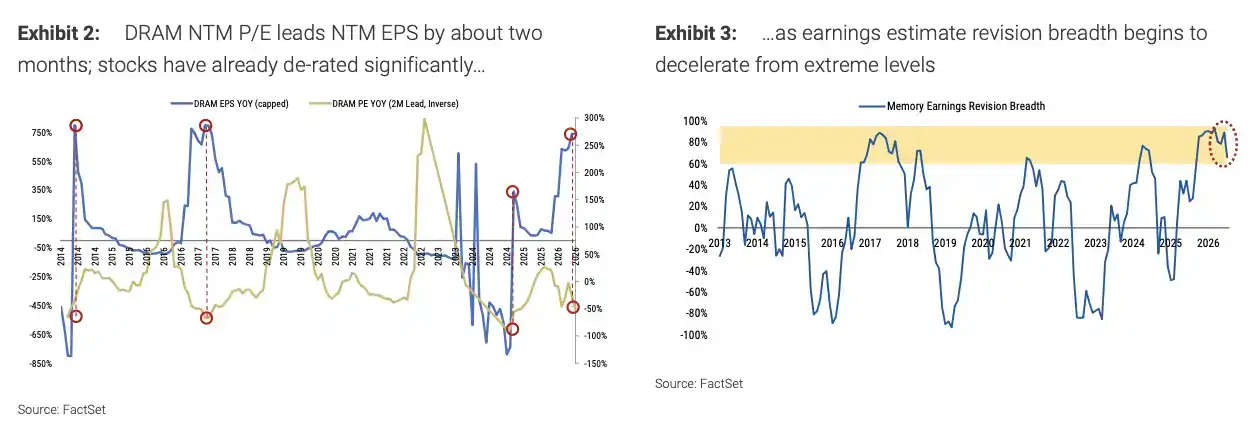
DRAM Valuation and Earnings Expectations. This chart shows that valuations typically change ahead of earnings expectations. It should not be interpreted as indicating a stable, mechanical causal relationship between the two.

İlgili Sorular

QWhat are the three main reasons Morgan Stanley remains bullish on SK Hynix and Samsung despite signs of a memory cycle slowdown?

AMorgan Stanley's continued optimism is based on three key factors: 1) AI capital expenditure continues to be revised upwards, sustaining demand. 2) Long-Term Agreements (LTAs) improve earnings visibility and provide some demand stability. 3) Recent valuation pullbacks in memory stocks already reflect some concerns about the cycle peaking.

QAccording to the report, what is the expected trend for DRAM and NAND contract price growth rates in Q3 and Q4 2026?

AThe report, citing TrendForce data, expects DRAM and NAND contract price growth to decelerate significantly. For Q3 2026, DRAM price is forecast to rise ~16% quarter-over-quarter (QoQ) and NAND ~13% QoQ. By Q4 2026, growth is expected to slow further to ~6% for DRAM and ~3% for NAND.

QHow do Long-Term Agreements (LTAs) benefit memory suppliers like SK Hynix and Samsung, and what are their limitations?

ALTAs benefit suppliers by providing better demand visibility, supporting capacity investment plans, and reducing some price volatility through mechanisms like minimum price floors and prepayments. However, their limitations include: they do not completely lock in future profits, coverage of total capacity is often partial (e.g., Samsung targets 60-70%), terms vary by client, and their protective value has boundaries if AI demand slows, product specs change, or market prices adjust significantly.

QWhat is the report's view on the relationship between high current profitability and future supply in the DRAM market?

AThe report highlights that current DRAM gross margins near 90% are historically high and could incentivize increased supply. High returns may prompt leading manufacturers to accelerate capacity expansion or attract new suppliers, which could eventually pressure profit margins to revert toward long-term averages. This is cited as a key factor for the future sustainability of earnings.

QWhat potential risk does the report associate with Chinese memory manufacturers like CXMT and YMTC?

AThe report identifies new supply from Chinese manufacturers, specifically ChangXin Memory (CXMT) and Yangtze Memory Technologies Corp (YMTC), as a long-term risk that could alleviate shortages for some products. It mentions that CXMT's roadmap includes potentially supplying HBM in the China market starting from 2027, though it clarifies this is not equivalent to mass production or immediate substitution of Korean high-end products.

İlgili Okumalar

Bill CLARITY Proposes Adding Requirements for Cryptoplatform Developers

A new amendment to the CLARITY bill proposes creating a category called "non-decentralized financial trading protocols." This includes individuals or groups with direct or indirect control over a protocol's functions, operations, or consensus rules. These entities would be required to register with the Commodity Futures Trading Commission (CFTC). The bill also mandates the CFTC and Treasury Department to develop specific rules and standards for these platforms. The stated goal is to distinguish truly decentralized projects from those that are effectively controlled, for example, through a majority of governance tokens or a project treasury. The amendment aims to resolve previous debates by clearly assigning compliance responsibilities, including for customer funds, to developers and governing communities even if they don't hold the assets directly. Additionally, the updated bill proposes legal protections for stablecoin issuers and exchanges that freeze assets suspected of being involved in illicit activity, shielding them from civil lawsuits demanding unfreezing. All crypto platforms would also be subject to bank-like regulations. The senator sponsoring the amendments hopes they will garner broader support for the CLARITY bill in an upcoming procedural Senate vote. The bill retains an "ethics provision" prohibiting government officials and their spouses from issuing, promoting, or engaging in crypto business, though a separate proposal could allow certain individuals, like former President Trump, a tax deferral on crypto asset sales.

cryptonews.ru37 dk önce

Bill CLARITY Proposes Adding Requirements for Cryptoplatform Developers

cryptonews.ru37 dk önce

Novo Holdings points to lack of investment in quantum applications

Novo Holdings reports that from 2014-2025, about 70% of the $13.9 billion in private investment in the quantum sector went to hardware and components. Investment in business applications remains insufficient relative to their potential value. By early September 2026, disclosed private funding for quantum companies had already surpassed the total for all of 2025. The report argues that while initial hardware investment was necessary, the next phase requires funding for specialized algorithms and services alongside computer development. These solutions should help customers with specific tasks like selecting molecules for research. Developers who create hard-to-replicate services—combining algorithms, proprietary data, and client integration—will gain an advantage. The life sciences, including pharmaceuticals, are identified as a highly promising field for early quantum applications. However, even early fault-tolerant computers are not expected to handle entire drug development workflows. Instead, they will tackle critical, small-scale tasks where classical approximations fail, such as calculating chemical bond behavior. More routine calculations will still be performed by classical computers. For a quantum service to be commercially valuable, its results must tangibly influence a client's next decision, like which experiment to run. Useful applications in materials science, energy, and chemistry may emerge earlier than in pharma. The report outlines two scenarios: early fault-tolerant systems in the late 2020s/early 2030s and more scalable systems from the mid-2030s. Key risks include progress in classical computing and AI potentially reducing quantum advantages, and the possibility of in-house development by pharmaceutical firms or cloud providers.

cryptonews.ru38 dk önce

Novo Holdings points to lack of investment in quantum applications

cryptonews.ru38 dk önce

U.S. Treasury's $5 Billion+ Buyback of 10-Year Bonds Failed to Stop Their Sell-Off

On September 10th, the U.S. Treasury, led by Scott Bessent, conducted a significantly larger-than-usual buyback of long-term government bonds, purchasing $5.2 billion worth. However, this intervention failed to halt a continued sell-off, with the yield on the benchmark 10-year Treasury note rising above 4.85% for the first time since 2023 and hitting nearly 4.98% the next day. Investors viewed the scale of the operation as insufficient for the massive $32 trillion U.S. debt market. They cited persistent pressures including rising oil prices, inflation risks, a large budget deficit, and expectations of further Federal Reserve rate hikes as reasons the buyback couldn't reverse the trend. The Treasury had announced it was prepared to buy up to $6 billion in long-term debt, triple its standard $2 billion operation. Yet, it only accepted $5.2 billion of the over $10 billion in investor offers. Market participants, including strategists from Bank of America and Amundi, criticized the move as too timid and potentially counterproductive, signaling government "nervousness" without addressing core issues. Key factors driving yields higher include the U.S. national debt exceeding $40 trillion, soaring debt servicing costs, strong new borrowing needs, and inflationary pressures from high energy prices. Additional concerns were raised by proposals for large new government spending. Analysts concluded the market is effectively "fighting the U.S. Treasury," with the intervention unable to overcome these fundamental headwinds.

cryptonews.ru40 dk önce

U.S. Treasury's $5 Billion+ Buyback of 10-Year Bonds Failed to Stop Their Sell-Off

cryptonews.ru40 dk önce

Fly Brain Successfully Made to Engage in Crypto Trading

Researchers have conducted an experiment using a digital connectome (brain map) of a fruit fly, the Drosophila MaleCNS v1.0, containing 166,700 neurons and 25.6 million synaptic connections. In this project, real-time Bitcoin ($BTC) to US Dollar Coin ($USDC) price data from Coinbase was converted into an RGB visual signal. This signal was fed into the fly brain model, with "buy" actions encoded as "sweet" and "sell" as "bitter." A fixed neural reader then translated the brain's activity into trading commands—buy, sell, or hold—which were routed through an intermediary service to place spot orders on Coinbase Advanced. The experiment ran in a safe, simulated environment with virtual $100, not real money. The programmer noted that real-money trading is technically possible by creating a limited portfolio (max $100 USDC) with restricted API keys. However, the fly's model would be capped at trades of $10 each, with a maximum of 24 trades per day, no leverage, no shorting, and trading halted after a $20 portfolio loss. The system incorporates a learning mechanism: profitable outcomes stimulate 15 dopamine-like neurons (PAM11), while losses activate two aversive neurons (PPL101), encouraging the model to avoid unprofitable trades. Despite this, the developer acknowledges that the fly brain has not yet demonstrated an ability to trade profitably; synaptic changes do not equate to a successful trading strategy. This remains a research experiment. In related news, a Solana-based bot recently turned $0.227 USDC into roughly $696,000 in seconds by capitalizing on a sharp price drop of the memecoin ANB.

cryptonews.ru40 dk önce

Fly Brain Successfully Made to Engage in Crypto Trading

cryptonews.ru40 dk önce

İşlemler

Spot
活动图片