Morgan Stanley Files For Ethereum ETF Amid Major Crypto Push

bitcoinist2026-01-08 tarihinde yayınlandı2026-01-08 tarihinde güncellendi

Özet

Morgan Stanley has filed an S-1 form with the SEC for a spot Ethereum ETF, named the Morgan Stanley Ethereum Trust. The proposed fund aims to track the price of ETH and generate returns, including through staking a portion of the trust's assets. This filing follows the bank's recent submissions for spot Bitcoin and Solana ETFs, which also include staking plans for the Solana fund. This move is part of the firm's broader expansion into crypto, which includes offering crypto ETFs to its wealth management clients and enabling cryptocurrency access through its E-Trade platform. The push aligns with a wider regulatory shift in the U.S. towards embracing digital assets.

Wall Street behemoth Morgan Stanley is expanding its recent push into crypto Exchange-Traded Funds (ETFs) and has filed a registration statement for an Ethereum (ETH) Trust with the US Securities and Exchange Commission (SEC).

Morgan Stanley Files For Ethereum Trust

On Tuesday, banking giant Morgan Stanley submitted an S-1 form with the US SEC for its Morgan Stanley Ethereum Trust, which seeks to generate returns for investors by tracking the price of ETH and to “reflect rewards from staking a portion of the Trust’s ether.”

The SEC Filing shows that the bank “plans to engage one or more Staking Services Providers to conduct such Staking Activities,” using a staking model that “aims to maximize the portion of the Trust’s ether available for staking while controlling for liquidity and redemption risks.
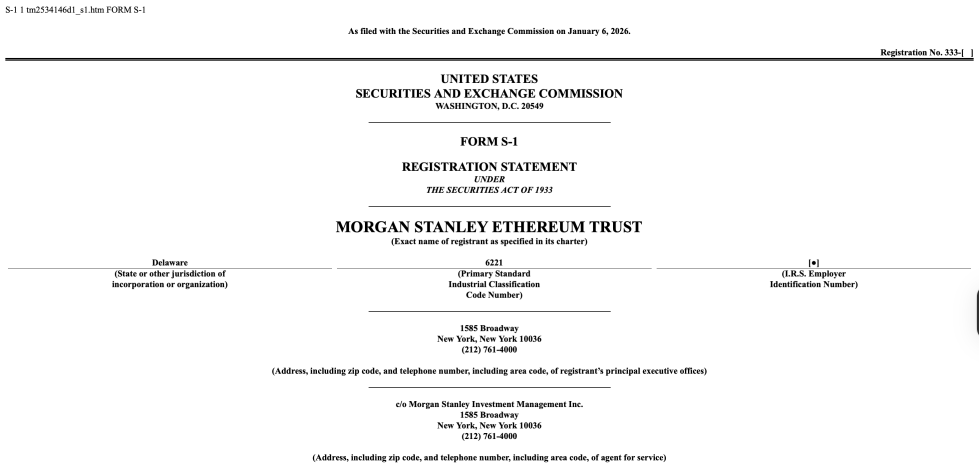
Morgan Stanley files S-1 form for Ethereum ETF. Source: sec.gov

Nonetheless, the document doesn’t address key details, such as the exchange on which the fund will be listed, the Trust’s custodian, or the ticker. Morgan Stanley’s Ethereum ETF filing follows recent efforts to launch other investment products based on some of the largest cryptocurrencies by market capitalization.

As reported by Bitcoinst, the Wall Street giant announced that it had submitted preliminary filings for spot Bitcoin (BTC) and Solana (SOL) Trusts on Tuesday, seeking to hold and generate returns by tracking these two cryptocurrencies.

In a January 6 statement, the bank detailed that “Morgan Stanley Bitcoin Trust and Morgan Stanley Solana Trust are pending regulatory approval and would be passive investment vehicles that seek to track the performance of the price of the relevant cryptocurrency.”

Similar to its submitted Ethereum ETF, the Solana fund will include an allocation for staking, and plans to engage one or more third-party staking service providers to conduct these activities.

A Broader Crypto Push

Notably, Morgan Stanley’s crypto ETF move is part of a broader shift toward a more welcoming approach that expands the presence of traditional institutions in the digital assets industry.

This pivot follows US regulatory efforts led by the Trump administration to turn the country into the “crypto capital of the world.” Amid this major push, the SEC has published new generic listing standards for crypto-based ETFs, which have seen a successful run since their initial launch nearly two years ago.

In 2024, Morgan Stanley, which had built one of the most significant Bitcoin ETF holdings in the US, allowed its managers to offer the products as an investment option for its wealthy customers. This enabled access to individuals with a minimum of $1.5 million in assets and an aggressive risk tolerance.

In October 2025, it expanded its access to crypto fund investments for all clients, including those with retirement accounts, moving away from its previous customer restrictions. The shift allowed its financial advisors to present crypto funds to any client.

It also announced last year that it would enable trading of the largest cryptocurrencies, Bitcoin, Ethereum, and Solana, through its E-Trade subsidiary.
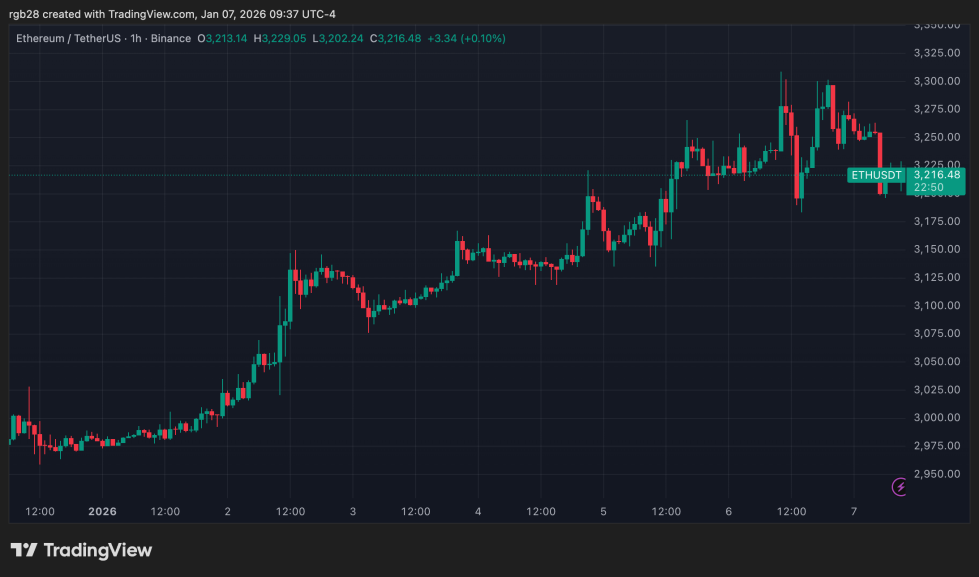
Ethereum trades at $3,216 in the one-week chart. Source: ETHUSDT on TradingView


İlgili Sorular

QWhat type of financial product has Morgan Stanley filed for with the SEC, and which cryptocurrency does it track?

AMorgan Stanley has filed an S-1 form for a Morgan Stanley Ethereum Trust, an Exchange-Traded Fund (ETF) that seeks to generate returns by tracking the price of Ethereum (ETH).

QBeyond price tracking, what additional feature does the proposed Morgan Stanley Ethereum Trust include to generate returns?

AThe Trust also aims to reflect rewards from staking a portion of its ether holdings, and it plans to engage one or more Staking Services Providers to conduct these staking activities.

QBesides an Ethereum ETF, what other two cryptocurrency-based investment products did Morgan Stanley file for on the same day?

AOn the same day, Morgan Stanley also submitted preliminary filings for a spot Bitcoin (BTC) Trust and a Solana (SOL) Trust.

QHow has Morgan Stanley's policy on offering crypto investments to its clients evolved since 2024?

AIn 2024, it allowed managers to offer Bitcoin ETFs only to wealthy customers with at least $1.5M in assets. By October 2025, it expanded access to crypto funds for all clients, including those with retirement accounts, and allowed financial advisors to present them to any client.

QThrough which subsidiary did Morgan Stanley announce it would enable direct trading of Bitcoin, Ethereum, and Solana?

AMorgan Stanley announced it would enable trading of these major cryptocurrencies through its E-Trade subsidiary.

İlgili Okumalar

The AI Agent Era Accelerates Its Arrival: Questflow Defines a New Paradigm of Financial Intelligence with On-Chain AI Brokerage

The AI Agent era is accelerating, with the CB Insights AI 100 list highlighting global investment confidence. The focus has shifted from whether AI works to its speed of deployment and ability to manage complex workflows, with autonomous AI Agents driving this transformation. At the forefront is Questflow, a Singapore-based startup redefining financial intelligence through its on-chain AI brokerage. Unlike tools that merely provide data dashboards, Questflow deploys AI Agents that proactively scan markets, form judgments, and execute trades via a conversational interface—operating 24/7 without requiring manual confirmation for each decision. This embodies the new AI paradigm of agents capable of executing multi-step workflows autonomously. Questflow's mission is to democratize institutional-grade trading intelligence. Historically reserved for the ultra-wealthy, this capability is now accessible starting from just $1 through Questflow's "AI Clone + Copy Trade" model. The platform charges only a 1% execution fee, aligning its incentives directly with users and eliminating traditional management or performance fees. The timing is opportune, aligning with key trends identified by CB Insights: the scalable deployment of AI Agents, accelerated AI adoption in financial services, and the maturation of on-chain infrastructure. With robust liquidity on platforms like Hyperliquid and Polymarket, alongside advancements in AI reasoning and non-custodial wallet security, Questflow is positioned to merge the roles of broker, fund, and exchange into a single, accessible platform for millions.

链捕手33 dk önce

The AI Agent Era Accelerates Its Arrival: Questflow Defines a New Paradigm of Financial Intelligence with On-Chain AI Brokerage

链捕手33 dk önce

Why Pricing Social Interactions is Doomed to Fail?

Titled "Why Putting a Price on Social Interaction Is Doomed to Fail," this article critiques attempts to monetize social networks directly through SocialFi models, arguing their inevitable failure stems from a fundamental misunderstanding of media dynamics. Using Marshall McLuhan's theory of "hot" and "cold" media, the author posits that social networks are inherently "cold" media. Their value isn't contained in individual posts but is co-created through user participation, interpretation, and fragmented, ongoing interaction (e.g., replies, shares). This ambiguity and need for user involvement are core to their function. The article asserts that SocialFi projects like Friend.tech failed because introducing real-time, tradable financial pricing (a definitive "hot" signal) into this "cold" environment doesn't add a layer—it replaces the medium's essence. The unambiguous price signal overshadows and nullifies the nuanced, participatory social signal. Users become traders, not participants, and when speculative profits vanish, the underlying social ecosystem—never genuinely cultivated—collapses entirely. This principle extends beyond crypto. The author argues platforms like Twitter have gradually "heated up" through metrics (likes, retweets counts, algorithmically defined value), shifting users from participants to performers and eroding organic engagement. The solution isn't to abandon capital but to manage its entry point. Successful models like Substack, Patreon, or Bandcamp allow capital to "condense" at specific, isolated nodes (e.g., subscriptions, one-time payments) without permeating and "heating" every social interaction. They preserve the core "cold," participatory medium while enabling monetization at designated boundaries. The NFT boom and bust serves as a stark parallel: the ancient "cold" medium of collecting (valued for story, community, gradual accumulation) was rapidly destroyed by platforms that introduced real-time floor prices, rarity scores, and trading dashboards, transforming collectors into speculators and vaporizing cultural value when prices fell. The core lesson: "Liquidity equals heat." Injecting high liquidity and definitive pricing into a "cold" participatory medium doesn't optimize it; it fundamentally alters and destroys its value-creating mechanism. The future lies not in pricing every social gesture but in finding precise, non-invasive points for capital to condense without overheating the entire ecosystem.

marsbit41 dk önce

Why Pricing Social Interactions is Doomed to Fail?

marsbit41 dk önce

İşlemler

Spot
Futures

Popüler Makaleler

PUSH Nasıl Satın Alınır

HTX.com’a hoş geldiniz! Push Protocol (PUSH) satın alma işlemlerini basit ve kullanışlı bir hâle getirdik. Adım adım açıkladığımız rehberimizi takip ederek kripto yolculuğunuza başlayın. 1. Adım: HTX Hesabınızı OluşturunHTX'te ücretsiz bir hesap açmak için e-posta adresinizi veya telefon numaranızı kullanın. Sorunsuzca kaydolun ve tüm özelliklerin kilidini açın. Hesabımı Aç2. Adım: Kripto Satın Al Bölümüne Gidin ve Ödeme Yönteminizi SeçinKredi/Banka Kartı: Visa veya Mastercard'ınızı kullanarak anında Push Protocol (PUSH) satın alın.Bakiye: Sorunsuz bir şekilde işlem yapmak için HTX hesap bakiyenizdeki fonları kullanın.Üçüncü Taraflar: Kullanımı kolaylaştırmak için Google Pay ve Apple Pay gibi popüler ödeme yöntemlerini ekledik.P2P: HTX'teki diğer kullanıcılarla doğrudan işlem yapın.Borsa Dışı (OTC): Yatırımcılar için kişiye özel hizmetler ve rekabetçi döviz kurları sunuyoruz.3. Adım: Push Protocol (PUSH) Varlıklarınızı SaklayınPush Protocol (PUSH) satın aldıktan sonra HTX hesabınızda saklayın. Alternatif olarak, blok zinciri transferi yoluyla başka bir yere gönderebilir veya diğer kripto para birimlerini takas etmek için kullanabilirsiniz.4. Adım: Push Protocol (PUSH) Varlıklarınızla İşlem YapınHTX'in spot piyasasında Push Protocol (PUSH) ile kolayca işlemler yapın.Hesabınıza erişin, işlem çiftinizi seçin, işlemlerinizi gerçekleştirin ve gerçek zamanlı olarak izleyin. Hem yeni başlayanlar hem de deneyimli yatırımcılar için kullanıcı dostu bir deneyim sunuyoruz.

509 Toplam GörüntülenmeYayınlanma 2024.12.13Güncellenme 2025.03.21

PUSH Nasıl Satın Alınır

Tartışmalar

HTX Topluluğuna hoş geldiniz. Burada, en son platform gelişmeleri hakkında bilgi sahibi olabilir ve profesyonel piyasa görüşlerine erişebilirsiniz. Kullanıcıların PUSH (PUSH) fiyatı hakkındaki görüşleri aşağıda sunulmaktadır.

活动图片












