Morgan Stanley Bitcoin ETF to Launch Tomorrow, Recommends Clients Allocate Up to 4% to Crypto Assets

marsbit2026-04-08 tarihinde yayınlandı2026-04-08 tarihinde güncellendi

Özet

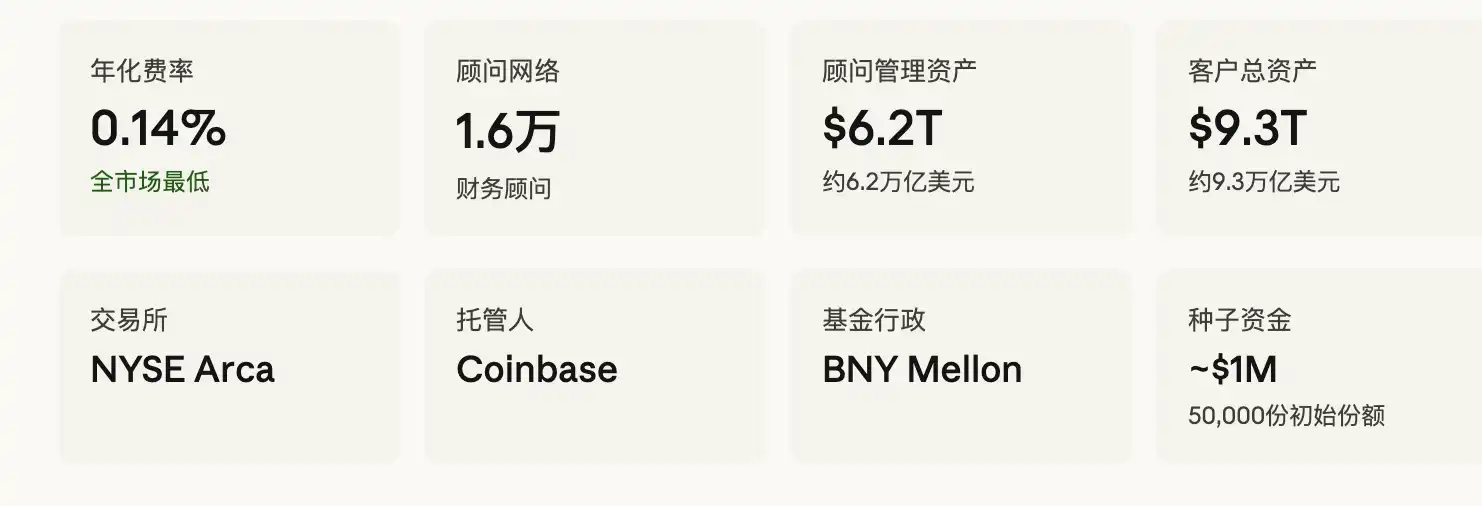
Morgan Stanley is set to launch its own spot Bitcoin ETF (ticker: MSBT) on NYSE Arca on April 8, making it the first major U.S. bank to directly issue such a product. With an annual management fee of 0.14%, it becomes the lowest-cost Bitcoin ETF on the market. The fund will hold Bitcoin directly and track the CoinDesk Bitcoin price index. The bank’s vast network of approximately 16,000 financial advisors, who manage around $6.2 trillion in client assets, can begin recommending the ETF immediately upon launch. Morgan Stanley’s Global Investment Committee has already advised clients to allocate up to 4% of their portfolios to crypto assets. Analysts suggest this distribution capability could unlock substantial institutional and advisory-driven capital into Bitcoin. Beyond Bitcoin, Morgan Stanley is building a broader crypto infrastructure, having also filed for Solana and staked Ethereum ETFs, applied for a national trust bank charter, and plans to offer direct crypto trading via E*Trade in 2026. The move is seen as a significant step in the institutional adoption of Bitcoin and a shift in traditional finance’s approach to cryptocurrency.

Author: Curry, Deep Tide TechFlow

Deep Tide Guide: The SEC has approved the registration statement for the Morgan Stanley Bitcoin Trust (ticker: MSBT), which will begin trading on NYSE Arca on April 8th, with an annual management fee of 0.14%, the lowest in the market.

Morgan Stanley thus becomes the first major U.S. bank to directly issue a Bitcoin spot ETF. Its approximately 16,000 financial advisors, managing $6.2 trillion in client assets, will be able to recommend the product to clients starting on the first day of trading.

The countdown to Morgan Stanley's Bitcoin spot ETF has officially begun.

According to a CoinDesk report on April 8th, the U.S. Securities and Exchange Commission (SEC) has declared the registration statement for the Morgan Stanley Bitcoin Trust (MSBT) effective. The bank submitted its final prospectus on the same day. Bloomberg ETF analyst Eric Balchunas confirmed on platform X that MSBT will begin trading on NYSE Arca on April 8th (Wednesday).

This comes just three months after Morgan Stanley initially filed the S-1 registration document in January of this year. The speed from application to listing far exceeded market expectations.
Lowest Fee in the Market, First Major Bank to Self-Issue

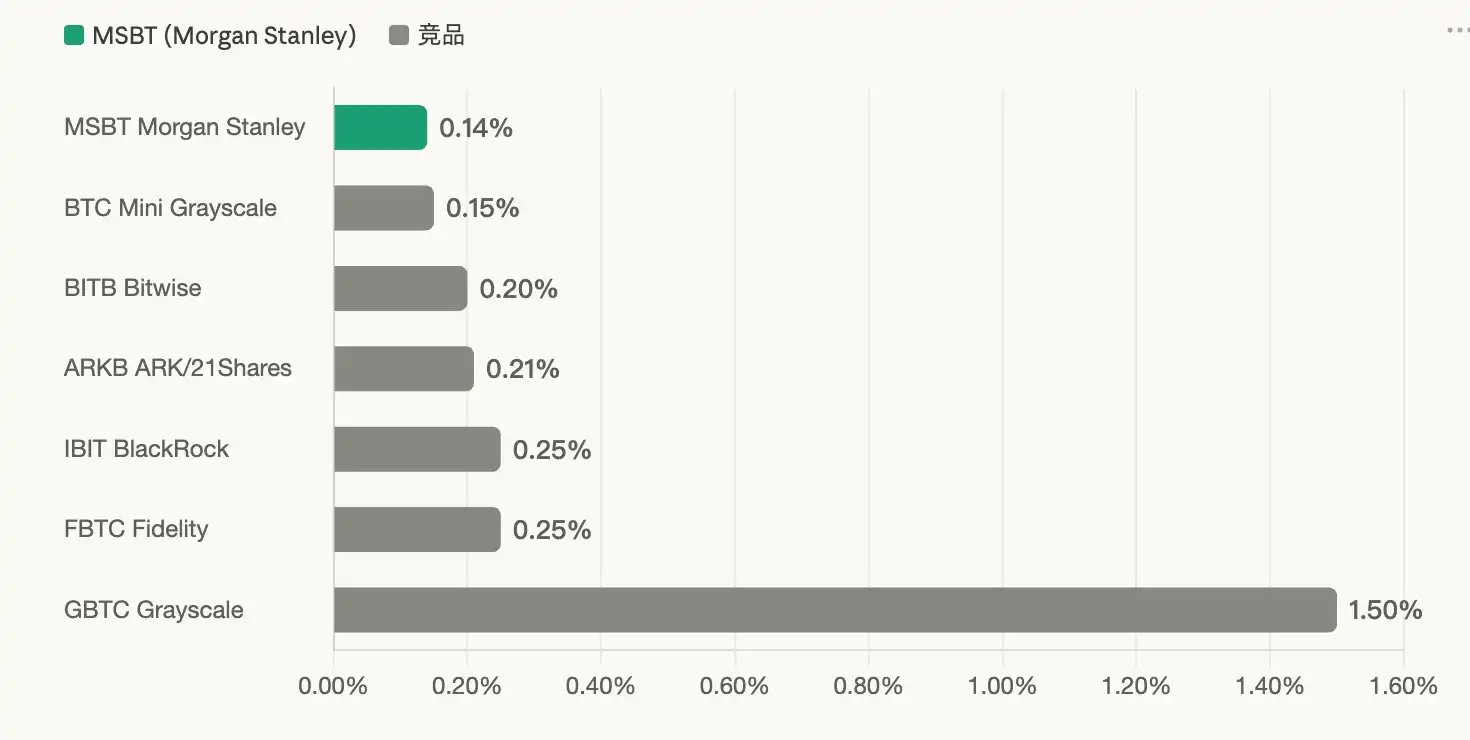
MSBT's annual management fee is set at 0.14%, which is 1 basis point lower than Grayscale's Bitcoin Mini Trust (0.15%) and 11 basis points lower than BlackRock's IBIT (0.25%), making it the product with the lowest fee among all U.S. Bitcoin spot ETFs.

Fee comparison of major competitors: Grayscale Bitcoin Mini Trust 0.15%, Bitwise BITB 0.20%, ARK/21Shares ARKB 0.21%, BlackRock IBIT and Fidelity FBTC both 0.25%, Grayscale's flagship product GBTC 1.5%.
The fee is one of the few core differentiating factors in the Bitcoin spot ETF market. All products directly hold Bitcoin and track the spot price, with highly homogeneous investment strategies. Cost differences become significant in large allocations and long-term holdings. For a $100,000 investment, MSBT saves approximately $110 in management fees compared to IBIT annually.

Historical data has proven the driving force of fees on fund flows: Grayscale's flagship product GBTC charges 1.5% and has seen its assets under management (AUM) shrink from about $29 billion to less than half since its conversion to an ETF in January 2024.

Regarding the MSBT product structure, the fund directly holds Bitcoin, tracking the CoinDesk Bitcoin Benchmark 4:00 PM New York Settlement Price, without using leverage, derivatives, or active trading strategies. Coinbase serves as the custodian and prime broker, BNY Mellon is responsible for cash custody and fund administration, and the initial seed capital is approximately $1 million, corresponding to 50,000 creation baskets.

More importantly, MSBT is the 12th product of its kind since the first batch of Bitcoin spot ETFs were listed in January 2024, and the first Bitcoin spot ETF directly issued and listed by a major U.S. bank. Previously, the issuers of listed products were all asset management companies or crypto-native institutions. Morgan Stanley's entry means that Wall Street banks are moving from "distributing others' products" to "making their own products."

The Distribution Network is the Real Weapon

The fee is just one card on Morgan Stanley's table; the real differentiator is the distribution network.

Morgan Stanley's approximately 16,000 financial advisors manage about $6.2 trillion in client assets (total client assets for the entire bank are about $9.3 trillion). MSBT will receive distribution support from this network starting on its first trading day. Bloomberg ETF analyst Balchunas referred to Morgan Stanley as a "captive audience" for the Bitcoin ETF market and pointed out that while Fidelity also has a partial advisor network, "Morgan Stanley is a whole other level."

Amy Oldenburg, the bank's Head of Digital Asset Strategy, previously revealed that currently about 80% of crypto ETF trading activity comes from self-directed investors, not advisor-managed accounts.

A self-owned product with the lowest fee in the market is expected to eliminate cost concerns advisors might have when recommending Bitcoin allocations, thereby unlocking the incremental space of the advisor channel, which has not yet been fully activated.

Morgan Stanley's Global Investment Committee had already recommended that clients allocate 0-4% of their investment portfolio to crypto assets. Phong Le, CEO of Strategy (formerly MicroStrategy), provided a more aggressive calculation on platform X: based on $6.2 trillion in client assets and a 2% allocation ratio, the potential capital scale is approximately $160 billion, nearly three times the current AUM of BlackRock's IBIT. He called MSBT the "Monster Bitcoin".

However, the actual allocation pace still holds uncertainty. Multiple steps are typically required between product availability and large-scale recommendation through the advisor channel, including compliance approval, investment policy adjustments, and client education.

More Than One ETF: Morgan Stanley's Full-Scale Crypto Layout

MSBT is not an isolated product. Morgan Stanley is systematically building crypto asset infrastructure.

The bank submitted applications for both Bitcoin and Solana spot ETFs in January of this year, followed by an application for a staking Ethereum ETF. In February, Morgan Stanley applied for a National Trust Bank charter (Morgan Stanley Digital Trust) to directly provide clients with digital asset custody, trading, and staking services.

On the retail side, the bank plans to open spot trading for Bitcoin, Ethereum, and Solana to retail investors through the E*Trade platform in the first half of 2026, partnering with Zero Hash. Jed Finn, Head of the Wealth Management Division, called direct crypto trading the "tip of the iceberg," hinting that more services such as custody, wallets, and tokenized assets will follow.

The logic of this multi-channel strategy is clear: institutional clients get MSBT allocations through advisors, self-directed investors trade cryptocurrencies directly through E*Trade, all completed within Morgan Stanley's ecosystem. CEO Ted Pick has already communicated with the U.S. Treasury regarding product development.

Reddit Community: 'Traditional Finance Has Surrendered'

The news sparked heated discussion in the Reddit crypto community. Several users interpreted Morgan Stanley's self-issuance of a Bitcoin ETF as a "surrender signal" from traditional finance towards Bitcoin, believing that the shift from resistance and观望 (wait-and-see) to active embrace by major Wall Street banks marks an irreversible institutionalization process for Bitcoin as an asset class.

Other users offered pragmatic views: the trading volume on the first day and the net inflows in the first month will be key indicators to test whether the distribution network can truly translate into actual allocations.


Trend Kriptolar

İlgili Sorular

QWhat is the ticker symbol and management fee for Morgan Stanley's Bitcoin ETF?

AThe ticker symbol is MSBT, and it has an annual management fee of 0.14%, which is the lowest in the market.

QHow much client assets do Morgan Stanley's financial advisors manage, and what is the potential impact on the Bitcoin ETF market?

AMorgan Stanley's approximately 16,000 financial advisors manage about $6.2 trillion in client assets. The bank's global investment committee has recommended clients allocate 0-4% of their portfolio to crypto assets, potentially unlocking significant new capital into the Bitcoin ETF market.

QWhat makes Morgan Stanley's Bitcoin ETF (MSBT) unique compared to other existing Bitcoin ETFs?

AMSBT is the first Bitcoin spot ETF to be directly issued and listed by a major U.S. bank. Its key differentiators are its lowest-in-market fee (0.14%) and its immediate access to the bank's massive network of financial advisors and their clients.

QBesides the Bitcoin ETF, what other crypto-related products and services is Morgan Stanley developing?

AMorgan Stanley is building a full crypto infrastructure. This includes applications for a Solana spot ETF, a staking Ethereum ETF, a national trust bank charter (Morgan Stanley Digital Trust) for custody services, and plans to offer direct spot trading of Bitcoin, Ethereum, and Solana on its E*Trade platform for retail investors in 2026.

QWho are the key service providers (custodian, administrator) for the Morgan Stanley Bitcoin Trust (MSBT)?

ACoinbase serves as the custodian and prime broker for the MSBT, while BNY Mellon is responsible for cash custody and fund administration.

İlgili Okumalar

NVIDIA CPU Advances, China's RISC-V Responds: Semiconductor Deep Dive - Part Four

NVIDIA is set to launch its new Vera AI data center CPU in China as early as August, with high pricing. While this move offers a new option, it highlights China's continued dependence on foreign-controlled Arm architecture. In response, the Chinese semiconductor industry is increasingly turning to RISC-V as a strategic alternative for achieving high-performance computing autonomy. The article explores the concept of the "impossible triangle" in CPU development—balancing prosperity, control, and autonomy—and posits that RISC-V's open-source, modular nature offers a unique path to achieving all three. While RISC-V is already dominant in embedded systems, the focus is now shifting to data centers and AI workloads. China has become a global hotspot for RISC-V development, driven by AI-driven compute demand, supply chain concerns from export controls, cost benefits of open-source, and strong policy support. Multiple Chinese companies have reportedly crossed the key performance threshold of 15 SPECint per GHz, a benchmark for entering the high-performance CPU club. Progress extends beyond single-core benchmarks. Companies are developing complete computing subsystems, including commercial-grade coherent network-on-chip (NoC) technology and server processors with up to 40 cores that strictly adhere to the RVA23 standard to ensure software compatibility. Real-world applications are emerging in areas like video transcoding and edge AI. However, significant challenges remain. The RISC-V ecosystem faces fragmentation, immature toolchains and verification processes, and gaps in single-core performance and energy efficiency compared to mature x86 and Arm architectures. The formidable software moat, epitomized by NVIDIA's CUDA, is a long-term hurdle. In conclusion, while RISC-V cannot immediately replace offerings like NVIDIA's Vera, it represents a viable long-term path for China to develop a self-sufficient, high-performance CPU ecosystem. The journey is acknowledged to be long and arduous, requiring sustained effort to overcome technical and ecosystem challenges.

marsbit5 saat önce

NVIDIA CPU Advances, China's RISC-V Responds: Semiconductor Deep Dive - Part Four

marsbit5 saat önce

My Coding Betting Dashboard is Profiting, but Polymarket is Truly Not a Good Place for 'Arbitrage'

The author built a custom monitoring dashboard for Polymarket, a prediction market platform, and tested it with $1,600, achieving over 30% returns. However, the core argument is that Polymarket is not a good venue for traditional arbitrage. The dashboard has two main sections: a "Portfolio Dashboard" for tracking active positions with key metrics like total capital, P&L, and a risk-control module using a tier system (T1, T2, T3), and an "Opportunity Watchlist" for monitoring markets. The article details a critical structural trap in binary markets: a bet with a high perceived probability of success still carries a 100% loss risk if wrong. The author's T1/T2/T3 system is designed to manage this by limiting position sizes based on conviction and time horizon, emphasizing that high confidence should not equal high concentration. A key insight is the danger of "pseudo-diversification"—betting on different markets driven by the same underlying variable. The author concludes that Polymarket offers few true low-risk, arbitrage opportunities. It is instead a high-risk environment where wins can create a false sense of mastery, leading to large losses. The platform is better viewed as a training ground for honing judgment through disciplined, framework-driven betting rather than a reliable income source. The tools help transform intuition into structured, rule-based decisions to mitigate the risk of catastrophic errors.

marsbit8 saat önce

My Coding Betting Dashboard is Profiting, but Polymarket is Truly Not a Good Place for 'Arbitrage'

marsbit8 saat önce

WeChat AI Card Hands-On Guide: Has the AI Shopping Era Arrived?

**"WeChat AI Card" Practical Test Guide: Has the Era of AI Shopping Arrived?** WeChat has officially launched the "AI Exclusive Card," a feature integrated into its Workbuddy AI assistant. This card is designed to handle payments for AI-initiated purchases. Our hands-on test reveals it's not yet a tool for fully autonomous AI shopping, but rather a controlled payment layer for AI agents. The AI Card functions as an isolated sub-wallet within WeChat Pay. Users must bind the card and transfer funds into it from their main wallet. Crucially, every transaction requires explicit user confirmation via smartphone scan; AI cannot spend autonomously. Currently accessible through the Workbuddy agent, the card targets specific digital consumption scenarios: purchasing paid content (reports, data), calling paid APIs/tools, and subscribing to services. Its design prioritizes security and control by separating funds and mandating approval for each payment. We tested a real-world scenario: ordering bubble tea via Workbuddy using a "Meituan Life Assistant" skill. The process encountered multiple hurdles: high "skill" usage costs (exceeding daily free credits), and most importantly, while a payment was successfully initiated, the AI purchased an incorrect product (a mismatched group-buy coupon instead of the desired drink). This highlights the current limitation: the **AI Card only solves the payment step**. The broader challenge lies in the **AI agent's execution chain**—accurately understanding intent, navigating third-party platforms, selecting the right product, and ensuring proper fulfillment. The payment succeeded, but the purchase failed to meet the user's need. In conclusion, the WeChat AI Exclusive Card is a cautious, early-step experiment in AI commerce. It provides a secure, user-controlled payment method for agent interactions but is not yet capable of reliable, end-to-end complex purchases. For now, it's best used for low-value, low-risk digital services with careful user verification at each step. The vision of AI handling complete shopping tasks remains a work in progress.

marsbit11 saat önce

WeChat AI Card Hands-On Guide: Has the AI Shopping Era Arrived?

marsbit11 saat önce

İşlemler

Spot
Futures

Popüler Makaleler

4 Nasıl Satın Alınır

HTX.com’a hoş geldiniz! 4 (4) satın alma işlemlerini basit ve kullanışlı bir hâle getirdik. Adım adım açıkladığımız rehberimizi takip ederek kripto yolculuğunuza başlayın. 1. Adım: HTX Hesabınızı OluşturunHTX'te ücretsiz bir hesap açmak için e-posta adresinizi veya telefon numaranızı kullanın. Sorunsuzca kaydolun ve tüm özelliklerin kilidini açın. Hesabımı Aç2. Adım: Kripto Satın Al Bölümüne Gidin ve Ödeme Yönteminizi SeçinKredi/Banka Kartı: Visa veya Mastercard'ınızı kullanarak anında 4 (4) satın alın.Bakiye: Sorunsuz bir şekilde işlem yapmak için HTX hesap bakiyenizdeki fonları kullanın.Üçüncü Taraflar: Kullanımı kolaylaştırmak için Google Pay ve Apple Pay gibi popüler ödeme yöntemlerini ekledik.P2P: HTX'teki diğer kullanıcılarla doğrudan işlem yapın.Borsa Dışı (OTC): Yatırımcılar için kişiye özel hizmetler ve rekabetçi döviz kurları sunuyoruz.3. Adım: 4 (4) Varlıklarınızı Saklayın4 (4) satın aldıktan sonra HTX hesabınızda saklayın. Alternatif olarak, blok zinciri transferi yoluyla başka bir yere gönderebilir veya diğer kripto para birimlerini takas etmek için kullanabilirsiniz.4. Adım: 4 (4) Varlıklarınızla İşlem YapınHTX'in spot piyasasında 4 (4) ile kolayca işlemler yapın.Hesabınıza erişin, işlem çiftinizi seçin, işlemlerinizi gerçekleştirin ve gerçek zamanlı olarak izleyin. Hem yeni başlayanlar hem de deneyimli yatırımcılar için kullanıcı dostu bir deneyim sunuyoruz.

392 Toplam GörüntülenmeYayınlanma 2025.10.20Güncellenme 2026.06.02

4 Nasıl Satın Alınır

Tartışmalar

HTX Topluluğuna hoş geldiniz. Burada, en son platform gelişmeleri hakkında bilgi sahibi olabilir ve profesyonel piyasa görüşlerine erişebilirsiniz. Kullanıcıların 4 (4) fiyatı hakkındaki görüşleri aşağıda sunulmaktadır.

活动图片