Original | Odaily Planet Daily (@OdailyChina)
Author | Golem (@web3_golem)
On July 27th, the leading domestic memory chipmaker, ChangXin Memory Technologies (CXMT), debuted on the A-share STAR Market. Its IPO first day shattered multiple historical records on the A-share market. CXMT became the first technology stock in A-share history to surpass a market capitalization of 3 trillion RMB at the opening bell (opening market cap of 3.31 trillion RMB), and also the first stock to achieve over 100 billion RMB in trading volume within the first hour of listing. CXMT closed its first day up 465.82%, with its final market capitalization standing at 3.28 trillion USD, ranking first among A-shares and surpassing the market cap of Intel in the US stock market.
Another notable aspect is that CXMT's IPO serves as the first validation of TradeXYZ's "pricing dominance" in the A-share market.
As the first pre-market contract for an A-share individual stock launched on TradeXYZ, CXMT opened at 49.5 RMB on the A-share market, which translates to approximately 7.31 USD at the current USD/CNY exchange rate of 6.77. At the same time, the CXMT contract on TradeXYZ was quoted at 7.12 USD, an error of less than 0.2 USD.
TradeXYZ Successfully "Pre-Priced" the CXMT IPO
As a highly anticipated tech stock, most domestic brokerages and institutions believed before the IPO that CXMT's valuation on its first trading day would reasonably fall within the range of 2 to 3 trillion RMB. Expectations exceeding 3 trillion USD already fully accounted for the "premium for domestic scarcity" and future performance assumptions, with 4 trillion RMB considered only under extremely optimistic scenarios.
However, facts have proven that domestic brokerages and institutional reports were overly conservative. In contrast, the overseas platform TradeXYZ provided a more accurate price discovery for CXMT.
On July 15th, TradeXYZ launched the CXMT pre-IPO perpetual contract on Hyperliquid's HIP-3 market, with leverage support of up to 5x. Within hours of the launch, order books on Hyperliquid saw millions of dollars in buy orders for CXMT at the $6 price point. Subsequently, the price climbed steadily, hitting a daily high of $8.64. At that pre-IPO price, CXMT's implied market capitalization had already exceeded $550 billion, translating to over 3.72 trillion RMB, surpassing Tencent to rank 32nd globally by market cap.
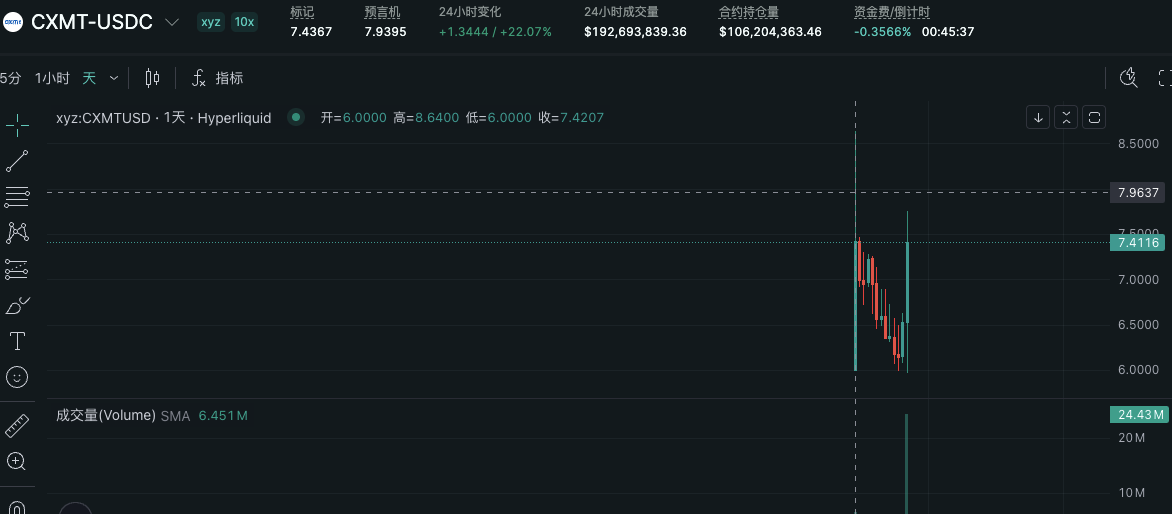
CXMT contract price on TradeXYZ reached a high of $8.64 on its first trading day.
As the first A-share individual stock contract launched on TradeXYZ, it provided risk exposure for investors who were not eligible to participate in CXMT's IPO subscription or A-share trading. Therefore, the pricing for CXMT on the first day was influenced by speculative fervor, excessively pushing up the pre-IPO contract price.
Market rationality soon returned. In the lead-up to CXMT's listing on July 27th, the price of the CXMT pre-IPO contract showed an overall downward correction. By July 26th, it stabilized around $6.1-$6.4 (approximately 41-43 RMB), implying a market valuation still around 3 trillion RMB.
When CXMT opened on July 27th with a market cap of 3.31 trillion RMB, it did not deviate significantly from the valuation implied during its Pre-IPO phase on TradeXYZ. During the A-share pre-market auction period before CXMT's opening, the price of the CXMT pre-IPO contract on TradeXYZ further converged towards the A-share auction price. Finally, at the A-share market open at 9:30, the CXMT pre-IPO contract price was $7.12, with an error of less than $0.2 compared to CXMT's A-share spot opening price.
This left investors hoping to arbitrage between the on-chain and traditional financial markets for CXMT with little opportunity. Well-known crypto KOL Jiang Zhuoe commented that CXMT became "unplayable" because the auction price was essentially the same as the price on TradeXYZ, stating, "Currently, it's neither possible to buy in, nor to conduct arbitrage."
Thus, TradeXYZ's price discovery for the CXMT IPO was remarkably successful. This indicates that TradeXYZ's price discovery mechanism is becoming more sophisticated and is further eroding the pricing power traditionally held by conventional finance over corporate IPOs in the global market.
Discount Trading Emerged After Opening
However, after the opening, as CXMT was converted to a standard XYZ perpetual contract supporting up to 10x leverage, the discrepancy between the mark price of the CXMT contract on TradeXYZ and CXMT's A-share spot price widened. The CXMT contract on TradeXYZ traded at a discount compared to the A-share spot price.
This is actually related to TradeXYZ's oracle mechanism. During the Pre-IPO phase, with no external real-time price available, the CXMT contract price was determined by TradeXYZ's internal oracle. Once CXMT officially listed, the CXMT contract price gradually switched to an external oracle tracking the A-share spot trading price. Therefore, the discrepancy in the CXMT contract's mark price essentially arose from an error relative to this external oracle price.

After opening, a discrepancy emerged between the CXMT contract's mark price and the oracle price, at one point widening to $0.4.
The reason for this discrepancy is that during the transition period where the contract price switches from tracking the internal oracle to tracking the external oracle, TradeXYZ employs a gradual convergence limit. This means the contract's mark price is restricted to slowly approach the target price at a controlled speed. The oracle price updates approximately every 3 seconds, but each price movement is limited to ±1%. Consequently, the contract's mark price can only converge incrementally towards the target price. This restriction thus caused the CXMT contract's mark price to trade at a discount while catching up to the external oracle price.
However, when the A-share market is closed, the CXMT contract price will switch back to being based on the internal oracle price, effectively entering a "pre-market" trading phase again.
Although CXMT is not the first individual stock Pre-IPO contract launched on TradeXYZ—having previously excelled in price discovery for IPOs of US-listed companies like Cerebras and SpaceX—for TradeXYZ, pricing CXMT served as a crucial test for its contract price mechanism, funding rate, and liquidity performance. This was especially true as the oracle needed to add a layer of USD/CNY exchange rate conversion on top of the original tracking quote, meaning holders' profits and losses had to reflect both stock price and exchange rate fluctuations.
Judging by the outcome, aside from the brief episode of discounted trading due to the oracle transition, TradeXYZ's shift from the pre-market contract to the standard contract for CXMT proceeded relatively smoothly, without the public controversy seen during SpaceX's listing (related reading:Hyperliquid Pre-Market Contract Controversy: How Come the Promised SpaceX Share Count Doesn't Count?).
Data shows that, as of the time of writing, the open interest for the CXMT contract on Hyperliquid is $91.85 million, having reached a high of $100 million. The 24-hour trading volume is $232 million, approximately 0.16% of CXMT's A-share spot trading volume on its first day.

Open Interest (OI) and trading volume for the CXMT contract on Hyperliquid.
However, judging TradeXYZ's value solely by trading volume would clearly underestimate its significance. The hundreds of millions in trading volume on TradeXYZ remains just the tip of the iceberg compared to traditional stock exchanges and cannot shake their dominance in liquidity. What it truly changes is the barrier to entry and the method of participating in the price discovery of stocks like CXMT.
For global investors, TradeXYZ provides a novel channel to gain exposure to the price movements of stocks like CXMT without needing to enter the A-share market directly. In the past, there were significant barriers for ordinary investors to participate in the A-share STAR Market, and overseas investors found it particularly difficult to gain direct exposure to A-shares.
On TradeXYZ, without the need for a securities account, asset thresholds, or geographic restrictions, any wallet user holding stablecoins can gain trading exposure to CXMT, unaffected by the closure of traditional financial markets. Even at this moment, the on-chain speculation on CXMT's price continues.
The Largest On-Chain Short Position on CXMT Incurred Over $1.4 Million in Floating Loss
On CXMT's first trading day, bullish on-chain whales suffered significant losses, with the most representative being the "largest short position on CXMT."
Prior to CXMT's listing, the "largest short position on CXMT" on Hyperliquid (address 0xf2...1244) continuously increased its short position in CXMT over several days. According to hypurrscan data, this address currently holds 2.6 million CXMT short contracts, valued at approximately $18 million, with an average entry price of $6.4 (approximately 43.3 RMB). As of writing, it has incurred a floating loss of $1.39 million.

Position of the largest CXMT short on Hyperliquid.
Notably, one hour before CXMT's listing today, this address placed limit orders to close its short position at prices between $2 and $4.5 (approximately 13~30 RMB). This suggests it believed CXMT's reasonable valuation should be no higher than 2 trillion RMB.
Conversely, some on-chain whales who went long on CXMT pre-IPO reaped substantial profits. Address 0x2b6...32f6c began accumulating CXMT long positions as early as July 23rd. According to hypurrscan data, this address currently holds 977,000 CXMT long contracts, valued at approximately $6.77 million, with an average entry price of $6.71 (approximately 45 RMB). As of writing, it has a floating profit exceeding $200,000. This whale also holds a long position in Hynix worth $380,000.

Furthermore, this whale placed limit orders to close its long position at prices between $7.1693 and $7.688, indicating a belief that CXMT's market cap could still reach above 3.4 trillion RMB again (it reached over 3.5 trillion RMB intraday).
Analyzing the long/short divergence from a regional perspective, according to HyperInsight monitoring, on the eve of CXMT's listing, attributable wallets for CXMT on Hyperliquid showed: wallets labeled as from the US, Hong Kong, and Mainland China were generally net long, while wallets labeled as from South Korea were the main shorting force in this sample. Among them, South Korean-labeled wallets held approximately $760,000 in short positions, with short position size being about 38 times that of long positions; Taiwan-labeled wallets also leaned short, with a net short position of about $329,000.
On the long side, US-labeled wallets held $1.6 million in long positions and $345,000 in short positions, net long about $1.255 million; Hong Kong-labeled wallets held $1.3 million in long positions and $431,000 in short positions, net long about $869,000; Mainland China-labeled wallets held only $83,000 in long positions and $16,000 in short positions, net long about $67,000.
Assuming the $760,000 in short positions from South Korean-labeled wallets were all opened before the market open, with a unified entry price of $6.48, no subsequent position adjustments, and all calculated with 1x leverage, the theoretical floating loss for these short positions would be approximately $48,500, representing a loss rate of about 6.4%.






