MoneyGram Expands Cash and Cryptocurrency Conversion Service to Solana

cryptonews.ru2026-08-11 tarihinde yayınlandı2026-08-11 tarihinde güncellendi

Özet

MoneyGram has expanded its "Ramps" service for cash-to-crypto conversion to the Solana blockchain. The move extends its existing service from the Stellar network, making Solana the second supported blockchain. The integration enables wallets, exchanges, and developers on Solana to offer users the ability to convert between fiat currency and cryptocurrency through MoneyGram's vast retail network, which serves over 60 million customers across nearly 500,000 locations in more than 170 countries. The Rift wallet has become the first Solana wallet to integrate the Ramps service. Through a single API within the Solana Developer Platform, developers can now incorporate MoneyGram's fiat on- and off-ramp infrastructure directly into their applications, eliminating the need for building custom banking integrations. MoneyGram's expansion onto Solana is part of a broader strategy to embed its services across multiple blockchain ecosystems. This follows the company's move in June to become a validator on the Solana network, staking SOL tokens and processing transactions.

MoneyGram has expanded its Ramps service to Solana. Wallets, exchanges, and developers in this network now have access to converting fiat funds to cryptocurrency and vice versa through the company's payment network.

Ramps previously operated on the Stellar network, making Solana the second supported blockchain network. Rift became the first Solana ($SOL) wallet to integrate the service. Now users can transfer funds between cryptocurrencies and local currencies via MoneyGram.

In a post on X announcing the Solana launch, MoneyGram stated that it serves over 60 million customers at nearly 500,000 retail locations across more than 170 countries. Solana developers gained access to this network through a single API.
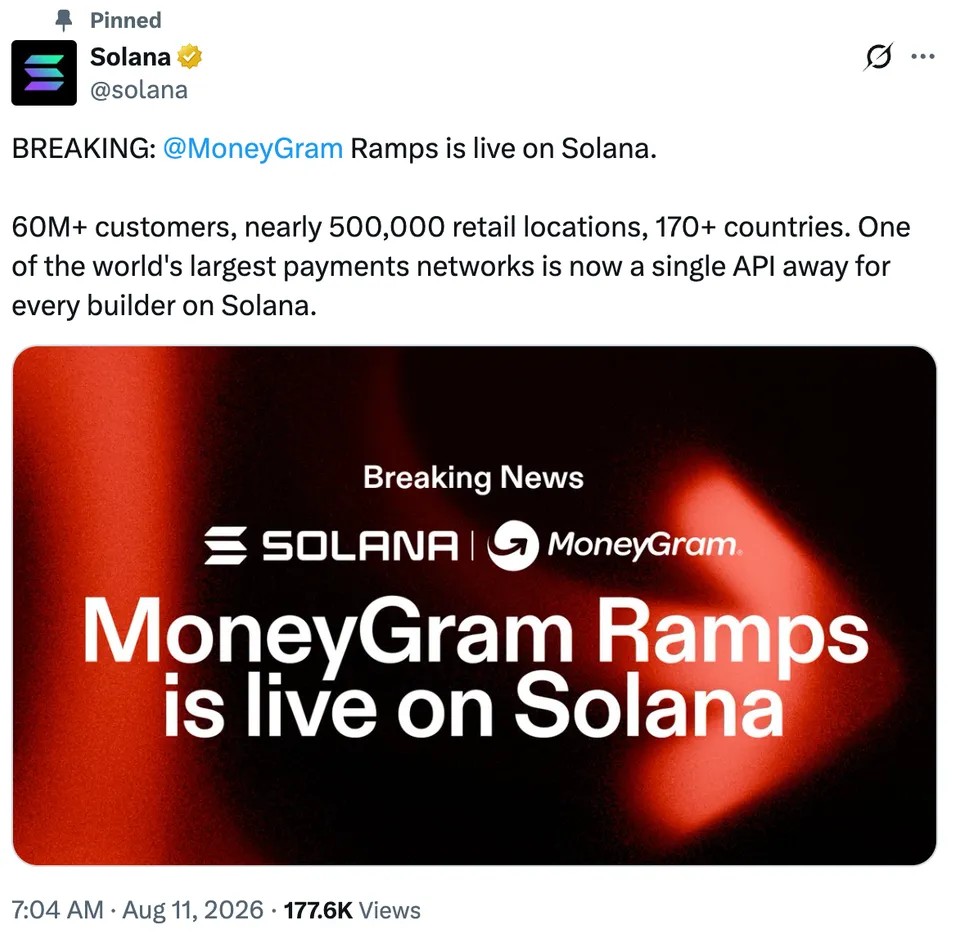
Source: Solana

According to MoneyGram, Ramps supports cash deposits in over 25 countries and cash withdrawals in over 170 countries and territories. The service is integrated into the Solana Developer Platform's payments module: developers can add MoneyGram's infrastructure for fiat on- and off-ramps without building their own bank integrations.

The company stated that launching Ramps on Solana is part of a broader effort to deploy the service across multiple blockchain ecosystems. In June, MoneyGram became a Solana validator by staking $SOL and processing transactions on the network. As part of this expansion, the company joined the Solana Developer Platform.

Magazine: Bitcoin will never drop below $60K again: Nansen founder

end-content

İlgili Sorular

QWhat new blockchain network has MoneyGram expanded its Ramps service to?

AMoneyGram has expanded its Ramps service to the Solana blockchain network.

QWhat is the core function of the MoneyGram Ramps service on Solana?

AThe core function of the MoneyGram Ramps service on Solana is to enable the conversion of fiat money to cryptocurrency and vice versa for wallets, exchanges, and developers.

QWhich Solana wallet was the first to integrate the MoneyGram Ramps service?

ARift was the first Solana wallet to integrate the MoneyGram Ramps service.

QHow many retail locations does MoneyGram reportedly service globally according to the announcement?

AAccording to the announcement, MoneyGram services over 500,000 retail locations globally.

QBesides launching Ramps, how else has MoneyGram recently engaged with the Solana network?

ABesides launching Ramps, MoneyGram recently became a validator on the Solana network by staking SOL and joined the Solana Developer Platform.

İlgili Okumalar

Fed Research: Crypto Investors Driven by Beliefs, Returns Change Their Decisions

A new working paper from the Federal Reserve Bank of Cleveland provides a novel explanation for cryptocurrency's divergence from traditional financial assets. It finds that American crypto investors are distinguished not by demographics or risk tolerance alone, but by their radically different beliefs about future returns. This divergence in expectations better explains who owns crypto than factors like age or income, a reversal of the pattern seen with stocks or bonds. The research, based on surveys of up to 25,000 US households, shows crypto owners expected an average 22% annual return, compared to just 7% for non-owners. A one-percentage-point increase in an individual's expected return was linked to a 0.8-point rise in ownership likelihood. A randomized experiment revealed that simply showing information about Bitcoin's past 12-month performance increased respondents' desired crypto portfolio share by about 47% and spurred subsequent purchases, primarily among those who previously felt uninformed. The study suggests this dynamic—where past gains attract new buyers, pushing prices higher and reinforcing bullish beliefs—could fuel speculative bubbles. It also indicates crypto wealth gains are treated more like "gambling winnings" than permanent income, boosting purchases of durable goods but not everyday spending. The broader conclusion is that crypto volatility stems partly from investor disagreement and learning, not just market fundamentals. With widespread misunderstanding and shifting expectations driven by performance data, price swings are likely to remain a defining feature of the asset class. Future retail demand may depend not just on Bitcoin's price, but on what information investors receive about its past performance.

cryptonews.ru1 saat önce

Fed Research: Crypto Investors Driven by Beliefs, Returns Change Their Decisions

cryptonews.ru1 saat önce

İşlemler

Spot
活动图片