Ministry of Finance Doubles Long-Term Bond Buyback Volume Amid Bitcoin and US Stock Rally

cryptonews.ru2026-08-19 tarihinde yayınlandı2026-08-19 tarihinde güncellendi

Özet

The U.S. Treasury Department has doubled the purchase limit for long-term bond buybacks aimed at supporting liquidity in the 10-to-20-year and 20-to-30-year Treasury segments. The new rules, effective from September 9, will be in place for the current refunding quarter ending November 4. This move responds to sustained high activity and high-quality market offerings for longer-dated securities. The program targets older, less liquid "off-the-run" bonds to improve secondary market trading without significantly reducing overall debt, as the Treasury continues issuing new debt to fund the government. The expansion follows a sharp rise in long-term Treasury yields, with the 30-year yield recently exceeding 5.33%, a level not seen since 2007. In immediate reaction, the 10-year yield fell about 6 basis points to around 4.647%, and the 30-year yield dropped roughly 9 basis points to around 5.196%. Market observers quickly termed the larger buybacks a "mini-QE," noting their potential to reduce the supply of long-term bonds that private investors must absorb. Amid the yield decline, U.S. stock indices like the Dow Jones and S&P 500 traded higher, while Bitcoin rebounded to trade around $65,000, supported by spot ETF inflows and derivatives market dynamics. Lower yields can reduce the appeal of safe dollar assets, potentially supporting Bitcoin, though it faces resistance near $65,600-$66,000. The Treasury will decide on November 4 whether to maintain, expand, or scale back the inc...

The higher limit applies to buyback operations aimed at supporting liquidity in Treasury bond segments with maturities of 10 to 20 years and 20 to 30 years. The new set of rules from the U.S. Department of the Treasury will take effect on September 9 and will be in force for the current refinancing quarter, which ends on November 4.

The Treasury Department stated that this change reflects consistently high participant activity in operations with longer-dated maturities. Market participants have submitted significant volumes of high-quality offers, giving the Treasury Department reason to increase the amount it is willing to purchase.

An updated buyback schedule will be published later. The Treasury Department plans to provide more detailed information about the volumes of future operations during the next quarterly refinancing announcement on November 4. This news comes as long-term government bonds, not just in the US, are showing warning signals not seen for several decades.

Treasury Targets Older Bonds

The program is designed to ease trading in older Treasury securities. These bonds, known as "off-the-run," were issued before the newest benchmark bonds and may be less liquid, meaning they can be harder to buy or sell without affecting prices.
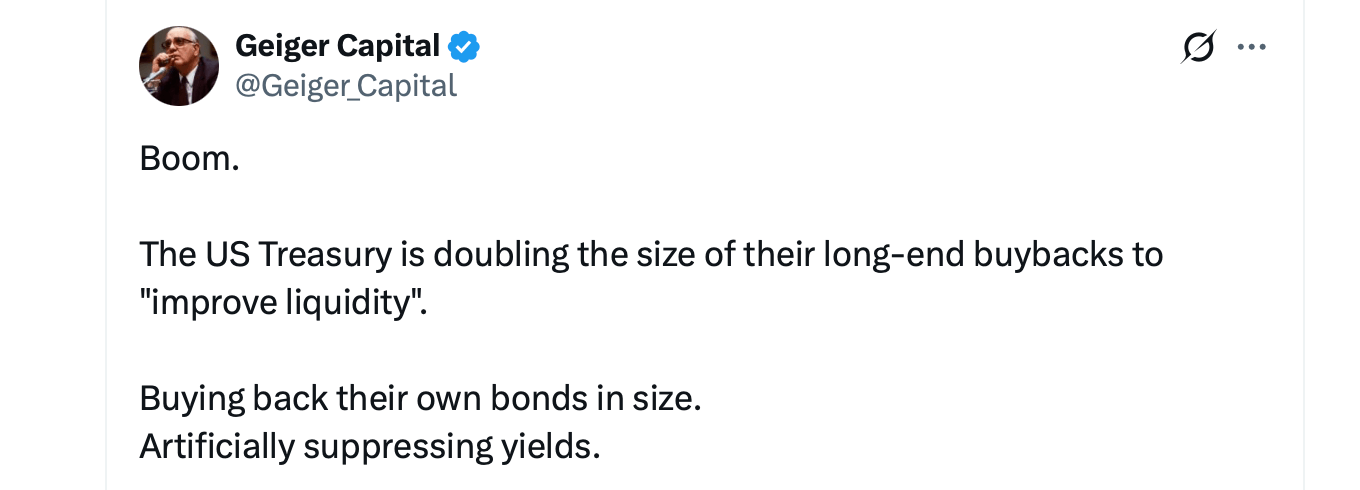
Image Source: X

The U.S. Treasury Department resumed regular buybacks in May 2024 after a long hiatus. Its cash management operations primarily target short-term securities and help regulate fluctuations in the government's cash balance. Liquidity support operations are designed to improve trading in the secondary market across the Treasury yield curve.

The Treasury can buy back older securities from dealers and other market participants and then retire them. It continues to issue new debt to finance the federal government, so these operations are more about altering the debt structure and supporting market functioning than leading to a significant reduction in outstanding debt volume.

The Department does not acquire newly issued benchmark bonds, securities that are particularly scarce in the repo market, or bonds used for delivery against Treasury futures contracts. It also remains a price-sensitive buyer and may purchase less than the stated maximum if the submitted offers are not attractive.

Yield Rise Prompted Swift Response

The expansion of the program followed a sharp rise in long-term Treasury yields. The yield on 30-year bonds recently exceeded 5.33%—the highest level since 2007—while 10-year yields climbed as investors priced in a significant volume of government borrowing, budget concerns, and a shift in the buyer base. The military conflict in the Middle East is only exacerbating the situation.
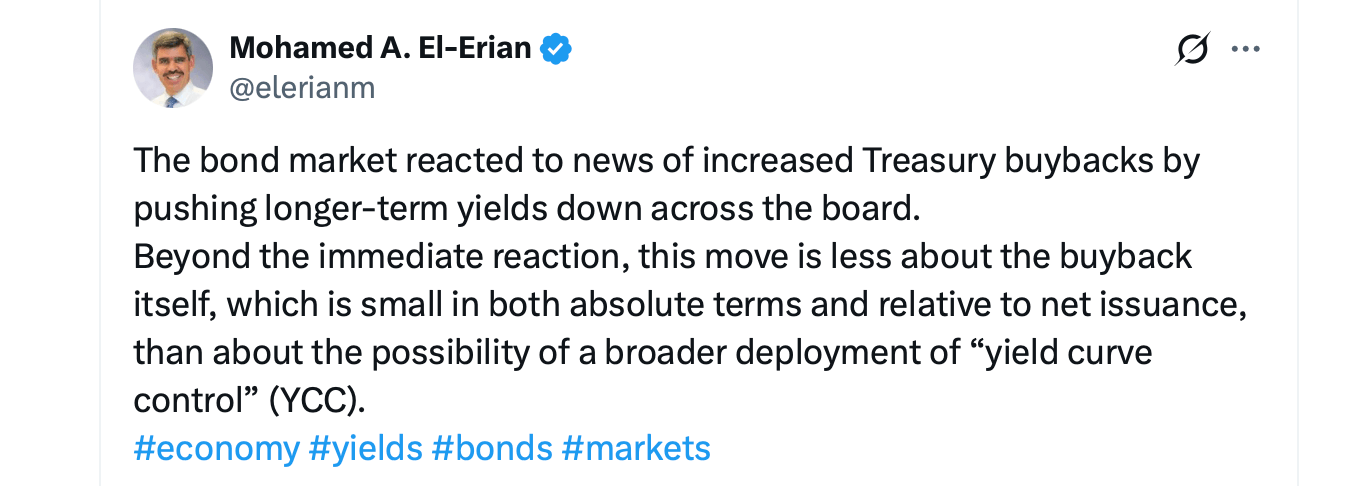
Image Source: X

The rise in long-term yields affects far more than just bond investors. It can lead to higher U.S. mortgage rates and borrowing costs for companies, while simultaneously reducing the real value of future profits in today's dollars. This pressure may particularly impact technology and other high-growth company stocks.

The initial market reaction was swift. The yield on 10-year Treasury bonds fell by about 6 basis points to around 4.647%, and the yield on 30-year bonds decreased by about 9 basis points to around 5.196%.

Market observers quickly characterized these larger-scale purchases as "mini-QE"—a term reflecting the timing of the decision: The U.S. Treasury Department increased demand for long-term bonds just as their yields approached multi-year highs. This characterization also reflects the potential of buyback operations to reduce the volume of long-term bonds that private investors must purchase.

"The U.S. Treasury Department is at least doubling the size of liquidity support buyback operations for long-term nominal coupon securities; the current maximum of $2 billion per operation will be increased to at least $4 billion per operation," wrote the X account managed by the financial publication Zerohedge on Wednesday.

They also added:

"Yields are falling, USDJPY is plummeting. Well, this settles the debate once and for all on whether Treasury buyback operations are 'mini-QE.'"

Stocks and Bitcoin Join the Rally

Amid the decline in yields, U.S. stock markets traded higher. However, the Nasdaq Composite was at 26,251.49, down 38.22 points. The New York Stock Exchange Index was at 24,779.71, up 150.57 points at 10:00 AM ET on Wednesday morning.

The Dow Jones Industrial Average rose 145.50 points to 53,488.90. The S&P 500 gained 28.12 points, reaching 7,719.88. Falling yields typically ease pressure on stock valuations and provide short-term relief for stocks sensitive to borrowing costs and discount rates.

Bitcoin was also trading in the $65,000 range after briefly returning to that price zone at the time of writing. This rise followed a hold of the $62,000 to $63,000 zone and occurred against the backdrop of recent inflows into U.S. spot Bitcoin exchange-traded funds (ETFs).

Short covering in derivatives markets also fueled the BTC rebound, accelerating a modest rise. The actions of the U.S. Treasury were not the sole driver of this move, but the decline in yields may support Bitcoin by reducing the appeal of safer dollar-denominated assets. Bitcoin still faces resistance in the $65,600 to $66,000 range, where sellers have recently emerged. The higher the price rises, the stronger the resistance.

November Presents the Next Test

On November 4, the Treasury Department will decide whether to maintain, expand, or scale back the increased volume of long-term bond buybacks. Investors will be watching to see if high-quality offerings in the bond market persist, if the yield on 30-year bonds continues to decline, and if the rally in U.S. stocks and Bitcoin solidifies.

end-content

İlgili Sorular

QWhy has the U.S. Treasury Department doubled the limit for its long-term bond buyback operations, and which specific bond segments are affected?

AThe U.S. Treasury Department doubled the limit for its long-term bond buyback operations due to persistently high activity from market participants in the longer-dated maturity sectors and significant volumes of high-quality offers received. The higher limit applies to buyback operations supporting liquidity in Treasury bond segments with maturities of 10 to 20 years and 20 to 30 years.

QWhat is the primary goal of the Treasury's buyback program targeting 'off-the-run' securities?

AThe primary goal of the Treasury's buyback program targeting 'off-the-run' securities (older Treasury securities issued before the newest benchmark bonds) is to improve their trading liquidity. These bonds can be less liquid and harder to buy or sell without impacting prices, so the program aims to ease trading in these older securities on the secondary market.

QHow did the financial markets initially react to the Treasury's announcement of expanded buybacks, particularly regarding bond yields and the U.S. dollar?

AThe financial markets reacted swiftly to the announcement. The yield on the 10-year Treasury note fell by approximately 6 basis points to around 4.647%, and the 30-year yield dropped by about 9 basis points to around 5.196%. Concurrently, the USD/JPY exchange rate declined sharply. Market observers quickly characterized the larger purchases as 'mini-QE' (quantitative easing).

QAccording to the article, what are two potential consequences of rising long-term Treasury yields for the broader U.S. economy?

ATwo potential consequences of rising long-term Treasury yields for the broader U.S. economy are: 1) It can push up U.S. mortgage rates and borrowing costs for companies. 2) It can reduce the present value of companies' future earnings, which can put particular pressure on the stock prices of technology and other high-growth companies.

QWhat key date will be important for investors to watch regarding the future of the Treasury's expanded buyback program, and what factors will influence the decision on that date?

AThe key date is November 4th. On this date, during its next quarterly refunding announcement, the U.S. Treasury Department will decide whether to maintain, expand, or reduce the increased size of its long-term bond buybacks. Investors will be monitoring factors such as whether high-quality bond market offerings persist, if 30-year bond yields continue to decline, and if the rally in U.S. stocks and Bitcoin is sustained.

İlgili Okumalar

Russian Suspected of Stealing Cryptocurrency from Cold Wallet Worth Almost 10 Million Rubles

Russian authorities are investigating a suspect accused of stealing nearly 10 million rubles worth of cryptocurrency from a cold wallet. According to investigators, the wallet belonged to an unnamed commercial company executive's assistant. In March, the suspect allegedly gained access to the victim's wallet by "an unidentified method" and transferred the digital assets to another address. During a search of the suspect's home, police seized three computers and three mobile phones for forensic examination, as they may contain important digital evidence. The case is being investigated as grand larceny under the Russian Criminal Code, carrying a potential sentence of up to ten years in prison. Police are also checking the suspect's possible involvement in other cryptocurrency thefts and identifying potential accomplices. The article notes that while cold wallets (hardware wallets storing private keys offline) are considered more secure against remote hacking, they remain vulnerable if a perpetrator gains physical or direct access to the keys. In a related case earlier in June, a court in Tomsk sentenced two men to 8 and 9.5 years in a strict-regime colony for a robbery and cryptocurrency theft. They forced an acquaintance at knifepoint to log into a crypto exchange account and transfer over 85 bitcoins, valued at approximately $5.1 million at the time.

cryptonews.ru41 dk önce

Russian Suspected of Stealing Cryptocurrency from Cold Wallet Worth Almost 10 Million Rubles

cryptonews.ru41 dk önce

Bitwise Names Three Mistakes Investors Make When Assessing the Cryptocurrency Market

Bitwise's chief investment officer, Matt Hougan, identifies three common mistakes investors make when evaluating the cryptocurrency market, all stemming from a disconnect between its current perception and potential evolution. First, investors often view crypto applications like Uniswap or Aave solely through the lens of the $2 trillion crypto market. However, with the tokenization of traditional assets (like $150 trillion in equities and $350 trillion in bonds), the potential market for these platforms could become 100 times larger. Second, there's an underestimation of crypto-native companies. Despite entry by major financial firms (e.g., PayPal in stablecoins, Fidelity in custody), native players like Tether, Circle, and Coinbase retain dominant market shares due to speed, focus, and established user bases (though exceptions like BlackRock's Bitcoin ETF success exist). Third, future blockchain transaction volumes are underestimated. Tokenized securities could trade 24/7, not just 33 hours per week, and the rise of AI agents managing portfolios could increase transaction activity by 50-100 times. Hougan concludes that investors assess the sector based on its present state while the underlying infrastructure is rapidly changing through tokenization, expanding use cases, and increased operational scale. This gap between current perception and future potential creates significant investment opportunities.

cryptonews.ru43 dk önce

Bitwise Names Three Mistakes Investors Make When Assessing the Cryptocurrency Market

cryptonews.ru43 dk önce

Grayscale Submits Fourth Amendment to Agreement for Zcash Trust, Whose Shares Will Be Listed on the NYSE Arca

Grayscale has submitted a fourth amendment to its S-3 registration form for the Grayscale Zcash Trust, a key step toward converting it into a U.S. exchange-traded fund (ETF) listed on NYSE Arca under the ticker ZCSH. This would be the first U.S. ETF providing regulated stock market access to the privacy-focused cryptocurrency ZEC ($ZEC). The amendment details the creation and redemption of shares, primarily through cash, though authorized participants can create shares in-kind by depositing ZEC. The trust is sponsored by Grayscale Investments, with Coinbase as the prime broker and custodian, and Bank of New York Mellon as administrator. The filing also notes non-binding discussions where Digital Currency Group's DCG International Investments could acquire shares by contributing 200,000 ZEC. A ZEC ETF is seen as a breakthrough due to regulatory caution around privacy-enhancing tokens. Following the filing, ZEC's price rose over 9% in 24 hours. Demand for the existing trust product has grown, with its average daily trading volume doubling from March to April, and shielded ZEC balances reaching a record ~30% of the circulating supply. Despite this momentum, Zcash has faced challenges in 2026, including a vulnerability discovered in its shielded Orchard pool that briefly caused its price to drop significantly. Developers quickly patched the issue. A regulated ETF would offer traditional investors exposure to this dual-faceted privacy asset.

cryptonews.ru44 dk önce

Grayscale Submits Fourth Amendment to Agreement for Zcash Trust, Whose Shares Will Be Listed on the NYSE Arca

cryptonews.ru44 dk önce

İşlemler

Spot
活动图片