Micron Invests $24 Billion in Singapore Factory, But Your RAM Sticks Are Not in the Plan

marsbit2026-01-27 tarihinde yayınlandı2026-01-27 tarihinde güncellendi

Özet

Micron announces a $24 billion investment to build an advanced NAND wafer fabrication plant in Singapore, with production starting in late 2028. This follows a previous $7 billion investment in a high-bandwidth memory (HBM) advanced packaging facility at the same site, bringing total new investments in Singapore to over $30 billion. The move comes as Micron shifts its focus toward AI-driven demand and away from consumer products, having recently discontinued its Crucial consumer brand, which sold retail memory modules and SSDs. The strategic pivot is driven by surging demand from AI and data centers. Micron’s HBM revenue reached $1.98 billion in Q3 FY2025, with full-year 2026 HBM supply already sold out. The company predicts the HBM market will grow to around $100 billion by 2028, surpassing the entire DRAM market of 2024. In contrast, consumer memory market is lower-margin and highly competitive. This supply shift has contributed to significant price increases in consumer memory products, with DDR4 and DDR5 spot prices rising over 150% and 300% respectively in 2025. Although Samsung and SK Hynix have extended DDR4 production in response to soaring prices, overall supply remains tight. As AI continues to drive memory demand, consumer memory costs are expected to stay elevated.

Author: David, Shenchao TechFlow

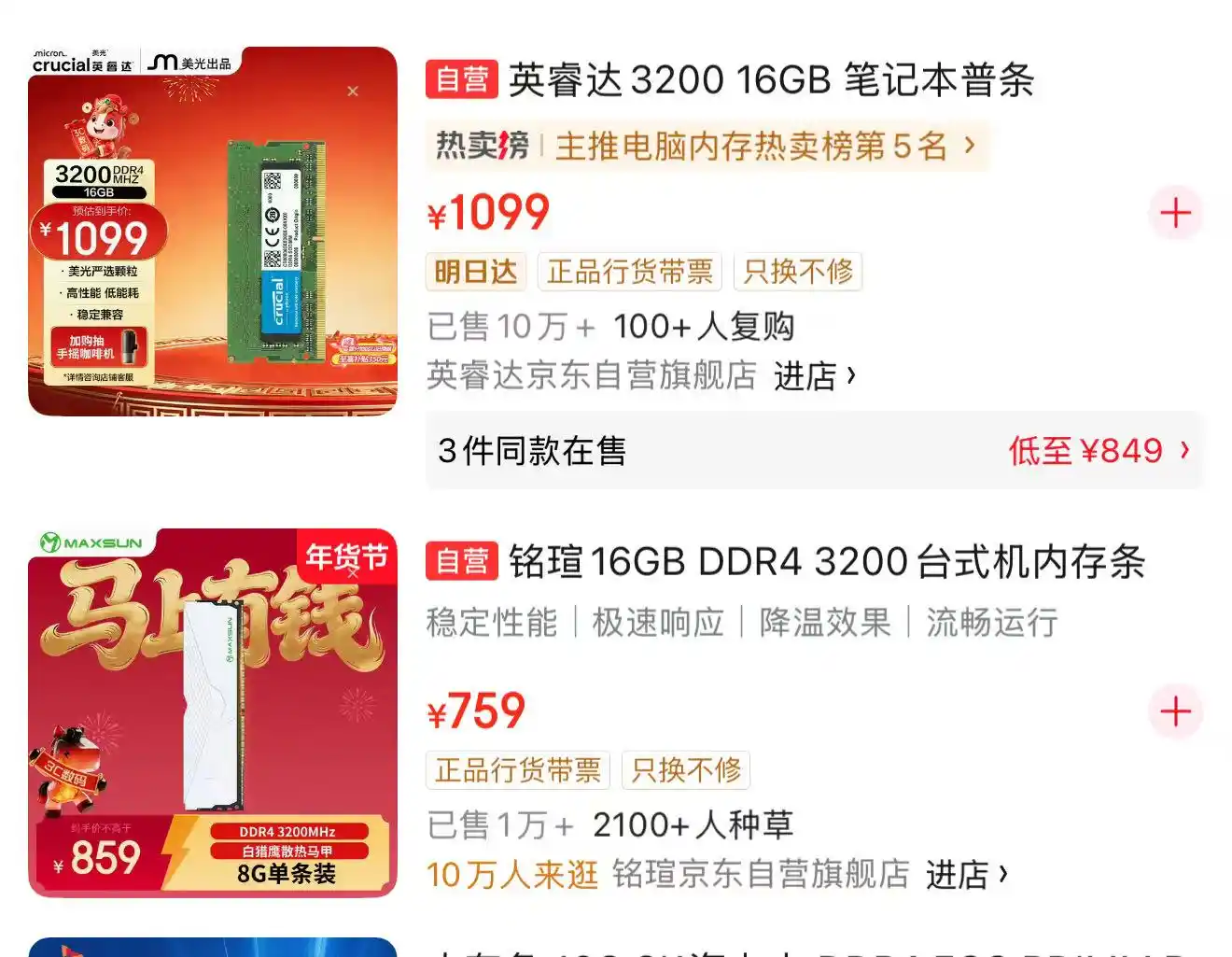
At this time last year, a 16GB DDR4 RAM stick cost just over 200 RMB. Now, the same model is priced at 600 RMB, with some models even approaching 700 RMB.

The direct reason for the price increase is a tightening of supply. The three major memory giants have collectively shifted their production capacity towards the AI market. And Micron is the latest to lay its cards on the table.

On January 27, Micron Technology announced a $24 billion (approximately S$31 billion) investment to build an advanced NAND (flash memory) wafer fabrication plant in Singapore. The investment will be phased over 10 years, with shipments starting in the second half of 2028. Singapore's Deputy Prime Minister Gan Kim Yong attended the groundbreaking ceremony.

This is Micron's second major investment in Singapore.

In January 2025, Micron had already begun construction on a $7 billion HBM (High Bandwidth Memory) advanced packaging facility within the same campus, scheduled for production in 2027. Combined, these two projects represent over $30 billion in new investments by Micron in Singapore.
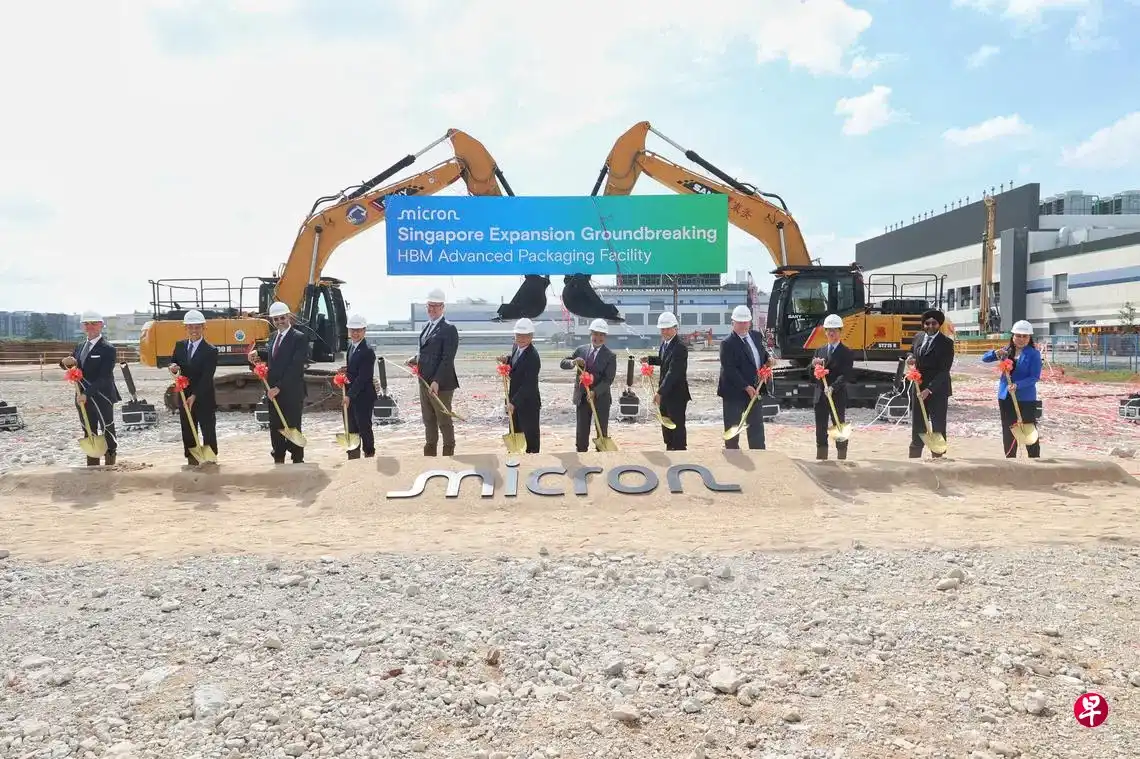
Image source: Lianhe Zaobao, photo by Tang Jiahong

Yet, this is the same company that just two months ago announced the shutdown of its 29-year-old Crucial consumer brand—the memory sticks and solid-state drives you can buy on JD.com and Taobao.

On one hand, spending billions to build factories; on the other, cutting the consumer business. Both point to the same clue: the demand for memory from AI remains high.

Capacity Reallocation After China Market Contraction

Micron's increased investment in Singapore has a clear geopolitical background.

In May 2023, China's Cyberspace Administration announced that Micron's products had not passed the cybersecurity review and required domestic critical information infrastructure operators to stop procurement. In 2018, the Chinese mainland market contributed 58% of Micron's revenue (approximately $17.36 billion); by fiscal year 2022, this had fallen to 10.8% (approximately $3.31 billion).

Production capacity needs a new outlet.

Currently, Micron already has three 3D NAND fabrication plants and several packaging and testing facilities in Singapore, employing about 9,000 people and producing 98% of Micron's flash memory chips.

Micron stated in its latest announcement that the HBM factory is expected to make a significant contribution to supply by 2027 and mentioned that as HBM becomes part of the Singapore manufacturing operations, "synergistic effects" in both NAND and DRAM (Dynamic Random-Access Memory, the common memory chips) production are anticipated.

But the priority of this "synergy" is clear: HBM capacity for 2026 is completely sold out, data center customer demand cannot be fully met, and the consumer brand is being shut down simultaneously.

Within the same campus, consumer-grade production lines are making way for AI production lines.

The Business Logic of Exiting the Consumer Market

On December 3, 2025, Micron announced via its official website a complete exit from the Crucial consumer business, including the sales of RAM sticks and SSD (Solid State Drive) products through global retailers, e-commerce platforms, and distributors.

Shipments will continue until the end of February 2026, at which point this brand, founded in 1996, will bid farewell to the retail market.

In the statement, Micron's Executive Vice President, Sadana, stated that the surge in memory and storage demand driven by AI in data centers prompted Micron to make the "difficult decision" to exit the Crucial consumer business in order to more effectively supply and support large strategic customers in high-growth areas.

Data supports this judgment.

Micron's fiscal year 2025 third-quarter HBM product income reached $1.98 billion, with an annualized revenue close to $8 billion. According to TrendForce data, the unit price of HBM memory required for AI servers is about 8 times that of ordinary servers.

Micron predicts the HBM market size will grow from approximately $35 billion in 2025 to about $100 billion in 2028, by which time it will exceed the size of the entire DRAM market in 2024.

In contrast, consumer-grade storage is a business with thin profits and fierce competition.

Micron's exit means the world's major consumer DRAM manufacturers are reduced from three—Samsung, SK Hynix, Micron—to two.

The AI Rally of Memory Stocks

The capital market has already priced in this shift.

According to statistics from *National Business Daily*, memory stocks occupied the top four spots on the U.S. stock gainers list for the full year 2025:

SanDisk rose 577%, becoming the S&P 500's top performer for the year; Western Digital rose 281%; Micron rose 236%; Seagate rose 216%.
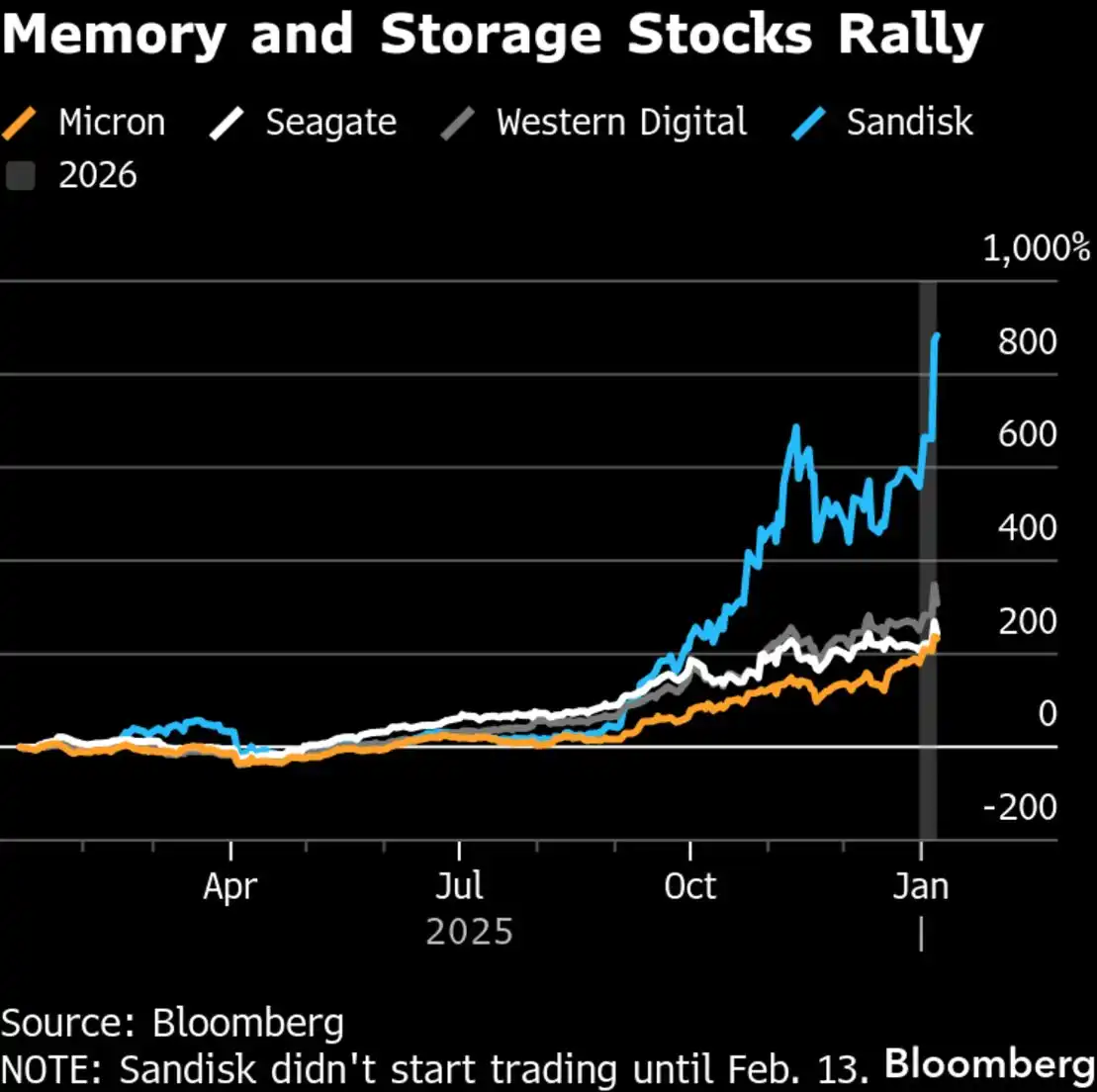
For comparison, Nvidia rose 39% in the same period, ranking 71st.

It was reported that tech giants like Google and Amazon presented Micron with "unlimited purchase demands" in October 2025. Micron CEO Mehrotra revealed on an earnings call that the company's entire HBM supply for 2026 is already sold out, and currently, it can only meet half to two-thirds of the demand from key customers.

Micron's latest financial report shows revenue of $13.6 billion for September-November 2025, a year-on-year increase of 57%, with DRAM revenue of $10.8 billion, up 69% year-on-year.

Consumer Side: Price Hikes May Continue

Samsung, SK Hynix, and Micron had all previously announced plans to gradually phase out DDR4 production from late 2025 to early 2026. Micron issued an end-of-life notice for DDR4/LPDDR4 in June.

Although Samsung and SK Hynix later extended their DDR4 production plans to the end of 2026 due to soaring DDR4 prices, the overall trend of tightening supply remains unchanged.

The price reaction has been intense. According to TrendForce data, since 2025, the spot price of DDR5 memory chips has risen over 300%, while DDR4 has risen over 150%. DDR4 has even seen a "price inversion," with the price of some specifications exceeding that of DDR5.
ADATA Chairman Chen Libai also publicly stated that the comprehensive shortage and price increase across the four major storage categories—DRAM, NAND, SSD, HDD—is a situation he is witnessing for the first time in over thirty years in the industry.

If you want to add memory to your old computer or build a new desktop, the cost remains high. Because AI needs computing power, and computing power needs memory. Your old computer is probably still behind AI demand in the queue.

Memory stocks have risen, and memory stick prices have risen too.

One is an investment opportunity; the other is paying the bill for that opportunity.

İlgili Sorular

QWhy did Micron announce the closure of its Crucial consumer brand?

AMicron closed its Crucial consumer brand to reallocate resources and supply to meet the surging demand for memory and storage from data centers and large strategic customers driven by AI, as the consumer market is less profitable and highly competitive.

QWhat is the total investment Micron is making in Singapore for new manufacturing facilities?

AMicron is investing a total of over $30 billion in Singapore, including $24 billion for a new NAND wafer fab and over $7 billion for an HBM advanced packaging plant.

QHow has the price of consumer memory modules changed recently according to the article?

AThe price of a 16GB DDR4 memory module has increased from over 200 yuan to about 600 yuan, with some models nearing 700 yuan, due to tightened supply and shifted production focus to AI.

QWhat percentage of Micron's revenue came from the Chinese market in 2022 compared to 2018?

AIn 2018, the Chinese market contributed 58% of Micron's revenue, but by the 2022 fiscal year, it had decreased to 10.8%.

QWhich storage-related stocks were the top performers in the U.S. stock market in 2025 according to the article?

AIn 2025, the top-performing U.S. storage stocks were SanDisk (up 577%), Western Digital (up 281%), Micron (up 236%), and Seagate (up 216%).

İlgili Okumalar

The Essence of AI Layoffs: Why More AI Adoption Leads to More Corporate Anxiety?

The author, awaiting potential inclusion on an 8000-person layoff list, analyzes the true nature of recent "AI-driven" layoffs. They argue that while AI use, particularly tools like Claude for code generation, has skyrocketed and boosted developer output (e.g., 2-5x more code commits), this has not translated into proportional business growth or revenue. The core issue is a misalignment between increased "Input" (code) and tangible "Outcomes" (user value, revenue). AI acts as a costly B2B SaaS, inflating operational expenses without guaranteed returns. Two key problems emerge: 1) The friction that once filtered out bad ideas is gone, as AI allows cheap pursuit of even weak concepts. 2) Organizational "alignment tax"—the difficulty of coordinating across teams—becomes crippling when development velocity outpaces consensus-building. Thus, layoffs serve two immediate purposes: 1) To offset ballooning AI costs (Token consumption) and maintain cash flow, as rising input costs without outcome growth destroys unit economics. 2) To reduce organizational bloat and alignment friction by simply removing teams, thereby speeding up execution in the short term. Therefore, these layoffs are fundamentally caused by AI, even if AI doesn't directly replace roles. They represent a painful correction until companies learn to convert AI-driven productivity into real business outcomes and streamline organizational coordination to match the new pace of work. The cycle will continue until this learning curve is mastered.

marsbit1 dk önce

The Essence of AI Layoffs: Why More AI Adoption Leads to More Corporate Anxiety?

marsbit1 dk önce

Can the Solana Foundation and Google's Collaboration on Pay.sh Bridge the Payment Link Between Web2 and Web3 in the Agent Economy?

Solana Foundation, in collaboration with Google Cloud, has launched Pay.sh, a payment gateway designed to bridge the gap between AI agents and enterprise-grade service infrastructure. The initiative aims to solve a key bottleneck in the "agent economy": existing payment systems are ill-suited for autonomous AI agents. Traditional methods like credit cards require human verification, while newer on-chain protocols like x402 and MPP create a separate, Web3-native system that raises barriers for service providers. Pay.sh functions as a universal payment layer. It allows users to fund a Solana wallet via credit card or stablecoin, which then acts as an identity and payment proxy for AI agents. When an agent needs to access a paid API service (e.g., Google Cloud, Alibaba Cloud), Pay.sh handles the transaction seamlessly. It leverages the HTTP 402 status code ("Payment Required") to initiate payments, intelligently choosing between one-time transfers (x402-style) or session-based authorizations (MPC-style) based on the service's billing model. This spares agents from manual account registration and API key management. A key feature for service providers is low integration effort. They can adopt Pay.sh by providing a declarative configuration file, enabling features like tiered pricing, free tiers, and automatic revenue splitting to multiple addresses (e.g., for royalties, cloud costs). Providers can also list their APIs in a central Pay Skill Registry for agent discovery. The collaboration with Google Cloud provides crucial infrastructure for API proxying, traffic routing, and compliance logging, aiming to keep agent activities within regulated boundaries. By connecting Web2 services with Web3 payment rails, Pay.sh positions the Solana wallet as a foundational identity and payment tool for AI agents, potentially driving more transaction volume to the Solana ecosystem. However, the report notes challenges. The service registry currently lacks robust vetting, risking exposure to unauthorized or malicious third-party APIs. Pay.sh also inherits security and compatibility risks from its underlying payment protocols (x402, MPC). Furthermore, adoption may be hindered by varying regional data privacy and payment compliance regulations among API providers. Despite these hurdles, Pay.sh represents a significant step towards integrating Web2 and Web3 for autonomous agent commerce.

marsbit8 dk önce

Can the Solana Foundation and Google's Collaboration on Pay.sh Bridge the Payment Link Between Web2 and Web3 in the Agent Economy?

marsbit8 dk önce

Bitcoin's Bull-Bear Cycle Indicator Turns Positive for the First Time in 7 Months: End of Bear Market or False Breakout?

Bitcoin's "Bull-Bear Market Cycle Indicator" from CryptoQuant has turned positive for the first time since October 2025. This gauge, based on the P&L Index relative to its 365-day moving average, suggests a potential shift from a bear market phase. Concurrently, the Bull Score Index rose to a neutral reading of 50 in late April. The indicator's move into positive territory follows a roughly 35% price rebound from a low near $60,000 in February to above $81,000. The recovery over approximately three months was faster than the 12-month period observed during the 2022 bear market. However, analysts caution against premature optimism, citing a historical precedent from March 2022. Back then, the Bull Score Index briefly hit 50, but it proved to be a false signal as Bitcoin's price subsequently plunged further. Structural differences exist in the current cycle, including consistent inflows into spot Bitcoin ETFs and an increase in large holder addresses. Yet, some models, referencing the four-year halving cycle, suggest a potential deeper bottom near $50,000 might still be possible around late 2026. In summary, while on-chain data shows marked improvement and the worst panic may be over, market participants remain cautious. A convincing trend reversal confirmation likely requires Bitcoin to sustainably break above key resistance, such as the 200-day moving average near $82,000.

marsbit16 dk önce

Bitcoin's Bull-Bear Cycle Indicator Turns Positive for the First Time in 7 Months: End of Bear Market or False Breakout?

marsbit16 dk önce

How to Automate Any Workflow with Claude Skills (Complete Tutorial)

This is a comprehensive guide to mastering Claude Skills, a feature for creating permanent, reusable instruction sets that automate specific workflows. Unlike simple saved prompts, Skills function like trained employees, delivering consistent, high-quality outputs by defining the entire task process, standards, error handling, and output format. The guide is structured in four phases: **Phase 1: Installation (5 minutes).** Skills are folders containing a `SKILL.md` file. The user is instructed to find a relevant Skill online, install it, test it on a real task, and compare its performance to one-off prompts. **Phase 2: Building Your First Custom Skill.** Start by rigorously defining the Skill's purpose, trigger phrases, and providing a concrete example of perfect output. The `SKILL.md` file has two parts: a YAML frontmatter with a specific name/description/triggers, and a detailed, step-by-step workflow written in natural language with examples and quality standards. **Phase 3: Testing & Optimization for Production.** Test the Skill in three scenarios: 1) a standard, common task; 2) edge cases with missing or conflicting data; and 3) a pressure test with maximum complexity. Any failure indicates a needed instruction. Implement a weekly optimization cycle to continuously refine the Skill based on real usage. **Phase 4: Building a Complete Skill Library.** The goal is to create a team of Skills for all repetitive tasks. Examples are given for industries like real estate, marketing, finance, consulting, and e-commerce. The user should list their tasks, prioritize them, and build one new Skill per week, maintaining a master document to track their library. The conclusion emphasizes the compounding time savings: ten Skills saving 30 minutes each per week reclaims over 260 hours (6.5 work weeks) per year, fundamentally transforming one's work system.

marsbit39 dk önce

How to Automate Any Workflow with Claude Skills (Complete Tutorial)

marsbit39 dk önce

İşlemler

Spot
Futures
活动图片





