Metrics Ventures: Why Are Gold, the Renminbi, and Bitcoin the Same Answer?

marsbit2026-01-28 tarihinde yayınlandı2026-01-28 tarihinde güncellendi

Özet

Metrics Ventures analyzes the shifting global monetary and geopolitical order, arguing that gold, the Chinese yuan, and Bitcoin are all responses to the same underlying trend: a loss of faith in the existing international system and governance structures. The article begins by noting the surge in gold demand, particularly from central banks, which signals a deeper repricing of sovereign currency credit and global governance effectiveness rather than mere inflation hedging. This sentiment was a key theme at the Davos forum, where leaders discussed the breakdown of the "rules-based international order." As trust in multilateral institutions wanes, nations are rationally shifting towards strategic autonomy and risk management, preparing for uncertainty rather than operating within old assumptions. This erosion of trust is penetrating financial markets. Sovereign debt and currencies are no longer just economic tools but are now discounted for a state's governance capability and political constraints. The core of the issue is identified as structural within the dollar-centric system, which requires the U.S. to run persistent deficits to supply the world with "risk-free" dollar assets. This imbalance was sustainable as long as dollar assets were seen as uniquely safe, but the weaponization of financial tools and declining governance trust is forcing a repricing. The piece contrasts the responses of two major surplus economies: Japan and China. Japan absorbed adjustment costs thr...

Authored by: Metrics Ventures

Over the past year, gold's performance has been particularly striking. More importantly, the demand structure has undergone significant changes: the willingness of central banks and sovereign entities to allocate has noticeably increased. This can no longer be simply explained as inflation hedging or short-term safe-haven trading. A more reasonable understanding is that gold is responding to a deeper change—a repricing of sovereign monetary credit and the effectiveness of global governance.

This change was repeatedly discussed at this year's Davos Forum. Whether in formal agendas or private discussions, phrases like "imbalance in the world governance structure," "the old order is breaking," and "we are entering a phase from which there is no return" almost became the common context. On Tuesday, Canadian Prime Minister Mark Carney's speech at Davos clearly articulated this sense of unease pervading the venue. He bluntly stated that the so-called "rules-based international order" is disintegrating, and humanity is moving from a once useful, albeit fictional, narrative towards a harsher reality: great power competition is no longer constrained, economic integration is being weaponized, and rules are selectively applied in the face of power.

Carney did not simply blame a single country but pointed to a more widespread change in circumstances. When tariffs, financial infrastructure, supply chains, and even security commitments can be used as bargaining chips, the multilateral institutions—whether the WTO, the UN, or other rule-based frameworks—on which medium-sized powers and open economies rely for survival are losing their binding force. In such an environment, continuing to pretend that the rules are still functioning normally becomes a form of self-deception. He used Havel's metaphor of "living within a lie" to remind countries: the real risk is not that the order is changing, but that people are still acting according to the language and assumptions of the old order.

More notably, what Carney repeatedly emphasized was not ideological confrontation but a shift in governance choices. When rules no longer automatically provide security, nations turn to another rationality: enhancing strategic autonomy, diversifying dependencies, and building "pressure-resistant" capabilities. In his view, this is a typical risk management logic, not a betrayal of values. But it is precisely here that the foundation sustaining the old order begins to loosen—because once countries no longer believe the system can consistently provide public goods, they will instead buy "insurance" for themselves.

If we abstract the Davos discussions from specific countries, we find a deeper common direction: countries have not suddenly become more conservative but have begun to tacitly accept that a key assumption is failing—that the existing global governance system can long-term coordinate fiscal, monetary, and international responsibilities. When this premise is no longer widely believed, national behavior shifts from "division of labor within rules" to "preparing for uncertainty." And this shift will ultimately be reflected in the most fundamental areas: debt, fiscal policy, and currency.

It is here that the cracks in world governance begin to penetrate financial pricing. National debt is no longer just a macro-control tool but is re-examined as a discount of governance capacity and political constraints; sovereign currency is no longer just a medium of exchange but is required to simultaneously bear the functions of intertemporal commitment, international responsibility, and crisis buffer. Once the market begins to doubt whether these roles can still be fulfilled simultaneously, the impact on monetary credit is no longer an extreme scenario but a gradual yet irreversible process.

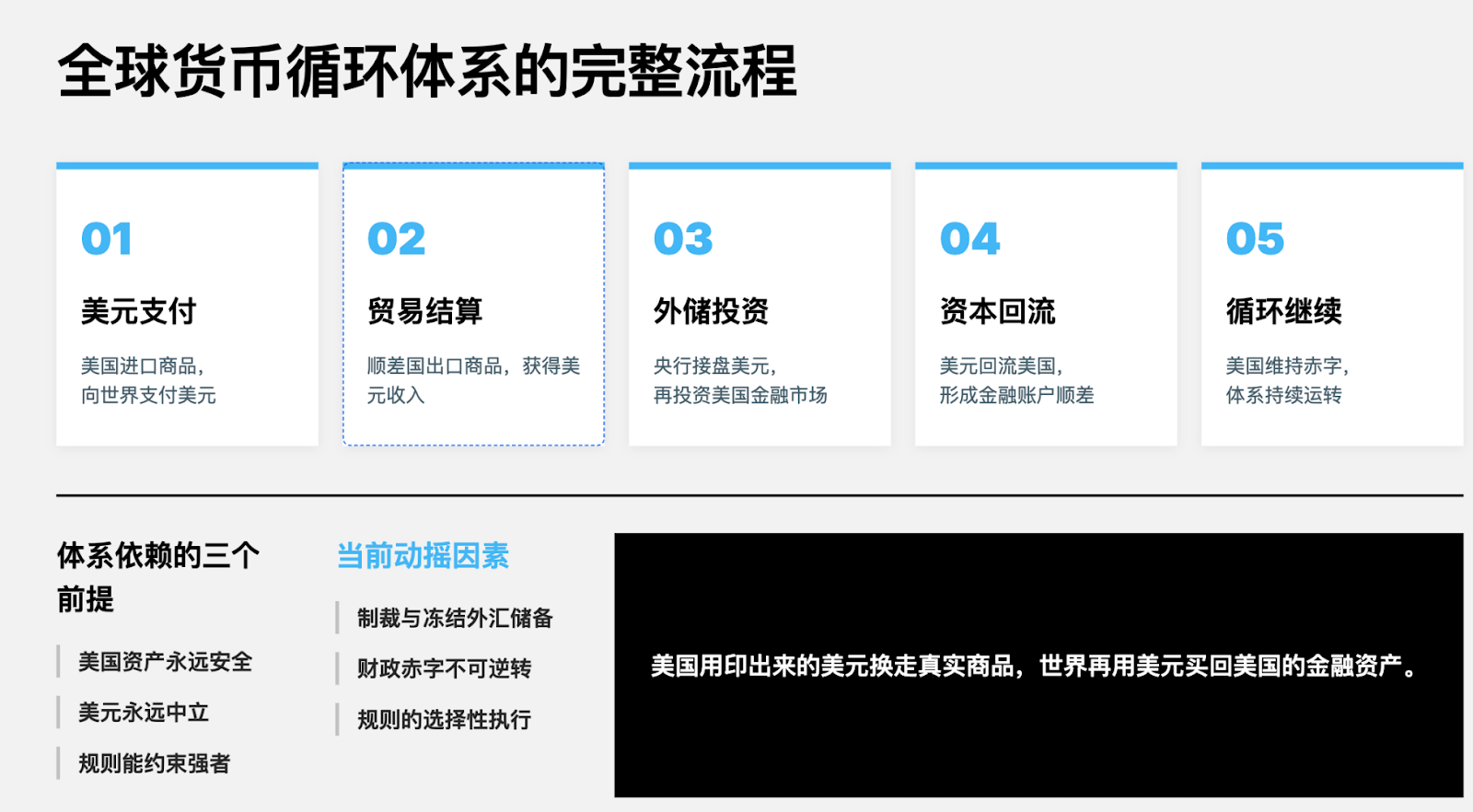
And all this does not stem from the fiscal mistakes of a particular country but is embedded within the current international monetary system. The dollar-centric system dictates that the world must have a long-term deficit center that absorbs external savings, and it also dictates that surpluses and deficits are not accidental but a role division solidified by the system. The US dollar is both a sovereign currency of the United States and the basis for global reserves, pricing, and safe assets. This means that global demand for "risk-free dollar assets" further intensifies when uncertainty rises. To provide these assets to the world, the US can only fulfill this role by continuously incurring external liabilities.

In an environment of financialization and free capital flows, this division of labor is constantly amplified. Surpluses are no longer primarily digested through adjustments in commodity prices or exchange rates but are transformed into long-term allocations to US Treasury bonds and dollar-denominated financial assets; deficits are no longer immediately constrained but are postponed and absorbed through the financial system and central bank intervention. As long as the world still believes that dollar assets possess irreplaceable safety in a crisis, this imbalance can persist long-term, even being seen as a source of systemic stability.

But when governance trust declines, rule constraints weaken, and financial tools are frequently weaponized, this structural imbalance begins to be repriced. Surpluses and deficits are no longer just macroeconomic phenomena but become risk exposures themselves. It is also against this backdrop that Japan and China, both surplus countries, have gradually moved towards different paths.
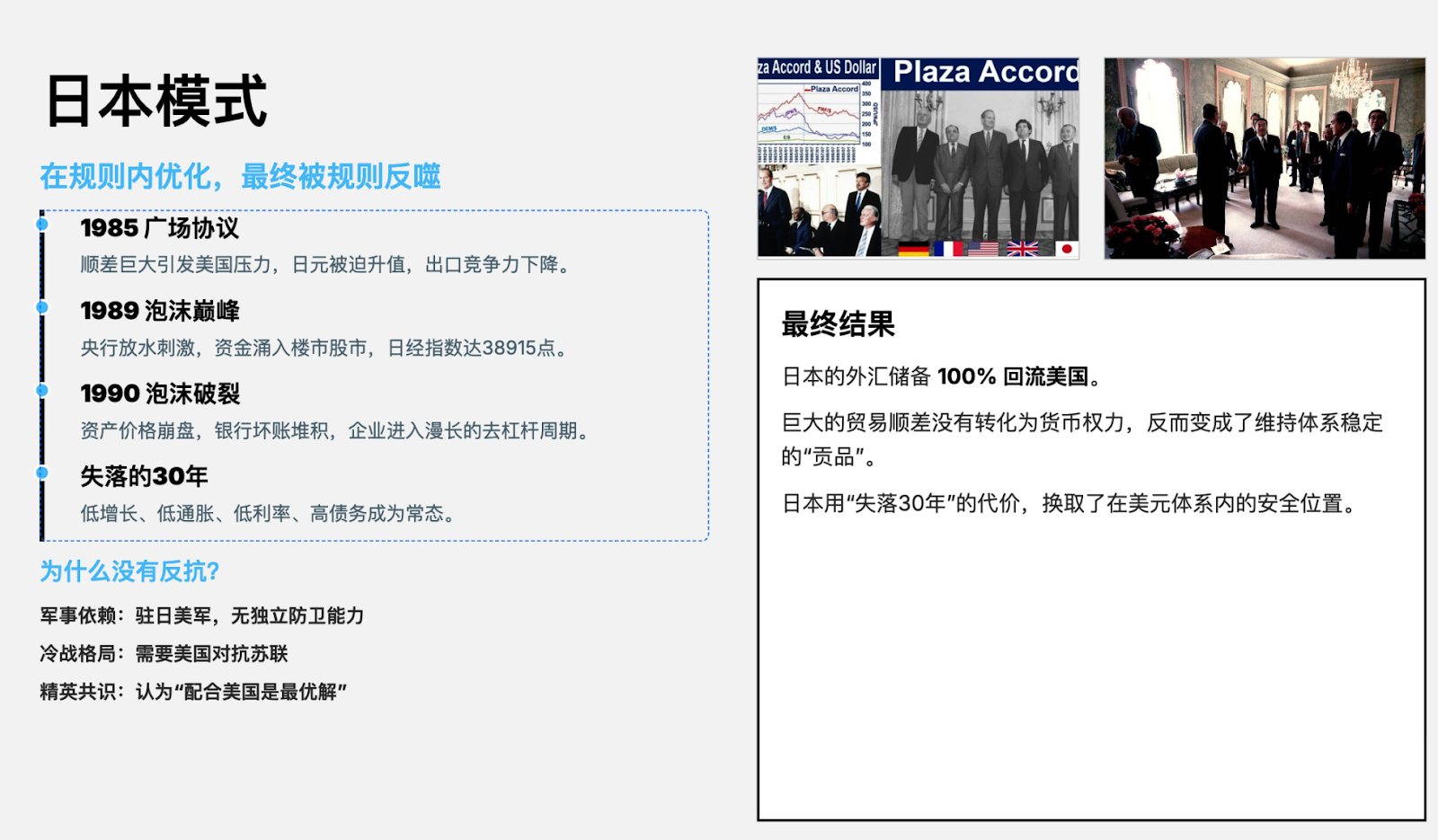
Japan has played the most typical and "cooperative" surplus country role in this system. Under external pressure and rule constraints, Japan chose to absorb adjustment costs through currency appreciation, financial liberalization, and long-term accommodative policies, thereby maintaining the stability of the overall order. This strategy reduced friction in the short term but transformed structural adjustments into domestic low growth, high debt, and deep central bank intervention. The surplus did not disappear but was internalized as the cost of long-term stagnation; Japan's monetary internationalization capacity was also significantly limited in this process.
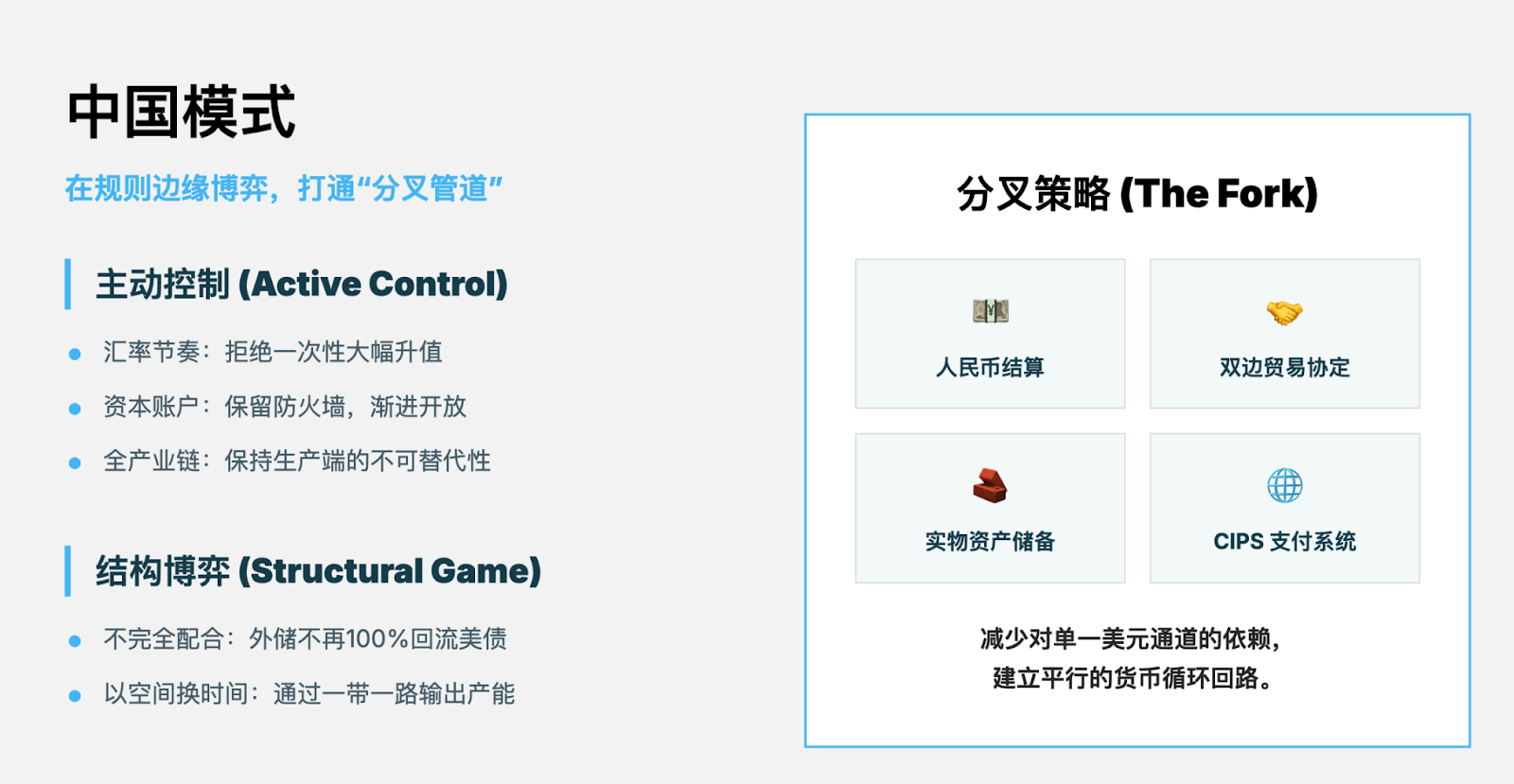
China entered this system later, and its stage of development and internal constraints were significantly different from Japan's. Faced with surplus expansion and external pressure, China did not fully choose to clear rapidly through price and financial channels but, within the framework of exchange rate management, capital account controls, and industrial upgrading, sought to preserve policy autonomy as much as possible. This choice has long placed China in controversy, accused of "distorting rules" or "free-riding," but from a governance perspective, it appears more like a strategic arrangement to buy time and space for internal transformation within the existing system, rather than simple institutional arbitrage.

More importantly, this path did not stop at "maintaining a surplus" but quietly changed the structure of renminbi demand. As China's position in global trade, manufacturing, and key supply chains has risen, the renminbi is no longer just a settlement tool but is increasingly seen by more economies as a practical option for reducing external dependence and diversifying currency risk. Against the backdrop of intensified geopolitics and the instrumentalization of financial sanctions, sole reliance on the dollar system itself begins to be seen as a risk exposure, giving demand for renminbi settlement, renminbi financing, and renminbi asset allocation a clear strategic motivation.

Once renminbi demand shifts from passive use to active allocation, its impact is no longer limited to the trade level but transmits to the financial level. More frequent and stable usage scenarios mean the market needs a deeper and more liquid renminbi asset pool to accommodate this demand. Increased liquidity, in turn, affects how assets are priced, gradually moving renminbi assets from "domestic policy pricing" towards "a logic closer to international marginal pricing." This process does not rely on complete capital liberalization but is更多的是 pulled by real demand, representing a gradual yet hard-to-reverse change.
It is also in this contrast that "the East rises while the West declines" has once again become a proposition that can be seriously discussed in recent years. It is no longer an emotional judgment about the rise and fall of a particular country but a reflection of the changing costs of systemic roles. As the self-healing capacity of the dollar system declines, the space for the deficit center to continue absorbing imbalances through debt and financial expansion is shrinking; meanwhile, the importance of surplus economies in industrial chains, security, and regional arrangements is rising. In this process, China, by not fully replicating Japan's adjustment path, has retained industrial, policy, and monetary space, giving it higher strategic elasticity in systemic restructuring.

But this change does not mean a new single hegemonic currency is forming. A more realistic picture is the monetary system moving towards a multi-center and coexisting structure. The centrality of the US dollar may be weakened but will not disappear quickly; the status of the renminbi in trade settlement, regional finance, and liquidity provision will gradually increase, yet not necessarily predicated on full free floatation, but more reliant on trade networks, industrial chain depth, and policy credibility. Monetary internationalization here is no longer an institutional label but an outcome that is used into existence.

In such systemic evolution, the logic of reserve assets also changes accordingly. Gold's return to a core position is not because it can provide yield, but because it does not rely on any country's tax base, political stability, or international commitments; it is a direct response to governance uncertainty. It provides countries with a de-sovereign, de-credit reserve option, particularly suited to function in an environment lacking consensus and with weakened rule constraints.

Bitcoin represents another tier of de-sovereign asset. Although its performance has lagged behind gold and some traditional assets over the past year and a half, its core logic has not been disproven. As a digital, scarce asset not attached to any single governance system, it更像 is more like a long-term option on future monetary forms. As monetary system restructuring becomes more explicit and liquidity is reallocated, its pricing logic is more likely to catch up in later stages rather than lead in the early phases.

If these clues are finally gathered together, one finds that what this as-yet-unnamed order migration is truly changing is not short-term power comparisons, but the preconditions for the validity of assets. When rules no longer automatically provide safety, when monetary credit itself becomes a risk that needs to be hedged, the core question of asset allocation is no longer betting on who wins, but how to remain valid in a world where uncertainty has become the norm.

Against this backdrop, gold is a defensive response, while more directional choices are embodied in the renminbi and Bitcoin. The renminbi represents the real liquidity embedded in the new order, a bet on monetary restructuring pulled by trade, industry, and real demand; Bitcoin represents the ultimate hedge against governance uncertainty, a long-term option detached from any single sovereign system. Choosing them is not a statement of stance, but a largely self-consistent outcome of asset allocation under the premise that the cracks in world governance have already become explicit.

History does not announce itself with dramatic events. It is often only at a moment when looking back that people realize the order has already, imperceptibly, migrated.


İlgili Sorular

QAccording to the article, why is gold experiencing a resurgence in demand from central banks and sovereign entities?

AThe demand is not just a simple inflation hedge or short-term safe-haven trade. It is a response to a deeper structural change: a repricing of sovereign currency credit and the perceived declining effectiveness of global governance. Gold provides a non-sovereign, non-credit-based reserve asset that acts as a direct hedge against governance uncertainty.

QWhat fundamental flaw in the current international monetary system does the article identify as the root cause of instability?

AThe article identifies the dollar-centric system as the root cause. This system structurally requires a permanent deficit center (the U.S.) to absorb global savings by issuing debt, while surplus countries accumulate dollar assets. This imbalance is institutionalized, and its stability relies on the unwavering global belief in the safety of dollar assets, a belief that is now eroding due to geopolitical weaponization of financial tools and declining trust in governance.

QHow does the strategic response of China to its trade surplus differ from that of Japan, as described in the article?

AJapan absorbed the costs of adjustment through currency appreciation, financial liberalization, and long-term easing policies to maintain the existing order, which led to domestic stagnation and high debt. China, however, used capital controls and managed exchange rates to retain policy autonomy, focusing on internal transformation and industrial upgrading. This path has given China greater strategic elasticity and is now shifting RMB demand from passive use to active strategic configuration by other nations.

QWhat role does the article assign to Bitcoin in the evolving monetary landscape?

ABitcoin is described as a long-term option on future monetary forms. It is a digital, scarce asset that is not dependent on any single governance system. It represents the ultimate hedge against governance uncertainty. Its pricing logic is expected to catch up later in the cycle of monetary system restructuring rather than lead in the early stages.

QWhat is the common answer that gold, the RMB, and Bitcoin provide, according to the article's conclusion?

AThey are all responses to a world where the 'rules-based international order' is fracturing and monetary credit itself has become a risk that needs to be hedged. Gold is the defensive response. The RMB represents a bet on a new monetary structure embedded in real trade and industrial demand. Bitcoin is the ultimate, long-term hedge against sovereign system uncertainty. Choosing them is a coherent asset allocation result in a world where uncertainty is the new constant.

İlgili Okumalar

Computing Power Constrained, Why Did DeepSeek-V4 Open Source?

DeepSeek-V4 has been released as a preview open-source model, featuring 1 million tokens of context length as a baseline capability—previously a premium feature locked behind enterprise paywalls by major overseas AI firms. The official announcement, however, openly acknowledges computational constraints, particularly limited service throughput for the high-end DeepSeek-V4-Pro version due to restricted high-end computing power. Rather than competing on pure scale, DeepSeek adopts a pragmatic approach that balances algorithmic innovation with hardware realities in China’s AI ecosystem. The V4-Pro model uses a highly sparse architecture with 1.6T total parameters but only activates 49B during inference. It performs strongly in agentic coding, knowledge-intensive tasks, and STEM reasoning, competing closely with top-tier closed models like Gemini Pro 3.1 and Claude Opus 4.6 in certain scenarios. A key strategic product is the Flash edition, with 284B total parameters but only 13B activated—making it cost-effective and accessible for mid- and low-tier hardware, including domestic AI chips from Huawei (Ascend), Cambricon, and Hygon. This design supports broader adoption across developers and SMEs while stimulating China's domestic semiconductor ecosystem. Despite facing talent outflow and intense competition in user traffic—with rivals like Doubao and Qianwen leading in monthly active users—DeepSeek has maintained technical momentum. The release also comes amid reports of a new funding round targeting a valuation exceeding $10 billion, potentially setting a new record in China’s LLM sector. Ultimately, DeepSeek-V4 represents a shift toward open yet realistic infrastructure development in the constrained compute landscape of Chinese AI, emphasizing engineering efficiency and domestic hardware compatibility over pure model scale.

marsbit37 dk önce

Computing Power Constrained, Why Did DeepSeek-V4 Open Source?

marsbit37 dk önce

İşlemler

Spot
Futures

Popüler Makaleler

$S$ Nedir

SPERO'yu Anlamak: Kapsamlı Bir Genel Bakış SPERO'ya Giriş İnovasyonun manzarası gelişmeye devam ederken, web3 teknolojilerinin ve kripto para projelerinin ortaya çıkışı dijital geleceği şekillendirmede önemli bir rol oynamaktadır. Bu dinamik alanda dikkat çeken projelerden biri SPERO, $$s$$ olarak adlandırılmaktadır. Bu makale, SPERO hakkında ayrıntılı bilgi toplamak ve sunmak amacıyla, meraklılar ve yatırımcıların web3 ve kripto alanlarındaki temellerini, hedeflerini ve yeniliklerini anlamalarına yardımcı olmayı amaçlamaktadır. SPERO,$$s$$ Nedir? SPERO,$$s$$, kripto alanında merkeziyetsizlik ve blok zinciri teknolojisi ilkelerini kullanarak etkileşimi, faydayı ve finansal kapsayıcılığı teşvik eden bir ekosistem yaratmayı amaçlayan benzersiz bir projedir. Proje, kullanıcıların yenilikçi finansal çözümler ve hizmetler sunarak eşler arası etkileşimleri yeni yollarla kolaylaştırmayı hedeflemektedir. SPERO,$$s$$'nin temel amacı, bireyleri güçlendirmek ve kripto para alanındaki kullanıcı deneyimini artıran araçlar ve platformlar sağlamaktır. Bu, daha esnek işlem yöntemlerini mümkün kılmayı, topluluk odaklı girişimleri teşvik etmeyi ve merkeziyetsiz uygulamalar (dApp'ler) aracılığıyla finansal fırsatlar yaratmayı içermektedir. SPERO,$$s$$'nin temel vizyonu kapsayıcılık etrafında dönmekte olup, geleneksel finansal sistemlerdeki boşlukları kapatmayı ve blok zinciri teknolojisinin faydalarından yararlanmayı hedeflemektedir. SPERO,$$s$$'nin Yaratıcısı Kimdir? SPERO,$$s$$'nin yaratıcısının kimliği bir miktar belirsizdir, çünkü kurucusu(ları) hakkında ayrıntılı arka plan bilgisi sağlayan sınırlı kamuya açık kaynaklar bulunmaktadır. Bu şeffaflık eksikliği, projenin merkeziyetsizlik taahhüdünden kaynaklanabilir—birçok web3 projesinin paylaştığı bir etik anlayışı, bireysel tanınmanın yerine kolektif katkıları önceliklendirmektedir. Topluluk ve onun kolektif hedefleri etrafında tartışmaları merkezileştirerek, SPERO,$$s$$, belirli bireyleri öne çıkarmadan güçlendirme özünü taşımaktadır. Bu nedenle, SPERO'nun etik anlayışını ve misyonunu anlamak, tek bir yaratıcının kimliğini belirlemekten daha önemlidir. SPERO,$$s$$'nin Yatırımcıları Kimlerdir? SPERO,$$s$$, kripto sektöründe yeniliği teşvik etmeye adanmış girişim sermayedarlarından melek yatırımcılara kadar çeşitli yatırımcılar tarafından desteklenmektedir. Bu yatırımcıların odak noktası genellikle SPERO'nun misyonuyla uyumlu olup, toplumsal teknolojik ilerlemeyi, finansal kapsayıcılığı ve merkeziyetsiz yönetimi vaat eden projeleri önceliklendirmektedir. Bu yatırımcı temelleri, yalnızca yenilikçi ürünler sunan projelere değil, aynı zamanda blok zinciri topluluğuna ve ekosistemlerine olumlu katkılarda bulunan projelere de ilgi duymaktadır. Bu yatırımcıların desteği, SPERO,$$s$$'yi hızla gelişen kripto projeleri alanında dikkate değer bir rakip haline getirmektedir. SPERO,$$s$$ Nasıl Çalışır? SPERO,$$s$$, onu geleneksel kripto para projelerinden ayıran çok yönlü bir çerçeve kullanmaktadır. İşte benzersizliğini ve yeniliğini vurgulayan bazı temel özellikler: Merkeziyetsiz Yönetim: SPERO,$$s$$, kullanıcıların projenin geleceğiyle ilgili karar alma süreçlerine aktif olarak katılmalarını sağlayan merkeziyetsiz yönetim modellerini entegre etmektedir. Bu yaklaşım, topluluk üyeleri arasında sahiplik ve hesap verebilirlik duygusunu teşvik etmektedir. Token Kullanımı: SPERO,$$s$$, ekosistem içinde çeşitli işlevler sunmak üzere tasarlanmış kendi kripto para token'ını kullanmaktadır. Bu token'lar, işlemleri, ödülleri ve platformda sunulan hizmetlerin kolaylaştırılmasını sağlayarak genel etkileşimi ve faydayı artırmaktadır. Katmanlı Mimari: SPERO,$$s$$'nin teknik mimarisi, modülerlik ve ölçeklenebilirliği destekleyerek projenin evrimi sırasında ek özelliklerin ve uygulamaların sorunsuz bir şekilde entegrasyonuna olanak tanımaktadır. Bu uyum sağlama yeteneği, sürekli değişen kripto manzarasında geçerliliği sürdürmek için hayati öneme sahiptir. Topluluk Katılımı: Proje, işbirliği ve geri bildirim teşvik eden mekanizmalar kullanarak topluluk odaklı girişimlere vurgu yapmaktadır. Güçlü bir topluluk oluşturarak, SPERO,$$s$$, kullanıcı ihtiyaçlarını daha iyi karşılayabilir ve piyasa trendlerine uyum sağlayabilir. Kapsayıcılığa Odaklanma: Düşük işlem ücretleri ve kullanıcı dostu arayüzler sunarak, SPERO,$$s$$, daha önce kripto alanında yer almamış bireyler de dahil olmak üzere çeşitli bir kullanıcı tabanını çekmeyi hedeflemektedir. Bu kapsayıcılık taahhüdü, erişilebilirlik yoluyla güçlendirme misyonuyla uyumludur. SPERO,$$s$$ Zaman Çizelgesi Bir projenin tarihini anlamak, gelişim yolculuğu ve kilometre taşları hakkında kritik bilgiler sağlar. Aşağıda, SPERO,$$s$$'nin evriminde önemli olayları haritalayan önerilen bir zaman çizelgesi bulunmaktadır: Kavram Geliştirme ve Fikir Aşaması: SPERO,$$s$$'nin temelini oluşturan ilk fikirler, blok zinciri endüstrisindeki merkeziyetsizlik ve topluluk odaklılık ilkeleriyle yakından uyumlu olarak geliştirildi. Proje Beyaz Kağıdının Yayınlanması: Kavramsal aşamayı takiben, SPERO,$$s$$'nin vizyonunu, hedeflerini ve teknolojik altyapısını ayrıntılı bir şekilde açıklayan kapsamlı bir beyaz kağıt yayımlandı ve topluluk ilgisini ve geri bildirimini toplamak amacıyla sunuldu. Topluluk Oluşturma ve Erken Katılımlar: Projenin hedefleri etrafında tartışmalar yürüterek destek toplamak ve erken benimseyenler ile potansiyel yatırımcılar için bir topluluk oluşturmak amacıyla aktif iletişim çabaları gerçekleştirildi. Token Üretim Etkinliği: SPERO,$$s$$, yerel token'larını erken destekçilere dağıtmak ve ekosistem içinde başlangıç likiditesini sağlamak amacıyla bir token üretim etkinliği (TGE) gerçekleştirdi. İlk dApp'in Yayınlanması: SPERO,$$s$$ ile ilişkili ilk merkeziyetsiz uygulama (dApp) faaliyete geçti ve kullanıcıların platformun temel işlevleriyle etkileşimde bulunmalarını sağladı. Sürekli Gelişim ve Ortaklıklar: Projenin tekliflerine sürekli güncellemeler ve iyileştirmeler yapılmakta olup, blok zinciri alanındaki diğer oyuncularla stratejik ortaklıklar, SPERO,$$s$$'yi rekabetçi ve gelişen bir oyuncu haline getirmiştir. Sonuç SPERO,$$s$$, web3 ve kripto paranın finansal sistemleri devrim niteliğinde dönüştürme ve bireyleri güçlendirme potansiyelinin bir kanıtıdır. Merkeziyetsiz yönetime, topluluk katılımına ve yenilikçi tasarlanmış işlevselliğe olan bağlılığıyla, daha kapsayıcı bir finansal manzaraya doğru bir yol açmaktadır. Hızla gelişen kripto alanındaki herhangi bir yatırımda olduğu gibi, potansiyel yatırımcılar ve kullanıcılar, SPERO,$$s$$ içindeki devam eden gelişmelerle ilgili olarak kapsamlı bir araştırma yapmaları ve düşünceli bir şekilde katılmaları teşvik edilmektedir. Proje, kripto endüstrisinin yenilikçi ruhunu sergileyerek, sayısız olasılığını keşfetmeye davet etmektedir. SPERO,$$s$$'nin yolculuğu hala devam ederken, temel ilkeleri, teknoloji, finans ve birbirimizle etkileşim biçimimizi etkileyebilir.

89 Toplam GörüntülenmeYayınlanma 2024.12.17Güncellenme 2024.12.17

$S$ Nedir

AGENT S Nedir

Agent S: Web3'te Otonom Etkileşimin Geleceği Giriş Web3 ve kripto para dünyasında sürekli gelişen manzarada, yenilikler bireylerin dijital platformlarla etkileşim biçimlerini sürekli olarak yeniden tanımlıyor. Bu tür öncü projelerden biri olan Agent S, açık ajans çerçevesi aracılığıyla insan-bilgisayar etkileşimini devrim niteliğinde değiştirmeyi vaat ediyor. Otonom etkileşimlerin yolunu açarak, Agent S karmaşık görevleri basitleştirmeyi ve yapay zeka (AI) alanında dönüştürücü uygulamalar sunmayı hedefliyor. Bu detaylı inceleme, projenin karmaşıklıklarına, benzersiz özelliklerine ve kripto para alanındaki etkilerine dalacaktır. Agent S Nedir? Agent S, bilgisayar görevlerinin otomasyonunda üç temel zorluğu ele almak üzere özel olarak tasarlanmış çığır açıcı bir açık ajans çerçevesidir: Alan Spesifik Bilgi Edinimi: Çerçeve, çeşitli dış bilgi kaynaklarından ve iç deneyimlerden akıllıca öğrenir. Bu çift yönlü yaklaşım, alan spesifik bilgi açısından zengin bir veri havuzu oluşturmasını sağlar ve görev yürütmedeki performansını artırır. Uzun Görev Ufukları Üzerinde Planlama: Agent S, karmaşık görevlerin verimli bir şekilde parçalanmasını ve yürütülmesini kolaylaştıran deneyim artırımlı hiyerarşik planlama kullanır. Bu özellik, çoklu alt görevleri etkili ve verimli bir şekilde yönetme yeteneğini önemli ölçüde artırır. Dinamik, Homojen Olmayan Arayüzlerle Başlama: Proje, ajanlar ve kullanıcılar arasındaki etkileşimi geliştiren yenilikçi bir çözüm olan Ajan-Bilgisayar Arayüzü'ni (ACI) tanıtmaktadır. Çok Modlu Büyük Dil Modellerini (MLLM'ler) kullanarak, Agent S çeşitli grafik kullanıcı arayüzlerini sorunsuz bir şekilde gezinebilir ve manipüle edebilir. Bu öncü özellikler aracılığıyla, Agent S, makinelerle insan etkileşimini otomatikleştirmede karşılaşılan karmaşıklıkları ele alan sağlam bir çerçeve sunarak, AI ve ötesinde birçok uygulama için zemin hazırlıyor. Agent S'nin Yaratıcısı Kimdir? Agent S'nin kavramı temelde yenilikçi olsa da, yaratıcısı hakkında spesifik bilgiler belirsizliğini koruyor. Yaratıcı şu anda bilinmiyor, bu da projenin yeni aşamasını veya kurucu üyeleri gizli tutma stratejik tercihini vurguluyor. Anonimlikten bağımsız olarak, odak çerçevenin yetenekleri ve potansiyeli üzerinde kalıyor. Agent S'nin Yatırımcıları Kimlerdir? Agent S, kriptografik ekosistemde oldukça yeni olduğundan, yatırımcıları ve finansal destekçileri hakkında ayrıntılı bilgiler açıkça belgelenmemiştir. Projeyi destekleyen yatırım temelleri veya organizasyonları hakkında kamuya açık bilgilerdeki eksiklik, finansman yapısı ve gelişim yol haritası hakkında sorular doğuruyor. Destekleyicilerin anlaşılması, projenin sürdürülebilirliğini ve potansiyel pazar etkisini değerlendirmek için kritik öneme sahiptir. Agent S Nasıl Çalışır? Agent S'nin temelinde, çeşitli ortamlarda etkili bir şekilde çalışmasını sağlayan son teknoloji bir sistem yatmaktadır. İşleyiş modeli birkaç ana özellik etrafında inşa edilmiştir: İnsan Benzeri Bilgisayar Etkileşimi: Çerçeve, bilgisayarlarla etkileşimleri daha sezgisel hale getirmeyi amaçlayan gelişmiş AI planlaması sunar. Görev yürütmedeki insan davranışını taklit ederek, kullanıcı deneyimlerini yükseltmeyi vaat eder. Anlatı Belleği: Yüksek düzeyde deneyimlerden yararlanmak için kullanılan Agent S, görev geçmişlerini takip etmek amacıyla anlatı belleğini kullanarak karar verme süreçlerini geliştirir. Episodik Bellek: Bu özellik, kullanıcılara adım adım rehberlik sağlayarak, çerçevenin görevler gelişirken bağlamsal destek sunmasına olanak tanır. OpenACI Desteği: Yerel olarak çalışabilme yeteneği ile Agent S, kullanıcıların etkileşimleri ve iş akışları üzerinde kontrol sağlamasına olanak tanır ve Web3'ün merkeziyetsiz felsefesiyle uyumlu hale gelir. Dış API'lerle Kolay Entegrasyon: Çeşitli AI platformlarıyla uyumluluğu ve çok yönlülüğü, Agent S'nin mevcut teknolojik ekosistemlere sorunsuz bir şekilde entegre olmasını sağlar ve geliştiriciler ile organizasyonlar için cazip bir seçenek haline getirir. Bu işlevsellikler, Agent S'nin kripto alanındaki benzersiz konumuna katkıda bulunarak, karmaşık, çok aşamalı görevleri minimum insan müdahalesi ile otomatikleştirir. Proje geliştikçe, Web3'teki potansiyel uygulamaları dijital etkileşimlerin nasıl gelişeceğini yeniden tanımlayabilir. Agent S'nin Zaman Çizelgesi Agent S'nin gelişimi ve kilometre taşları, önemli olaylarını vurgulayan bir zaman çizelgesinde özetlenebilir: 27 Eylül 2024: Agent S'nin kavramı, “Bilgisayarları İnsan Gibi Kullanan Açık Bir Ajans Çerçevesi” başlıklı kapsamlı bir araştırma makalesi ile tanıtıldı ve projenin temelini sergiledi. 10 Ekim 2024: Araştırma makalesi arXiv'de kamuya açık olarak yayınlandı ve çerçevenin derinlemesine bir incelemesini ve OSWorld benchmark'ına dayalı performans değerlendirmesini sundu. 12 Ekim 2024: Agent S'nin yetenekleri ve özellikleri hakkında görsel bir içgörü sağlayan bir video sunumu yayımlandı ve potansiyel kullanıcılar ve yatırımcılarla daha fazla etkileşim sağlandı. Bu zaman çizelgesindeki işaretler, sadece Agent S'nin ilerlemesini değil, aynı zamanda şeffaflık ve topluluk katılımına olan bağlılığını da göstermektedir. Agent S Hakkında Ana Noktalar Agent S çerçevesi gelişmeye devam ederken, birkaç ana özellik öne çıkmakta ve yenilikçi doğasını ve potansiyelini vurgulamaktadır: Yenilikçi Çerçeve: İnsan etkileşimine benzer bir bilgisayar kullanımı sağlamak üzere tasarlanan Agent S, görev otomasyonuna yeni bir yaklaşım getiriyor. Otonom Etkileşim: GUI aracılığıyla bilgisayarlarla otonom olarak etkileşim kurabilme yeteneği, daha akıllı ve verimli hesaplama çözümlerine doğru bir sıçrama anlamına geliyor. Karmaşık Görev Otomasyonu: Sağlam metodolojisi ile karmaşık, çok aşamalı görevleri otomatikleştirerek süreçleri daha hızlı ve daha az hata payı ile gerçekleştirebilir. Sürekli İyileştirme: Öğrenme mekanizmaları, Agent S'nin geçmiş deneyimlerden öğrenmesini sağlar ve sürekli olarak performansını ve etkinliğini artırır. Çok Yönlülük: OSWorld ve WindowsAgentArena gibi farklı işletim ortamlarında uyumlu olması, geniş bir uygulama yelpazesine hizmet edebilmesini sağlar. Agent S, Web3 ve kripto alanında kendini konumlandırırken, etkileşim yeteneklerini artırma ve süreçleri otomatikleştirme potansiyeli, AI teknolojilerinde önemli bir ilerlemeyi temsil etmektedir. Yenilikçi çerçevesi aracılığıyla, Agent S dijital etkileşimlerin geleceğini örneklemekte ve çeşitli sektörlerde kullanıcılar için daha sorunsuz ve verimli bir deneyim vaat etmektedir. Sonuç Agent S, AI ve Web3'ün birleşiminde cesur bir sıçramayı temsil ediyor ve teknoloji ile etkileşim biçimimizi yeniden tanımlama kapasitesine sahip. Henüz erken aşamalarında olmasına rağmen, uygulama olanakları geniş ve çekici. Kritik zorlukları ele alan kapsamlı çerçevesi ile Agent S, otonom etkileşimleri dijital deneyimin ön plana çıkmasına taşımayı hedefliyor. Kripto para ve merkeziyetsizlik alanlarına daha derinlemesine girdikçe, Agent S gibi projelerin teknoloji ve insan-bilgisayar işbirliğinin geleceğini şekillendirmede önemli bir rol oynayacağı kesin.

439 Toplam GörüntülenmeYayınlanma 2025.01.14Güncellenme 2025.01.14

AGENT S Nedir

S Nasıl Satın Alınır

HTX.com’a hoş geldiniz! Sonic (S) satın alma işlemlerini basit ve kullanışlı bir hâle getirdik. Adım adım açıkladığımız rehberimizi takip ederek kripto yolculuğunuza başlayın. 1. Adım: HTX Hesabınızı OluşturunHTX'te ücretsiz bir hesap açmak için e-posta adresinizi veya telefon numaranızı kullanın. Sorunsuzca kaydolun ve tüm özelliklerin kilidini açın. Hesabımı Aç2. Adım: Kripto Satın Al Bölümüne Gidin ve Ödeme Yönteminizi SeçinKredi/Banka Kartı: Visa veya Mastercard'ınızı kullanarak anında Sonic (S) satın alın.Bakiye: Sorunsuz bir şekilde işlem yapmak için HTX hesap bakiyenizdeki fonları kullanın.Üçüncü Taraflar: Kullanımı kolaylaştırmak için Google Pay ve Apple Pay gibi popüler ödeme yöntemlerini ekledik.P2P: HTX'teki diğer kullanıcılarla doğrudan işlem yapın.Borsa Dışı (OTC): Yatırımcılar için kişiye özel hizmetler ve rekabetçi döviz kurları sunuyoruz.3. Adım: Sonic (S) Varlıklarınızı SaklayınSonic (S) satın aldıktan sonra HTX hesabınızda saklayın. Alternatif olarak, blok zinciri transferi yoluyla başka bir yere gönderebilir veya diğer kripto para birimlerini takas etmek için kullanabilirsiniz.4. Adım: Sonic (S) Varlıklarınızla İşlem YapınHTX'in spot piyasasında Sonic (S) ile kolayca işlemler yapın.Hesabınıza erişin, işlem çiftinizi seçin, işlemlerinizi gerçekleştirin ve gerçek zamanlı olarak izleyin. Hem yeni başlayanlar hem de deneyimli yatırımcılar için kullanıcı dostu bir deneyim sunuyoruz.

1.3k Toplam GörüntülenmeYayınlanma 2025.01.15Güncellenme 2025.03.21

S Nasıl Satın Alınır

Tartışmalar

HTX Topluluğuna hoş geldiniz. Burada, en son platform gelişmeleri hakkında bilgi sahibi olabilir ve profesyonel piyasa görüşlerine erişebilirsiniz. Kullanıcıların S (S) fiyatı hakkındaki görüşleri aşağıda sunulmaktadır.

活动图片