MemeCore jumps 18% as traders turn bullish: Is a breakout toward $2 next?

ambcrypto2026-03-17 tarihinde yayınlandı2026-03-17 tarihinde güncellendi

Özet

MemeCore surged 18% in 24 hours, reaching $1.74, as trading volume spiked 46% to $13.67M. The price broke out from a symmetrical triangle pattern, with its next key resistance at $1.85. A successful break above this level could target $2.60. Technical indicators like the MACD show strengthening upward momentum. Market sentiment is bullish, with Binance top traders holding 60.91% long positions. Short liquidations, totaling around $7.68K, have further fueled the rally. While the overall alignment is positive, a failure to break $1.85 could trigger volatility due to crowded long positioning.

MemeCore has rallied over 18% in the last 24 hours, pushing the price toward $1.74 as trading activity expands rapidly across Spot markets.

Volume has surged to $13.67M, marking a sharp 46% increase, which reflects strong participation behind the move.

At the same time, market cap has climbed to $2.23B, reinforcing the scale of capital entering the asset. However, price still trades below a key resistance near $1.85, which continues to define the next directional move for MemeCore [M].

Can MemeCore sustain this breakout structure?

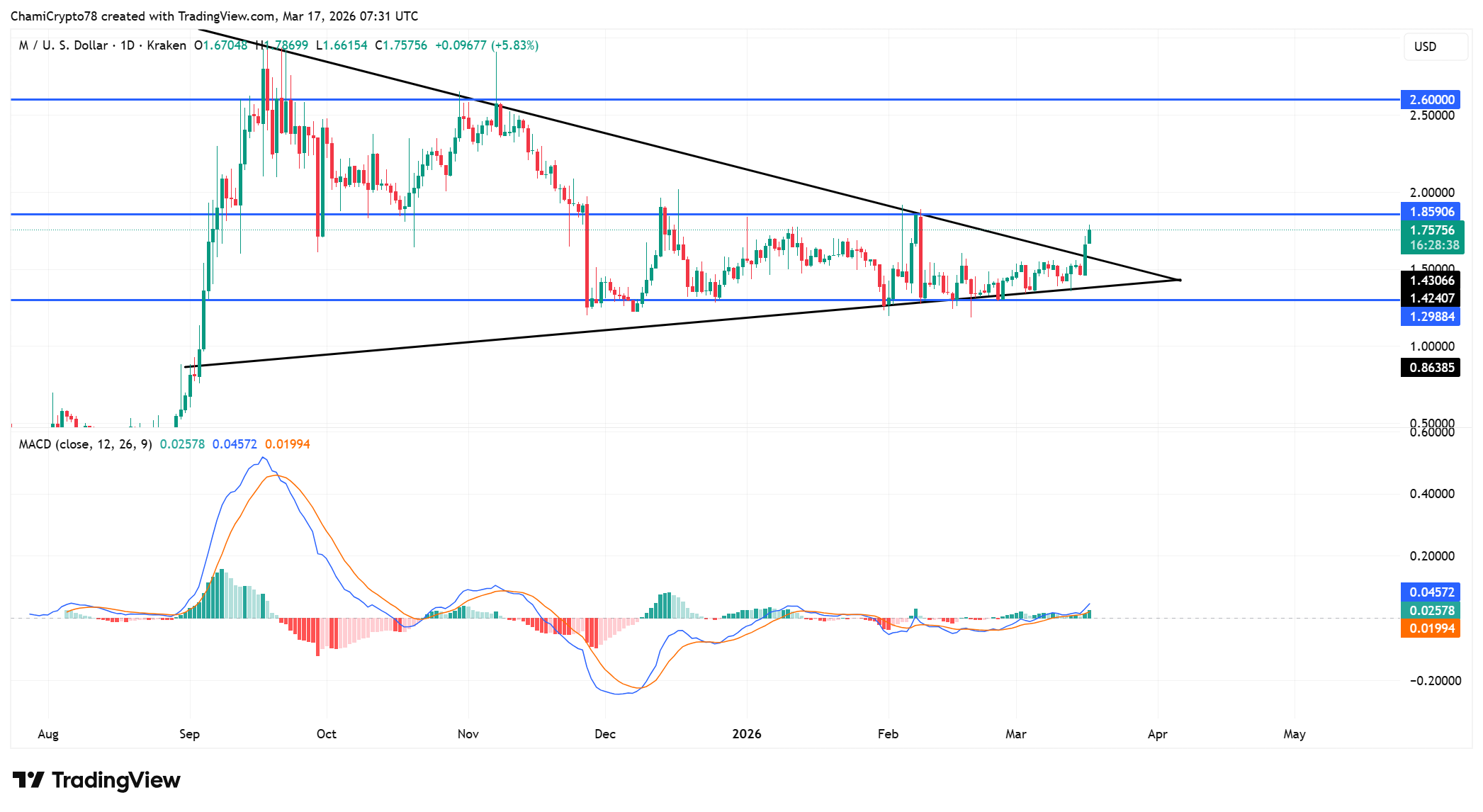
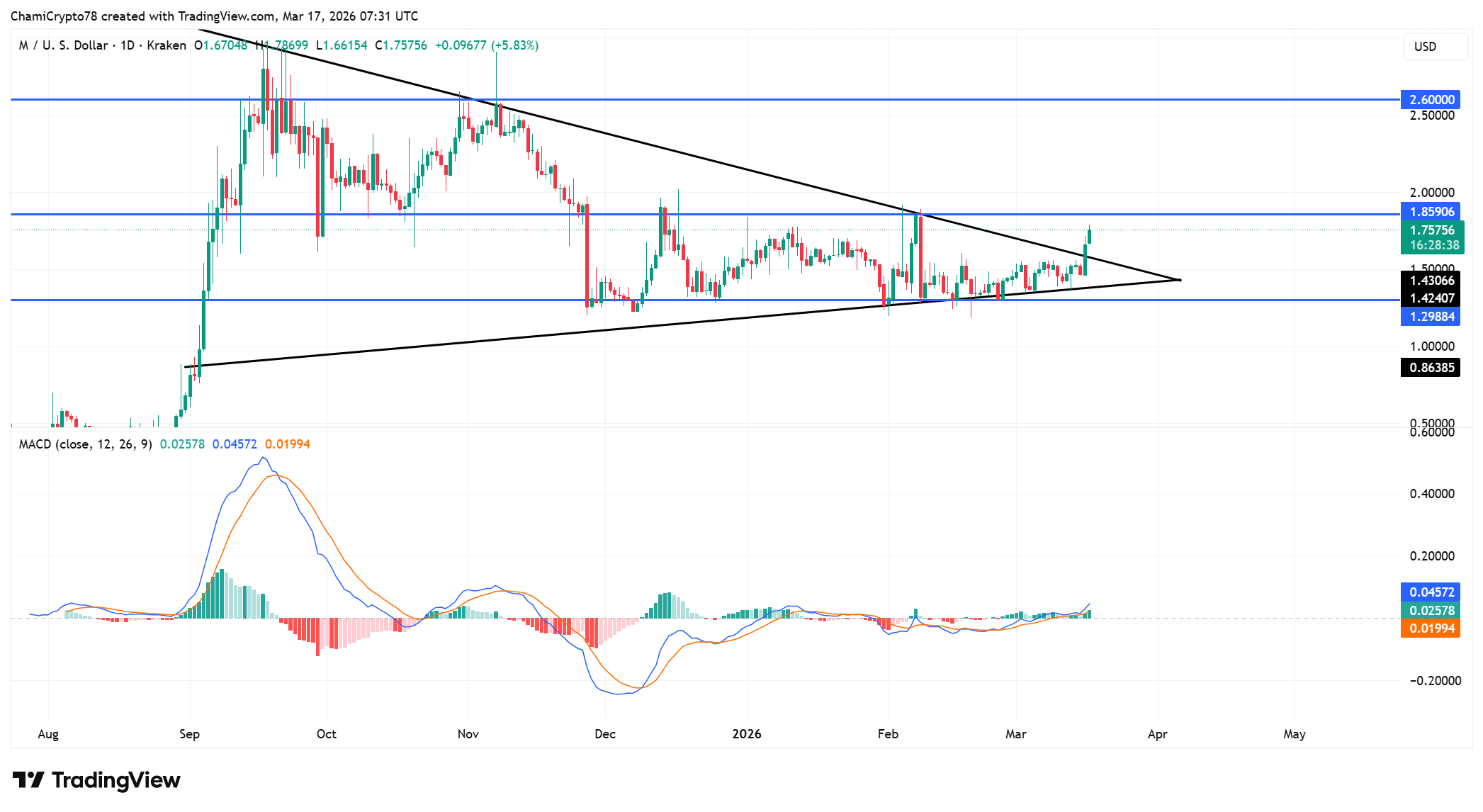
MemeCore has broken above a tightening symmetrical triangle, with price pushing upward after weeks of compression between converging trendlines.

This structure had formed between roughly $1.29 support and $1.85 resistance, creating a clear squeeze zone before the breakout attempt.

At the time of writing, M traded near $1.74, holding above the upper boundary of the triangle, which signaled that buyers have taken control of the short-term structure.

However, the $1.85 level still acts as overhead resistance, and repeated rejections at this level highlight its importance.

If MemeCore continues holding above the breakout zone, price could extend toward the $2.60 resistance, which remains the next major target.

The MACD indicator has shifted into a constructive phase, with the MACD line rising above the signal line and the histogram printing positive values.

Current readings near 0.025 for MACD and 0.019 for the signal line show expanding separation, which reflects strengthening upward pressure.

At the same time, the histogram has turned green, indicating that buying strength has started to dominate recent sessions.
Source: TradingView

Why are top traders leaning heavily long on MemeCore?

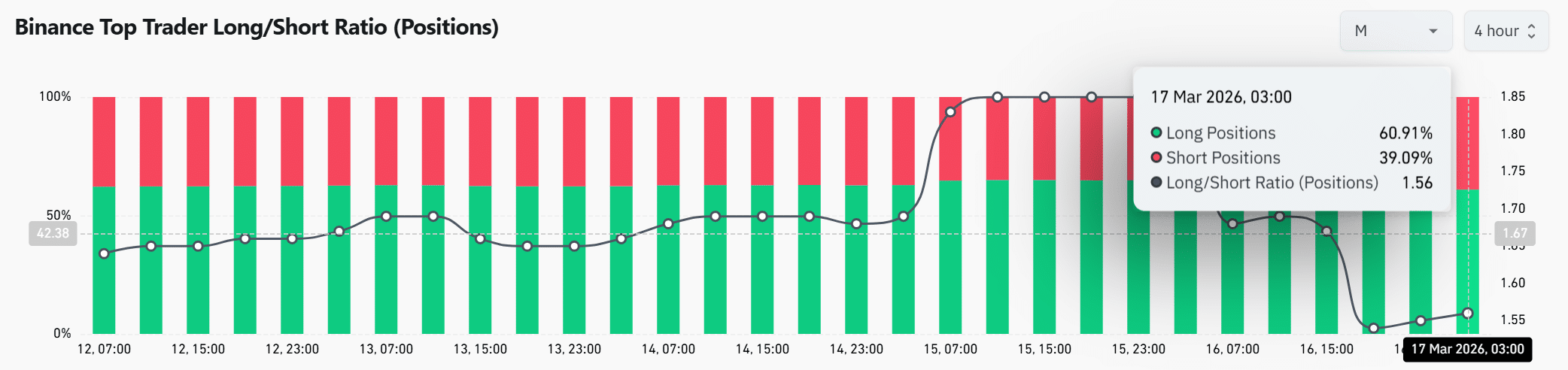
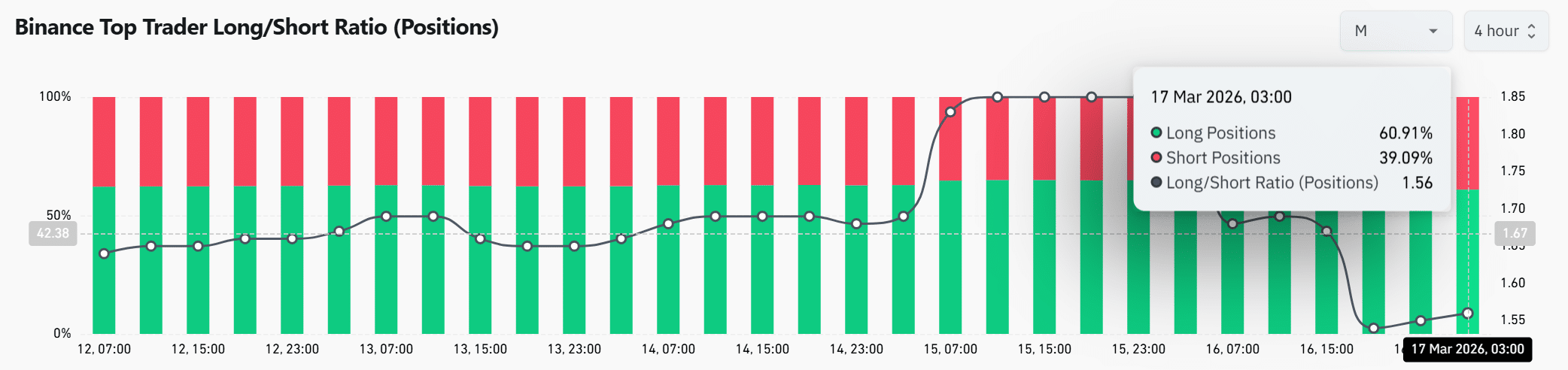
Binance top trader positioning showed a clear bias toward long exposure at press time, with 60.91% of positions favoring longs compared to 39.09% shorts.

This imbalance pushed the Long/Short Ratio to 1.56, reflecting growing confidence among large traders. As price has approached resistance, this positioning suggests that traders expect further upside rather than rejection.

However, such strong long dominance can also increase sensitivity to volatility if price fails to break higher.

Even so, the alignment between rising price and long positioning reinforces the bullish structure, indicating that MemeCore continues attracting directional conviction from experienced participants in the derivatives market.
Source: CoinGlass

Are short liquidations fueling the rally?

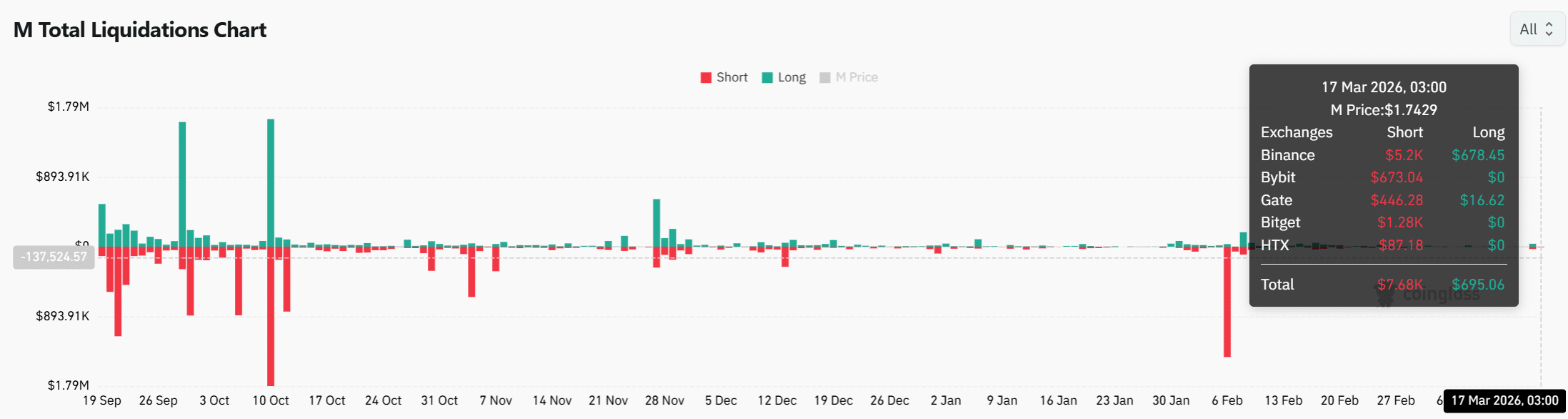
Liquidation data revealed that short positions have faced increasing pressure, particularly during recent upward spikes.

At the latest reading, short liquidations totaled around $7.68K, while long liquidations remained significantly lower, near $695, showing a clear imbalance.

This pattern indicated that sellers have been forced out as price moves higher, contributing to upward acceleration.

Additionally, repeated liquidation spikes across the timeline suggested that short traders have struggled to maintain positions during the rally.

This dynamic often amplifies price moves, as forced exits add to buying pressure. As a result, MemeCore’s recent advance appears partly driven by this squeeze effect.
Source: CoinGlass

MemeCore shows a strengthening structure supported by breakout behavior, rising derivatives conviction, and sustained short liquidations.

Price holds above compression levels while indicators continue improving steadily.

As long as this alignment persists, MemeCore appears positioned for continuation rather than reversal, with the $1.85 resistance acting as the immediate trigger for a broader upward expansion toward higher targets.


Final Summary

  • Strong alignment between price action, derivatives conviction, and liquidations suggests MemeCore could continue trending upward.
  • A failure to break resistance may trigger volatility as crowded long positioning increases downside risk in the short term.


İlgili Sorular

QWhat is the current price of MemeCore and how much has it increased in the last 24 hours?

AMemeCore is currently trading near $1.74 and has rallied over 18% in the last 24 hours.

QWhat key resistance level is MemeCore currently trading below?

AMemeCore is trading below a key resistance level near $1.85.

QWhat pattern did MemeCore break out of, and what are the support and resistance levels that defined this pattern?

AMemeCore broke out of a symmetrical triangle pattern that had formed between roughly $1.29 support and $1.85 resistance.

QWhat percentage of Binance top traders are holding long positions in MemeCore according to the article?

A60.91% of Binance top traders' positions are favoring longs compared to 39.09% shorts.

QHow much were short liquidations compared to long liquidations during the recent price move?

AShort liquidations totaled around $7.68K, while long liquidations remained significantly lower, near $695.

İlgili Okumalar

a16z: AI's 'Amnesia', Can Continuous Learning Cure It?

The article "a16z: AI's 'Amnesia' – Can Continual Learning Cure It?" explores the limitations of current large language models (LLMs), which, like the protagonist in the film *Memento*, are trapped in a perpetual present—unable to form new memories after training. While methods like in-context learning (ICL), retrieval-augmented generation (RAG), and external scaffolding (e.g., chat history, prompts) provide temporary solutions, they fail to enable true internalization of new knowledge. The authors argue that compression—the core of learning during training—is halted at deployment, preventing models from generalizing, discovering novel solutions (e.g., mathematical proofs), or handling adversarial scenarios. The piece introduces *continual learning* as a critical research direction to address this, categorizing approaches into three paths: 1. **Context**: Scaling external memory via longer context windows, multi-agent systems, and smarter retrieval. 2. **Modules**: Using pluggable adapters or external memory layers for specialization without full retraining. 3. **Weights**: Enabling parameter updates through sparse training, test-time training, meta-learning, distillation, and reinforcement learning from feedback. Challenges include catastrophic forgetting, safety risks, and auditability, but overcoming these could unlock models that learn iteratively from experience. The conclusion emphasizes that while context-based methods are effective, true breakthroughs require models to compress new information into weights post-deployment, moving from mere retrieval to genuine learning.

marsbit28 dk önce

a16z: AI's 'Amnesia', Can Continuous Learning Cure It?

marsbit28 dk önce

Can a Hair Dryer Earn $34,000? Deciphering the Reflexivity Paradox in Prediction Markets

An individual manipulated a weather sensor at Paris Charles de Gaulle Airport with a portable heat source, causing a Polymarket weather market to settle at 22°C and earning $34,000. This incident highlights a fundamental issue in prediction markets: when a market aims to reflect reality, it also incentivizes participants to influence that reality. Prediction markets operate on two layers: platform rules (what outcome counts as a win) and data sources (what actually happened). While most focus on rules, the real vulnerability lies in the data source. If reality is recorded through a specific source, influencing that source directly affects market settlement. The article categorizes markets by their vulnerability: 1. **Single-point physical data sources** (e.g., weather stations): Easily manipulated through physical interference. 2. **Insider information markets** (e.g., MrBeast video details): Insiders like team members use non-public information to trade. Kalshi fined a剪辑师 $20,000 for insider trading. 3. **Actor-manipulated markets** (e.g., Andrew Tate’s tweet counts): The subject of the market can control the outcome. Evidence suggests Tate’sociated accounts coordinated to profit. 4. **Individual-action markets** (e.g., WNBA disruptions): A single person can execute an event to profit from their pre-placed bets. Kalshi and Polymarket handle these issues differently. Kalshi enforces strict KYC, publicly penalizes insider trading, and reports to regulators. Polymarket, with its anonymous wallet-based system, has historically been more permissive, arguing that insider information improves market accuracy. However, it cooperated with authorities in the "Van Dyke case," where a user traded on classified government information. The core paradox is reflexivity: prediction markets are designed to discover truth, but their financial incentives can distort reality. The more valuable a prediction becomes, the more likely participants are to influence the event itself. The market ceases to be a mirror of reality and instead shapes it.

marsbit1 saat önce

Can a Hair Dryer Earn $34,000? Deciphering the Reflexivity Paradox in Prediction Markets

marsbit1 saat önce

İşlemler

Spot
Futures
活动图片