$MAXI: The Next Crypto to 1000X? How Political Scandal is Driving Eyes to New Defi Projects

bitcoinist2026-02-03 tarihinde yayınlandı2026-02-03 tarihinde güncellendi

Özet

U.S. political scandals, like Senator Chris Murphy’s allegations of "potentially criminal conduct" in crypto deals, are shifting investor attention from institutional projects to decentralized finance (DeFi). This distrust is driving capital toward community-driven, politically independent assets. Maxi Doge ($MAXI), a meme token emphasizing transparency, leverage, and high-risk growth, is positioned to benefit. With over $4.5M raised in its presale and a focus on active community participation, it appeals to traders seeking alternatives to politically influenced cryptocurrencies. However, such investments carry significant risk.

When U.S. Senators start tossing around terms like ‘potentially criminal conduct’ to describe high-profile crypto deals, the market listens.

But perhaps not in the way regulators intend. Senator Chris Murphy’s recent grilling of potential UAE investments, citing ‘brazen, open corruption’, has dominated headlines. Yet, this geopolitical friction highlights a growing fracture. It’s the widening gap between ‘corporate’ crypto and the wild, permissionless world of DeFi.
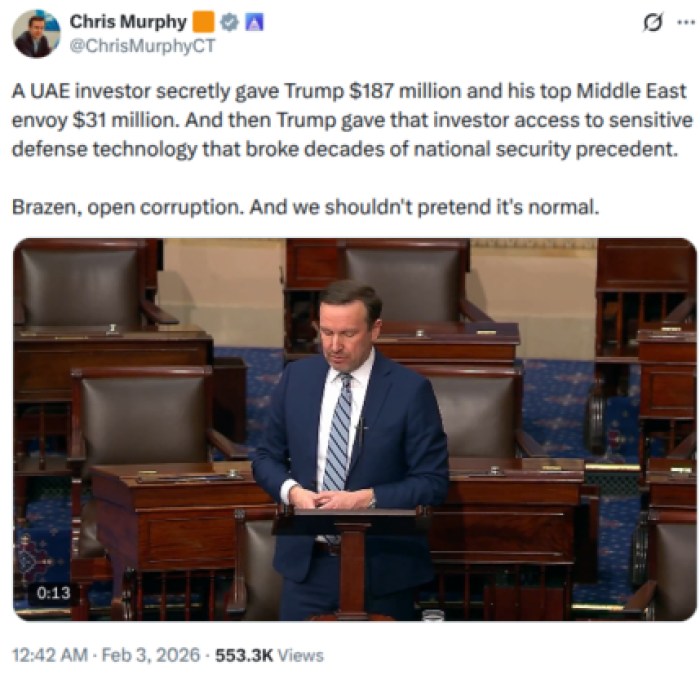
Source: X

The fear? Foreign entities are buying influence through blockchain projects tied to political figures. For the average retail trader, that signals a familiar danger: becoming exit liquidity for backroom deals. Trust is the only real currency here.

When that erodes at the institutional level, bogged down by regulatory scrutiny and conflicts of interest, capital historically flees toward the ‘wild west’ of the market.

We’re already seeing this migration on-chain. While institutional projects stall under the weight of Senate hearings, traders are rotating liquidity into assets that prioritize raw community strength. The narrative is shifting from ‘who do you know in Washington?’ to ‘how strong is your community?’

In this trust vacuum, high-leverage meme tokens are emerging as vehicles for retail conviction. So, who is leading this charge? Maxi Doge ($MAXI) , a project capitalizing on the market’s appetite for assets that operate far outside the sphere of political influence. It could be the next crypto to 1000x.

Escaping The Political Theater Through High-Leverage DeFi

The allure of DeFi during political scandals is simple: transparency. There are no backroom deals in a smart contract; there is only code. This environment has paved the way for Maxi Doge ($MAXI), a project that strips away the pretense of ‘institutional adoption’ to focus on what you actually want: volatility, leverage, and aggressive growth.

Traders familiar with previous cycles know that during periods of regulatory FUD (Fear, Uncertainty, and Doubt), meme coins often outperform utility tokens precisely because they’re uncorrelated with government policy. Maxi Doge leans into this.

Branding itself as a ‘240-lb canine juggernaut’ with a ‘lift, trade, repeat’ mentality, it creates a distinct psychological separation from the suit-and-tie narrative of Washington-linked crypto. The selling point isn’t a treaty; it’s a ‘Leverage King Culture,’ something wildly different from other kawaii dog-themed coins.
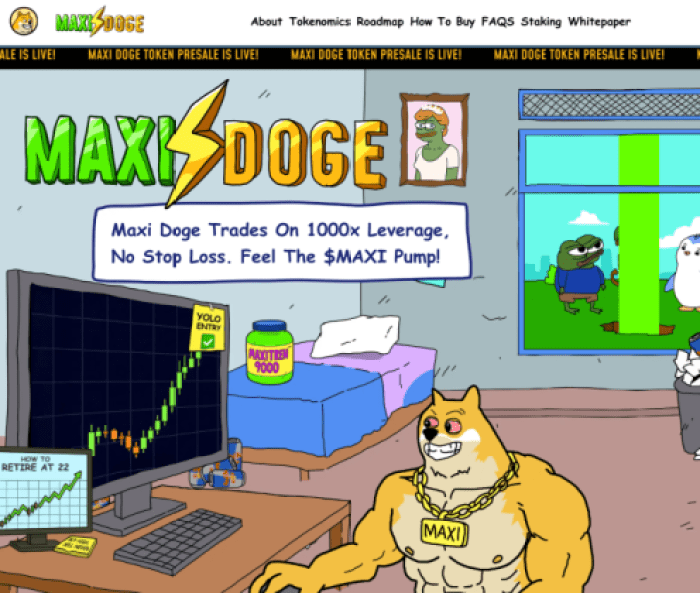
Source: Maxi Doge

Through planned holder-only trading competitions and a gamified ‘Maxi Fund’ treasury, the project plans to incentivize active participation rather than passive speculation. It hopes to solve a critical problem for retail traders lacking whale-tier capital: offering a playground where conviction pays better than connections.

Plus, the plan to integrate futures platform partnerships suggests a roadmap designed to capture the high-risk, high-reward segment alienated by current political discourse.

Learn ‘how to buy maxi doge’ in our guide.

Retail Hype Signals Shift Toward Retail-First Assets

While headlines focus on Senators and foreign treaties, social media and project engagement show where investors are looking. Political scandal appears to be driving investors toward fresh presales offering better risk-to-reward ratios than established, politically sensitive coins.

Maxi Doge has already secured over $4.5M in its ongoing presale, suggesting significant liquidity is rotating into this new sector. Even more telling is the social media following it’s managed to garner. Boasting over 6K followers on X, and over 3.3K subscribers on Telegram, $MAXI clearly has its fans.

Don’t get us wrong, these aren’t numbers to break a bank, but it’s still something to note for a hype project still in presale, that’s mainly thriving on vibes alone.

Beyond the socials, the protocol’s staking mechanics offer shelter for its capital. With dynamic APY fueled by daily automatic smart contract distribution, investors can compound holdings while waiting for the broader market to stabilize.

It fits the project’s ‘Never skip leg-day’ ethos: steady accumulation regardless of external conditions. If you’re exhausted by the volatility of political news cycles, the straightforward mechanics of a meme-driven ecosystem offer a refreshing (if high-risk) alternative.

CHECK OUT THE MAXI DOGE ($MAXI) PRESALE.

The information provided in this article is for educational purposes only and does not constitute financial advice. Cryptocurrency investments, particularly in meme tokens and presales, carry high risks, including the potential for significant loss. Always perform independent due diligence.


İlgili Sorular

QWhat is the main reason the article suggests that DeFi projects like Maxi Doge ($MAXI) are gaining attention during political scandals?

AThe article suggests that DeFi projects gain attention during political scandals because they offer transparency through smart contracts, operating outside the sphere of political influence and backroom deals, which attracts capital fleeing institutional crypto due to eroding trust, regulatory scrutiny, and conflicts of interest.

QAccording to the article, what specific feature of Maxi Doge ($MAXI) is designed to incentivize active participation rather than passive speculation?

AMaxi Doge plans to incentivize active participation through holder-only trading competitions and a gamified 'Maxi Fund' treasury, creating a playground where conviction is rewarded more than connections.

QHow does the article describe the performance of meme coins compared to utility tokens during periods of regulatory FUD (Fear, Uncertainty, and Doubt)?

AThe article states that during periods of regulatory FUD, meme coins often outperform utility tokens because they are uncorrelated with government policy, making them a more attractive option for traders seeking assets detached from political influence.

QWhat evidence does the article provide to show that Maxi Doge ($MAXI) is attracting significant interest from retail investors?

AThe article cites that Maxi Doge has secured over $4.5M in its ongoing presale and has garnered a social media following of over 6K followers on X and 3.3K subscribers on Telegram, indicating significant retail investor interest and liquidity rotation.

QWhat is the core ethos or mentality that the Maxi Doge ($MAXI) project brands itself with, according to the article?

AMaxi Doge brands itself with a 'Leverage King Culture' and a 'lift, trade, repeat' mentality, creating a psychological separation from traditional finance and emphasizing steady accumulation and high-risk, high-reward dynamics, encapsulated in its 'Never skip leg-day' ethos.

İlgili Okumalar

Jensen Huang's CMU Speech: In the AI Era, Don't Just Watch, Build

Jensen Huang, CEO of NVIDIA and a first-generation immigrant, delivered the commencement address to Carnegie Mellon University's class of 2026. He shared his personal journey from a humble background to founding NVIDIA, emphasizing resilience, learning from failure, and the responsibility that comes with leadership. Huang framed the present moment as the dawn of the AI revolution, a shift he believes is more profound than previous computing waves. He described AI as fundamentally resetting computing—moving from human-written software to machines that understand, reason, and use tools. This will create a new industry for generating intelligence and transform every sector. While acknowledging AI's potential to automate tasks and displace some jobs, Huang distinguished between the *tasks* of a job and its core *purpose*. He argued AI will augment human capability, not replace humans. The real risk, he stated, is not AI itself, but people being left behind by those who effectively use AI. He presented AI as a generational opportunity for massive infrastructure investment—in chip factories, data centers, energy grids, and advanced manufacturing—that could re-industrialize nations like the U.S. and bridge the digital divide by making computing and intelligent tools accessible to all. Huang called for a balanced approach: advancing AI safely and responsibly, establishing prudent policies, ensuring broad access, and encouraging universal participation. He urged the graduates not to fear the future but to engage with optimism and ambition, reminding them of CMU's motto, "My heart is in the work." His core message was clear: this is their moment to actively build and shape the AI-powered future, not merely observe it.

marsbit57 dk önce

Jensen Huang's CMU Speech: In the AI Era, Don't Just Watch, Build

marsbit57 dk önce

The Era Has Arrived Where Human Writers Must Prove They Are Not Machines

The article describes an era where AI-generated content is flooding the market, forcing human authors to prove they are not machines. It begins with the example of dozens of AI-written, error-ridden biographies of Henry Kissinger appearing on Amazon within hours of his death, a pattern repeated for other deceased celebrities and even living experts who find fraudulent books under their names. This spam content has exploded, with monthly new book releases on platforms like Amazon reaching 300,000 by late 2025. The issue spans genres, from suspiciously high proportions of AI-written teen romance and self-help books to dangerous, AI-generated foraging guides containing lethal advice. The platforms' automated review systems, designed to catch plagiarism and banned words, are ill-equipped to detect AI-generated text that avoids these pitfalls while being nonsensical or fraudulent. The problem has infiltrated traditional publishing. A major publisher, Hachette, had to recall a bestselling horror novel after AI detection tools suggested 78% of its content was machine-generated. An acclaimed European philosophy book was later revealed to be entirely written by AI under a fake author persona. In response, authors are fighting back. At the 2026 London Book Fair, 10,000 writers published a blank book titled "Don't Steal This Book" containing only their signatures—using emptiness as a protest weapon in an age of AI overproduction. Initiatives like the "Human Author Certification" program have emerged, ironically placing the burden on humans to prove their work is not machine-made. The article warns of a vicious cycle: AI-generated low-quality books pollute the data used to train future AI models, leading to "model collapse" and an ever-worsening flood of digital waste, eroding trust in publishing and devaluing human creativity.

marsbit1 saat önce

The Era Has Arrived Where Human Writers Must Prove They Are Not Machines

marsbit1 saat önce

İşlemler

Spot
Futures
活动图片




