$MAXI: The Next Crypto to 1000X? How Political Scandal is Driving Eyes to New Defi Projects

bitcoinist2026-02-03 tarihinde yayınlandı2026-02-03 tarihinde güncellendi

Özet

U.S. political scandals, like Senator Chris Murphy’s allegations of "potentially criminal conduct" in crypto deals, are shifting investor attention from institutional projects to decentralized finance (DeFi). This distrust is driving capital toward community-driven, politically independent assets. Maxi Doge ($MAXI), a meme token emphasizing transparency, leverage, and high-risk growth, is positioned to benefit. With over $4.5M raised in its presale and a focus on active community participation, it appeals to traders seeking alternatives to politically influenced cryptocurrencies. However, such investments carry significant risk.

When U.S. Senators start tossing around terms like ‘potentially criminal conduct’ to describe high-profile crypto deals, the market listens.

But perhaps not in the way regulators intend. Senator Chris Murphy’s recent grilling of potential UAE investments, citing ‘brazen, open corruption’, has dominated headlines. Yet, this geopolitical friction highlights a growing fracture. It’s the widening gap between ‘corporate’ crypto and the wild, permissionless world of DeFi.
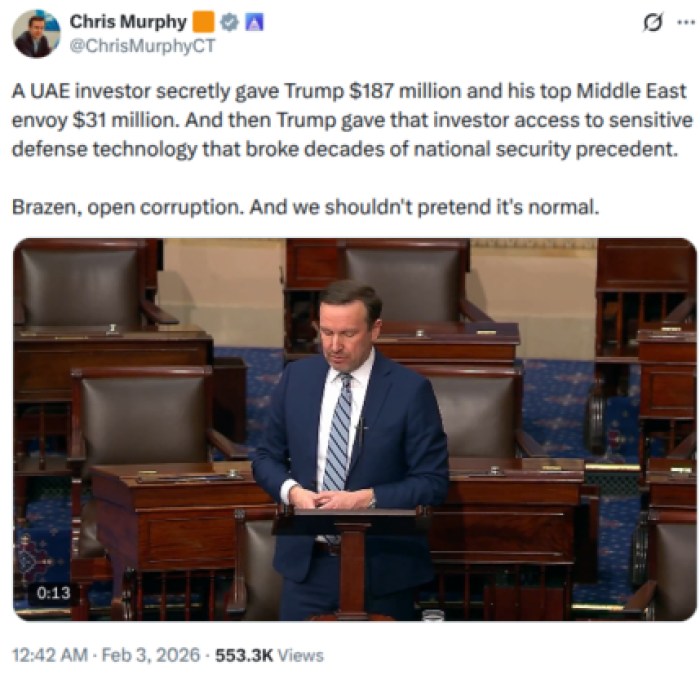
Source: X

The fear? Foreign entities are buying influence through blockchain projects tied to political figures. For the average retail trader, that signals a familiar danger: becoming exit liquidity for backroom deals. Trust is the only real currency here.

When that erodes at the institutional level, bogged down by regulatory scrutiny and conflicts of interest, capital historically flees toward the ‘wild west’ of the market.

We’re already seeing this migration on-chain. While institutional projects stall under the weight of Senate hearings, traders are rotating liquidity into assets that prioritize raw community strength. The narrative is shifting from ‘who do you know in Washington?’ to ‘how strong is your community?’

In this trust vacuum, high-leverage meme tokens are emerging as vehicles for retail conviction. So, who is leading this charge? Maxi Doge ($MAXI) , a project capitalizing on the market’s appetite for assets that operate far outside the sphere of political influence. It could be the next crypto to 1000x.

Escaping The Political Theater Through High-Leverage DeFi

The allure of DeFi during political scandals is simple: transparency. There are no backroom deals in a smart contract; there is only code. This environment has paved the way for Maxi Doge ($MAXI), a project that strips away the pretense of ‘institutional adoption’ to focus on what you actually want: volatility, leverage, and aggressive growth.

Traders familiar with previous cycles know that during periods of regulatory FUD (Fear, Uncertainty, and Doubt), meme coins often outperform utility tokens precisely because they’re uncorrelated with government policy. Maxi Doge leans into this.

Branding itself as a ‘240-lb canine juggernaut’ with a ‘lift, trade, repeat’ mentality, it creates a distinct psychological separation from the suit-and-tie narrative of Washington-linked crypto. The selling point isn’t a treaty; it’s a ‘Leverage King Culture,’ something wildly different from other kawaii dog-themed coins.
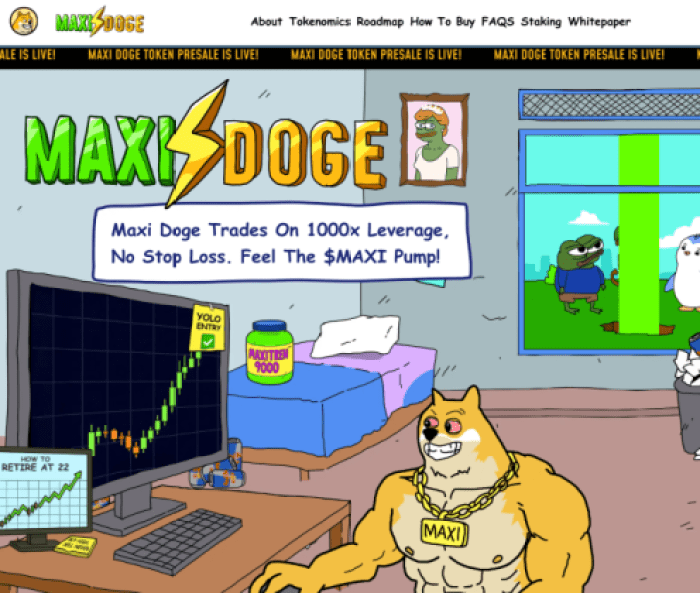
Source: Maxi Doge

Through planned holder-only trading competitions and a gamified ‘Maxi Fund’ treasury, the project plans to incentivize active participation rather than passive speculation. It hopes to solve a critical problem for retail traders lacking whale-tier capital: offering a playground where conviction pays better than connections.

Plus, the plan to integrate futures platform partnerships suggests a roadmap designed to capture the high-risk, high-reward segment alienated by current political discourse.

Learn ‘how to buy maxi doge’ in our guide.

Retail Hype Signals Shift Toward Retail-First Assets

While headlines focus on Senators and foreign treaties, social media and project engagement show where investors are looking. Political scandal appears to be driving investors toward fresh presales offering better risk-to-reward ratios than established, politically sensitive coins.

Maxi Doge has already secured over $4.5M in its ongoing presale, suggesting significant liquidity is rotating into this new sector. Even more telling is the social media following it’s managed to garner. Boasting over 6K followers on X, and over 3.3K subscribers on Telegram, $MAXI clearly has its fans.

Don’t get us wrong, these aren’t numbers to break a bank, but it’s still something to note for a hype project still in presale, that’s mainly thriving on vibes alone.

Beyond the socials, the protocol’s staking mechanics offer shelter for its capital. With dynamic APY fueled by daily automatic smart contract distribution, investors can compound holdings while waiting for the broader market to stabilize.

It fits the project’s ‘Never skip leg-day’ ethos: steady accumulation regardless of external conditions. If you’re exhausted by the volatility of political news cycles, the straightforward mechanics of a meme-driven ecosystem offer a refreshing (if high-risk) alternative.

CHECK OUT THE MAXI DOGE ($MAXI) PRESALE.

The information provided in this article is for educational purposes only and does not constitute financial advice. Cryptocurrency investments, particularly in meme tokens and presales, carry high risks, including the potential for significant loss. Always perform independent due diligence.


İlgili Sorular

QWhat is the main reason the article suggests that DeFi projects like Maxi Doge ($MAXI) are gaining attention during political scandals?

AThe article suggests that DeFi projects gain attention during political scandals because they offer transparency through smart contracts, operating outside the sphere of political influence and backroom deals, which attracts capital fleeing institutional crypto due to eroding trust, regulatory scrutiny, and conflicts of interest.

QAccording to the article, what specific feature of Maxi Doge ($MAXI) is designed to incentivize active participation rather than passive speculation?

AMaxi Doge plans to incentivize active participation through holder-only trading competitions and a gamified 'Maxi Fund' treasury, creating a playground where conviction is rewarded more than connections.

QHow does the article describe the performance of meme coins compared to utility tokens during periods of regulatory FUD (Fear, Uncertainty, and Doubt)?

AThe article states that during periods of regulatory FUD, meme coins often outperform utility tokens because they are uncorrelated with government policy, making them a more attractive option for traders seeking assets detached from political influence.

QWhat evidence does the article provide to show that Maxi Doge ($MAXI) is attracting significant interest from retail investors?

AThe article cites that Maxi Doge has secured over $4.5M in its ongoing presale and has garnered a social media following of over 6K followers on X and 3.3K subscribers on Telegram, indicating significant retail investor interest and liquidity rotation.

QWhat is the core ethos or mentality that the Maxi Doge ($MAXI) project brands itself with, according to the article?

AMaxi Doge brands itself with a 'Leverage King Culture' and a 'lift, trade, repeat' mentality, creating a psychological separation from traditional finance and emphasizing steady accumulation and high-risk, high-reward dynamics, encapsulated in its 'Never skip leg-day' ethos.

İlgili Okumalar

From South Korea to the United States: Blue-Collar Jobs Are Becoming Increasingly Popular, Thanks to AI

AI is reshaping the labor market's value proposition. The traditional four-year college degree is losing its appeal as a guaranteed career path, while skilled blue-collar trades like electricians, welders, and plumbers are experiencing historic demand and wage premiums. This shift is driven by dual pressures: AI's displacement of certain white-collar roles and a booming need for physical infrastructure and data center construction. Data confirms the trend. In the U.S., vocational school revenue surged, and a significant portion of recent layoffs are AI-related. Surveys show a majority of Gen Z adults plan to pursue blue-collar work, citing better job security against AI automation. Vocational education interest has exploded recently. Experts cite a psychological shift as younger generations seek tangible, AI-resistant careers and avoid high student debt. In many cases, salaries for skilled trades now match or exceed those requiring a bachelor's degree. In South Korea, semiconductor vocational high schools boast near-total employment, with graduates securing high-paying roles at companies like Samsung. The shortage is structural, exacerbated by a retiring baby boomer workforce and massive infrastructure projects. Companies like JPMorgan Chase, Meta, and Lowe's are investing heavily in training programs. However, overcoming historical stigma and a "perception gap" around trade careers remains a key challenge to closing the talent gap.

marsbit1 saat önce

From South Korea to the United States: Blue-Collar Jobs Are Becoming Increasingly Popular, Thanks to AI

marsbit1 saat önce

Qualcomm: AI Hype Subsides, When Will Smartphones Emerge from the Gloom?

Qualcomm reported its Q3 FY2026 results (ending June 2026), with revenue of $9.95B, down 4% YoY but above expectations. Gross margin declined to 53.1%, pressured by rising costs across manufacturing and memory. Key business segments showed mixed performance: Handset revenue fell 19.6% YoY to $5.09B, dragged by an 11% decline in non-Apple Android shipments and weaker high-end mix. Conversely, Automotive revenue surged 61% to $1.59B, and IoT grew 9% to $1.83B. Core operating profit dropped 41% YoY due to margin compression and higher expenses. Management's Q4 FY2026 guidance projects revenue of $9.7B-$10.5B, in line with consensus, but Non-GAAP EPS guidance of $2.05-$2.25 fell short of expectations. Amidst persistent weakness in its core handset market, Qualcomm is pursuing growth in AI, focusing on Edge AI (smartphones, PCs, automotive) and Data Center AI. Its data center strategy includes four pillars: AI accelerators (e.g., AI200), commercial CPUs (Dragonfly C1000), custom silicon, and connectivity solutions. While these initiatives initially boosted its stock, concerns over AI capital expenditure sustainability have since erased those gains. The company targets $5B in data center revenue for FY2027 and $15B for FY2029. The report concludes that with the traditional handset business still under pressure, the data center opportunity is currently viewed as a longer-term option, and a more conservative valuation based on core operations may be warranted until AI contributions materialize.

marsbit1 saat önce

Qualcomm: AI Hype Subsides, When Will Smartphones Emerge from the Gloom?

marsbit1 saat önce

From TPU to Self-Evolving Agents: How Jeff Dean Predicts the Next Step in AI

At the 2026 YC Startup School, Jeff Dean outlined his vision for AI's next phase, shifting focus from simply scaling models to building intelligent, autonomous systems. He believes AI's progress is no longer just about creating smarter models, but about integrating them into systems capable of long-term, iterative work, automated experimentation, and continuous learning. This evolution moves the competition from "who has the bigger model" to "who can best organize intelligence." Dean suggests AI capabilities are now comparable to a junior engineer, enabling the automation of complex workflows. However, the true challenge and opportunity lie in managing these AI "workers" at scale. He emphasizes the importance of **context engineering**—structuring tools, memory, and feedback loops—over raw model power. For startups, this means building deep expertise in niche domains where general models currently fail (near 0-1% success rates), leveraging proprietary data, specialized tools, and domain-specific evaluators. A recurring theme is re-examining fundamental constraints. Dean's past work, like moving Google's search index to memory or creating the TPU, stemmed from questioning outdated assumptions about hardware and cost. He sees similar inflection points today, particularly in **specialized inference hardware** to drastically reduce latency and energy consumption for real-time Agent operation. Notably, he points out that in modern AI systems, the dominant cost is often not computation but **data movement**. Reliable, long-running Agents require robust system design, borrowing concepts from distributed computing like checkpointing, state management, and parallel exploration to handle failures and maintain progress over days or weeks. As AI automates execution, the scarcest human skills will shift to **defining clear specifications**, **judging what problems are worth solving** (taste), and designing effective feedback loops. Ultimately, Dean's framework prioritizes understanding the problem deeply, identifying the true bottlenecks, and systematically building closed-loop systems where AI can not only perform tasks but also improve AI itself.

marsbit1 saat önce

From TPU to Self-Evolving Agents: How Jeff Dean Predicts the Next Step in AI

marsbit1 saat önce

İşlemler

Spot
活动图片




