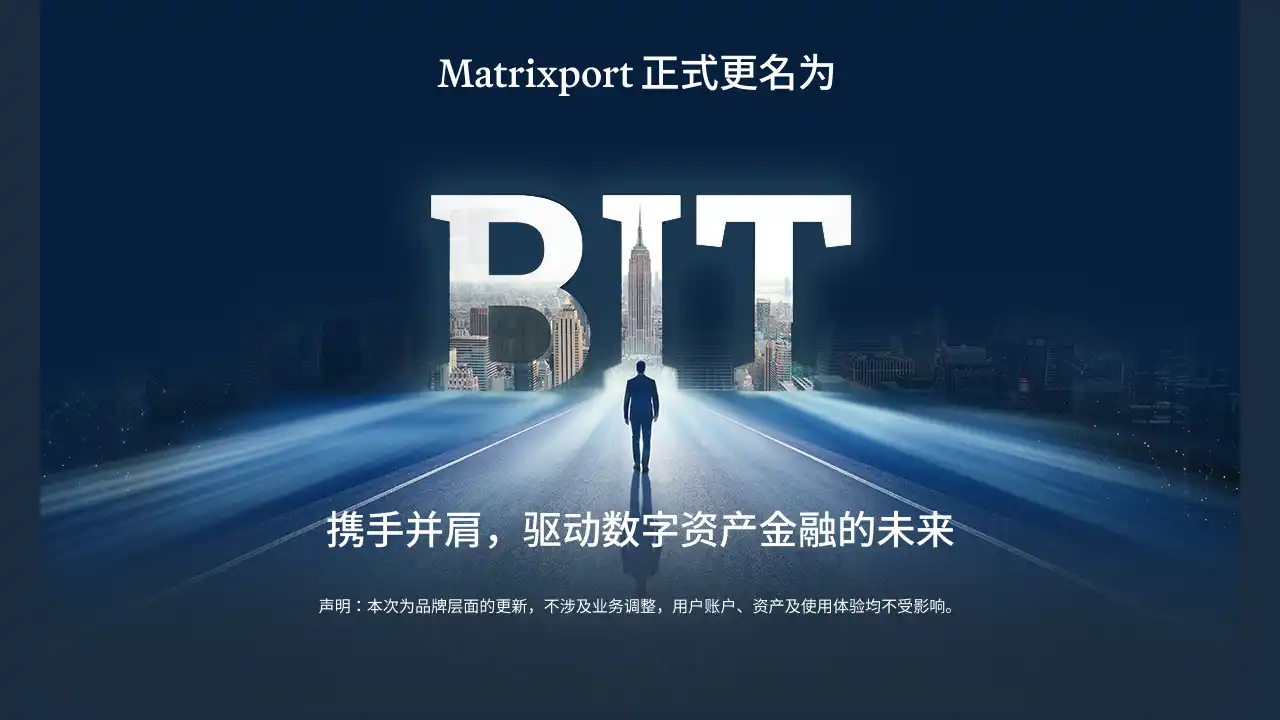
Matrixport Officially Rebrands as BIT, Clarifying New Strategic Positioning

marsbit2026-03-20 tarihinde yayınlandı2026-03-20 tarihinde güncellendi

Özet

Digital financial services group Matrixport has officially rebranded to BIT, marking a new phase in its strategic positioning. The company will now operate globally under the unified BIT brand. Alongside the rebranding, BIT released its "2026 Trust Whitepaper," which systematically details the group's established governance and risk control frameworks to provide a verifiable foundation of trust for clients and partners. As the digital asset industry undergoes increasing institutionalization and regulatory maturation, market demands for robust governance and compliance capabilities are growing. The new BIT brand better reflects the company's current business focus and strategic direction for future development. CEO John Ge stated that the industry is entering a stage where governance and compliance are increasingly critical. The name BIT represents the evolution of the company's business and its long-term commitment to building trusted digital asset financial infrastructure. The brand's tagline, "Bridge into Tomorrow," signifies its vision to connect traditional finance with digital asset markets and build lasting trust with clients. The rebrand does not affect existing customer accounts, products, or services, and all legal entities and contractual arrangements remain unchanged. As part of its next strategic phase, BIT is also exploring opportunities in U.S. capital markets, including a potential public listing. Founded in 2019 and headquartered in Singapore, BIT operates...

Digital financial services group Matrixport today announced its official rebranding as BIT and will operate globally under the unified BIT brand. Along with the brand upgrade, BIT simultaneously released the "2026 Trust Whitepaper," systematically disclosing for the first time the governance and risk control framework the group has established and continues to operate, providing customers and partners with a verifiable foundation of trust.

Currently, as the digital asset industry's institutionalization process accelerates and the regulatory system becomes increasingly完善, market demands for platform governance capabilities and compliant operations are continuously rising. The new BIT brand more clearly reflects the company's current business positioning and represents the strategic direction for the next phase of development.

BIT CEO John Ge stated: "The digital asset industry is entering a new phase where governance capabilities and compliant operations are becoming increasingly important. BIT embodies the成果 of the company's continuous business evolution and our long-term commitment to building a trusted digital asset financial infrastructure."

He added: "'Bridge into Tomorrow' is not only our brand proposition but also represents our vision of connecting traditional finance with the digital asset market and establishing long-term trust with our customers."

The company stated that this rebranding does not affect existing customer accounts, products, or services, with all relevant legal entities and contractual arrangements remaining unchanged.

As part of the next phase of its strategy, BIT is also actively exploring opportunities related to the U.S. capital markets, including a potential public listing.

About BIT

BIT (formerly Matrixport), founded in 2019, is a global digital asset financial services group built on integrity. The group is headquartered in Singapore and has offices in seven countries and regions worldwide. Through a robust governance system, technological capabilities, and compliant operations, it connects traditional finance with the digital asset market.

BIT provides global institutional and professional investors with services covering trading, custody, asset management, liquidity, and financing solutions, and supports the on-chain introduction and application of real-world assets (RWA). Its entities hold corresponding licenses and are regulated in Singapore, Hong Kong, Switzerland, the UK, the US, and Bhutan, including a Major Payment Institution (MPI) license in Singapore and a collective asset management license issued by Switzerland's FINMA.

Currently, the group manages over $6 billion in assets, with a monthly trading volume exceeding $7 billion. It has累计 paid over $2 billion in interest to customers, boasts a valuation exceeding $1 billion, and has been入选 the "2024 Hurun Global Unicorn List" and the "2025 Singapore FinTech Unicorn List."


İlgili Sorular

QWhat is the new name of the digital financial services group formerly known as Matrixport?

AThe new name is BIT.

QWhat did the company release alongside its rebranding to BIT?

AThe company released its '2026 Trust Whitepaper', which systematically discloses the governance and risk control framework it has established and continues to operate.

QWhat is the significance of the new brand name 'BIT' according to the CEO?

AThe CEO stated that 'BIT' represents the company's evolved business focus and its long-term commitment to building trusted digital asset financial infrastructure. It also stands for the brand proposition 'Bridge into Tomorrow', symbolizing the vision to connect traditional finance with the digital asset market and build long-term trust with clients.

QDoes the rebranding to BIT affect existing customer accounts, products, or services?

ANo, the company stated that the rebranding does not affect existing customer accounts, products, or services, and all relevant legal entities and contractual arrangements remain unchanged.

QWhat is one of the strategic opportunities BIT is exploring as part of its next phase?

ABIT is exploring opportunities in the U.S. capital markets, including a potential public listing.

İlgili Okumalar

US Stocks Suffer Worst Plunge Since 2025: Three Triggers Ignite Tech Stock Valuation Reset

The US stock market experienced its most severe sell-off since the 2025 tariff crisis on June 5th, 2025. The Nasdaq Composite plummeted 4.18%, the S&P 500 fell 2.64%, and the Dow Jones dropped 695 points. The panic stemmed from three converging factors. First, Broadcom's earnings report ignited fears of a slowdown in AI growth. While its AI chip revenue surged 143% YoY to $10.8B, its Q3 AI revenue guidance of $16B fell short of the $17.2B consensus. This triggered a massive sector-wide sell-off, with the Philadelphia Semiconductor Index crashing 10.26% and semiconductor stocks losing roughly $1.3 trillion in market value in a single day. Second, a shockingly strong May jobs report crushed hopes for Federal Reserve rate cuts. Non-farm payrolls added 172,000 jobs, doubling expectations. This robust data, combined with persistently high oil prices above $92/barrel due to the ongoing Iran war and blockade of the Strait of Hormuz, drastically increased market expectations for a potential Fed rate hike instead of a cut. Higher interest rates compress the valuations of growth-heavy tech stocks. Third, the prolonged Iran conflict continues to fuel inflationary pressures, complicating the Fed's policy decisions and undermining the "inflation is tamed" narrative. Together, these events challenged the twin pillars of the market rally: the "limitless AI growth" story and expectations for imminent monetary easing. The sell-off spread globally, impacting Asian and European markets and cryptocurrencies. The article posits this is likely a severe "valuation repricing" rather than the end of the AI story. The underlying demand for AI remains strong, but investor expectations for growth speed and the prices they are willing to pay are being recalibrated. Key upcoming factors include the June FOMC meeting, future AI company earnings, and developments in the Iran conflict.

marsbit2 saat önce

US Stocks Suffer Worst Plunge Since 2025: Three Triggers Ignite Tech Stock Valuation Reset

marsbit2 saat önce

From Madison Square Garden to Kalshi: Prediction Markets Break into the NBA Finals

From Madison Square Garden to Kalshi: Prediction Markets Break into the NBA Finals Prediction markets are playing a significant role in the 2026 NBA Finals, particularly around the New York Knicks' unexpected 2-0 series lead. Platforms like Kalshi and Polymarket have seen massive trading volumes, exceeding hundreds of millions of dollars on championship and related markets. Their influence extends beyond online trading. Kalshi's official partnership with Madison Square Garden has given it prominent physical branding at the arena. Furthermore, local businesses like The Jeffrey bar are using prediction market contracts to hedge the risk of game-result-based promotions, turning potential losses into manageable costs—a concept similar to the famous "Mattress Mack" strategy from traditional sports betting. These markets differentiate themselves by offering a wider, more entertainment-focused range of "event contracts" beyond typical game outcomes, such as predicting celebrity attendance. They also have broader accessibility across the U.S. compared to age- and location-restricted traditional sportsbooks. However, their rapid integration into sports raises regulatory and ethical questions. The NBA is cautiously engaging, discussing integrity frameworks with regulators like the CFTC. While the league permits minor investments like Giannis Antetokounmpo's stake in Kalshi, it advocates for strict rules to prevent insider trading. Many fans express concern on platforms like Reddit, fearing that the close ties between prediction markets, the league, and players could compromise the game's integrity. The NBA Finals has thus become a high-stakes testing ground, showcasing prediction markets' commercial potential while challenging traditional boundaries between financial trading, entertainment, and gambling.

marsbit4 saat önce

From Madison Square Garden to Kalshi: Prediction Markets Break into the NBA Finals

marsbit4 saat önce

Recursive Self-Improvement AI Gains Traction, Google Pours Cold Water, While DeepSeek and Others Approach the Fringes

The term "recursive self-improvement" (RSI), where AI improves itself autonomously, is gaining momentum in the AI industry. Startups like Recursive Superintelligence and projects such as Andrej Karpathy's Auto-Research aim to create systems where AI designs, implements, and validates its own research, moving toward superintelligence. While Google CEO Sundar Pichai cautions that such exponential acceleration is not yet a reality, progress is evident. For instance, Anthropic reported its Claude Code writes nearly 100% of the team's code, though it still lacks true self-direction. Analysts frame RSI development in stages: "adequacy" (systems functioning without humans), "parity" (matching human research quality), and "supremacy" (exceeding human-AI collaboration). Reaching parity could trigger rapid, unpredictable advancement due to AI's continuous operation. In China, companies like DeepSeek and Baidu incorporate self-optimization techniques without explicitly branding them as RSI, focusing on algorithmic efficiency and reinforcement learning. However, challenges remain, including "model collapse" from training on AI-generated data and the immense computational and open-collaboration requirements. Ultimately, RSI represents a trend of increasing automation in AI development, potentially reducing human oversight in the creation process itself.

marsbit4 saat önce

Recursive Self-Improvement AI Gains Traction, Google Pours Cold Water, While DeepSeek and Others Approach the Fringes

marsbit4 saat önce

İşlemler

Spot
Futures
活动图片




