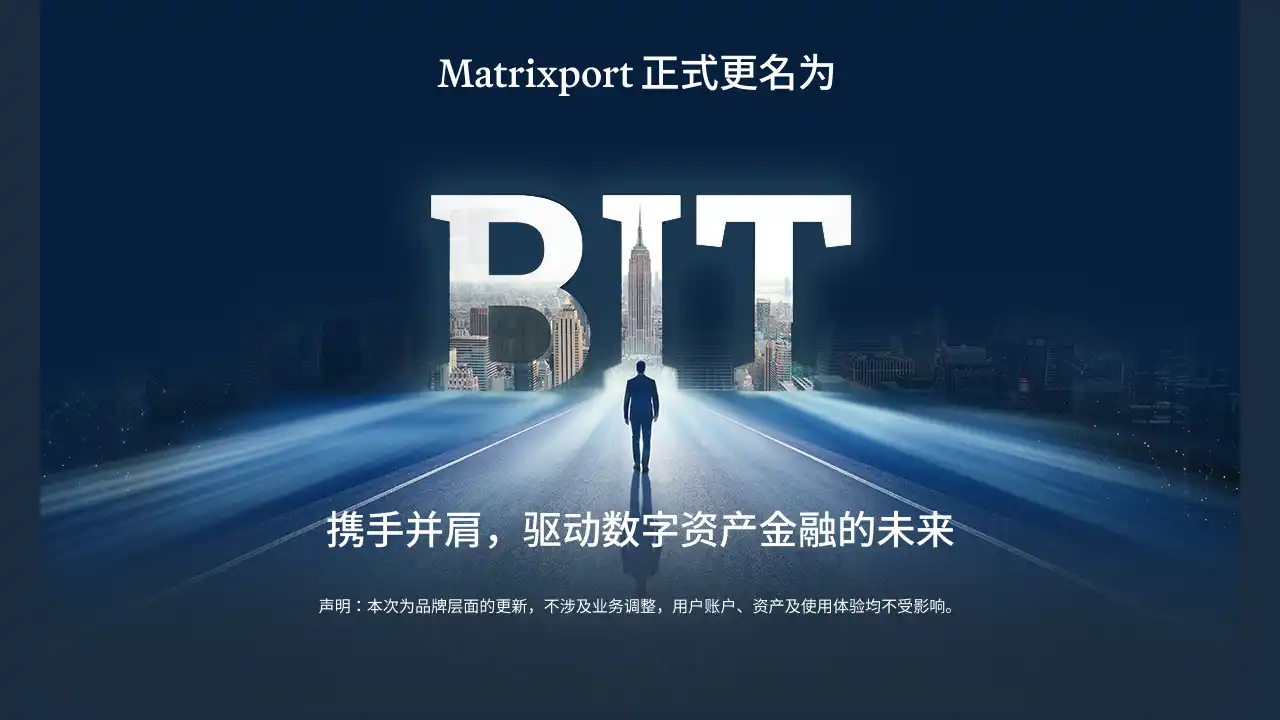
Matrixport Officially Rebrands as BIT, Clarifying New Strategic Positioning

marsbit2026-03-20 tarihinde yayınlandı2026-03-20 tarihinde güncellendi

Özet

Digital financial services group Matrixport has officially rebranded to BIT, marking a new phase in its strategic positioning. The company will now operate globally under the unified BIT brand. Alongside the rebranding, BIT released its "2026 Trust Whitepaper," which systematically details the group's established governance and risk control frameworks to provide a verifiable foundation of trust for clients and partners. As the digital asset industry undergoes increasing institutionalization and regulatory maturation, market demands for robust governance and compliance capabilities are growing. The new BIT brand better reflects the company's current business focus and strategic direction for future development. CEO John Ge stated that the industry is entering a stage where governance and compliance are increasingly critical. The name BIT represents the evolution of the company's business and its long-term commitment to building trusted digital asset financial infrastructure. The brand's tagline, "Bridge into Tomorrow," signifies its vision to connect traditional finance with digital asset markets and build lasting trust with clients. The rebrand does not affect existing customer accounts, products, or services, and all legal entities and contractual arrangements remain unchanged. As part of its next strategic phase, BIT is also exploring opportunities in U.S. capital markets, including a potential public listing. Founded in 2019 and headquartered in Singapore, BIT operates...

Digital financial services group Matrixport today announced its official rebranding as BIT and will operate globally under the unified BIT brand. Along with the brand upgrade, BIT simultaneously released the "2026 Trust Whitepaper," systematically disclosing for the first time the governance and risk control framework the group has established and continues to operate, providing customers and partners with a verifiable foundation of trust.

Currently, as the digital asset industry's institutionalization process accelerates and the regulatory system becomes increasingly完善, market demands for platform governance capabilities and compliant operations are continuously rising. The new BIT brand more clearly reflects the company's current business positioning and represents the strategic direction for the next phase of development.

BIT CEO John Ge stated: "The digital asset industry is entering a new phase where governance capabilities and compliant operations are becoming increasingly important. BIT embodies the成果 of the company's continuous business evolution and our long-term commitment to building a trusted digital asset financial infrastructure."

He added: "'Bridge into Tomorrow' is not only our brand proposition but also represents our vision of connecting traditional finance with the digital asset market and establishing long-term trust with our customers."

The company stated that this rebranding does not affect existing customer accounts, products, or services, with all relevant legal entities and contractual arrangements remaining unchanged.

As part of the next phase of its strategy, BIT is also actively exploring opportunities related to the U.S. capital markets, including a potential public listing.

About BIT

BIT (formerly Matrixport), founded in 2019, is a global digital asset financial services group built on integrity. The group is headquartered in Singapore and has offices in seven countries and regions worldwide. Through a robust governance system, technological capabilities, and compliant operations, it connects traditional finance with the digital asset market.

BIT provides global institutional and professional investors with services covering trading, custody, asset management, liquidity, and financing solutions, and supports the on-chain introduction and application of real-world assets (RWA). Its entities hold corresponding licenses and are regulated in Singapore, Hong Kong, Switzerland, the UK, the US, and Bhutan, including a Major Payment Institution (MPI) license in Singapore and a collective asset management license issued by Switzerland's FINMA.

Currently, the group manages over $6 billion in assets, with a monthly trading volume exceeding $7 billion. It has累计 paid over $2 billion in interest to customers, boasts a valuation exceeding $1 billion, and has been入选 the "2024 Hurun Global Unicorn List" and the "2025 Singapore FinTech Unicorn List."


İlgili Sorular

QWhat is the new name of the digital financial services group formerly known as Matrixport?

AThe new name is BIT.

QWhat did the company release alongside its rebranding to BIT?

AThe company released its '2026 Trust Whitepaper', which systematically discloses the governance and risk control framework it has established and continues to operate.

QWhat is the significance of the new brand name 'BIT' according to the CEO?

AThe CEO stated that 'BIT' represents the company's evolved business focus and its long-term commitment to building trusted digital asset financial infrastructure. It also stands for the brand proposition 'Bridge into Tomorrow', symbolizing the vision to connect traditional finance with the digital asset market and build long-term trust with clients.

QDoes the rebranding to BIT affect existing customer accounts, products, or services?

ANo, the company stated that the rebranding does not affect existing customer accounts, products, or services, and all relevant legal entities and contractual arrangements remain unchanged.

QWhat is one of the strategic opportunities BIT is exploring as part of its next phase?

ABIT is exploring opportunities in the U.S. capital markets, including a potential public listing.

İlgili Okumalar

Arbitrum Pretends to Be the Hacker, 'Steals' Back the Money Lost by KelpDAO

Title: Arbitrum Poses as Hacker to Recover Stolen Funds from KelpDAO Last week, KelpDAO suffered a hack resulting in nearly $300 million in losses, marking the largest DeFi security incident this year. Approximately 30,765 ETH (worth over $70 million) remained on an Arbitrum address controlled by the attacker. In an unprecedented move, Arbitrum’s Security Council utilized its emergency authority to upgrade the Inbox bridge contract, adding a function that allowed them to impersonate the hacker’s address and initiate a transfer without access to its private key. The council’s action, approved by 9 of its 12 members, moved the stolen ETH to a frozen address in a single transaction before reverting the contract to its original state. The operation was coordinated with law enforcement, which attributed the attack to North Korea’s Lazarus Group. Community reactions are divided: some praise the recovery of funds, while others question the centralization of power, as the council can upgrade core contracts without governance votes. However, such emergency mechanisms are common among major L2s. Despite the partial recovery, over $292 million was stolen in total, with more than $100 million in bad debt on Aave and remaining funds scattered across other chains. The incident highlights escalating security challenges in DeFi, with state-sponsored hackers employing advanced tactics and L2s responding with elevated countermeasures.

marsbit9 dk önce

Arbitrum Pretends to Be the Hacker, 'Steals' Back the Money Lost by KelpDAO

marsbit9 dk önce

iQiyi Is Too Impatient

The article "iQiyi Is Too Impatient" discusses the controversy surrounding the Chinese streaming platform IQiyi's recent announcement of an "AI Actor Library" during its 2026 World Conference. IQiyi claimed over 100 actors, including well-known names like Zhang Ruoyun and Yu Hewei, had joined the initiative. CEO Gong Yu suggested AI could enable actors to "star in 14 dramas a year instead of 4" and that "live-action filming might become a world cultural heritage." The announcement quickly sparked backlash. Multiple actors named in the list issued urgent statements denying they had signed any AI-related authorization agreements. This forced IQiyi to clarify that inclusion in the library only indicated a willingness to *consider* AI projects, with separate negotiations required for any specific role. The incident, which trended on social media with hashtags like "IQiyi is crazy," is presented as a sign of the company's growing desperation. Facing intense competition from short-video platforms like Douyin and Kuaishou, as well as Bilibili and Xiaohongshu, IQiyi's financial performance has weakened, with revenues declining for two consecutive years. The author argues that IQiyi is "too impatient" to tell a compelling AI story to reassure the market, especially as it pursues a listing on the Hong Kong stock exchange. The piece concludes by outlining three key "AI questions" IQiyi must answer: defining its role as a tool provider versus a content creator, balancing the "coldness" of AI with the human element audiences desire, and properly managing the interests of platforms, actors, and viewers. The core dilemma is that while AI can reduce costs and increase efficiency, it risks creating homogenized, formulaic content and devaluing human performers.

marsbit1 saat önce

iQiyi Is Too Impatient

marsbit1 saat önce

İşlemler

Spot
Futures
活动图片