Matrixdock Releases Latest Semi-Annual Physical Gold Audit Report, Strengthening Transparency Practices for Physical Gold

marsbit2026-01-15 tarihinde yayınlandı2026-01-15 tarihinde güncellendi

Özet

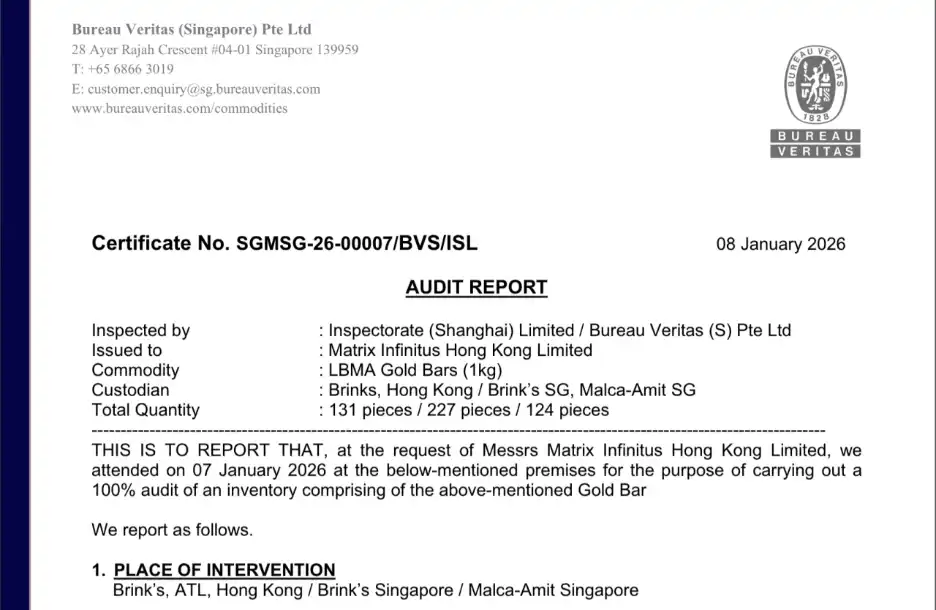
Matrixdock, the RWA platform under Matrixport, has released its H2 2025 semi-annual physical gold audit report for its XAUm token. The audit, conducted by an independent third party, verified 482 LBMA-approved 1kg gold bars held across Brink’s Hong Kong, Brink’s Singapore, and Malca-Amit Singapore vaults. The total reserve amounts to approximately 482 kg (15,595.336 oz), valued at around $71.75 million based on the audit date gold price. No discrepancies were found between the physical gold and recorded assets. Compared to the H1 2025 audit, an additional 61 gold bars were added to the reserve. Matrixdock employs a dual-verification mechanism, combining physical audits with on-chain validation tools, allowing XAUm holders to verify the gold backing their tokens via a Web3 wallet. Each 1kg gold bar corresponds to approximately 32.148 XAUm tokens. The platform emphasizes transparency and institutional-grade operations to build trust in digital gold assets.

Matrixdock, the RWA platform under Matrixport, recently released its semi-annual physical gold audit report for the second half (H2) of 2025. The report discloses details about the physical gold reserves corresponding to the XAUm token, reflecting Matrixdock's ongoing commitment to physical asset verification and information transparency.

The audit was conducted by an independent third-party professional agency according to institutional-grade standards, providing a comprehensive inspection of the physical gold reserves corresponding to the XAUm token. The audit strictly followed leading industry standards for gold ETF audits, covering all elements including weight, purity, serial numbers, and vault custody information, achieving item-by-item verification of each physical gold bar.

Matrixdock's XAUm gold token employs a "dual-layer verification" mechanism: on one hand, it relies on an independent physical audit process; on the other hand, it combines on-chain real-time verification tools, enabling investors to transparently and continuously observe the mapping relationship between token supply and the corresponding gold reserves.

Audit Coverage and Key Data

● Audit execution date: January 7, 2026

● Physical gold reserves: 482 LBMA-approved 1-kilogram gold bars

● Total weight: 482 kilograms (approximately 15,595.336 ounces)

● Custody vaults: Brink’s Hong Kong, Brink’s Singapore, Malca-Amit Singapore

● Market value of the relevant physical gold, estimated at the audit time point: approximately $71.75 million

● The audit results showed no discrepancies between the physical gold and the related records.

Furthermore, compared to the audit for the first half of 2025, the number of physical gold bars covered in this audit increased by 61.
Enhancing the Verifiability of Tokenized Gold Through On-Chain Tools

Additionally, Matrixdock's gold allocation query tool allows XAUm holders to view the specific gold bar information corresponding to their tokens via a Web3 wallet. For example, one standard 1-kilogram gold bar corresponds to approximately 32.148 XAUm tokens, providing a more intuitive asset mapping method for tokenized gold.

As tokenized assets transition from innovation to infrastructure building, investor trust will increasingly rely on verifiable facts rather than verbal promises. Matrixdock stated that it will continue to advance reserve transparency and institutionalized operational standards, committed to providing global investors with more trustworthy and secure digital asset solutions for gold.

Audit report link: https://matrixdock.gitbook.io/matrixdock-docs/english/gold-token-xaum/physical-gold-vault-audit


İlgili Sorular

QWhat is the main purpose of Matrixdock's recently released semi-annual physical gold audit report?

AThe main purpose is to disclose the status of the physical gold reserves backing the XAUm tokens, demonstrating Matrixdock's ongoing commitment to physical asset verification and information transparency.

QHow many physical gold bars were verified in the audit, and what was their total weight?

AThe audit verified 482 LBMA-approved 1-kilogram gold bars, with a total weight of 482 kilograms (approximately 15,595.336 troy ounces).

QWhich independent third-party standards were followed for the physical gold audit?

AThe audit was conducted by an independent third-party professional agency according to institutional-grade standards, strictly referencing the leading gold ETF audit standards in the industry.

QWhat is the 'dual-layer verification' mechanism used for the XAUm gold token?

AThe 'dual-layer verification' mechanism combines an independent physical audit process with an on-chain real-time verification tool, allowing investors to transparently and continuously see the mapping relationship between the token supply and the corresponding gold reserves.

QHow can XAUm token holders verify which specific gold bars their tokens are backed by?

AXAUm holders can use Matrixdock's gold allocation query tool via a Web3 wallet to view the specific information of the gold bars corresponding to their tokens.

İlgili Okumalar

The Verdict in Choi Tae-won's Divorce Case: Revealing the Inheritance Undercurrent Behind SK Hynix's Trillion-Won Empire

SK Group Chairman Chey Tae-won's high-profile divorce case, involving a record 1.38 trillion won settlement, has drawn attention to the succession plans for Korea's second-largest conglomerate, especially its crown jewel, SK hynix. Unlike traditional chaebol scripts centered on the eldest son, Chey's three children from his marriage to former President Roh Tae-woo's daughter, Roh Soh-yeong, are carving distinct, non-traditional paths. Eldest daughter Chey Yun-jung (b. 1989) is seen as the most evident successor. With a scientific and consulting background, she holds executive roles at SK bioscience and SK Inc.'s growth support department, focusing on future strategy and biopharma. Her marriage is to an AI infrastructure entrepreneur, not a traditional business alliance. Second daughter Chey Min-jung (b. 1991) took a unique route, voluntarily serving as a South Korean naval officer, including an anti-piracy deployment. She later worked on policy and strategy for SK hynix in Washington D.C. before co-founding an AI-driven healthcare startup. She married a former U.S. Marine Corps officer, connecting her to U.S. defense and policy circles—networks crucial for a global semiconductor giant. The only son, Chey In-geun (b. 1995), who studied physics like his father, worked briefly at SK E&S before joining McKinsey. Despite fitting the traditional "heir" profile as the eldest son, he remains silent and holds no public position or shares in SK, suggesting the old succession playbook is obsolete. As SK hynix's valuation soars, becoming a geopolitical asset in the AI era, the heirs' legitimacy is no longer automatic. They must prove themselves in fields like AI biotech, global policy, and strategic consulting. Their marriages also reflect new elite networks in tech and defense, not old political alliances. Their inheritance is the complex challenge of navigating a globalized, tech-driven world, not just a corporate throne.

marsbit7 saat önce

The Verdict in Choi Tae-won's Divorce Case: Revealing the Inheritance Undercurrent Behind SK Hynix's Trillion-Won Empire

marsbit7 saat önce

From OpenSea to OpenRouter: Is Alex Atallah Repeating His 'Exit at the Peak' Playbook?

From OpenSea to OpenRouter: Is Alex Atallah Repeating His "Exit at the Peak" Playbook? According to the Wall Street Journal, payments giant Stripe is in talks to acquire the AI model aggregation platform OpenRouter in a potential deal valuing the company near $100 billion. This would mark founder Alex Atallah's second creation of a company reaching a $100 billion valuation, following his co-founding of NFT marketplace OpenSea. OpenRouter, founded just over three years ago, has grown rapidly by acting as a unified gateway for developers to access over 400 AI models. It currently has about 10 million users and processes over 200 trillion tokens monthly. While the platform's annualized revenue is around $50 million, its valuation has skyrocketed from $1.3 billion in March 2026. The potential acquisition by Stripe, a company OpenRouter's founder once likened it to, represents a major expansion into AI infrastructure for the payments leader. This move echoes Atallah's previous timing with OpenSea, where he departed before the NFT market's significant downturn. For OpenRouter, selling now may be strategic. Despite its scale, its business model—charging a 5-5.5% fee on AI inference calls—faces pressure from competition, open-source models, and potential price wars among model providers, limiting its profitability narrative for an IPO. A key asset for potential acquirers like Stripe is OpenRouter's vast repository of real-world AI usage data, which offers unique insights into model performance and developer preferences that are difficult to replicate. Whether this potential deal signifies a new valuation benchmark for AI infrastructure or another market peak signal remains to be seen.

链捕手8 saat önce

From OpenSea to OpenRouter: Is Alex Atallah Repeating His 'Exit at the Peak' Playbook?

链捕手8 saat önce

İşlemler

Spot
活动图片




