Markets eye Bank of Japan meeting on Friday as yen repeats 40-year US dollar lows

cointelegraph2026-07-28 tarihinde yayınlandı2026-07-28 tarihinde güncellendi

Özet

The Japanese yen is nearing new 40-year lows against the US dollar, with USD/JPY approaching 164, as markets focus on the Bank of Japan's (BoJ) upcoming interest rate meeting on July 31. Current rates stand at 1%, their highest since 1995, with near-certain expectations for a hold. The yen's role as a major global funding currency means BoJ policy has significant worldwide impact. Analysts warn that the persistent yen weakness risks a sudden unwind of the massive yen carry trade—a key source of liquidity for markets, including crypto. Such an unwind, potentially triggered by BoJ policy shifts aimed at stabilizing the currency, could spark a rapid liquidity crunch, echoing a disruptive event from 2024. The BoJ has indicated future rate hikes are likely to continue, noting that exchange rate movements now have a greater potential to affect inflation and consumer prices.

Japan’s central bank is in focus this week as its next interest-rate meeting comes amid new 40-year yen lows against the US dollar.

Key points:

  • The Japanese yen is approaching new 40-year lows against the US dollar, nearly beating its latest record from last week.
  • The Bank of Japan will decide on interest-rate changes on July 31, with rates already at 1%, their highest since September 1995.
  • Analysts have been warning that the yen carry trade could unwind again, repeating a major crypto headwind from 2024.

Dollar-yen seeks to reclaim 40-year record

Data from TradingView showed USD/JPY approaching 164 on Tuesday, just a fraction below new 40-year highs seen last week.
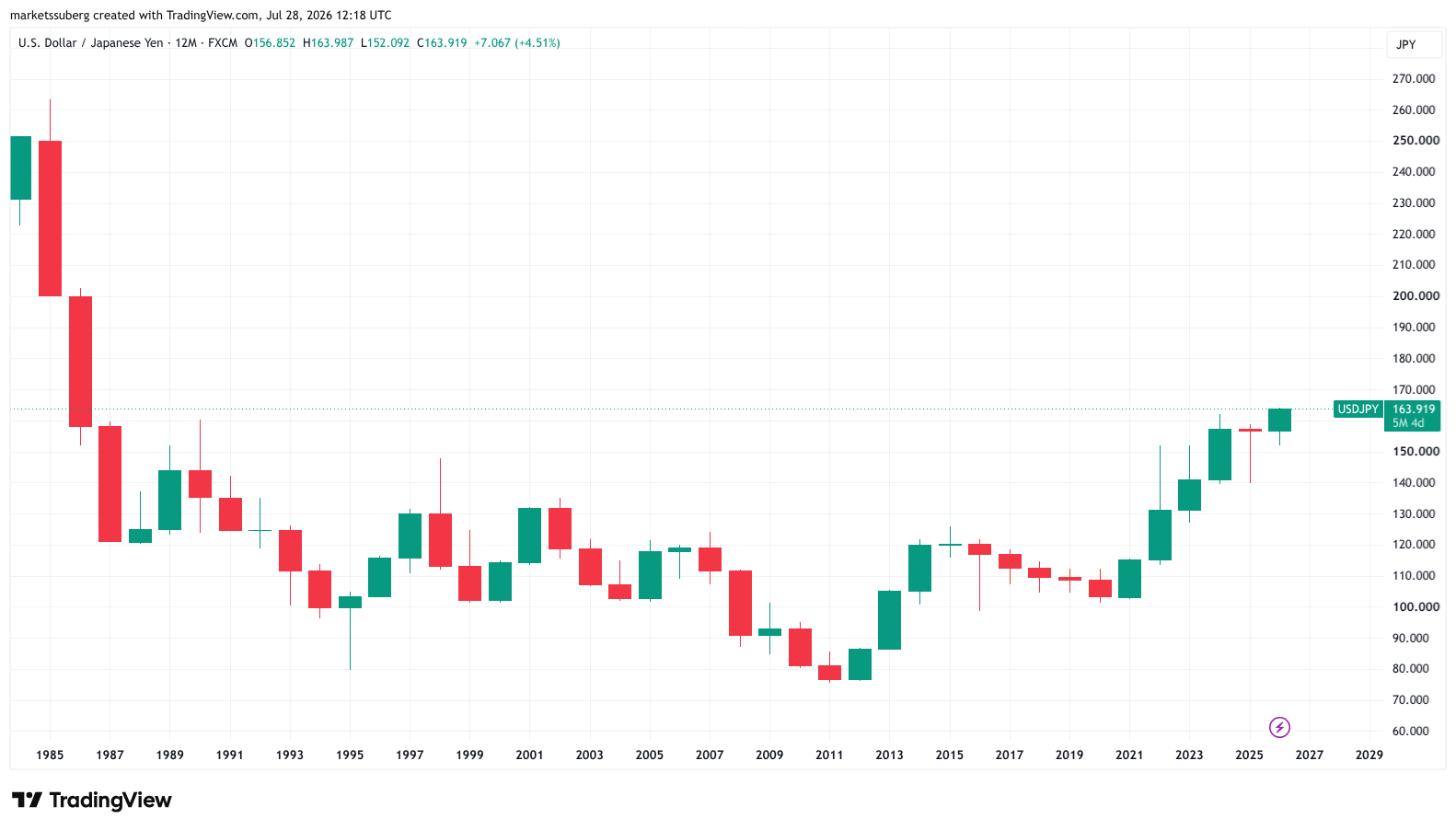
USD/JPY 12-month chart. Source: Cointelegraph/TradingView

The yen’s status as a funding currency is making BoJ monetary policy have an outsized influence on global markets. Japan’s currency markets are characterized by minimal capital controls and unmatched liquidity among non-dollar currencies.

Japan’s persistent current account and trade surpluses in earlier decades along with systemically low interest rates have made JPY the most important global funding currency. However, since Japanese inflation picked up in 2022, this has created the risk of carry trade unwinds accompanied by a liquidity crunch.

On Thursday and Friday, the Bank of Japan (BoJ) will decide on whether to adjust its benchmark rate, which at 1.0% is currently at its highest since 1995.

Markets expect rates to stay the same, with market-implied probabilities of a rate hold at 98%, given that policymakers enacted their latest raise in June. Prediction service Polymarket puts the odds of no change at 99% as of Tuesday.

At the time, however, the BoJ suggested that fresh hikes would come later. In a summary from the June meeting, it referenced inflationary trends in the form of the Consumer Price Index (CPI), coupled with historically low rates in place for the past three decades, as grounds for the change.

“As for the future conduct of monetary policy, given that underlying CPI inflation has been approaching 2% and financial conditions have been accommodative, it is appropriate for the Bank to continue to raise the policy interest rate and adjust the degree of monetary accommodation, in response to developments in economic activity and prices as well as financial conditions,” BoJ said.

Since then, a concurrent headwind, the weakening of the yen, has gathered pace, staying above the key 160 level against the dollar despite a dip following the June rate hike.

The BoJ previously noted the potential for a weaker yen to weigh on CPI growth, constricting consumer spending power.

“Attention should also be paid to the point that, with firms’ behavior shifting more toward raising wages and prices recently, exchange rate developments are, compared to the past, more likely to affect prices, and that such moves could affect underlying CPI inflation through changes in inflation expectations,” its Outlook for Economic And Prices document, issued after its April meeting, read.

Yen carry trade unwind risks global spread

For crypto traders, developments in the yen are of key importance. The yen carry trade, which can act as a liquidity source for crypto markets, is heavily influenced by BoJ moves to stabilize the yen’s exchange rate against the dollar. As Cointelegraph reported, interventions in August 2024 sparked a snap “unwinding” of the carry trade, with an immediate detrimental impact on Bitcoin and altcoins.

Related: Rate path still divides investors: Five things to know in Bitcoin this week

Now, with USD/JPY building on new 40-year highs, concerns of a repeat are growing.

“That trade only works if two conditions remain intact. Japanese interest rates remain exceptionally low. The yen remains broadly stable or continues depreciating,” analyst Ricky Ho wrote in his latest X commentary on Monday.

Ho said that carry-trade unwinds are “rarely gradual” thanks to high amounts of leverage deployed by participants.

He warned that any changes in BoJ policy could thus have wider-reaching consequences for a global economy already accustomed to the Japanese economic status quo.

“Ultimately, we think investors remain too focused on whether the BOJ hikes in September, October or December. The more important issue is that the direction of policy has fundamentally changed,” Ho said.


Trend Kriptolar

İlgili Sorular

QWhat are the main reasons for the Japanese yen approaching new 40-year lows against the US dollar mentioned in the article?

AThe article cites the yen's status as a global funding currency due to historically low interest rates in Japan, combined with the recent pickup in Japanese inflation since 2022. This situation creates pressure and risk for the yen carry trade. Additionally, the Bank of Japan's monetary policy, even with rates at their highest since 1995, and the persistent weakening of the yen which has stayed above the key 160 level against the dollar, are key factors.

QWhat is the market's expectation for the Bank of Japan's upcoming interest rate decision on July 31, and why?

AMarkets overwhelmingly expect the Bank of Japan to keep interest rates unchanged. Market-implied probabilities of a rate hold are at 98%, and prediction service Polymarket puts the odds at 99%. This expectation is primarily because the BoJ just enacted its latest rate hike in June, and policymakers at that time suggested that any further hikes would come later.

QAccording to the article, why are developments in the Japanese yen particularly important for crypto traders?

ADevelopments in the yen are crucial for crypto traders because the yen carry trade acts as a significant source of liquidity for cryptocurrency markets. Moves by the Bank of Japan to stabilize the yen's exchange rate can trigger a rapid 'unwinding' of this carry trade. The article notes that a similar intervention in August 2024 had an immediate detrimental impact on Bitcoin and altcoins.

QWhat are the two conditions that analyst Ricky Ho states must remain intact for the yen carry trade to work?

AAnalyst Ricky Ho stated that the yen carry trade only works if two conditions remain intact: 1) Japanese interest rates remain exceptionally low, and 2) The yen remains broadly stable or continues depreciating against other currencies like the US dollar.

QWhat potential global risk does the article associate with a possible unwind of the yen carry trade?

AThe article warns that an unwind of the yen carry trade poses a risk of spreading globally. Analyst Ricky Ho notes that such unwinds are 'rarely gradual' due to the high leverage used by participants. Any change in BoJ policy could therefore have wider-reaching consequences for a global economy that has become accustomed to the longstanding Japanese economic status quo of low rates and a weak yen.

İlgili Okumalar

In Conversation with Ray Dalio: We Are Currently in an AI Bubble, with 1% of My Portfolio in Bitcoin

Ray Dalio, founder of Bridgewater Associates, warns in an interview that the current AI boom shows classic bubble characteristics, which could lead to significant economic downturns as seen in past cycles like 1929 or 2000. He explains that speculative enthusiasm, fueled by debt and overvaluation, often precedes a crash when rising rates or taxation force asset sales, causing widespread losses and recession. Dalio also outlines his "Big Cycle" theory, describing an approximate 80-year pattern where widening wealth gaps, massive government deficits, and shifting geopolitical power (like China's rise) create internal conflict and global instability. He emphasizes that we are in a late-cycle, transitional phase where traditional powers like the US and UK face decline. For personal wealth protection, Dalio advises diversification beyond cash into assets like stocks, bonds, real estate, and particularly gold, which he prefers over Bitcoin. While he holds about 1% of his portfolio in Bitcoin as a non-printable hard asset, he views gold as more secure from technological or governmental threats. Regarding AI's impact, Dalio believes it will disproportionately benefit capital owners, worsening inequality by replacing both physical and cognitive labor. He suggests that human intuition and emotional intelligence, combined with AI, will be key for future workers. On taxation, Dalio argues that wealth taxes are impractical and risk triggering asset sell-offs, reducing productive investment. He points to the UK as a cautionary example of debt, low productivity, and political strife. Geopolitically, Dalio foresees a more regionalized world, with the US showing weakness in prolonged conflicts like with Iran, akin to past imperial declines. The ideal outcome, he suggests, is coexisting powerful blocs (e.g., Americas, China-Asia Pacific) without major war.

marsbit1 saat önce

In Conversation with Ray Dalio: We Are Currently in an AI Bubble, with 1% of My Portfolio in Bitcoin

marsbit1 saat önce

Daily 7.2 Trillion KRW: Foreign Capital's Record Net Buying on Friday! Wall Street Says Headwinds for Korean Stock Fund Flows Have Subsided

South Korean stock market sees a dramatic shift in fund flows. On July 31, foreign investors made a record net purchase of approximately KRW 7.2 trillion in KOSPI stocks, marking a fundamental reversal from the persistent large-scale net outflows seen in previous months. This contributed to a significant narrowing of foreign net selling in July to KRW 9.8 trillion, down sharply from KRW 48.4 trillion in June and KRW 44.5 trillion in May. Simultaneously, domestic institutional pressure eased. South Korean pension funds and asset managers turned to a net buying position in July, purchasing KRW 1.0 trillion worth of KOSPI shares, contrasting with net sales in May and June. Market volatility is expected to be dampened by new financial regulations. Effective July 31, the Financial Services Commission tightened access for retail investors to single-stock leveraged ETFs by raising the minimum cash deposit requirement. Trading volumes for these products subsequently dropped to about 50% of their monthly average. Citigroup Research maintains its year-end KOSPI target of 10,000 points. The firm cites several supportive factors: the substantial easing of headwinds from capital outflows, a robust fundamental outlook for the semiconductor sector, historically low market valuations, strong economic fundamentals, and the potential for policy support from financial authorities if needed.

marsbit1 saat önce

Daily 7.2 Trillion KRW: Foreign Capital's Record Net Buying on Friday! Wall Street Says Headwinds for Korean Stock Fund Flows Have Subsided

marsbit1 saat önce

Thanks to Dice Rolls, Bitcoin Keys Are Stored Offline, But Not Everyone Will Do It

The article discusses using dice rolls to generate secure Bitcoin wallet seeds, providing entropy independent of potentially flawed hardware random number generators. It explains that each fair dice roll offers about 2.585 bits of entropy, with around 50 rolls needed for a standard 12-word seed phrase and 99+ recommended for higher security. This method gained attention after a vulnerability was revealed in some Coldcard hardware wallets, where a faulty firmware RNG (dating back to 2021) compromised generated keys. The analysis notes that while a dice-generated main seed was safe from this specific flaw, other Coldcard functions (like creating paper wallets, backup keys, or passwords) could still be vulnerable if they used the defective RNG. The piece argues that while dice-based entropy is technically robust, the manual process is error-prone, tedious, and unrealistic for most new users, who might make mistakes in recording or inputting rolls. It concludes that while manual entropy generation should remain an option for advanced users, the long-term goal is to develop reliable, user-friendly hardware and software that securely generates randomness without requiring specialized knowledge. Coldcard users are advised to check their firmware version and replace any secondary secrets (like paper wallet keys) created with vulnerable devices, while also considering multi-signature setups with devices from different manufacturers for added security.

cryptonews.ru6 saat önce

Thanks to Dice Rolls, Bitcoin Keys Are Stored Offline, But Not Everyone Will Do It

cryptonews.ru6 saat önce

İşlemler

Spot

Popüler Makaleler

$BANK Nedir

Bank AI: Bankacılıkta Devrimsel Bir Adım Giriş Teknolojideki hızlı ilerlemelerin damgasını vurduğu bir çağda, Bank AI, yapay zeka (AI) ve bankacılık hizmetleri kesişiminde yer almaktadır. Bu yenilikçi proje, finansal manzarayı yeniden tanımlamayı, operasyonel verimliliği, güvenlik önlemlerini ve müşteri deneyimlerini AI'nin gücüyle geliştirmeyi hedefliyor. Bank AI yolculuğuna çıkarken, projenin içeriğine, operasyonel dinamiklerine, tarihsel bağlamına ve önemli kilometre taşlarına dalacağız. Bank AI Nedir? Bank AI, yapay zekanın çeşitli bankacılık operasyonlarına entegrasyonunu hedefleyen dönüştürücü bir girişimi temsil etmektedir. Bu proje, süreçleri otomatikleştirmek, risk yönetimi protokollerini geliştirmek ve kişiselleştirilmiş hizmetler aracılığıyla müşteri etkileşimini artırmak için AI'nin yeteneklerinden yararlanmaktadır. Bank AI'nin temel hedefleri şunlardır: Bankacılık Fonksiyonlarının Otomasyonu: AI teknolojilerini kullanarak, Bank AI rutin görevleri otomatikleştirmeyi, insan kaynakları üzerindeki yükü azaltmayı ve verimliliği artırmayı amaçlamaktadır. Geliştirilmiş Risk Yönetimi: Proje, dolandırıcılık ve diğer tehditlere karşı güvenlik önlemlerini güçlendirerek riski tahmin edip tanımlamak için AI algoritmalarını kullanmaktadır. Bankacılık Hizmetlerinin Kişiselleştirilmesi: Bank AI, müşteri verilerini ve davranışlarını analiz ederek, özel finansal ürünler ve hizmetler sunmaya odaklanmaktadır. Müşteri Deneyimini İyileştirme: Chatbotlar ve sanal asistanlar gibi AI destekli çözümlerin uygulanması, kullanıcıların daha insana yakın etkileşimler yaşamasını sağlamayı hedeflemekte, bankalarla etkileşim biçimlerini devrim niteliğinde değiştirmektedir. Bu hedeflerle, Bank AI, bankacılığı daha verimli, güvenli ve kullanıcı odaklı hale getiren önemli bir oyuncu olarak kendini konumlandırmaktadır. Bank AI'nin Yaratıcısı Kimdir? Bank AI'nin yaratıcısı hakkında detaylar bilinmemektedir. Bu nedenle, mevcut bilgilerde belirli bir kişi veya organizasyon tanımlanmamıştır. Projenin başlangıcı etrafındaki anonimlik soruları gündeme getirse de, bunun iddialı vizyonu ve hedefleri üzerinde bir olumsuz etkisi yoktur. Bank AI'nin Yatırımcıları Kimlerdir? Proje yaratıcılarında olduğu gibi, Bank AI'nin yatırımcıları veya destekleyen organizasyonları hakkında da özel bilgiler açıklanmamıştır. Bu bilgiler olmadan, projenin ilerlemesini destekleyen finansal destek ve kurumsal destek hakkında bir çerçeve çizmek zordur. Yine de, böyle yenilikçi bir alanda gelişimi sürdürmek için sağlam bir yatırım temelinin önemi büyüktür. Bank AI Nasıl Çalışır? Bank AI, geleneksel bankacılık çerçevelerinden ayıran benzersiz faktörlere odaklanarak birden fazla yenilikçi alanda faaliyet göstermektedir. İşte temel operasyonel özellikler: Otomasyon: Makine öğrenimi algoritmalarını uygulayarak, Bank AI bankalar içindeki çeşitli manuel süreçleri otomatikleştirir. Bu, operasyonel maliyetleri azaltır ve insan çalışanların daha stratejik faaliyetlere yönelmelerini sağlar. Gelişmiş Risk Yönetimi: Risk yönetimi uygulamalarına AI entegrasyonu, bankaların dolandırıcılık gibi potansiyel tehditleri doğru bir şekilde tahmin etme araçlarıyla donatılmasını sağlar, böylece müşteri bilgileri ve varlıkları güvence altına alınır. Özelleştirilmiş Finansal Tavsiyeler: Müşteri etkileşimlerinden sürekli olarak öğrenerek, AI sistemleri kullanıcı ihtiyaçlarının daha iyi anlaşılmasını sağlar ve finansal kararlar hakkında özelleştirilmiş tavsiyeler sunar. Geliştirilmiş Müşteri Etkileşimleri: AI destekli chatbotlar ve sanal asistanlar kullanarak, Bank AI daha etkileşimli bir müşteri deneyimi sunar, kullanıcıların sorularını hızlı bir şekilde çözmelerine imkan tanır, bekleme sürelerini azaltır ve memnuniyet seviyelerini artırır. Bu operasyonel özellikler, Bank AI'yi bankacılık sektöründe bir öncü olarak konumlandırmakta ve hizmet sunumu ile operasyonel mükemmeliyet için yeni standartlar belirlemektedir. Bank AI Zaman Çizelgesi Bank AI'nin gidişatını anlamak için tarihsel bağlamına bir göz atmak gerekmektedir. Aşağıda önemli kilometre taşlarını ve gelişmeleri vurgulayan bir zaman çizelgesi bulunmaktadır: 2010'ların Başları: AI entegrasyonunun bankacılık hizmetlerine olan ilgisi arttı, bankacılık kurumları potansiyel faydalarını tanımaya başladılar. 2018: Bankaların temel müşteri hizmetleri ve geliştirilmiş güvenlik yönetimi için risk yönetim sistemlerinde chatbotlar gibi AI araçları kullanmaya başlamasıyla AI teknolojilerinin uygulanmasında belirgin bir artış yaşandı. 2023: AI'nin karmaşıklığı artmaya devam etti ve belge işleme ile gerçek zamanlı yatırım analizi gibi daha karmaşık görevler için üretken AI devreye alındı. Bu yıl, AI teknolojisi sayesinde bankaların sahip olduğu yeteneklerde önemli bir sıçrama yaşandı. 2024-Güncel Durum: Bu yıl itibarıyla, Bank AI yükselişte, devam eden araştırmalar ve geliştirmeler bankacılık operasyonlarındaki yetenekleri daha da artırmaya hazırlanıyor. AI uygulamalarının sürekli araştırılması, heyecan verici gelişmelere işaret etmektedir. Bank AI Hakkında Anahtar Noktalar Bankacılıkta AI Entegrasyonu: Bank AI, bankacılık süreçlerini kolaylaştırmak ve kullanıcı deneyimlerini geliştirmek için yapay zekanın benimsenmesine odaklanmaktadır. Otomasyon ve Risk Yönetimi Vurgusu: Proje, rutin görevlerin yükünü azaltmayı amaçlarken, tahmine dayalı analizlerle güvenlik çerçevelerini geliştirmeye büyük önem vermektedir. Kişiselleştirilmiş Bankacılık Çözümleri: Müşteri verilerinden yararlanarak, Bank AI bireysel kullanıcı ihtiyaçlarına yönelik özelleştirilmiş bankacılık hizmetleri sunar. Gelişime Bağlılık: Bank AI, teknolojinin sürekli evrimi ile uyumlu olmasını sağlamak ve güncel kalmak için sürekli araştırma ve geliştirme çabalarına bağlı kalmaktadır. Sonuç Özetle, Bank AI bankacılık endüstrisinde önemli bir adımı temsil etmekte, yapay zekayı kullanarak operasyonel paradigmaları yeniden şekillendirmekte, güvenliği artırmakta ve müşteri memnuniyetini teşvik etmektedir. Yaratıcı ve yatırımcılar hakkındaki bilgi eksikliklerine rağmen, Bank AI'nin net hedefleri ve işlevsel mekanizmaları, devam eden evrimi için güçlü bir temel sunmaktadır. AI teknolojisi gelişmeye ve bankacılık sektörüyle birleşmeye devam ettikçe, Bank AI finansal hizmetlerin geleceğini önemli ölçüde etkilemeye hazır durumda, bankacılıkla olan anlayışımızı ve etkileşim biçimlerimizi geliştirmektedir.

208 Toplam GörüntülenmeYayınlanma 2024.04.06Güncellenme 2024.12.03

$BANK Nedir

BANK Nasıl Satın Alınır

HTX.com’a hoş geldiniz! Lorenzo Protocol (BANK) satın alma işlemlerini basit ve kullanışlı bir hâle getirdik. Adım adım açıkladığımız rehberimizi takip ederek kripto yolculuğunuza başlayın. 1. Adım: HTX Hesabınızı OluşturunHTX'te ücretsiz bir hesap açmak için e-posta adresinizi veya telefon numaranızı kullanın. Sorunsuzca kaydolun ve tüm özelliklerin kilidini açın. Hesabımı Aç2. Adım: Kripto Satın Al Bölümüne Gidin ve Ödeme Yönteminizi SeçinKredi/Banka Kartı: Visa veya Mastercard'ınızı kullanarak anında Lorenzo Protocol (BANK) satın alın.Bakiye: Sorunsuz bir şekilde işlem yapmak için HTX hesap bakiyenizdeki fonları kullanın.Üçüncü Taraflar: Kullanımı kolaylaştırmak için Google Pay ve Apple Pay gibi popüler ödeme yöntemlerini ekledik.P2P: HTX'teki diğer kullanıcılarla doğrudan işlem yapın.Borsa Dışı (OTC): Yatırımcılar için kişiye özel hizmetler ve rekabetçi döviz kurları sunuyoruz.3. Adım: Lorenzo Protocol (BANK) Varlıklarınızı SaklayınLorenzo Protocol (BANK) satın aldıktan sonra HTX hesabınızda saklayın. Alternatif olarak, blok zinciri transferi yoluyla başka bir yere gönderebilir veya diğer kripto para birimlerini takas etmek için kullanabilirsiniz.4. Adım: Lorenzo Protocol (BANK) Varlıklarınızla İşlem YapınHTX'in spot piyasasında Lorenzo Protocol (BANK) ile kolayca işlemler yapın.Hesabınıza erişin, işlem çiftinizi seçin, işlemlerinizi gerçekleştirin ve gerçek zamanlı olarak izleyin. Hem yeni başlayanlar hem de deneyimli yatırımcılar için kullanıcı dostu bir deneyim sunuyoruz.

816 Toplam GörüntülenmeYayınlanma 2025.05.09Güncellenme 2026.06.02

BANK Nasıl Satın Alınır

Tartışmalar

HTX Topluluğuna hoş geldiniz. Burada, en son platform gelişmeleri hakkında bilgi sahibi olabilir ve profesyonel piyasa görüşlerine erişebilirsiniz. Kullanıcıların BANK (BANK) fiyatı hakkındaki görüşleri aşağıda sunulmaktadır.

活动图片













