MARA Reports Q1 Revenue Below Expectations, Net Loss of $1.3 Billion, Stock Plunges After Hours

marsbit2026-05-12 tarihinde yayınlandı2026-05-12 tarihinde güncellendi

Özet

Bitcoin mining firm MARA Holdings reported disappointing Q1 2024 results, causing its stock to erase all daily gains and fall 3.44% in after-hours trading. Revenue dropped 18% year-over-year to $174.6 million, missing Wall Street estimates of $192.7 million. The company posted a net loss of $1.3 billion, a significant increase from a $533.4 million loss a year ago, primarily driven by unrealized losses on its holdings of 38,689 Bitcoin, which depreciated in value during the quarter. MARA also sold over 15,100 BTC in late March to repurchase debt at a discount. The broader mining environment remains challenging due to a 35% decline in Bitcoin's price from its all-time high and a nearly 30% increase in mining difficulty over the past year. MARA's market cap ranking among U.S. miners has slipped to seventh. Critically, the company announced a strategic pivot away from Bitcoin mining expansion. It stated it has no plans to purchase new mining equipment and is fully transitioning toward AI data centers. Its strategy involves retrofitting existing mining sites for AI and high-performance computing (HPC) and leveraging its recent $1.5 billion acquisition of Long Ridge Energy & Power, a gas-fired power plant and data center. This infrastructure could eventually support 600 MW of AI compute capacity, allowing MARA to redeploy up to 90% of its non-custodial mining power for AI and IT workloads.

Author: Brayden Lindrea

Compiled by: Deep Tide TechFlow

Deep Tide TechFlow Summary: Bitcoin miner MARA Holdings has delivered a dismal Q1 report: revenue fell 18% year-on-year, net loss expanded from $530 million to $1.3 billion, and the stock erased all its intraday gains after hours. The bulk of the loss stemmed from unrealized losses on its BTC holdings. More notably, MARA has clearly stated it will no longer purchase new mining rigs, pivoting entirely to AI data centers—its ranking as the largest miner by market capitalization has already slipped to seventh place.

MARA Holdings' stock fell 3.44% after hours on Monday, closing at $12.93, completely wiping out its 3.48% gain from the day. The reason is simple: its Q1 earnings report missed expectations across the board.

Revenue and Profit Both Miss

According to the report filed by MARA, revenue for the quarter ended March 31 was $174.6 million, down 18% year-on-year, falling short of Wall Street's expectation of $192.7 million.

Net loss was $1.3 billion, compared to a loss of $533.4 million in the same period last year, expanding by nearly 1.5 times. Loss per share was $3.31, also significantly exceeding analysts' forecast of $2.20.
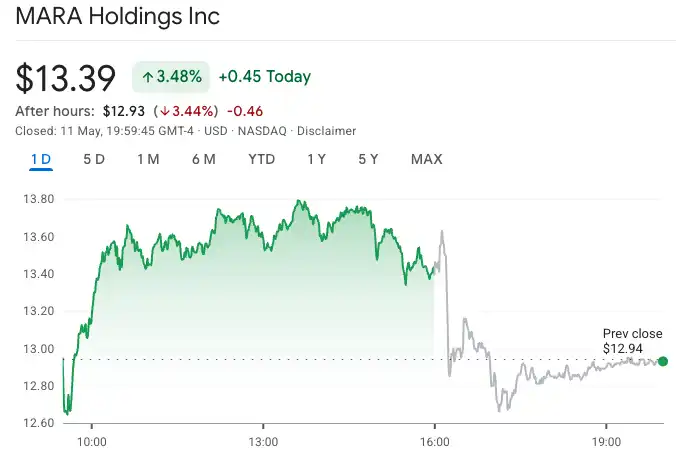
Caption: MARA's after-hours stock price movement, source: Google Finance

Where Did the $1.3 Billion Loss Come From?

The main reason for the loss was the unrealized losses on MARA's holdings of 38,689 bitcoins. Bitcoin price fell 23% in Q1, directly dragging down the book value.

MARA sold over 15,100 bitcoins in the final week of March, worth approximately $1.1 billion, to repurchase its debt at a discount.

Mining Environment Continues to Deteriorate

MARA's predicament is not an isolated case. The entire U.S. Bitcoin mining sector is sliding from profit to loss.

Two core pressures: Bitcoin is down over 35% from its all-time high of $126,080, significantly reducing miner revenue per block; simultaneously, mining difficulty has increased by nearly 30% over the past year, pushing hashing costs consistently higher.

MARA's industry standing is also declining. By market cap, it has fallen from being the largest Bitcoin miner to seventh place, as competitors move faster in their AI pivots.

Full Pivot to AI Data Centers

MARA says Bitcoin mining remains the "operational foundation" of the company, but its actions are already clear.

The company's AI strategy has two main thrusts: first, collaborating with Starwood Capital to convert existing mining sites into AI and High-Performance Computing (HPC) data centers; second, acquiring Long Ridge Energy & Power for $1.5 billion in late April, a natural gas power plant with an associated data center.

MARA's statement is:

"Our strategy is to colocate new infrastructure with our existing Bitcoin mining sites. The flexibility this creates is that we can generate revenue through mining today while preserving the option to divert power to AI and other critical IT loads."

The Long Ridge acquisition ultimately supports 600 MW of AI compute power, and approximately 90% of MARA's non-custodial mining capacity could be redeployed for AI and IT computing.

A one-sentence summary of its transformation resolve: The company explicitly stated it has no plans to purchase new mining rigs in the future.


İlgili Sorular

QWhy did MARA Holdings' stock price drop after-hours despite a gain during the day?

AThe stock dropped because the company released its Q1 earnings report, which showed both revenue and profits missing analyst expectations. Revenue fell 18% year-over-year, and the net loss expanded to $1.3 billion, causing investors to sell.

QWhat was the primary cause of MARA's significant $1.3 billion net loss in Q1?

AThe primary cause of the $1.3 billion net loss was the unrealized loss on the company's holding of 38,689 Bitcoins, as the price of Bitcoin fell by 23% during the quarter.

QWhat strategic shift did MARA announce regarding its mining operations?

AMARA announced a strategic shift away from purchasing new mining machines and towards fully transitioning into AI data centers. The company plans to repurpose its existing mining infrastructure for AI and High-Performance Computing (HPC) workloads.

QWhat actions did MARA take regarding its Bitcoin holdings in March, and why?

AIn the final week of March, MARA sold over 15,100 Bitcoins, valued at approximately $1.1 billion, in order to repurchase its debt at a discount.

QHow has the competitive landscape changed for MARA within the U.S. Bitcoin mining sector?

AMARA's position has weakened. By market capitalization, it has fallen from being the largest Bitcoin miner to the seventh largest. The company noted that competitors are moving faster in their transitions to AI-related businesses.

İlgili Okumalar

Token FOLD Auction Imminent, What is The Interfold, Supported by Vitalik?

**Title:** FOLD Token Auction Approaches: What is The Interfold, Supported by Vitalik? **Summary:** The Interfold, a "confidential coordination infrastructure" previously known as Enclave, is launching its functional token FOLD via a Uniswap Continuous Clearing Auction (CCA) starting July 8th. Endorsed by Ethereum co-founder Vitalik Buterin in May, the protocol tackles the core problem of governance bribery in decentralized voting (e.g., on platforms like Votium) by enabling multiple parties to compute a verifiable result without exposing their private input data. Its core technology, the Encrypted Execution Environment (E3), uses a distributed network of "Ciphernodes" that perform computations on fully encrypted data using Fully Homomorphic Encryption (FHE), with process integrity verified by Zero-Knowledge (ZK) proofs and decryption keys managed via Decentralized Threshold Cryptography (DTC) to eliminate a single point of trust. The primary application is CRISP (Coercion-Resistant Impartial Selection Protocol) for DAO governance, which ensures encrypted voting, "receipt-free" votes to prevent bribery, and verifiable tallying. The Interfold, developed by the Gnosis Guild team (creators of the Zodiac DAO tooling), positions itself as a focused solution to make on-chain voting truly un-buyable, realizing the vision of Vitalik's earlier MACI (Minimal Anti-Collusion Infrastructure) framework without its reliance on a single trusted coordinator. FOLD tokens will be used for Ciphernode staking, paying for computation requests, and protocol governance. Following the 48-hour auction, there is a 40-day cooling period where tokens can only be staked, with the official Token Generation Event (TGE) expected around August 19th.

Foresight News4 dk önce

Token FOLD Auction Imminent, What is The Interfold, Supported by Vitalik?

Foresight News4 dk önce

Bridging Traditional Funds and DeFi: Who Will Capture the Next Decade's RWA Dividends?

Bridging Traditional Funds and DeFi: Who Will Capture the RWA Decade's Value? Tokenization of real-world assets (RWA) is merging the 24/7, permissionless world of DeFi with the time-bound, regulated world of traditional finance. While the complexity is immense, the infrastructure layer enabling this fusion holds significant value. The total value of on-chain tokenized real-world assets now exceeds $33 billion. While tokenized U.S. Treasuries dominate, their share has fallen from 55% to under 45% in a year as other assets like institutional and private credit grow. The key differentiator for on-chain assets is *composability*, allowing capital to be recycled across multiple yield-generating strategies simultaneously. However, tokenized funds remain regulated products with daily NAV updates, KYC requirements, and redemption windows. Bridging these to DeFi requires solving core conflicts: pricing assets between NAV updates, enforcing compliance without stifling DeFi activity, and maintaining accurate accounting during cross-chain transfers. Solutions like the Centrifuge V3 architecture, in collaboration with LayerZero, propose a hub-and-spoke model. A single authoritative hub chain manages NAV, compliance, and accounting, while LayerZero's messaging layer syncs this data to spokechains where tokens can be freely composed in DeFi. This creates a high-barrier, essential middleware layer. The major incentive for institutions is the potential for recursive yield strategies—for example, depositing into a tokenized Treasury fund, borrowing stablecoins against it, and redeploying those funds into another yield-bearing asset, amplifying returns. Yet, risks remain: mismatches between on-chain instant redemptions and off-chain fund limits (as seen in recent private credit fund runs), pricing arbitrage due to NAV lags, and cross-chain settlement failures. Infrastructure must solve these while maintaining regulatory compliance. Just as SWIFT and Visa captured immense value as financial plumbing, the entities that build the robust middleware connecting traditional finance and DeFi are positioned to capture the next decade's value in the RWA space.

Foresight News29 dk önce

Bridging Traditional Funds and DeFi: Who Will Capture the Next Decade's RWA Dividends?

Foresight News29 dk önce

İşlemler

Spot
活动图片