Mantra CEO tells OM holders to withdraw from OKX over ‘inaccurate’ migration plan

cointelegraph2025-12-08 tarihinde yayınlandı2025-12-08 tarihinde güncellendi

Özet

Mantra CEO John Patrick Mullin has urged users to withdraw their OM tokens from the OKX exchange, accusing the platform of posting an "inaccurate" migration plan. Mullin claims OKX provided incorrect dates and details about the upcoming token migration from an Ethereum-based ERC-20 token to a native Mantra Chain token. He stated that OKX has not communicated with Mantra since April 13, when the OM token crashed over 90%, an event Mantra attributed to aggressive exchange leverage policies. Mullin advised users to avoid relying on OKX and complete the migration independently. The official migration is set to occur after January 15, contrary to OKX’s announced December timeline.

Tensions between blockchain platform Mantra and crypto exchange OKX are rising after Mantra accused the exchange of posting incorrect information about its token migration.

In a Monday X post, Mantra CEO John Patrick Mullin urged users of centralized cryptocurrency exchange (CEX) OKX to withdraw their Mantra (OM) tokens and cut their “dependency” on the platform.

“Users should consider withdrawing their OM tokens from OKX[...]. Avoid OKX Exchange Dependency: Complete migration without relying on potentially negligent or malicious intermediaries,” said Mullin.

His warning came in response to a Friday announcement from OKX about supporting the incoming OM token migration.
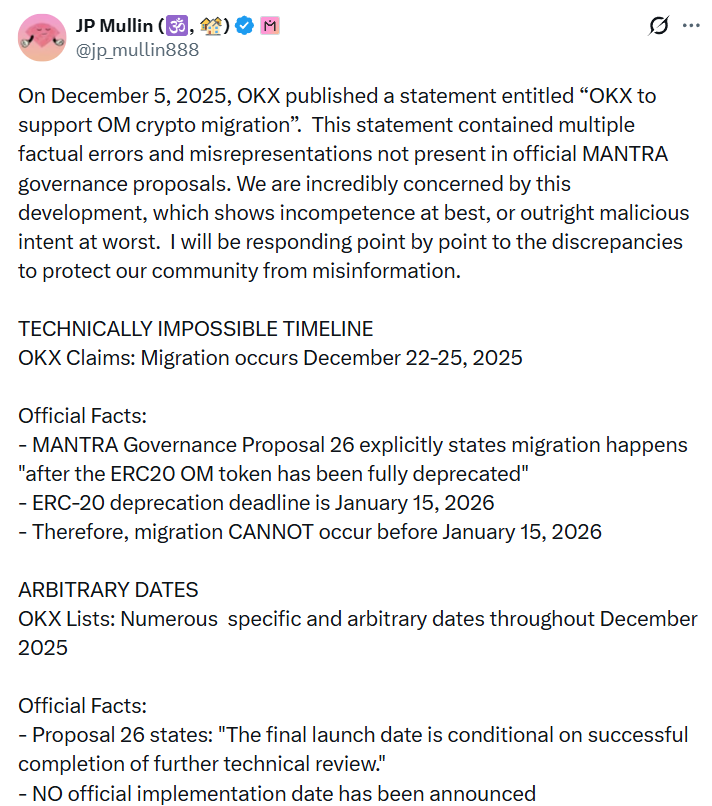
Source: JP Mullin

Related: BitMine buys $199M in Ether as smart money traders bet on ETH decline

According to Mullin, the OKX post contained multiple inaccuracies, including false migration and implementation dates.

OKX said the migration would occur between Dec. 22 and Dec. 25. Mantra’s governance proposal, by contrast, states that the migration will only take place after the Jan. 15 deprecation of the Ethereum-based ERC-20 OM token.

Mullin also said OKX’s post referenced “arbitrary dates throughout December 2025,” while Mantra has not yet announced an official implementation date.

He claimed OKX has not communicated with Mantra since “the events” of April 13, while Mantra has “helpfully [been] communicating with all other major exchanges regarding our migration.”
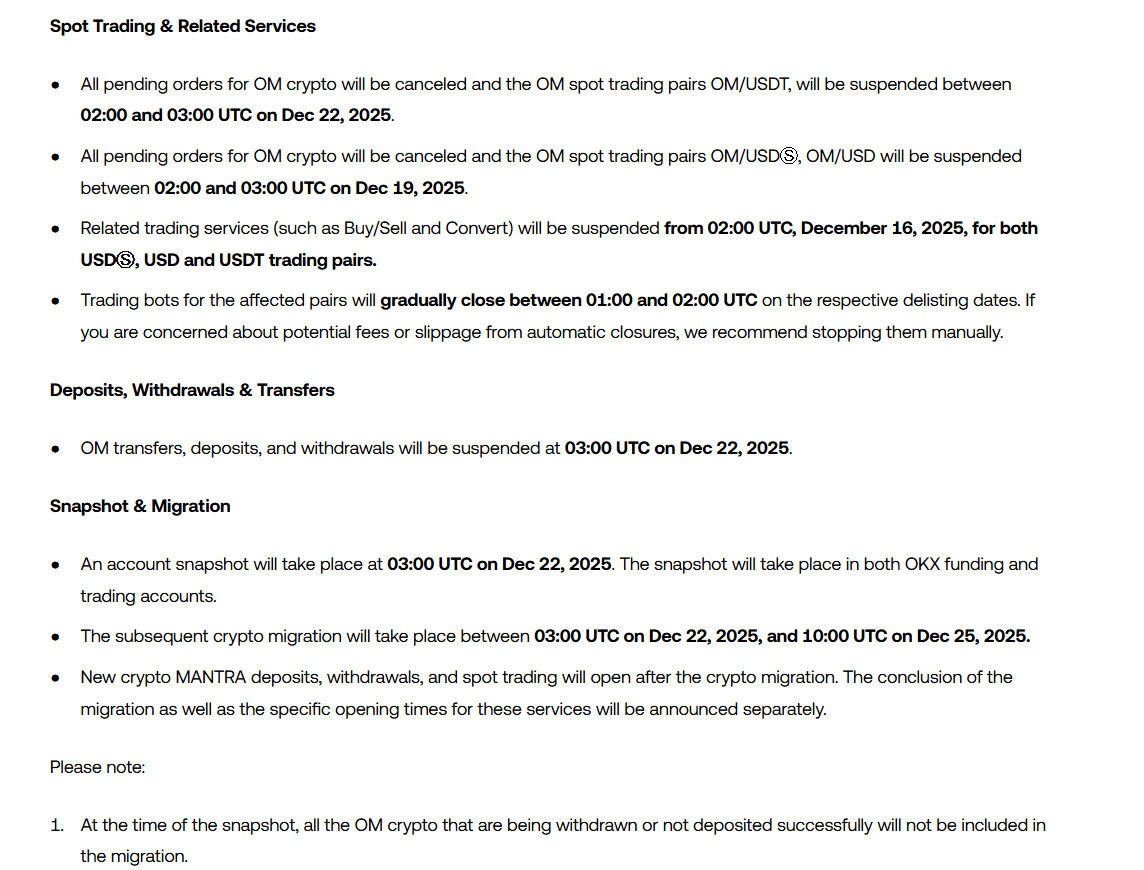
OKX’s OM Crypto Migration post. Source: okx.com

During the incoming migration, the OM token will migrate from an Ethereum-native ERC-20 token to a Mantra Chain-native token.

Cointelegraph has contacted OKX for comment but had not received a response by publication time.

Related: Prediction markets emerge as speculative ‘arbitrage arena’ for crypto traders

April crash still casting a shadow

On April 13, the Mantra’s OM token price fell by over 90% from around $6.30 to below $0.50.
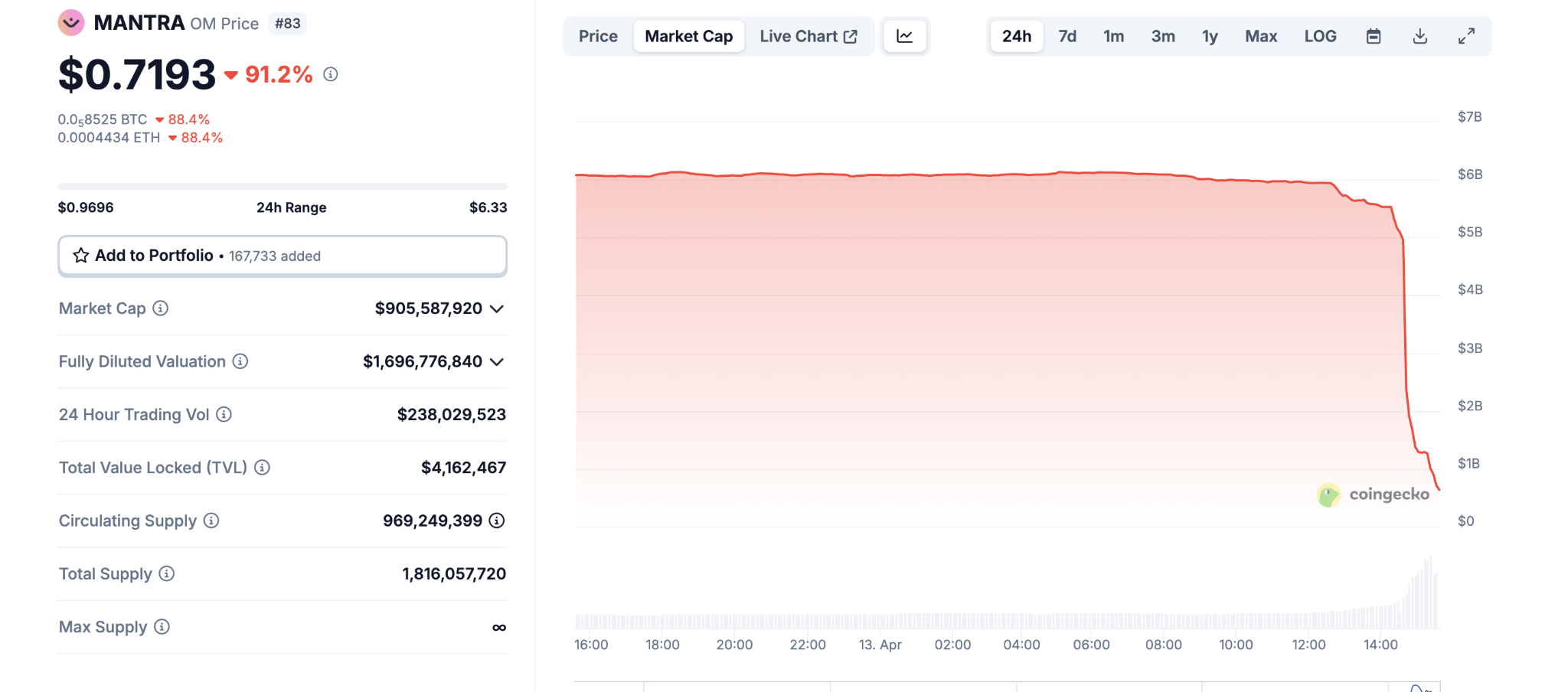
OM/USD, 1-day chart. Source: Coingecko.com

On April 30, Mantra published a post-mortem report that blamed the aggressive trading policies and high leverage on cryptocurrency exchanges for the token crash.

“Liquidation cascades could happen to any project in the crypto industry,” Mullin said in the post, pointing to the role of “aggressive leverage positions” on exchanges as a broader threat to investor safety.

Mullin also urged exchanges to review their leverage policies while implementing a transparency dashboard for OM tokenomics, along with announcing the burning of 150 million staked OM tokens, permanently removing them from circulation in a bid to tighten the token’s supply.

Magazine: If the crypto bull run is ending... it’s time to buy a Ferrari — Crypto Kid
İlgili Okumalar

Interlace: The World's Leading Agentic Payment and Stablecoin Infrastructure Platform, Building the Next-Generation Digital Financial Foundation

Interlace: A Leading Agentic Payment and Stablecoin Infrastructure Platform Interlace is a global stablecoin infrastructure platform bridging traditional and crypto finance. It addresses the fragmentation between crypto assets, global payments, and enterprise treasury management by integrating stablecoin payments, digital business banking, asset management, virtual card issuance, and AI payment capabilities into a unified global financial network. Key product pillars include: 1. **Next-Generation Payment Network**: Features **Agent Card** for AI agents (enabling autonomous spending with controls) and **Scan to Pay** for seamless stablecoin (USDT/USDC) to fiat payments via QR codes in emerging markets. 2. **Stablecoin Payment & Card Issuance**: Offers **Infinity Card** for corporate spend management, **CaaS (Card as a Service)** for embedded card issuance APIs, and **Infinity Launch** for turnkey white-label financial systems. 3. **Enterprise Accounts & Banking**: Provides **Business Accounts** for multi-currency management and **BaaS (Banking as a Service)** APIs for embedded global payments and banking capabilities. 4. **Crypto Finance Infrastructure**: Enables **On/Off Ramp** services for fiat-crypto conversions and ensures security with PCI DSS Level-1 certification, MPC wallets, and global compliance licenses. 5. **Integrated Financial Ecosystem**: Includes **Yield Treasury** for idle cash management and a full suite of APIs, serving over 12,000 businesses across 180+ countries. Interlace aims to make stablecoins viable for everyday payments and empower AI agents with secure spending, building the foundational infrastructure for the future of digital finance.

链捕手10 dk önce

Interlace: The World's Leading Agentic Payment and Stablecoin Infrastructure Platform, Building the Next-Generation Digital Financial Foundation

链捕手10 dk önce

Stanley Druckenmiller: From Soros' Comrade-in-Arms to the Godfather of Macro Investing—System, Disciples, and Latest Thoughts

Stanley Druckenmiller is a pivotal figure in global macro investing, renowned for his partnership with George Soros, his legendary fund Duquesne Capital, and a decades-long track record of near-30% annualized returns without a single annual loss. His methodology uniquely blends value, growth, macro, and trend investing. A key early experience was as a bank stock analyst, grounding him in both company fundamentals and macro forces. His most famous trade, shorting the British Pound in 1992, exemplified his approach: identifying unsustainable structural contradictions and concentrating capital on high-probability, high-payoff opportunities. The "Duquesne System" is built on four pillars: macro-directional analysis, concentrated bets on best ideas, rapid error correction, and acute awareness of liquidity. His famous phrase "Invest, then investigate" reflects a dynamic approach of entering a position based on a strong initial thesis and then adjusting based on market feedback. This differs fundamentally from Warren Buffett's focus on long-term intrinsic business value; Druckenmiller focuses on marginal changes, cycles, and capital allocation at inflection points. His influence extends through protégés like Scott Bessent (market execution) and Kevin Warsh (policy insight), representing the dual market-and-institutional understanding he embodies. He closed his flagship fund in 2010 at its peak, prioritizing flexibility and performance over asset-gathering. Recent moves highlight his core logic: reducing AI exposure as expectations became crowded while investing in copper, recognizing the underlying infrastructure and resource demands of the AI boom. He remains concerned about long-term US dollar purchasing power due to fiscal deficits and monetary policy. His core skill is judging risk/reward payoff, not just prediction accuracy. For ordinary investors, key lessons are to focus on marginal changes, align position size with conviction and risk, and seek second-order opportunities beneath surface-level narratives. Ultimately, Druckenmiller is a strategist who combines macro insight with price discipline, decisive action with rigorous risk management, succeeding by identifying major market mispricings, acting before full consensus, and exiting swiftly when proven wrong.

marsbit55 dk önce

Stanley Druckenmiller: From Soros' Comrade-in-Arms to the Godfather of Macro Investing—System, Disciples, and Latest Thoughts

marsbit55 dk önce

Morning Report | xAI Launches Skills; Duan Yongping Takes First Position in Circle in Q1 2026; Polymarket Partners with Nasdaq to Launch Prediction Market

**Title:** Daily Brief: Musk's xAI Launches "Skills"; Duan Yongping's First Circle Investment; Polymarket Partners with Nasdaq **Key Highlights:** * **AI Developments:** Elon Musk's xAI released "Skills," enabling its Grok AI to retain memory across conversations. OpenAI co-founder Andrej Karpathy joined rival Anthropic. * **Crypto & DeFi:** May saw 14 crypto hack incidents, including 3 major DeFi attacks in 5 days (Echo Protocol, THORChain, Verus). The Ethereum Foundation faces another exodus with two core members departing. * **Corporate Moves:** Investor Duan Yongping disclosed a new $19M position in Circle. Analog Devices is in talks to acquire AI chip firm Empower Semiconductor for ~$1.5B. * **Financials & Partnerships:** Canaan reported Q1 2026 revenue of $62.7M and record-high crypto reserves. Prediction market Polymarket partnered with Nasdaq to launch markets for private companies. * **Market Data:** VanEck predicts digital credit markets could reach $2.5T in a decade, with Bitcoin potentially hitting $1M. Top trending meme tokens on ETH, Solana, and Base networks are listed. **Featured Articles:** Three analysis pieces explore: 1) potential regulatory pressures on DEXs like Hyperliquid, 2) challenges to Solana's "internet capital market" narrative, and 3) the future emergence of a dedicated capital market for autonomous AI agents (Agents).

链捕手1 saat önce

Morning Report | xAI Launches Skills; Duan Yongping Takes First Position in Circle in Q1 2026; Polymarket Partners with Nasdaq to Launch Prediction Market

链捕手1 saat önce

Why is HYPE Still Surging? Has It Topped Out?

The article analyzes the reasons behind the continued surge of the HYPE token, despite the current market conditions. The primary drivers identified are: 1. **ETF Inflows and a New Buyback Mechanism:** The launch of two ETFs (THYP by 21Shares and BHYP by Bitwise) has opened a channel for traditional capital. Crucially, Bitwise announced it will allocate 10% of BHYP's management fee income to acquire and stake HYPE, creating a potential source of recurring buy pressure linked to the ETF's growth. 2. **USDC Integration and New Revenue Stream:** The return of USDC to Hyperliquid, facilitated by Coinbase and Circle, is significant. It establishes a protocol revenue-sharing model from USDC reserve yields. Community estimates suggest this could generate substantial daily income (approx. $440k), which could be used for HYPE buybacks, decoupling token demand from just trading fees and linking it to the platform's stablecoin deposits. 3. **Expansion into New Markets:** Hyperliquid is broadening beyond being just a Perp DEX. Its HIP-4 feature launches it into the prediction market space, already showing high volume. This requires HYPE staking for market creation, directly increasing token utility and staking demand. Furthermore, the platform's Real-World Asset (RWA) trading has seen Open Interest hit a new high of $2.6B, indicating growth in trading traditional assets like stocks and commodities. 4. **Regulatory Tailwinds for RWA:** Potential SEC exemptions for tokenized stock trading could further accelerate Hyperliquid's RWA business, turning a niche into a major battleground for on-chain trading. In summary, the market is re-rating HYPE as Hyperliquid evolves from a single-purpose DEX into a comprehensive on-chain trading system with multiple growing revenue streams (trading fees, reserve yields, prediction markets) and expanding asset classes (crypto, RWAs). However, the article notes that despite the strong long-term fundamentals, short-term price action is currently volatile due to a large-scale showdown between whale long and short positions exceeding $60 million.

marsbit1 saat önce

Why is HYPE Still Surging? Has It Topped Out?

marsbit1 saat önce

İşlemler

Spot
Futures
活动图片