Make crypto games great again? ‘Trump Billionaires Club’ launches this month

cointelegraph2025-12-10 tarihinde yayınlandı2025-12-10 tarihinde güncellendi

Özet

A Trump-themed crypto mobile game, "Trump Billionaires Club," is set to launch on the Apple App Store by December 30. Created by Freedom 45 Games and linked to the TRUMP Coin, the game operates under a licensing agreement to use Trump’s name. It features a Monopoly-style board where players use dice rolls to earn funds for construction and other activities. The game integrates cryptocurrency and NFTs, allowing players to fund accounts with cash, crypto, or TRUMP Coin, and trade in-game items. A pre-launch airdrop of Trump tokens is offered to top performers. However, a disclaimer states the game is not affiliated with Donald Trump, his businesses, or any campaign, and collectibles are for enjoyment, not investment. This launch occurs as the Trump memecoin has dropped 92% from its all-time high, though it saw a slight uptick following the game's announcement.

A Trump-themed crypto mobile game, created by Bill Zanker, a member of the team that helped launch the official Trump memecoin and various NFT collections, is reportedly set to be released on the Apple App Store before the end of the year.

The game uses Trump’s name under a licensing agreement and is being created by Freedom 45 Games, according to the game’s website. It is also tied in with the Trump Coin.

The Apple App Store has an expected release date of Dec. 30, and the app is currently in pre-registration.

Zanker was already linked to a project blending gaming and cryptocurrency elements in April, with the project reportedly bearing some similar aspects to MONOPOLY GO; however, at the time, a spokesperson denied any similarity to Monopoly.

On the game’s website, it lists cash, cryptocurrency, or TRUMP Coin as ways to fund a game account and mentions trading non-fungible token statues and pins that can be used in the game.
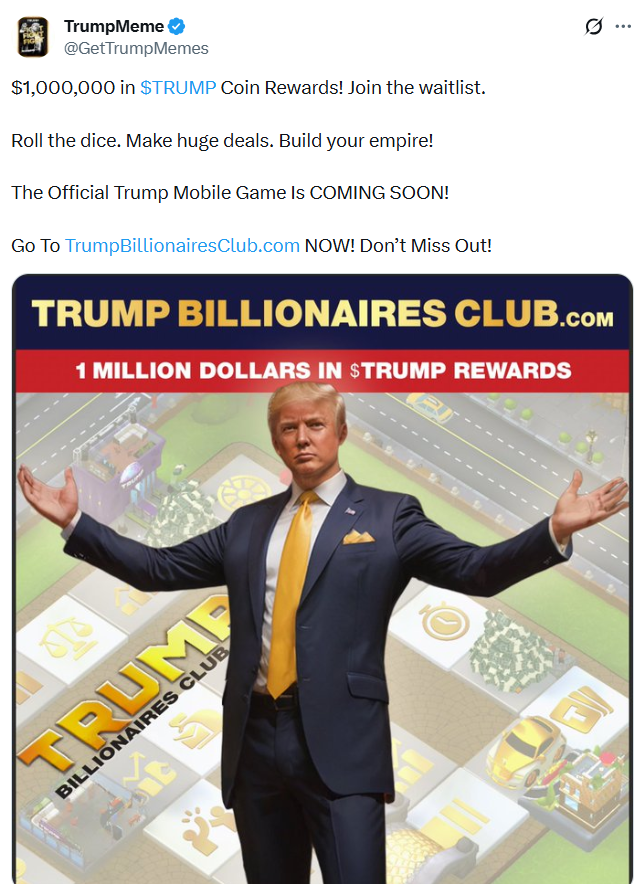
Source: TrumpMeme

However, a disclaimer outlines that it’s not designed, manufactured, or distributed by US President Donald Trump or any of his businesses or affiliates.

The Trump Billionaires Club didn’t immediately respond to a request for comment.

Trump game features crypto elements

A demo of Trump Billionaires Club on its website appear to feature a digital version of New York and show a player using dice rolls to move around a Monopoly-style gameboard, earning funds for constructions and other activities.

The game also offers an air drop of Trump tokens to whoever earns the most points pre-launch, which can be gained by opening an account, holding the TRUMP coin, and referring new users to the project.

Related: Trump’s national security strategy is silent on crypto, blockchain

Trump memecoin is down 92% from ATH

The new Trump-themed crypto game comes at a challenging time for Trump’s memecoin holders.

The Official Trump memecoin launched days before Donald Trump took office on Jan. 20. It surged to an all-time high of over $73 a day after launch — with its value reaching over $14.5 billion — but has since dropped over 92% to trade at $5.89 as of Wednesday, according to CoinGecko. Over the last 24 hours, since the game announcement, the token has seen a 3.4% increase.

Under the disclaimer, the game collectibles are said to be for “enjoyment only,” not for “investment purposes,” and are not connected to “any political campaign.”

Trump’s crypto ventures, and those bearing his name, have come under scrutiny from Democrat lawmakers in the US who have previously demanded an investigation from the financial regulators and the government ethics office.

Magazine: When privacy and AML laws conflict: Crypto projects’ impossible choice

İlgili Okumalar

a16z: AI's 'Amnesia', Can Continuous Learning Cure It?

The article "a16z: AI's 'Amnesia' – Can Continual Learning Cure It?" explores the limitations of current large language models (LLMs), which, like the protagonist in the film *Memento*, are trapped in a perpetual present—unable to form new memories after training. While methods like in-context learning (ICL), retrieval-augmented generation (RAG), and external scaffolding (e.g., chat history, prompts) provide temporary solutions, they fail to enable true internalization of new knowledge. The authors argue that compression—the core of learning during training—is halted at deployment, preventing models from generalizing, discovering novel solutions (e.g., mathematical proofs), or handling adversarial scenarios. The piece introduces *continual learning* as a critical research direction to address this, categorizing approaches into three paths: 1. **Context**: Scaling external memory via longer context windows, multi-agent systems, and smarter retrieval. 2. **Modules**: Using pluggable adapters or external memory layers for specialization without full retraining. 3. **Weights**: Enabling parameter updates through sparse training, test-time training, meta-learning, distillation, and reinforcement learning from feedback. Challenges include catastrophic forgetting, safety risks, and auditability, but overcoming these could unlock models that learn iteratively from experience. The conclusion emphasizes that while context-based methods are effective, true breakthroughs require models to compress new information into weights post-deployment, moving from mere retrieval to genuine learning.

marsbit2 saat önce

a16z: AI's 'Amnesia', Can Continuous Learning Cure It?

marsbit2 saat önce

Can a Hair Dryer Earn $34,000? Deciphering the Reflexivity Paradox in Prediction Markets

An individual manipulated a weather sensor at Paris Charles de Gaulle Airport with a portable heat source, causing a Polymarket weather market to settle at 22°C and earning $34,000. This incident highlights a fundamental issue in prediction markets: when a market aims to reflect reality, it also incentivizes participants to influence that reality. Prediction markets operate on two layers: platform rules (what outcome counts as a win) and data sources (what actually happened). While most focus on rules, the real vulnerability lies in the data source. If reality is recorded through a specific source, influencing that source directly affects market settlement. The article categorizes markets by their vulnerability: 1. **Single-point physical data sources** (e.g., weather stations): Easily manipulated through physical interference. 2. **Insider information markets** (e.g., MrBeast video details): Insiders like team members use non-public information to trade. Kalshi fined a剪辑师 $20,000 for insider trading. 3. **Actor-manipulated markets** (e.g., Andrew Tate’s tweet counts): The subject of the market can control the outcome. Evidence suggests Tate’sociated accounts coordinated to profit. 4. **Individual-action markets** (e.g., WNBA disruptions): A single person can execute an event to profit from their pre-placed bets. Kalshi and Polymarket handle these issues differently. Kalshi enforces strict KYC, publicly penalizes insider trading, and reports to regulators. Polymarket, with its anonymous wallet-based system, has historically been more permissive, arguing that insider information improves market accuracy. However, it cooperated with authorities in the "Van Dyke case," where a user traded on classified government information. The core paradox is reflexivity: prediction markets are designed to discover truth, but their financial incentives can distort reality. The more valuable a prediction becomes, the more likely participants are to influence the event itself. The market ceases to be a mirror of reality and instead shapes it.

marsbit3 saat önce

Can a Hair Dryer Earn $34,000? Deciphering the Reflexivity Paradox in Prediction Markets

marsbit3 saat önce

İşlemler

Spot
Futures
活动图片