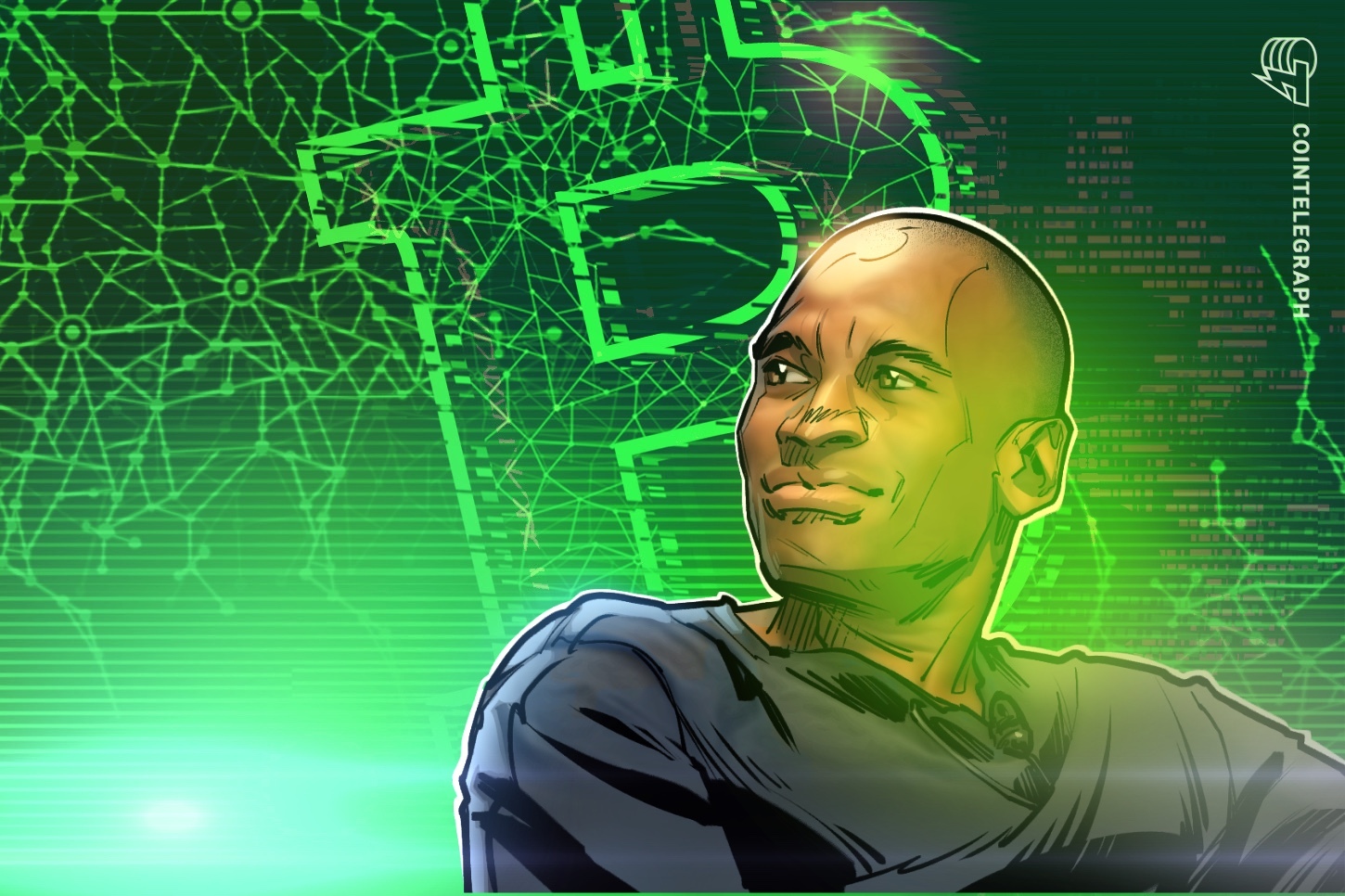
Make crypto games great again? ‘Trump Billionaires Club’ launches this month

cointelegraph2025-12-10 tarihinde yayınlandı2025-12-10 tarihinde güncellendi

Özet

A Trump-themed crypto mobile game, "Trump Billionaires Club," is set to launch on the Apple App Store by December 30. Created by Freedom 45 Games and linked to the TRUMP Coin, the game operates under a licensing agreement to use Trump’s name. It features a Monopoly-style board where players use dice rolls to earn funds for construction and other activities. The game integrates cryptocurrency and NFTs, allowing players to fund accounts with cash, crypto, or TRUMP Coin, and trade in-game items. A pre-launch airdrop of Trump tokens is offered to top performers. However, a disclaimer states the game is not affiliated with Donald Trump, his businesses, or any campaign, and collectibles are for enjoyment, not investment. This launch occurs as the Trump memecoin has dropped 92% from its all-time high, though it saw a slight uptick following the game's announcement.

A Trump-themed crypto mobile game, created by Bill Zanker, a member of the team that helped launch the official Trump memecoin and various NFT collections, is reportedly set to be released on the Apple App Store before the end of the year.

The game uses Trump’s name under a licensing agreement and is being created by Freedom 45 Games, according to the game’s website. It is also tied in with the Trump Coin.

The Apple App Store has an expected release date of Dec. 30, and the app is currently in pre-registration.

Zanker was already linked to a project blending gaming and cryptocurrency elements in April, with the project reportedly bearing some similar aspects to MONOPOLY GO; however, at the time, a spokesperson denied any similarity to Monopoly.

On the game’s website, it lists cash, cryptocurrency, or TRUMP Coin as ways to fund a game account and mentions trading non-fungible token statues and pins that can be used in the game.
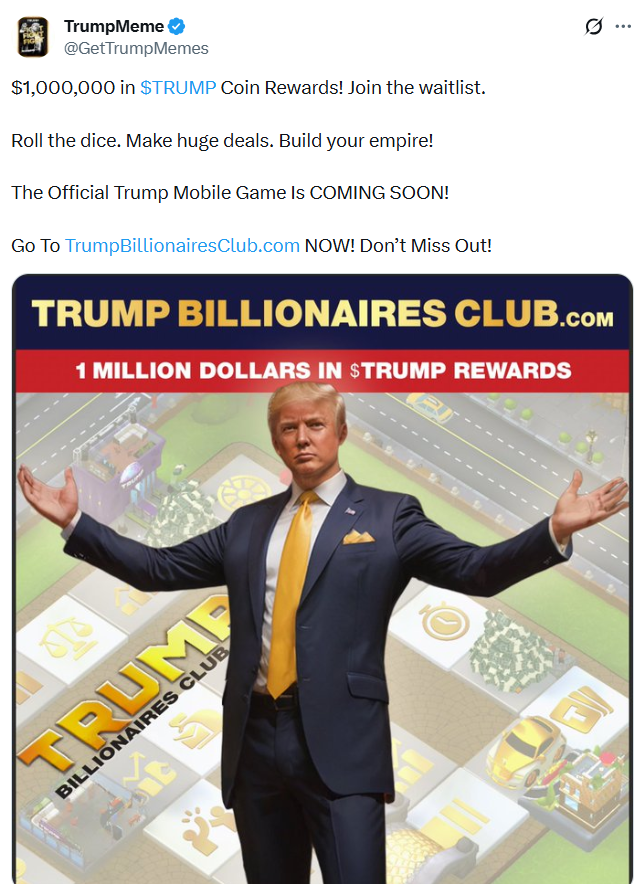
Source: TrumpMeme

However, a disclaimer outlines that it’s not designed, manufactured, or distributed by US President Donald Trump or any of his businesses or affiliates.

The Trump Billionaires Club didn’t immediately respond to a request for comment.

Trump game features crypto elements

A demo of Trump Billionaires Club on its website appear to feature a digital version of New York and show a player using dice rolls to move around a Monopoly-style gameboard, earning funds for constructions and other activities.

The game also offers an air drop of Trump tokens to whoever earns the most points pre-launch, which can be gained by opening an account, holding the TRUMP coin, and referring new users to the project.

Related: Trump’s national security strategy is silent on crypto, blockchain

Trump memecoin is down 92% from ATH

The new Trump-themed crypto game comes at a challenging time for Trump’s memecoin holders.

The Official Trump memecoin launched days before Donald Trump took office on Jan. 20. It surged to an all-time high of over $73 a day after launch — with its value reaching over $14.5 billion — but has since dropped over 92% to trade at $5.89 as of Wednesday, according to CoinGecko. Over the last 24 hours, since the game announcement, the token has seen a 3.4% increase.

Under the disclaimer, the game collectibles are said to be for “enjoyment only,” not for “investment purposes,” and are not connected to “any political campaign.”

Trump’s crypto ventures, and those bearing his name, have come under scrutiny from Democrat lawmakers in the US who have previously demanded an investigation from the financial regulators and the government ethics office.

Magazine: When privacy and AML laws conflict: Crypto projects’ impossible choice
İlgili Okumalar

Robinhood CEO named three benefits of tokenized stocks for American investors

Robinhood CEO Vlad Tenev advocates for the U.S. to allow trading of tokenized stocks domestically. He argues this model could modernize the financial system through three key benefits: **faster, near real-time settlements** reducing counterparty risk and broker capital requirements; **24/7 trading** enabling reaction to market events anytime; and **greater asset portability**, allowing tokens to be moved between platforms and held in self-custody wallets, increasing competition among services. Tenev emphasized tokenization is about rebuilding asset ownership infrastructure for freer movement, similar to information online. He highlighted potential integration with DeFi, where tokenized stocks could be used for lending or as collateral. Currently, Robinhood's stock tokens are not direct ownership of the underlying securities but are backed by them and provide access to economic value like dividends; their structure may evolve with future regulations. Tenev identified outdated securities laws and market infrastructure, developed over a century, as the main U.S. obstacle, urging regulators to adapt rules for blockchain while preserving investor protections. He warned it would be strange if the rest of the world could build the future of ownership around U.S. assets while Americans are left behind, suggesting tokenization could later expand to private company shares and other illiquid assets.

cryptonews.ru19 dk önce

Robinhood CEO named three benefits of tokenized stocks for American investors

cryptonews.ru19 dk önce

Web3 Wallets in a 'Turbulent Autumn': In the AI Era, How to Understand the Evolution of 'Spear and Shield' in Crypto Security?

The recent spate of incidents involving Coldcard, Trezor, and SafePal highlights a critical evolution in cryptocurrency wallet security, moving the focus beyond simple private key protection to a holistic, multi-layered attack surface. These events—spanning a random number generator flaw, supply chain data leaks, and plugin permission issues—underscore that vulnerabilities now exist across the entire wallet lifecycle: from secure element and code generation to logistics, user data, and daily interactions with dApps. This broadening threat landscape is accelerating with the advent of AI. Attackers are leveraging AI to automate and scale previously labor-intensive tasks like vulnerability discovery, sophisticated social engineering, and targeted phishing campaigns. This effectively lowers the cost of attacks, eroding the security margin once provided by the high effort required to find and exploit flaws. In response, defense strategies must also evolve by integrating AI. The future of wallet security lies not just in static rules and blacklists, but in proactive, AI-powered risk assessment. This includes pre-transaction simulation, behavioral analysis to detect anomalies (like sudden large approvals), and contextual awareness of dApps and counterparties. The goal is to transform wallets from passive signing tools into active guardians that can understand intent, predict outcomes, and clearly communicate risks to users—all while preserving user sovereignty and control through minimal permissions and human confirmation for critical actions. Ultimately, self-custody does not guarantee inherent safety; it returns absolute control to the user. Protecting that control requires a dynamic, evolving security posture where AI becomes a essential tool on both sides of an ongoing "spear and shield" arms race in the Web3 ecosystem.

marsbit29 dk önce

Web3 Wallets in a 'Turbulent Autumn': In the AI Era, How to Understand the Evolution of 'Spear and Shield' in Crypto Security?

marsbit29 dk önce

İşlemler

Spot
活动图片