Major Reshuffle in Foreign Trade Cities! Shenzhen Surpasses Shanghai, Suzhou Surpasses Beijing

marsbit2026-08-31 tarihinde yayınlandı2026-08-31 tarihinde güncellendi

Özet

A major reshuffle has occurred in China's foreign trade city rankings for the first seven months of 2026. Shenzhen has consolidated its position as the top city, significantly widening its lead over Shanghai. Notably, Shenzhen's import value surpassed Shanghai's for the first time historically. Suzhou overtook Beijing to become the third-ranked city, while Wuxi entered the top ten, replacing Qingdao which dropped out. Xi'an emerged as the biggest dark horse, with its foreign trade soaring by 100.4%. Nationally, import growth (22%) significantly outpaced export growth (14%), becoming the primary driver of overall trade expansion. This surge in imports, particularly of intermediate goods, signals a recovery in domestic demand and strengthens the foundation for future exports. Key cities leading the charge are those with strong foundations in semiconductors and AI hardware. Xi'an's explosive growth is powered by major memory chip manufacturers like Samsung and Micron. Suzhou's rise is driven by electronics and AI computing hardware exports. Shenzhen, Hefei, and Wuxi also benefited from their robust integrated circuit and electronics manufacturing industries. The overall trend shows manufacturing and export-oriented cities advancing rapidly in the rankings. However, 19 of the top 30 cities grew slower than the national average, indicating an uneven recovery.

The landscape of foreign trade cities in 2026 has changed once again.

In the first seven months, the national total import and export value continued to surge significantly, with the power of imports rising strongly, leading to a drastic reshuffle in the rankings of various cities.

Key points first: Shenzhen widens its gap with Shanghai, firmly securing its position as China's top foreign trade city. An important signal is that Shenzhen's import value has surpassed Shanghai's for the first time. Suzhou overtakes Beijing, rising to become the third-largest foreign trade city. Wuxi breaks into the top ten in foreign trade, while Qingdao exits the top ten positions. Xi'an emerges as the biggest dark horse, with its foreign trade soaring by 100.4% in the first seven months of this year.
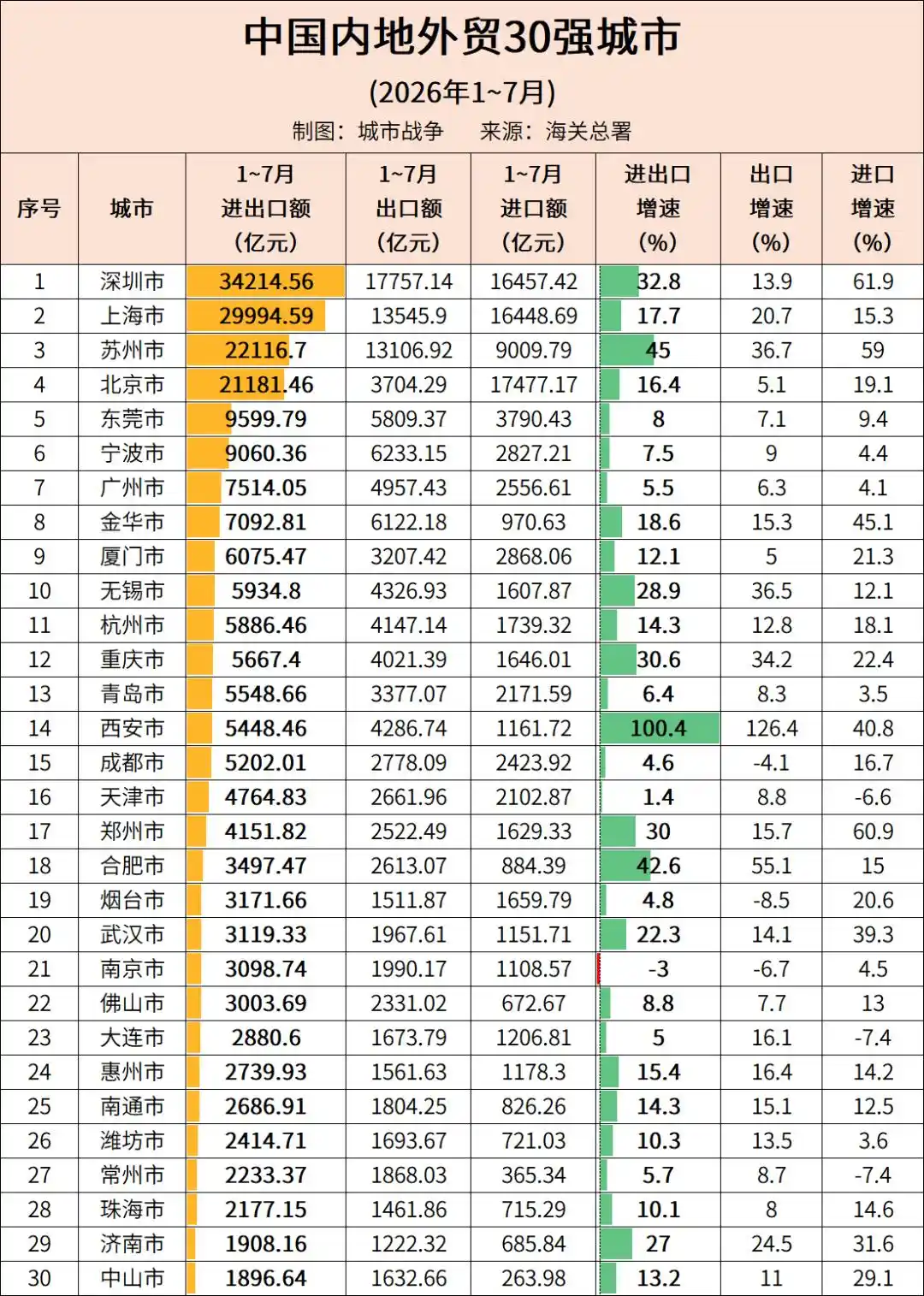
Recently, the General Administration of Customs released foreign trade data for the first seven months of this year, revealing a noteworthy change: imports are rising even more sharply than exports.

In the first seven months of this year, China's total goods import and export value reached 30.13 trillion yuan, a year-on-year increase of 17.3%. Exports amounted to 17.44 trillion yuan, growing by 14%, while imports reached 12.69 trillion yuan, surging by 22%. In the same period last year, imports had actually decreased by 1.6%.

One rising and the other falling, the growth rate of imports has clearly exceeded that of exports, becoming the main force driving foreign trade growth.

What does this indicate? Demand in the domestic market is genuinely recovering. People are buying more goods, factories are procuring more raw materials and components, and overall economic demand is on the rise.

Furthermore, many of the imported goods are intermediate products—such as chips, steel, and chemical raw materials—which are processed and assembled domestically before being exported abroad. This creates a cycle between imports and exports: stronger imports provide more momentum for exports as well.

The changes in the national picture are reflected in significant shifts in the rankings of individual cities.

Shenzhen continues to firmly hold its position as the "top foreign trade city," and its lead over Shanghai is widening. In the first seven months of this year, Shenzhen's total import and export value reached 3.42 trillion yuan, a year-on-year increase of 32.8%, exceeding Shanghai's total by 422 billion yuan. It's worth noting that for the whole of 2025, Shenzhen was only ahead of Shanghai by 43.05 billion yuan. In just one year, the gap has multiplied.

This recent surge in Shenzhen's foreign trade is primarily driven by imports. In the first seven months, Shenzhen's import value reached 1.65 trillion yuan, skyrocketing by 61.9% year-on-year. This also marks the first time in history that Shenzhen's import scale has surpassed Shanghai's—Shenzhen imported 1,645.7 billion yuan, while Shanghai imported 1,644.9 billion yuan. The difference is small, but the significance is substantial.

The change is even more evident compared to last year: in the same period of 2025, Shenzhen's import value was only 1.02 trillion yuan, with a growth rate of just 9.4%. In one year, the import scale has virtually leaped to a new level. Following the surge in imports, the structure of Shenzhen's imports and exports has undergone a fundamental change: in the past, exports were significantly larger than imports, but now their scales are almost equivalent.

It's worth mentioning that the foreign trade structures of Beijing and Shanghai differ from most cities, with imports exceeding exports in both. Imports account for 55% of Shanghai's total foreign trade, while Beijing is even more extreme, with imports making up 82.5% of its total.

The reason isn't hard to understand: these two cities are centers for headquarters economies and bulk commodity trading. A large portion of their imports serves the national market, hence their exceptionally large import volumes.

Compared to 2025, what changes have occurred among this year's top 30 foreign trade cities?

First, let's look at the cities rising the fastest. Suzhou has surpassed Beijing for the first time, rising from fourth to third nationally, becoming a top-tier TO3 city. Wuxi climbed from 14th to 10th place, entering the national top ten; Chongqing rose from 15th to 12th; Xi'an leaped five positions, jumping from 19th to 14th.

Additionally, Hefei moved from 21st to 18th, Wuhan from 22nd to 20th, Huizhou from 25th to 24th, and Jinan from 30th to 29th. Zhongshan rose from 32nd to 30th, successfully breaking into the national top 30 for foreign trade.

Which cities saw their rankings decline? Qingdao dropped from 10th to 13th, falling out of the top ten; Chengdu fell from 12th to 15th, and Tianjin dropped from 13th to 16th. Nanjing experienced a larger decline, falling from 17th to 21st, while Foshan dropped from 20th to 22nd.

Overall, the biggest change in this year's foreign trade city landscape is the collective surge of a group of manufacturing and export-oriented cities.

A distinct characteristic of this year's foreign trade is: whoever has a strong chip and AI hardware industry is surging rapidly. The three cities with the most explosive growth rates—Xi'an, Suzhou, Hefei, Shenzhen—with increases of 100.4%, 45%, 42.6%, and 32.8% respectively, all have powerful chip foundations behind them.

Xi'an is the biggest dark horse, with its imports and exports soaring by 100.4% in the first seven months. Samsung's factory in Xi'an is the world's largest NAND flash memory production base, accounting for 40% of Samsung's total production capacity. Micron also has a presence here, and local chip companies are also making efforts. In the first seven months, Xi'an's exports of mechanical and electrical products grew by 143.8%, accounting for over 95% of its total exports.

Suzhou relies on its electronic information and AI computing hardware sectors. Its single-month foreign trade growth rate in July reached 67.8%. The import and export value of the Suzhou Industrial Park in the first seven months has already exceeded that of the entire previous year, with AI computing hardware products accounting for over half of its exports.

Hefei boasts Changxin Technology, with its memory chip industry providing strong support for foreign trade.

Shenzhen needs no introduction; it is itself a major electronics manufacturing hub, with very active imports and exports of AI servers and consumer electronics. Wuxi, as a major hub for integrated circuits with a complete semiconductor industry chain, also saw its ranking rise significantly due to this.

However, not all cities have kept up with the pace. Among the top 30 foreign trade cities, 19 had growth rates below the national average of 17.3%.

This article is from the WeChat public account "City Wars," author: Ting Hai Moyu

İlgili Sorular

QAccording to the article, which city became the new top foreign trade city in China and what significant 'first' did it achieve?

AAccording to the article, Shenzhen is the new top foreign trade city in China, having widened its lead over Shanghai. A significant first is that Shenzhen's import volume exceeded Shanghai's for the first time in history.

QWhat are the key factors driving the surge in foreign trade for cities like Xi'an, Suzhou, and Hefei?

AThe key factor driving the surge in foreign trade for cities like Xi'an, Suzhou, and Hefei is their strong semiconductor (chip) and AI hardware industries. For example, Xi'an is a major NAND flash memory production base, Suzhou is strong in AI computing hardware, and Hefei is supported by its storage chip industry.

QWhich city is highlighted as the 'biggest dark horse' in the foreign trade rankings and what was its growth rate?

AXi'an is highlighted as the 'biggest dark horse' in the foreign trade rankings. Its foreign trade volume increased by 100.4% in the first seven months of the year.

QHow did the growth rate of imports compare to exports nationally in the first seven months, and what does this indicate?

ANationally, imports grew by 22%, significantly faster than exports which grew by 14%. This indicates that domestic demand is recovering strongly and has become the main force driving foreign trade growth.

QWhat major change occurred in the ranking of Suzhou and Wuxi in the national foreign trade top 10?

ASuzhou surpassed Beijing to become the third-ranked foreign trade city in the national top 3. Wuxi rose from 14th place to 10th place, successfully entering the national top 10.

İlgili Okumalar

Kraken Changed Its Vote at the Last Minute, Solana's Inflation Policy Narrowsly Passes by 0.33 Percent

Kraken’s last-minute vote reversal secured the passage of SGP-0002, a pivotal Solana governance proposal to accelerate the network’s annual inflation reduction from 15% to 30%. The final vote tally was 67.001%, narrowly exceeding the required 66.667% supermajority by just 0.334 percentage points. This change will bring Solana’s terminal inflation rate of 1.5% forward to around 2029, reducing future SOL issuance over six years by approximately 18.9 million tokens (about 2.6% of current supply). The vote, the first major test of Solana’s new on-chain governance system, saw intense drama. The Kraken 2 validator, controlling about 8.9 million staked SOL, switched from support to opposition hours before the deadline, pushing the "yes" vote below the passing threshold. A flurry of lobbying, including direct outreach by Helius CEO Mert Mumtaz, ensued. Kraken ultimately flipped back to supporting the proposal, and JitoSOL holders used the "staker override" mechanism to bypass opposing validators and vote directly with their stake. While SGP-0002 passed, a companion proposal (SGP-0003) to restructure transaction fees failed, indicating community willingness to adjust token supply but hesitance to change fee economics. The approved proposal now moves to a technical implementation phase, requiring client teams to code and activate the change. The event highlighted both the power of large validators and the resilience of Solana’s governance mechanisms, marking a significant, albeit messy, step in decentralized monetary policy management.

marsbit20 dk önce

Kraken Changed Its Vote at the Last Minute, Solana's Inflation Policy Narrowsly Passes by 0.33 Percent

marsbit20 dk önce

Trading Volume Surges 10 Times in a Month, Who's Driving UNI's Soaring Price?

The article discusses the recent surge in the price of UNI, the governance token of Uniswap, which reached a high above $5.4 on August 31, marking a three-month increase of over 100%. The resurgence is attributed primarily to two key developments. First, Uniswap was designated as the primary Automated Market Maker (AMM) on the newly launched Robinhood Chain. Data shows Uniswap generated $4.29 million in fees in 24 hours on this chain and facilitated a tenfold increase in stock token trading volume over a month, reaching approximately $130 million daily. Second, a fundamental change in UNI's tokenomics, approved in December 2025, activated a "fee switch" mechanism. A portion of protocol fees is now directed to a "TokenJar" contract. Arbitrage bots can destroy an equivalent value of UNI tokens to claim these fees, creating a perpetual buy-and-burn pressure. This mechanism has led to the burning of over 110 million UNI tokens (worth $630 million), with recent daily burns exceeding $400,000 in value, nearly half contributed by activity on Robinhood Chain. The symbiotic relationship is highlighted: Uniswap gains a substantial new source of on-chain revenue to fuel its token deflation, while Robinhood Chain leverages Uniswap's deep liquidity and decentralized infrastructure for its stock token offerings. This integration represents a deeper convergence of traditional and decentralized finance.

marsbit35 dk önce

Trading Volume Surges 10 Times in a Month, Who's Driving UNI's Soaring Price?

marsbit35 dk önce

Marvell: Can't Compare to NVIDIA, Can't Meet Expectations, Overvaluation Gets Squeezed First?

Marvell Technology (MRVL.O) reported its Q2 FY2027 earnings (ending July 2026) after market close on August 27. Key points include: The company raised its full-year revenue outlook for FY2027 to $12 billion (from $11.5B) and for FY2028 to $18 billion (from $16.5B). However, these upward revisions were only slightly above market expectations and significantly trailed NVIDIA's recent explosive guidance. The Data Center segment, accounting for 79% of revenue, grew 19% quarter-over-quarter to $2.17 billion, primarily driven by connectivity products. For FY2028, management forecasts over 60% growth for this segment, again below NVIDIA's >70% outlook. A major disappointment for investors was the lack of an upward revision to the Custom ASIC business guidance, despite Marvell's recent partnership agreement with Google. The market had anticipated potential gains from Google's TPU orders, but the maintained guidance for "over 100% growth" in FY2028 (with no specific target for FY2027) led to concerns that the Google deal may be a less favorable "framework agreement" where Marvell holds a weaker negotiating position. Adjusted gross margin was flat at 58.3%. Q3 revenue guidance is $3.15 billion, slightly above consensus. Overall, the report was largely in line with expectations, but the subsequent stock decline is attributed to growth forecasts that failed to meet heightened market expectations (particularly versus NVIDIA) and lingering uncertainty around the tangible benefits of the Google ASIC partnership. High valuation faces near-term pressure, but expectations for >50% growth in the coming years and long-term ASIC opportunity may provide support.

marsbit1 saat önce

Marvell: Can't Compare to NVIDIA, Can't Meet Expectations, Overvaluation Gets Squeezed First?

marsbit1 saat önce

US Stock Market Trend (August 31st): Kashkari's Hawkish Remarks Weigh on Chip Stocks, US-Iran Weekend Strikes Boost Oil Prices

U.S. stock markets ended lower on Friday following hawkish remarks from Federal Reserve Chair Wash at the Jackson Hole symposium, which sharply increased the probability of a September rate hike from 35% to nearly 60%. Major indexes fell: the S&P 500 dropped 0.25%, the Nasdaq declined 0.52%, and the Dow was essentially flat. This shift in interest rate expectations pressured rate-sensitive assets, leading to significant declines in chip stocks. The Philadelphia Semiconductor Index fell 3.47%, with Nvidia dropping 4.57%, erasing about half its post-earnings gains. Geopolitical tensions also escalated over the weekend as the U.S. and Iran exchanged military strikes, raising concerns over the security of oil transit through the Strait of Hormuz. This pushed oil prices up over 2% in early Asian trading on Monday, reintroducing a geopolitical risk premium. In other energy news, former President Trump announced a landmark 25-year oil deal with Venezuela, aiming to significantly increase the country's oil production. However, this long-term supply boost was overshadowed in the short term by the Middle East conflict and the dominant market focus on interest rates. The core market narrative for the coming week revolves around the interplay between re-priced hawkish rate expectations and escalating geopolitical risks. Key areas to watch include the trajectory of Treasury yields, the evolution of U.S.-Iran tensions and its impact on oil prices, and whether the sell-off in high-valuation tech and semiconductor stocks stabilizes or continues under the pressure of higher rates.

marsbit1 saat önce

US Stock Market Trend (August 31st): Kashkari's Hawkish Remarks Weigh on Chip Stocks, US-Iran Weekend Strikes Boost Oil Prices

marsbit1 saat önce

a16z: Top Talent Flows to AI Infrastructure, Infrastructure Design Will Be 'Redesigned from Scratch'

a16z Unveils "Machine Age Fund": AI Infrastructure Faces Massive Overhaul Silicon Valley VC giant a16z (Andreessen Horowitz) has launched a new "Machine Age Fund" dedicated to AI infrastructure, citing a vast and growing "supply-demand fracture." Key takeaways: * **Unlimited Demand vs. Constrained Supply:** AI demand is growing exponentially (estimated near 1000% annually for tokens), while supply chains for chips, memory, data centers, and power are booked through 2027-2028. GPU prices are rising against historical trends. * **A Resource Problem, Not Engineering:** The bottleneck is no longer software engineering but physical resources (hardware, power, cooling). Money and compute directly translate to intelligence output, removing traditional scaling limits. * **Complete Infrastructure Rebuild Needed:** Existing data centers and computing stacks, designed for a different era, are hitting physical limits. Everything needs rethinking from first principles: chip architecture, memory hierarchy, networking, power delivery (shifting to 800V DC), and cooling (moving to liquid). * **Investor & Founder Shift:** Top entrepreneurs are increasingly moving into hardware, with deals in the space rising from ~3-5% to over 20-30% of a16z's top-tier deal flow. Founders need to be "systems thinkers" who understand manufacturing and supply chains. * **Massive Economic Scale:** Training a frontier model now costs $3-5B. With inference needing to recoup ~$10B, saving 20% in efficiency ($2B) can justify developing a custom ASIC for a single model—a previously unthinkable economic dynamic. * **Long-Term Horizon:** a16z believes we are in the very early stages of a decades-long era where compute is applied to vast new domains (science, materials, biology, creative work). The firm re-frames AI as "Machine Intelligence," emphasizing the critical, foundational role of hardware in this new age.

marsbit2 saat önce

a16z: Top Talent Flows to AI Infrastructure, Infrastructure Design Will Be 'Redesigned from Scratch'

marsbit2 saat önce

İşlemler

Spot
活动图片