Macroeconomic Origins of the African Payments Market Structure

marsbit2026-06-05 tarihinde yayınlandı2026-06-05 tarihinde güncellendi

Özet

Africa’s payment landscape exhibits the world’s highest mobile money penetration and fastest cryptocurrency adoption. This is not a market anomaly but a macroeconomic inevitability driven by deep structural factors: a vast, young population, heavy reliance on commodity exports and remittances generating massive cross‑border payment needs, and a chronically underdeveloped formal banking system plagued by de‑risking, high inflation, and currency instability. This vacuum has allowed mobile money (e.g., M‑Pesa) to become the primary payment channel domestically, while cryptocurrencies—particularly stablecoins—serve as a store of value against local‑currency depreciation and a lower‑cost cross‑border medium. The key divide is the Sahara: North Africa integrates with the MENA oil‑centric financial system, while Sub‑Saharan Africa, facing acute dollar shortages and fragmented currencies, is the epicenter of this fintech surge. Structural reliance on dollars, driven by trade deficits and weak local currency credibility, creates persistent dollar scarcity, which crypto and mobile payments effectively address. Efforts like the Pan‑African Payment and Settlement System (PAPSS) aim at de‑dollarization, but these alternatives will remain essential as long as underlying economic constraints—commodity dependence, limited industrialization, and financial exclusion—persist.

Africa's payments market exhibits distinct characteristics, boasting the world's highest mobile payment penetration rate and the fastest growth in cryptocurrency adoption. This is not a market-level coincidence, but a necessity arising from the long-term evolution of macroeconomic structures.

This article analyzes the two deep-seated structural drivers behind this necessity: (1) Africa's long-term reliance on resource exports, trade circulation, and remittances has created immense demand for cross-border settlement and transfers; (2) Africa's domestic financial infrastructure is underdeveloped, suffering from international bank de-risking and poor foreign exchange management, leading to a persistent absence of commercial banking and stubborn inflationary pressures.

These two forces jointly create a vacuum where mobile payments and cryptocurrencies have flourished: mobile payment platforms have replaced banks as daily payment channels, while cryptocurrencies assume the role previously held by local fiat currencies or the US dollar in emerging economies, acting both as a store of value against currency depreciation and a low-cost medium for cross-border exchange.

The key dividing line on this continent is the Sahara Desert: North of the Sahara integrates into the Middle East and North Africa (MENA) framework, anchored by oil and aligned with the Middle East; while Sub-Saharan Africa (SSA), plagued by severe dollar shortages and fragmented currency systems, has fostered a vast market with a natural demand for mobile payments and cryptocurrencies. SSA countries like Nigeria, Kenya, and South Africa rank among the world's highest in mobile payment and cryptocurrency adoption rates.

1 Africa's Macroeconomic Panorama: A Vast, Young, Yet Commodity-Dependent Primary Economy

1.1 Demographic Structure

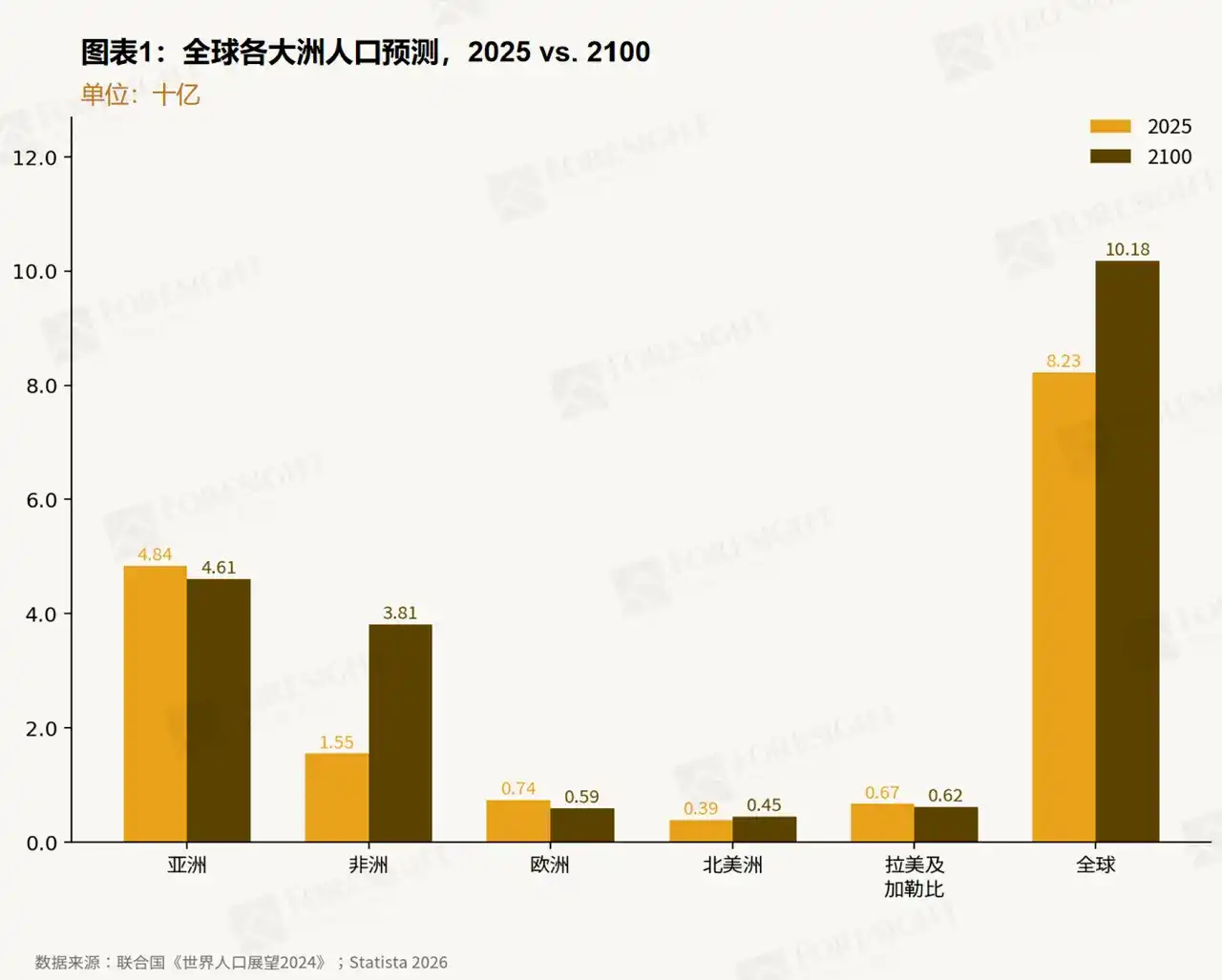
By 2025, Africa's population will reach about 1.55 billion, accounting for approximately 19% of the global total. It is the youngest continent globally, with a median age of just 19, and also the fastest-growing continent, with an annual growth rate of about 2%, unmatched by other continents.

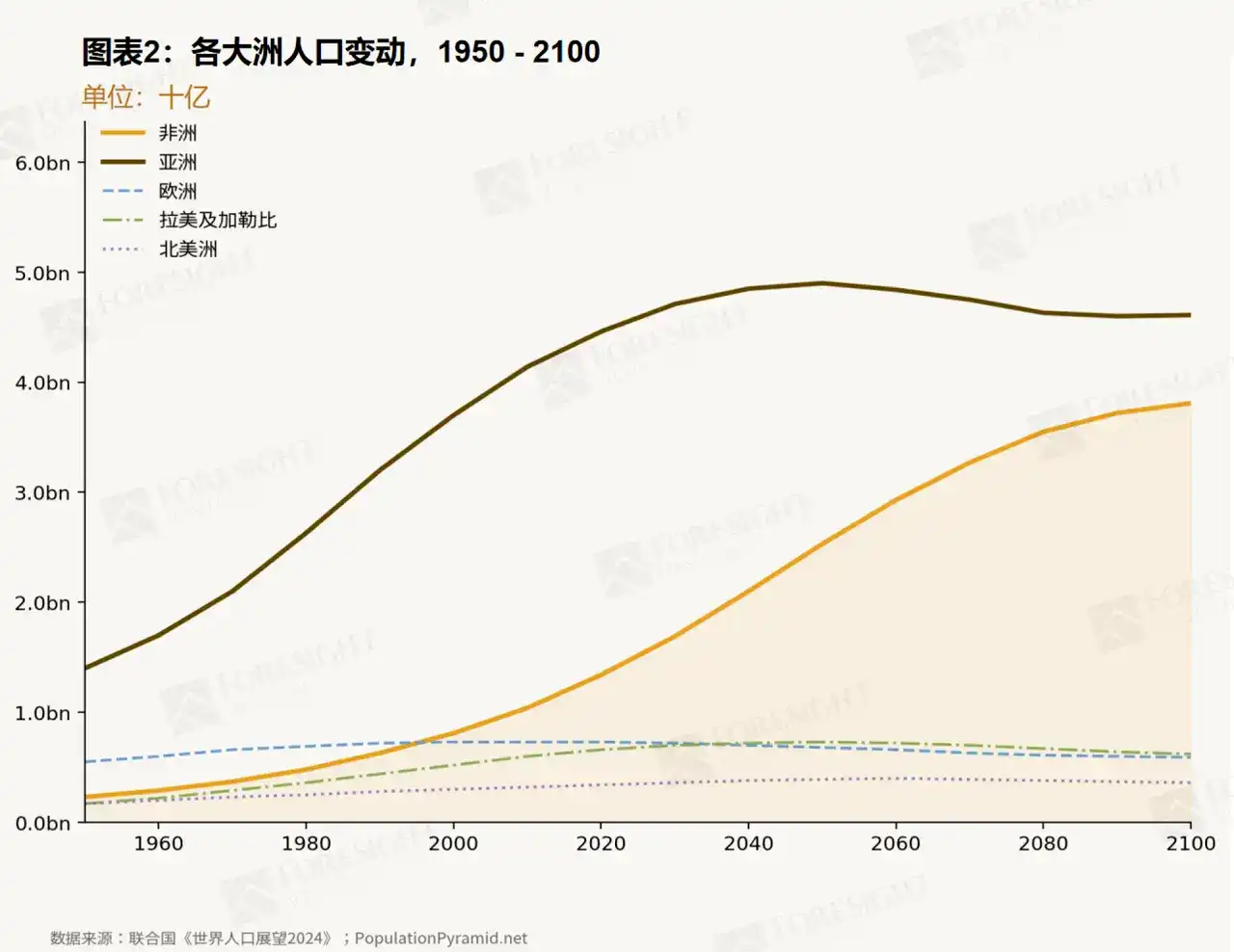
By 2100, Africa's population is projected to nearly triple to 3.81 billion, constituting 37% of humanity by then. In stark contrast, Asia's population is expected to peak and decline by mid-century, Europe and Latin America face absolute contraction, while Africa alone will sustain substantial growth throughout the century (see Figures 1 and 2).

This demographic trend has profound implications for payments infrastructure. Against a backdrop where traditional banking coverage remains low, a large, young, urbanizing, mobile-native cohort is entering the labor market and consumer economy at scale. Consequently, demand for convenient, low-cost financial services (including payments, savings, credit) will only intensify.
1.2 Resource Endowment and Industrial Structure

Africa possesses extremely rich natural resources. According to OPEC's Annual Statistical Bulletin, as of 2024, the continent's proven crude oil reserves were approximately 119.4 billion barrels, accounting for about 7.6% of the global total, with the largest reserves concentrated in Libya, Nigeria, Algeria, and Angola. Beyond hydrocarbons, Africa's mineral resources also hold significant global importance and dominate several categories: the continent is the world's most crucial diamond producer, holds about 49% of global cobalt reserves, and is the absolute source of platinum group metals (PGMs), with South Africa alone controlling about 78% of global PGM reserves. These endowments make Africa a critical node in the global commodity supply chain.

However, much of this wealth is still extracted and exported as raw materials with little downstream processing or value addition. Simultaneously, local manufacturing and agriculture are underdeveloped, infrastructure is severely lacking, and refined fuels, processed foods, etc., remain import-dependent. This economic structure of being 'large at both import and export ends' locks the continent into the trade dependency pattern discussed next.

1.3 Trade Dependency and Remittance Flows

Africa's economy is deeply intertwined with global trade and overseas remittances. In 2023, Africa's cross-border goods exports and imports reached $604.5 billion and $684.5 billion, respectively, while remittance inflows amounted to $52.16 billion. For reference, Africa's total GDP in 2023 was approximately $2.96 trillion. These two pillars of trade and remittances are not only pivotal in Africa's economic structure but also generate massive demand for B2B cross-border trade settlement and C2C cross-border transfers, respectively.

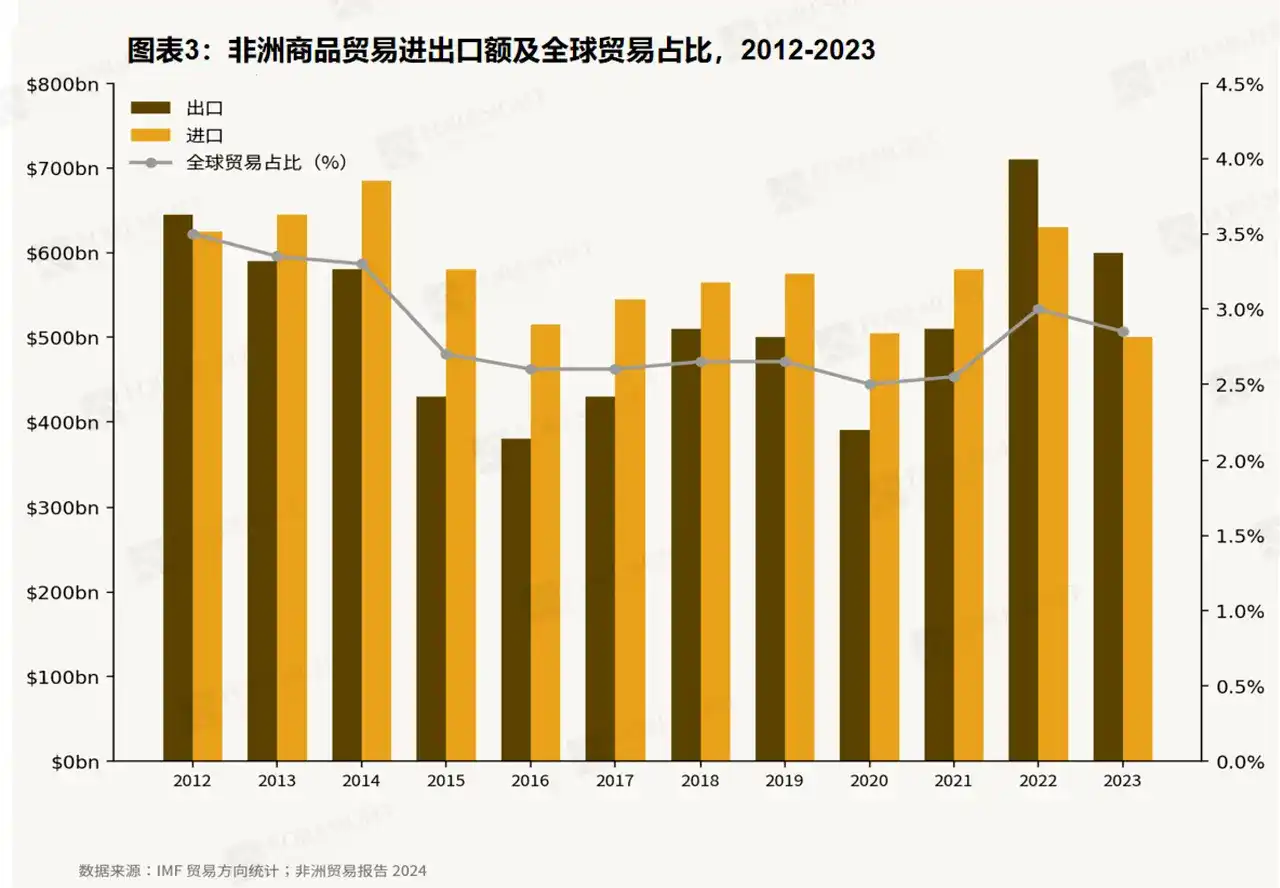
Cross-border trade is a vital pillar of Africa's economy, but the commodity-dependent export structure and persistent trade deficits make it highly sensitive to global macro cycles. In 2023, Africa's total goods exports were $604.5 billion (down 15.1% year-on-year), imports were $684.5 billion (down 1.6% year-on-year), resulting in a trade deficit of about $80 billion (see Figure 3). Over a ten-year trend, Africa is extremely sensitive to fluctuations in the global commodity cycle. The oil price collapse of 2015–2016 pushed Africa's trade volume to a two-decade low, stalling resource-dependent economies (e.g., Nigeria, Angola, oil exporters) while non-resource economies maintained 7%–8% growth, showing a clear divergence. The 2020 COVID-19 shock triggered another collapse: global commodity prices plummeted, African GDP growth fell to -2%, followed by a V-shaped recovery in 2021. More recently, during 2022–2023, driven by a spike in commodity prices triggered by the Russia-Ukraine conflict, African exports briefly surged. However, simultaneously, the aggressive US Federal Reserve rate hikes pushed up the US dollar and tightened global liquidity, subjecting the entire continent to severe imported inflation and currency depreciation.
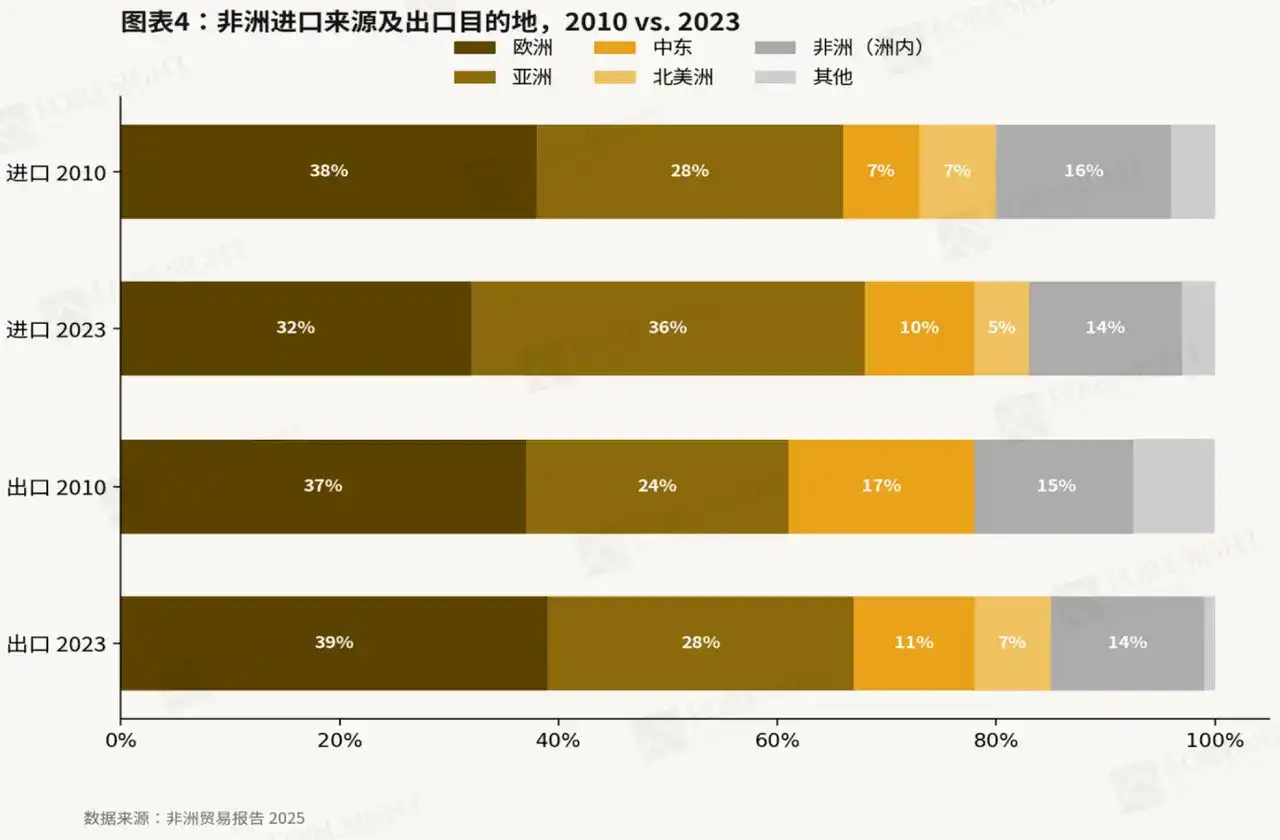
Africa's trade partner structure has changed significantly over the past decade (see Figure 4). Asia, led by China and India, has surpassed Europe to become Africa's largest source of imports—its share of total African imports rose from 28% in 2010 to 36% in 2023, while Europe's share fell from 38% to 32%. On the export side, Europe remains the top destination with a 39% share, but Asia's share has grown from 24% to 28%, and the Middle East has expanded sharply from 3% to 11%. North America's role has contracted on both import and export ends. These changes reflect the deepening commodity trade corridor between China and Africa and the Gulf states' growing importance as energy buyers and investment partners.

Beyond intercontinental trade, 'Intra-Africa Trade' among African countries is also growing rapidly, but barriers like currency and language remain bottlenecks to be overcome. Intra-African trade reached $192.2 billion in 2023, growing 3.8%. However, intra-African trade accounts for only 18% of Africa's total exports, compared to 70% for Europe and 52% for Asia. This reflects persistent obstacles like tariff fragmentation, currency inconvertibility, and weak cross-border infrastructure to intra-African trade growth. Against this backdrop, the African Continental Free Trade Area (AfCFTA) began operations in 2021, aiming to increase intra-African trade by 52% upon full implementation, but progress has been slow.

Remittances are another lifeline for Africa's economy and a source of massive C2C payment demand. According to World Bank data, Africa received $52.2 billion in remittances in 2023. The top five remittance corridors are Saudi Arabia→Egypt, UAE→Egypt, US→Nigeria, Kuwait→Egypt, France→Morocco. African labor exports to the Gulf, North America, and Europe form continuous reverse income flows to households. These corridors constitute one of the largest sources of cross-border C2C transfer demand and are also where the pain points of the traditional financial system in cross-border transfers—high costs, long time, and opacity—are most acutely felt, a key issue discussed in the next section.
2 The Deep Mismatch Between Foreign Trade/Remittance Demand and the Backward Financial System

2.1 Low Banking Coverage, Huge Unbanked Population Gap

Africa's formal financial system only covers a minority. According to the World Bank's 2021–2022 global Findex database, only 49% of adults in Sub-Saharan Africa had a financial account; by 2024, this figure rose to 58% but remained among the lowest globally. Beyond low coverage, African banking outlet density is also lagging. IMF's Financial Access Survey shows Kenya has only 4.4 bank branches per 100,000 adults, Morocco 22.2, and even South Africa, with Africa's most developed banking system, has just 38.7, all far below global averages. The result is a massive unmet demand for basic financial services: payments, savings, credit, insurance.

2.2 International De-risking and Correspondent Banking Retreat

Africa's second major hurdle comes from the retreat of the international financial system itself. Driven by concerns over anti-money laundering (AML) and customer due diligence (KYC) compliance risks, compounded by local realities like lack of formal ID, no fixed address, incomplete tax records, and a high cash economy share, major global banks have engaged in a de-risking wave. Since 2016, correspondent banking relationships have shrunk dramatically. According to SWIFT data, South Africa lost over 10% of its overseas correspondents, while Angola's decline reached 37%. This retreat directly raises the cost of legitimate cross-border transactions and marginalizes smaller African financial institutions from the global system.

2.3 Poor Foreign Exchange Management and Chronic Inflation

Currency system fragility further amplifies these structural defects. Due to fiscal deficits and a weak tax base, many African central banks resort to printing money to finance government spending, causing persistent imported inflation. Prices for food, fuel, and raw materials for manufactured goods surge as the local currency depreciates. Simultaneously, shallow capital markets, highly concentrated banking systems, and a historical deficit in central bank independence lead to ineffective monetary policy transmission, making interest rate hikes ineffective at curbing inflation or stabilizing exchange rates. In 2024, Africa's overall inflation rate hit 20.1%, the highest among major global regions, severely eroding the real value of local currency savings.

2.4 Consequence: Cash Dominance and Payments System Dysfunction

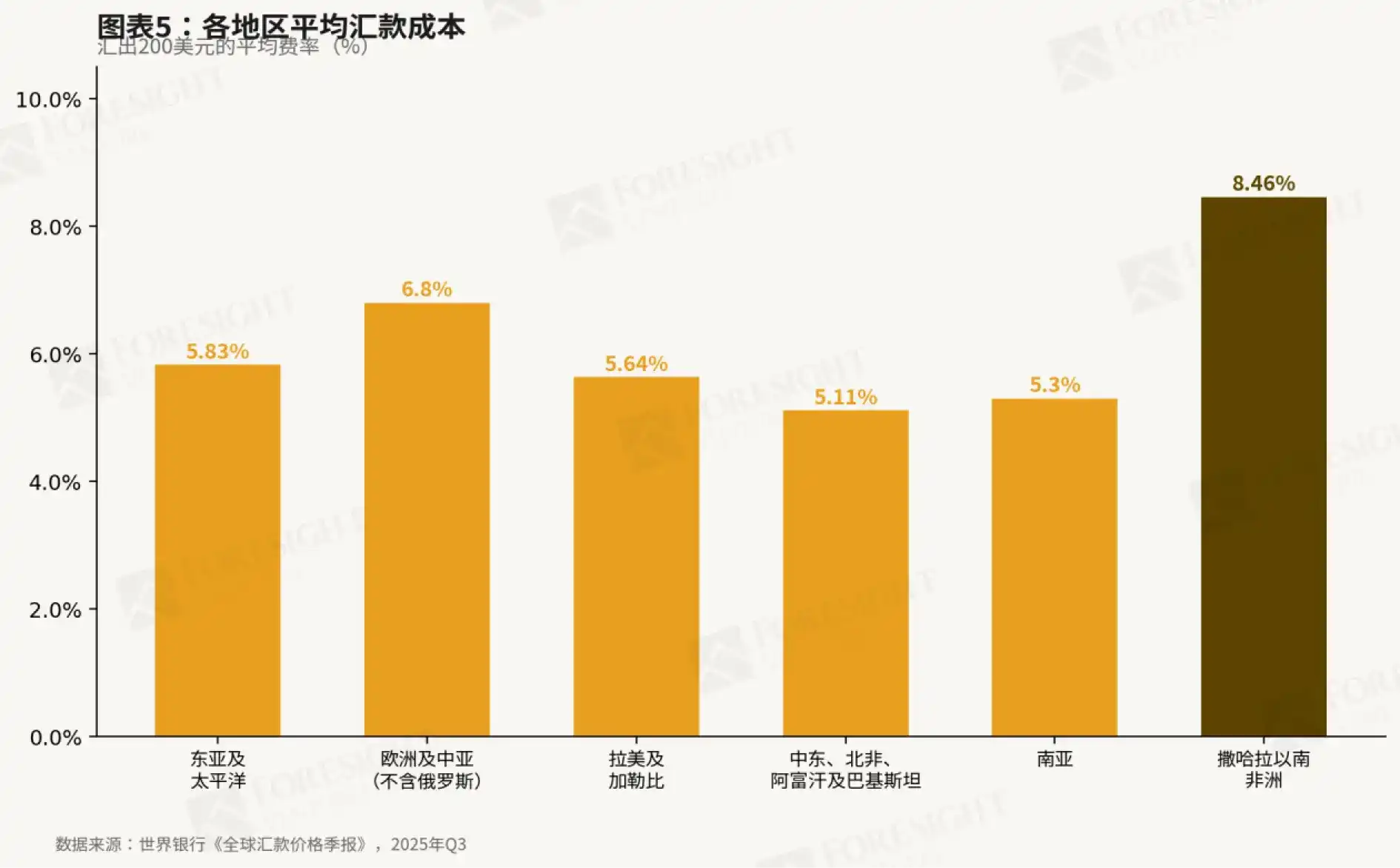
The triple dysfunction of bank exclusion, de-risking, and monetary instability has obvious consequences. Most Africans still rely on cash for daily transactions; remittance costs in Sub-Saharan Africa are the world's highest, averaging 8.46% per transfer according to the World Bank's Q3 2025 Remittance Price Report; ordinary people also lack effective inflation-hedging stores of value. The banking system fails comprehensively in access convenience, affordability, and currency stability, creating a market vacuum rapidly filled by emerging payment channels and cryptocurrencies.
3 Mobile Payments and Cryptocurrencies Thrive in the Vacuum Left by the Traditional Financial System

In the gap left by the absent banking system and under pressure from severe inflation and currency depreciation, Africa has developed the world's most dynamic mobile money and cryptocurrency markets. The emergence of these alternative payment channels is not a matter of choice but of necessity—they solve real problems the banking system cannot address: accessibility, affordability, and stability.

3.1 Mobile Payments: Africa Leads Globally

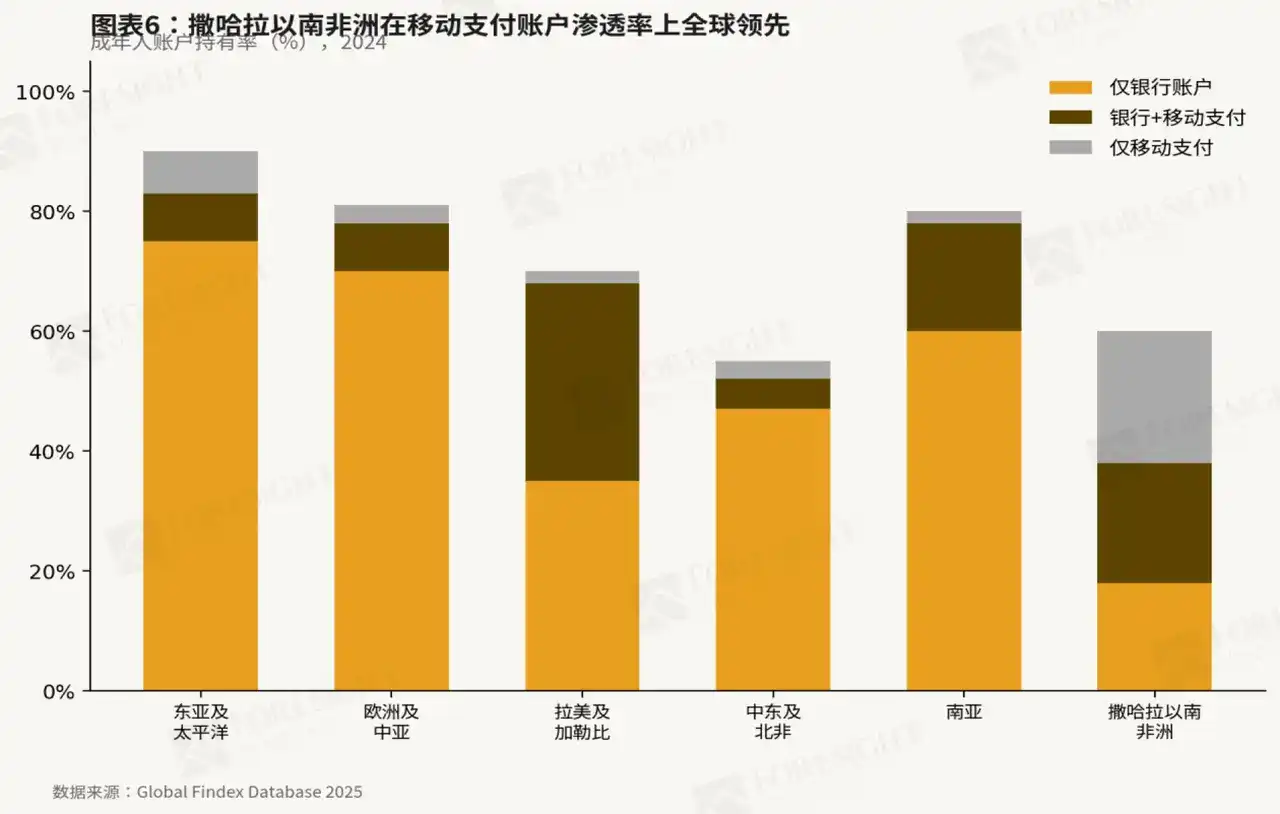
Africa accounts for most global mobile money transactions. According to the 2025 global Findex database, about 40% of adults in Sub-Saharan Africa use a mobile money account as their primary (or only) formal financial service. Kenya's M-Pesa platform exemplifies this model: relying on ubiquitous USSD technology (accessible via basic feature phone keypads), it built a network of millions of offline agent outlets and leveraged universal mobile coverage to capture 90.8% of Kenya's mobile payments market, successfully expanding to seven other African countries like Tanzania, Ghana, and Egypt. This offline agent-based, low-tech barrier architecture has proven far more scalable and inclusive than branch-based traditional banking, amassing a vast user base across urban and rural Africa.
3.2 Widespread Cryptocurrency Adoption Across the African Continent

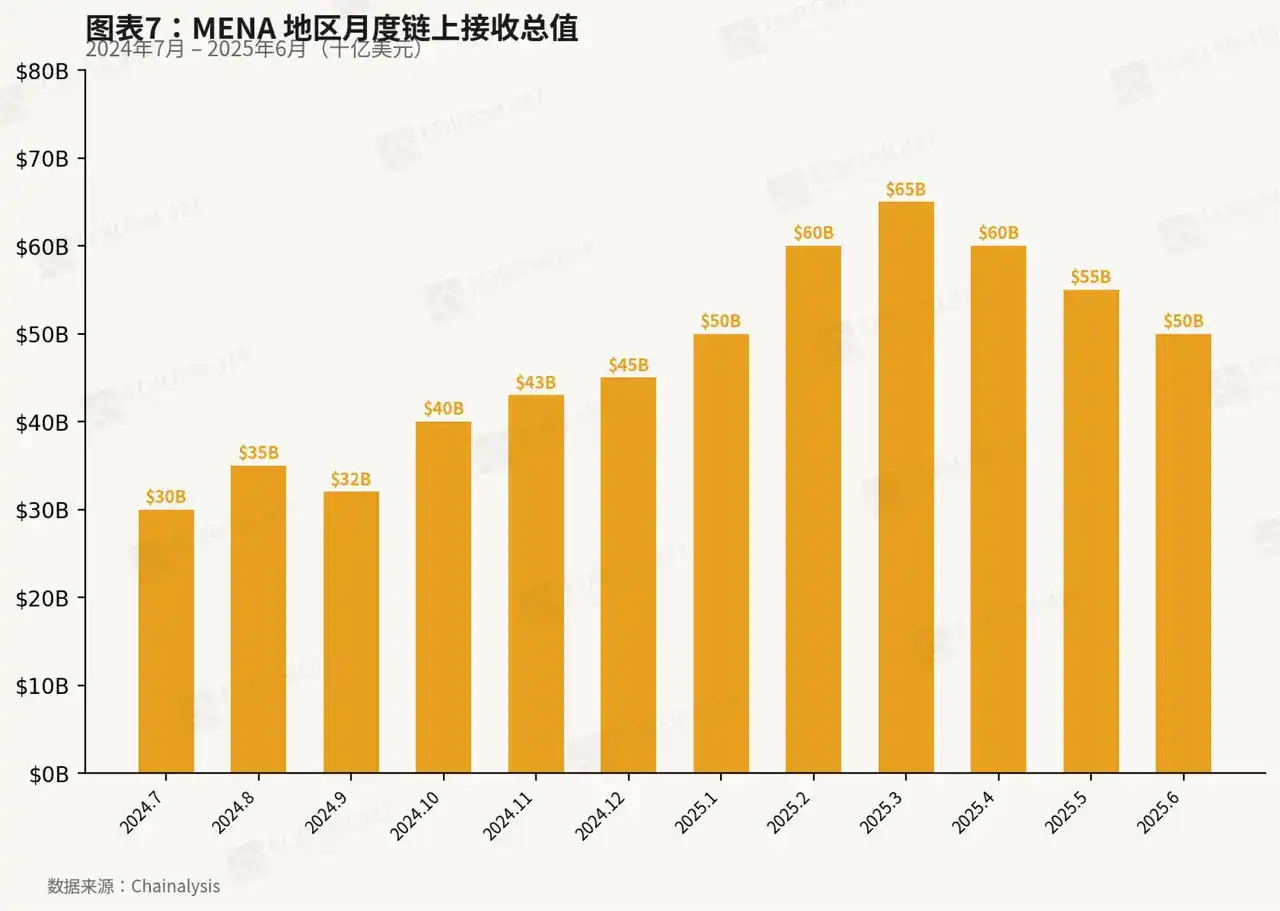
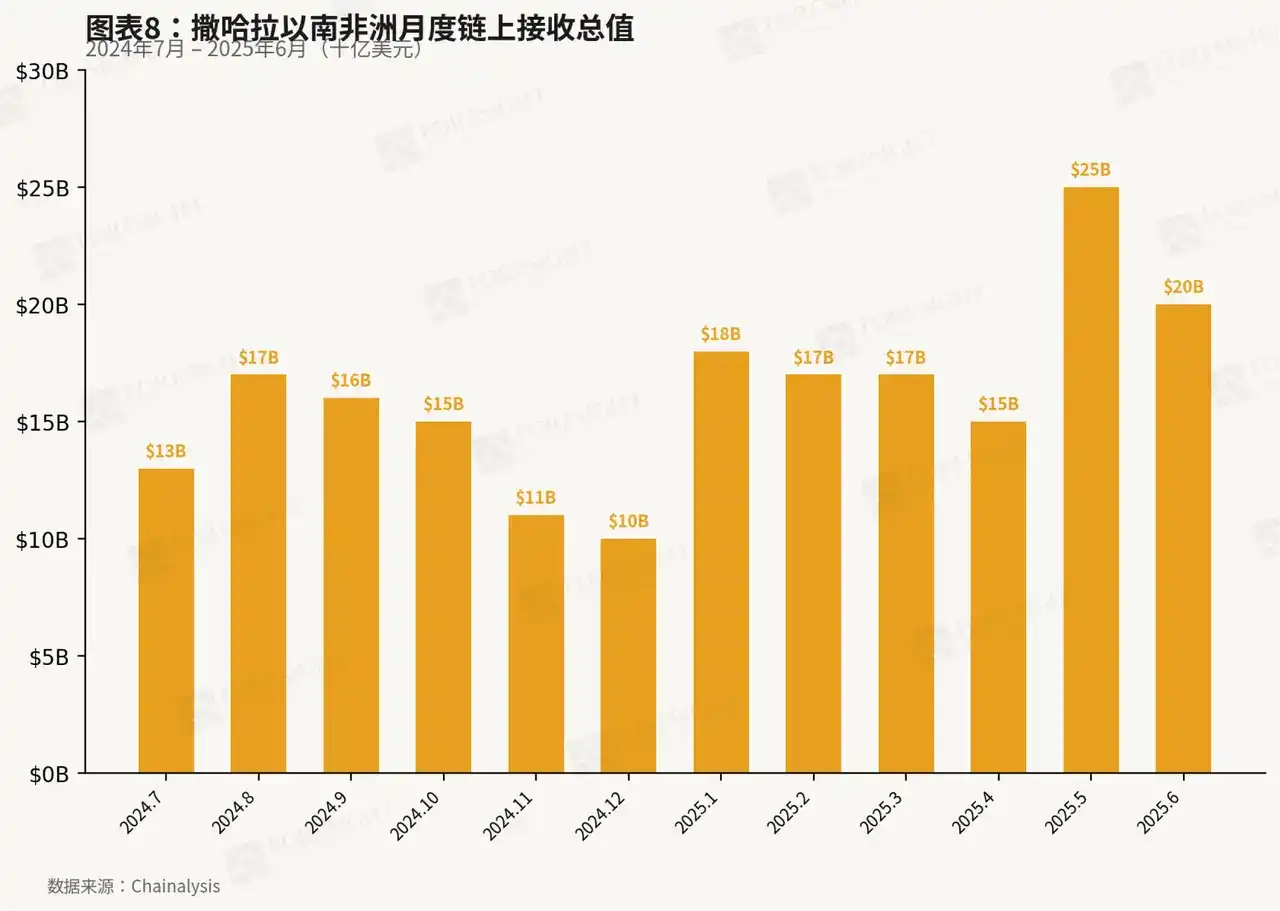
Cryptocurrency adoption rates on the African continent are among the world's highest and still rising sharply. In the Middle East and North Africa, total on-chain value received between July 2024 and June 2025 was approximately $600 billion; Sub-Saharan Africa recorded $200 billion in the same period, with a high growth rate of 52%, driven primarily by retail users and concentrated in a few countries (Nigeria, South Africa, Ethiopia, Kenya). Cryptocurrencies effectively meet African businesses' and individuals' needs for an inflation-hedging store of value and low-cost cross-border settlement—needs that mobile money and formal banking systems cannot fully satisfy.
4 Heterogeneity Within the African Continent

4.1 Why Understanding Internal Divergence in Africa Is Crucial

Africa's 54 countries span 42 different currency systems and belong to multiple linguistic spheres: Francophone, Anglophone, Arabophone, Lusophone, and Hispanophone. This fragmentation in language and currency is not merely a cultural difference but profoundly impacts cross-border trade, financial flows, and regulatory systems: payment networks are disjointed, regulatory frameworks are separate, and market opportunities are highly fragmented. Therefore, after establishing a holistic understanding of Africa's macroeconomic environment, it's essential to recognize internal regional differences in culture, regulation, and financial systems.

4.2 Divided by the Sahara: Middle East & North Africa (MENA) vs. Sub-Saharan Africa (SSA)

The most common analytical framework currently divides Africa into two systems along the Sahara Desert: the Middle East and North Africa (MENA) and Sub-Saharan Africa (SSA).

North Africa is highly integrated with the Arab world culturally, institutionally, and economically, with its economy centered on oil and gas resources and deeply embedded in the global energy market. Accordingly, its financial system and policy frameworks operate more within the MENA ecosystem, with a relatively mature banking system and lower levels of financial exclusion.

In contrast, Sub-Saharan Africa largely falls outside this system. The market driving the explosive growth of crypto and mobile payments is precisely this region, long plagued by deep-seated financial system inadequacy, dollar shortages, and currency instability. SSA currently accounts for nearly 60% of global mobile payment transaction volume and is also the world's fastest-growing region for cryptocurrency adoption.

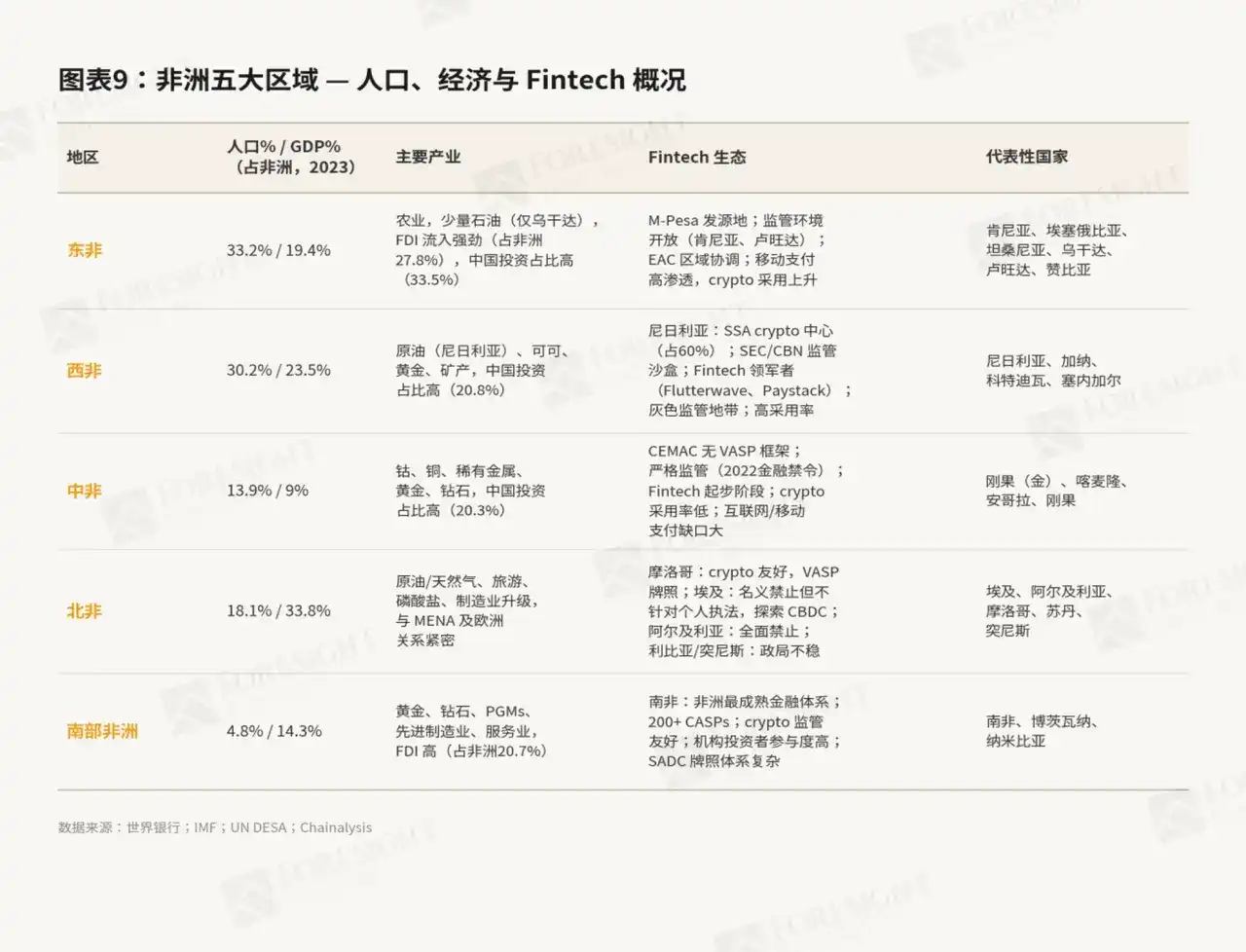
4.3 Five-Region Framework: Differentiation in Population, Economy, and Fintech Ecosystems

Further subdivision yields five African regions with significantly different macroeconomic characteristics. North Africa and Southern Africa have the highest GDP per capita; West and Central Africa are relatively less developed; East Africa has the lowest per capita income. However, economic growth rates show an inverse relationship with wealth levels: East Africa grows fastest, followed by Central Africa, North Africa, West Africa, and Southern Africa.

Cryptocurrency adoption patterns show similar features. Nigeria alone (in West Africa) accounts for most crypto transaction volume in SSA; meanwhile, East Africa, South Africa, and North Africa also show high adoption. Central and broader West Africa remain in earlier market stages. This differentiation essentially reflects variations in financial exclusion, dollar shortage pressure, and regulatory environments across regions.
5 The "Dollarization" and "Dollar Shortage" Behind Sub-Saharan Africa's Payments Market

5.1 Dollarization in Sub-Saharan Africa

Sub-Saharan African economies exhibit deep dollarization, far exceeding most other global regions. Dollar deposit and loan shares are key proxy indicators: in Nigeria, dollar deposits once constituted 40% of total deposits, and over 80% of external debt is dollar-denominated; in Ghana, dollar deposit shares have reached relatively high levels of 20%–30%. This dollarization is not accidental but a manifestation of rational economic behavior in the face of long-term currency instability.

5.2 Three Structural Drivers of Dollarization

Dollarization in Sub-Saharan Africa stems from three distinct economic pressures.

First, Store of Value: Due to fiscal deficits and external imbalances forcing central banks to print money, local currencies persistently depreciate, while the US dollar offers a stable unit of account.

Second, Medium of Exchange: Commodity prices (oil, minerals, food) are globally priced in US dollars, and even intra-African trade between two African countries is often settled in dollars—because the dollar is more stable than any single local currency.

Third, Financing Channel: Shallow local capital markets mean businesses and governments must borrow dollars from international creditors; when dollar debt becomes too large relative to dollar income, exchange rate risk becomes acute, driving more funds into dollar deposits.

5.3 Causes of the "Dollar Shortage"

The real pain point in Sub-Saharan Africa's current payments market is the dollar shortage. Limited foreign exchange earning capacity (commodity dependence, weak manufacturing exports), coupled with huge trade deficits and debt service pressures, continuously deplete government forex reserves. Consequently, central banks can only ration official forex through administrative controls. This scarcity fosters a parallel black market where dollars trade at significant premiums—sometimes 50% to 100% above official rates. Residents and businesses unable to obtain forex through official channels turn to informal channels: global remittance companies like Western Union, informal exchange houses, and increasingly, stablecoins and cryptocurrencies. The gap between official and parallel market exchange rates is precisely the crack alternative payment systems exploit.

5.4 Why Cryptocurrencies Thrive in This Vacuum

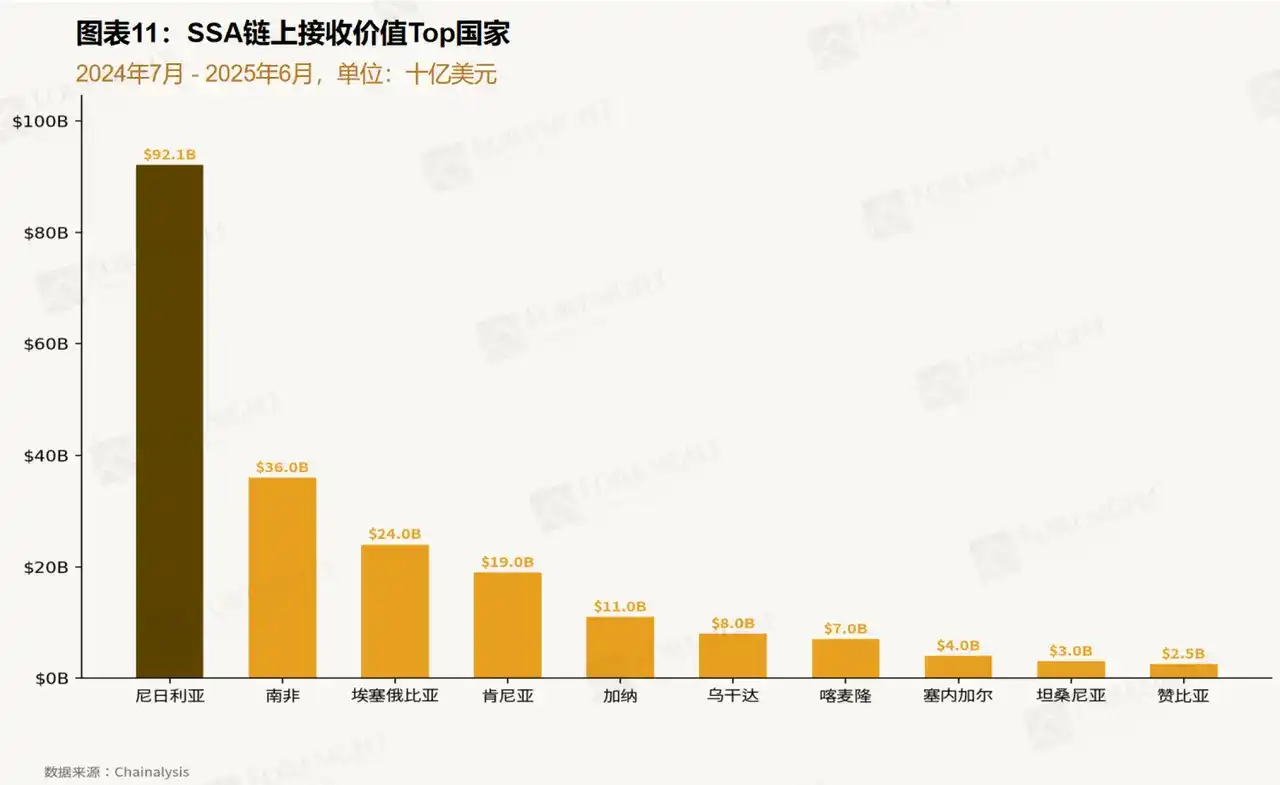
Stablecoins and other cryptocurrencies perform three critical functions missing from the formal banking system. They bypass capital controls, providing access to parallel market dollars; they execute cross-border transactions at lower costs than banks and remittance corridors; they also offer a globally liquid store of value unaffected by local currency risk. Therefore, Sub-Saharan Africa's crypto adoption is overwhelmingly retail-driven with small transaction amounts. As Figure 11 shows, compared to other global regions, Sub-Saharan Africa has a higher share of transfers in the $1,000–$10,000 range, reflecting flows for small remittances, informal business trade settlement, and personal savings. Nigeria dominates the region, accounting for about 45% of Sub-Saharan Africa's on-chain transaction volume (as shown in Figure 12), but Kenya, South Africa, and Ethiopia are also important regional hubs.
5.5 De-dollarization Attempts and Their Structural Limitations

African policymakers and regional institutions have attempted to reduce dollar dependence. The Pan-African Payment and Settlement System (PAPSS) aims to settle intra-African trade in local currencies and reduce forex costs; the planned 'Eco' currency zone in West Africa seeks stability through monetary union; central banks have also employed aggressive interest rate hikes and capital controls. However, all these efforts face a fundamental constraint: Sub-Saharan Africa's structural trade dependency. As long as the continent's imports exceed exports, external accounts remain in deficit, and most forex income comes from commodities, dollar demand will persistently outstrip supply. De-dollarization requires industrialization and trade rebalancing, a decades-long transformation not achievable by policy alone. In the interim, mobile money and cryptocurrencies will continue playing crucial roles, filling the gaps left by the traditional financial system.

Conclusion

Africa's outstanding performance in mobile money and cryptocurrency adoption is not a market coincidence but a macroeconomic necessity.

The continent's young demographic, rich natural resources, and deep integration into global commodity markets generate massive cross-border payment flows. However, its weak financial system, chronic monetary instability, and severe dollar shortages make the formal banking system fundamentally incapable of meeting this demand.

Mobile money solves domestic payments; cryptocurrencies are solving cross-border value transfer and inflation hedging. These are not niche use cases or speculative holdings but critical financial infrastructure filling the vacuum left by structural economic constraints. Crucially, these constraints are not cyclical; they are rooted in Africa's resource dependency, limited industrialization, and underdeveloped financial markets.

De-dollarization requires trade rebalancing and industrialization, both multi-decade transformations. Before that, and likely long after, alternative payment channels and currencies will remain central to Africa's economy.

Original article link

İlgili Sorular

QAccording to the article, what are the two deep structural drivers that shape Africa's unique payment market landscape?

AThe two deep structural drivers are: (1) Africa's long-term reliance on resource exports, trade circulation, and remittances, creating massive demand for cross-border settlement and remittances. (2) The underdevelopment of Africa's domestic financial infrastructure, compounded by international bank de-risking and mismanaged foreign exchange controls, leading to a chronic absence of commercial banking and persistent inflationary pressures.

QWhat key geographic and economic divide within Africa is highlighted in the analysis, and how does it affect payment system adoption?

AThe key divide is the Sahara Desert. North Africa is integrated into the oil-anchored MENA (Middle East and North Africa) framework, with relatively mature banking. Sub-Saharan Africa (SSA), facing severe dollar shortages and fragmented monetary systems, has naturally fostered a massive market with high demand for mobile payments and cryptocurrencies, making it a global leader in adoption rates for both.

QHow does the article explain the phenomenon of 'dollarization' in Sub-Saharan Africa and its connection to the 'dollar shortage'?

ADollarization in SSA is driven by the need for a stable store of value (against local currency depreciation), a medium of exchange (for dollar-priced commodities and intra-African trade), and access to financing (via dollar-denominated debt). The 'dollar shortage' arises from limited export earnings (due to commodity dependence), large trade deficits, and debt repayments, draining official reserves. This scarcity creates parallel black markets for dollars and pushes residents and businesses towards informal channels, including cryptocurrencies, to access foreign exchange.

QWhat specific roles do mobile payments and cryptocurrencies play in filling the vacuum left by the traditional financial system in Africa?

AMobile payment platforms, like Kenya's M-Pesa, have replaced banks as the primary channel for everyday domestic payments, offering accessibility and low cost through extensive agent networks. Cryptocurrencies, particularly stablecoins, fulfill roles that the local currency or traditional dollars once did: they act as a store of value against inflation and a low-cost medium for cross-border exchange, effectively bypassing capital controls and high remittance fees.

QWhy does the article argue that Africa's high adoption of mobile money and crypto is a macroeconomic 'necessity' rather than a market 'accident'?

AIt is a necessity because it directly addresses structural gaps created by Africa's macroeconomic conditions. The continent's young population, trade-dependent economy, and massive cross-border payment flows generate enormous demand for financial services. However, its weak banking infrastructure, chronic currency instability, and dollar shortages render the traditional system incapable of meeting this demand. Mobile money and crypto are not niche innovations but essential financial infrastructure filling this vacuum, a situation rooted in long-term structural constraints like resource dependency and limited industrialization.

İlgili Okumalar

Near Returns to the AI Stage: Transformation into a Public Chain Due to 'Payroll Difficulties,' Agent and Privacy Emerge as New Growth Narratives

NEAR Returns to AI Origins: From Payroll Struggles to Blockchain, Now Focusing on AI Agents and Privacy NEAR Protocol's journey began not with grand blockchain ambitions, but from a practical hurdle: its AI startup founders, including Transformer paper co-author Illia Polosukhin, couldn't efficiently pay international developers in 2017. This led them to pivot and build a high-performance, scalable blockchain. After years navigating various crypto narratives like sharding and cross-chain interoperability, NEAR is now leveraging its AI roots to re-enter the AI arena. A key driver is its "NEAR Intents" layer, which abstracts complex cross-chain transactions. Users simply state their goal (e.g., swap BTC for ETH), and a solver network finds the optimal route. This system has processed over $20B in cross-chain volume, generating significant fee revenue. A major growth area is private transactions via "Confidential Intents/Swaps," which hide trade details until settlement to protect against MEV and front-running. Remarkably, private swaps recently accounted for over 40% of NEAR's transaction volume, highlighting strong demand but also potential regulatory scrutiny. With its AI-founder pedigree, NEAR is positioning itself at the intersection of blockchain, AI agents, and privacy, aiming to become infrastructure for the emerging agent economy while navigating the challenges of its rapid adoption.

marsbit1 saat önce

Near Returns to the AI Stage: Transformation into a Public Chain Due to 'Payroll Difficulties,' Agent and Privacy Emerge as New Growth Narratives

marsbit1 saat önce

From Ethereum to AI's 'CROPS': What Exactly is This Set of 'Slow Variables' That Vitalik Repeatedly Emphasizes?

In recent discussions, Vitalik Buterin has frequently emphasized the concept of "CROPS," a framework defining core values for Ethereum's development. CROPS stands for Censorship Resistance, Capture Resistance, Open Source, Privacy, and Security. Initially outlined in the Ethereum Foundation's "EF Mandate," it represents a commitment to user sovereignty, ensuring that the network resists external control, remains open, protects privacy, and prioritizes security. The relevance of CROPS extends beyond Ethereum's foundational principles, becoming crucial in the context of AI integration. As AI agents begin handling wallet operations and automated transactions, the risk increases that users may cede control over their digital assets, privacy, and intentions to centralized AI service providers. A "CROPS AI" would therefore emphasize local execution where possible, privacy-preserving remote model calls (e.g., using zero-knowledge proofs), and transparent, verifiable processes to maintain user agency. Vitalik highlights a significant convergence between "CROPS Ethereum access layer" and "CROPS AI." Both address the same fundamental challenge: how users can access powerful services—be it blockchain data via RPCs or AI models—without exposing sensitive information or relinquishing ultimate control. This intersection points toward a future digital entry point that is more private, secure, and user-controlled. Ultimately, CROPS is not merely an abstract ideal but a practical guidepost. It steers development—from protocol resilience and wallet design to AI agent safety—towards a future where users retain self-sovereignty even as digital systems grow more complex and powerful. In an era of accelerating AI adoption, these "slow variables" of censorship resistance, openness, privacy, and security may define Ethereum's enduring value.

marsbit1 saat önce

From Ethereum to AI's 'CROPS': What Exactly is This Set of 'Slow Variables' That Vitalik Repeatedly Emphasizes?

marsbit1 saat önce

Silicon Valley 'Startup Guru' Steve Hoffman: Web3 + AI Could Be a Trap

Silicon Valley investor and "Godfather of Startups" Steve Hoffman warns that combining Web3 with AI is likely a trap, not a promising venture. In an interview, Hoffman argues that while AI is a foundational technology touching all industries, Web3 adds complexity, friction, and regulatory risk without solving mainstream consumer or business needs. He advises founders to focus on deep, specialized applications where startups can out-iterate giants, rather than on generic features easily replicated by large tech companies. Hoffman observes that Silicon Valley will lead foundational AI research, while China excels at rapid, large-scale application and commercialization, particularly in robotics. He stresses that AI-driven autonomous agents capable of collaborative, multi-step tasks are 2-4 years away, which will cause significant job displacement. The solution is not to slow AI but to redesign business models around human-AI collaboration and reform social systems like education and retraining. For startups, Hoffman recommends focusing on vertical, expertise-heavy domains to build defensibility. He sees major opportunities in AI fraud detection and cybersecurity. Key founder mindsets include systemic thinking over feature-focus, relentless customer centricity, building adaptive teams, and deeply understanding AI's capabilities and limits. Hoffman is also leading a non-profit initiative to establish university centers aimed at training future leaders in responsible, human-value-aligned AI innovation.

marsbit3 saat önce

Silicon Valley 'Startup Guru' Steve Hoffman: Web3 + AI Could Be a Trap

marsbit3 saat önce

Token Inefficient, Economy Tokenless

The article "Tokens Aren't Economical, Economics Aren't Tokenized" analyzes a pivotal shift in the AI industry from a technology-driven narrative to one dominated by capital efficiency. It highlights two concurrent trends: a severe capital shortage due to the exorbitant and recurring costs of compute (e.g., OpenAI's high burn rate) and a wave of corporate spin-offs where major tech companies are separating their AI units (like Kuaishou's Kling and Baidu's Kunlunxin). The core argument is that AI's "anti-internet" business model, where user growth increases costs rather than profits, has created a disconnect between high valuations and actual cash flow. Spin-offs address this by allowing AI assets to be valued independently. Within a parent company, they are seen as cost centers, but as standalone entities, they are priced based on their growth potential and scarcity in the primary market, leading to massive valuation premiums (e.g., Kling's estimated value tripling post-spin-off). The industry is at an inflection point, moving from "model worship" to "value realization." The competition is evolving from a pure compute (GPU) race to a broader focus on systemic efficiency and full-stack engineering (involving CPUs and orchestration) to achieve viable commercialization. The year 2026 is framed as a critical moment where the industry must definitively answer how to economically translate AI capability into tangible business value, reshaping the sector's future power structure.

marsbit3 saat önce

Token Inefficient, Economy Tokenless

marsbit3 saat önce

İşlemler

Spot
Futures

Popüler Makaleler

$S$ Nedir

SPERO'yu Anlamak: Kapsamlı Bir Genel Bakış SPERO'ya Giriş İnovasyonun manzarası gelişmeye devam ederken, web3 teknolojilerinin ve kripto para projelerinin ortaya çıkışı dijital geleceği şekillendirmede önemli bir rol oynamaktadır. Bu dinamik alanda dikkat çeken projelerden biri SPERO, $$s$$ olarak adlandırılmaktadır. Bu makale, SPERO hakkında ayrıntılı bilgi toplamak ve sunmak amacıyla, meraklılar ve yatırımcıların web3 ve kripto alanlarındaki temellerini, hedeflerini ve yeniliklerini anlamalarına yardımcı olmayı amaçlamaktadır. SPERO,$$s$$ Nedir? SPERO,$$s$$, kripto alanında merkeziyetsizlik ve blok zinciri teknolojisi ilkelerini kullanarak etkileşimi, faydayı ve finansal kapsayıcılığı teşvik eden bir ekosistem yaratmayı amaçlayan benzersiz bir projedir. Proje, kullanıcıların yenilikçi finansal çözümler ve hizmetler sunarak eşler arası etkileşimleri yeni yollarla kolaylaştırmayı hedeflemektedir. SPERO,$$s$$'nin temel amacı, bireyleri güçlendirmek ve kripto para alanındaki kullanıcı deneyimini artıran araçlar ve platformlar sağlamaktır. Bu, daha esnek işlem yöntemlerini mümkün kılmayı, topluluk odaklı girişimleri teşvik etmeyi ve merkeziyetsiz uygulamalar (dApp'ler) aracılığıyla finansal fırsatlar yaratmayı içermektedir. SPERO,$$s$$'nin temel vizyonu kapsayıcılık etrafında dönmekte olup, geleneksel finansal sistemlerdeki boşlukları kapatmayı ve blok zinciri teknolojisinin faydalarından yararlanmayı hedeflemektedir. SPERO,$$s$$'nin Yaratıcısı Kimdir? SPERO,$$s$$'nin yaratıcısının kimliği bir miktar belirsizdir, çünkü kurucusu(ları) hakkında ayrıntılı arka plan bilgisi sağlayan sınırlı kamuya açık kaynaklar bulunmaktadır. Bu şeffaflık eksikliği, projenin merkeziyetsizlik taahhüdünden kaynaklanabilir—birçok web3 projesinin paylaştığı bir etik anlayışı, bireysel tanınmanın yerine kolektif katkıları önceliklendirmektedir. Topluluk ve onun kolektif hedefleri etrafında tartışmaları merkezileştirerek, SPERO,$$s$$, belirli bireyleri öne çıkarmadan güçlendirme özünü taşımaktadır. Bu nedenle, SPERO'nun etik anlayışını ve misyonunu anlamak, tek bir yaratıcının kimliğini belirlemekten daha önemlidir. SPERO,$$s$$'nin Yatırımcıları Kimlerdir? SPERO,$$s$$, kripto sektöründe yeniliği teşvik etmeye adanmış girişim sermayedarlarından melek yatırımcılara kadar çeşitli yatırımcılar tarafından desteklenmektedir. Bu yatırımcıların odak noktası genellikle SPERO'nun misyonuyla uyumlu olup, toplumsal teknolojik ilerlemeyi, finansal kapsayıcılığı ve merkeziyetsiz yönetimi vaat eden projeleri önceliklendirmektedir. Bu yatırımcı temelleri, yalnızca yenilikçi ürünler sunan projelere değil, aynı zamanda blok zinciri topluluğuna ve ekosistemlerine olumlu katkılarda bulunan projelere de ilgi duymaktadır. Bu yatırımcıların desteği, SPERO,$$s$$'yi hızla gelişen kripto projeleri alanında dikkate değer bir rakip haline getirmektedir. SPERO,$$s$$ Nasıl Çalışır? SPERO,$$s$$, onu geleneksel kripto para projelerinden ayıran çok yönlü bir çerçeve kullanmaktadır. İşte benzersizliğini ve yeniliğini vurgulayan bazı temel özellikler: Merkeziyetsiz Yönetim: SPERO,$$s$$, kullanıcıların projenin geleceğiyle ilgili karar alma süreçlerine aktif olarak katılmalarını sağlayan merkeziyetsiz yönetim modellerini entegre etmektedir. Bu yaklaşım, topluluk üyeleri arasında sahiplik ve hesap verebilirlik duygusunu teşvik etmektedir. Token Kullanımı: SPERO,$$s$$, ekosistem içinde çeşitli işlevler sunmak üzere tasarlanmış kendi kripto para token'ını kullanmaktadır. Bu token'lar, işlemleri, ödülleri ve platformda sunulan hizmetlerin kolaylaştırılmasını sağlayarak genel etkileşimi ve faydayı artırmaktadır. Katmanlı Mimari: SPERO,$$s$$'nin teknik mimarisi, modülerlik ve ölçeklenebilirliği destekleyerek projenin evrimi sırasında ek özelliklerin ve uygulamaların sorunsuz bir şekilde entegrasyonuna olanak tanımaktadır. Bu uyum sağlama yeteneği, sürekli değişen kripto manzarasında geçerliliği sürdürmek için hayati öneme sahiptir. Topluluk Katılımı: Proje, işbirliği ve geri bildirim teşvik eden mekanizmalar kullanarak topluluk odaklı girişimlere vurgu yapmaktadır. Güçlü bir topluluk oluşturarak, SPERO,$$s$$, kullanıcı ihtiyaçlarını daha iyi karşılayabilir ve piyasa trendlerine uyum sağlayabilir. Kapsayıcılığa Odaklanma: Düşük işlem ücretleri ve kullanıcı dostu arayüzler sunarak, SPERO,$$s$$, daha önce kripto alanında yer almamış bireyler de dahil olmak üzere çeşitli bir kullanıcı tabanını çekmeyi hedeflemektedir. Bu kapsayıcılık taahhüdü, erişilebilirlik yoluyla güçlendirme misyonuyla uyumludur. SPERO,$$s$$ Zaman Çizelgesi Bir projenin tarihini anlamak, gelişim yolculuğu ve kilometre taşları hakkında kritik bilgiler sağlar. Aşağıda, SPERO,$$s$$'nin evriminde önemli olayları haritalayan önerilen bir zaman çizelgesi bulunmaktadır: Kavram Geliştirme ve Fikir Aşaması: SPERO,$$s$$'nin temelini oluşturan ilk fikirler, blok zinciri endüstrisindeki merkeziyetsizlik ve topluluk odaklılık ilkeleriyle yakından uyumlu olarak geliştirildi. Proje Beyaz Kağıdının Yayınlanması: Kavramsal aşamayı takiben, SPERO,$$s$$'nin vizyonunu, hedeflerini ve teknolojik altyapısını ayrıntılı bir şekilde açıklayan kapsamlı bir beyaz kağıt yayımlandı ve topluluk ilgisini ve geri bildirimini toplamak amacıyla sunuldu. Topluluk Oluşturma ve Erken Katılımlar: Projenin hedefleri etrafında tartışmalar yürüterek destek toplamak ve erken benimseyenler ile potansiyel yatırımcılar için bir topluluk oluşturmak amacıyla aktif iletişim çabaları gerçekleştirildi. Token Üretim Etkinliği: SPERO,$$s$$, yerel token'larını erken destekçilere dağıtmak ve ekosistem içinde başlangıç likiditesini sağlamak amacıyla bir token üretim etkinliği (TGE) gerçekleştirdi. İlk dApp'in Yayınlanması: SPERO,$$s$$ ile ilişkili ilk merkeziyetsiz uygulama (dApp) faaliyete geçti ve kullanıcıların platformun temel işlevleriyle etkileşimde bulunmalarını sağladı. Sürekli Gelişim ve Ortaklıklar: Projenin tekliflerine sürekli güncellemeler ve iyileştirmeler yapılmakta olup, blok zinciri alanındaki diğer oyuncularla stratejik ortaklıklar, SPERO,$$s$$'yi rekabetçi ve gelişen bir oyuncu haline getirmiştir. Sonuç SPERO,$$s$$, web3 ve kripto paranın finansal sistemleri devrim niteliğinde dönüştürme ve bireyleri güçlendirme potansiyelinin bir kanıtıdır. Merkeziyetsiz yönetime, topluluk katılımına ve yenilikçi tasarlanmış işlevselliğe olan bağlılığıyla, daha kapsayıcı bir finansal manzaraya doğru bir yol açmaktadır. Hızla gelişen kripto alanındaki herhangi bir yatırımda olduğu gibi, potansiyel yatırımcılar ve kullanıcılar, SPERO,$$s$$ içindeki devam eden gelişmelerle ilgili olarak kapsamlı bir araştırma yapmaları ve düşünceli bir şekilde katılmaları teşvik edilmektedir. Proje, kripto endüstrisinin yenilikçi ruhunu sergileyerek, sayısız olasılığını keşfetmeye davet etmektedir. SPERO,$$s$$'nin yolculuğu hala devam ederken, temel ilkeleri, teknoloji, finans ve birbirimizle etkileşim biçimimizi etkileyebilir.

89 Toplam GörüntülenmeYayınlanma 2024.12.17Güncellenme 2024.12.17

$S$ Nedir

AGENT S Nedir

Agent S: Web3'te Otonom Etkileşimin Geleceği Giriş Web3 ve kripto para dünyasında sürekli gelişen manzarada, yenilikler bireylerin dijital platformlarla etkileşim biçimlerini sürekli olarak yeniden tanımlıyor. Bu tür öncü projelerden biri olan Agent S, açık ajans çerçevesi aracılığıyla insan-bilgisayar etkileşimini devrim niteliğinde değiştirmeyi vaat ediyor. Otonom etkileşimlerin yolunu açarak, Agent S karmaşık görevleri basitleştirmeyi ve yapay zeka (AI) alanında dönüştürücü uygulamalar sunmayı hedefliyor. Bu detaylı inceleme, projenin karmaşıklıklarına, benzersiz özelliklerine ve kripto para alanındaki etkilerine dalacaktır. Agent S Nedir? Agent S, bilgisayar görevlerinin otomasyonunda üç temel zorluğu ele almak üzere özel olarak tasarlanmış çığır açıcı bir açık ajans çerçevesidir: Alan Spesifik Bilgi Edinimi: Çerçeve, çeşitli dış bilgi kaynaklarından ve iç deneyimlerden akıllıca öğrenir. Bu çift yönlü yaklaşım, alan spesifik bilgi açısından zengin bir veri havuzu oluşturmasını sağlar ve görev yürütmedeki performansını artırır. Uzun Görev Ufukları Üzerinde Planlama: Agent S, karmaşık görevlerin verimli bir şekilde parçalanmasını ve yürütülmesini kolaylaştıran deneyim artırımlı hiyerarşik planlama kullanır. Bu özellik, çoklu alt görevleri etkili ve verimli bir şekilde yönetme yeteneğini önemli ölçüde artırır. Dinamik, Homojen Olmayan Arayüzlerle Başlama: Proje, ajanlar ve kullanıcılar arasındaki etkileşimi geliştiren yenilikçi bir çözüm olan Ajan-Bilgisayar Arayüzü'ni (ACI) tanıtmaktadır. Çok Modlu Büyük Dil Modellerini (MLLM'ler) kullanarak, Agent S çeşitli grafik kullanıcı arayüzlerini sorunsuz bir şekilde gezinebilir ve manipüle edebilir. Bu öncü özellikler aracılığıyla, Agent S, makinelerle insan etkileşimini otomatikleştirmede karşılaşılan karmaşıklıkları ele alan sağlam bir çerçeve sunarak, AI ve ötesinde birçok uygulama için zemin hazırlıyor. Agent S'nin Yaratıcısı Kimdir? Agent S'nin kavramı temelde yenilikçi olsa da, yaratıcısı hakkında spesifik bilgiler belirsizliğini koruyor. Yaratıcı şu anda bilinmiyor, bu da projenin yeni aşamasını veya kurucu üyeleri gizli tutma stratejik tercihini vurguluyor. Anonimlikten bağımsız olarak, odak çerçevenin yetenekleri ve potansiyeli üzerinde kalıyor. Agent S'nin Yatırımcıları Kimlerdir? Agent S, kriptografik ekosistemde oldukça yeni olduğundan, yatırımcıları ve finansal destekçileri hakkında ayrıntılı bilgiler açıkça belgelenmemiştir. Projeyi destekleyen yatırım temelleri veya organizasyonları hakkında kamuya açık bilgilerdeki eksiklik, finansman yapısı ve gelişim yol haritası hakkında sorular doğuruyor. Destekleyicilerin anlaşılması, projenin sürdürülebilirliğini ve potansiyel pazar etkisini değerlendirmek için kritik öneme sahiptir. Agent S Nasıl Çalışır? Agent S'nin temelinde, çeşitli ortamlarda etkili bir şekilde çalışmasını sağlayan son teknoloji bir sistem yatmaktadır. İşleyiş modeli birkaç ana özellik etrafında inşa edilmiştir: İnsan Benzeri Bilgisayar Etkileşimi: Çerçeve, bilgisayarlarla etkileşimleri daha sezgisel hale getirmeyi amaçlayan gelişmiş AI planlaması sunar. Görev yürütmedeki insan davranışını taklit ederek, kullanıcı deneyimlerini yükseltmeyi vaat eder. Anlatı Belleği: Yüksek düzeyde deneyimlerden yararlanmak için kullanılan Agent S, görev geçmişlerini takip etmek amacıyla anlatı belleğini kullanarak karar verme süreçlerini geliştirir. Episodik Bellek: Bu özellik, kullanıcılara adım adım rehberlik sağlayarak, çerçevenin görevler gelişirken bağlamsal destek sunmasına olanak tanır. OpenACI Desteği: Yerel olarak çalışabilme yeteneği ile Agent S, kullanıcıların etkileşimleri ve iş akışları üzerinde kontrol sağlamasına olanak tanır ve Web3'ün merkeziyetsiz felsefesiyle uyumlu hale gelir. Dış API'lerle Kolay Entegrasyon: Çeşitli AI platformlarıyla uyumluluğu ve çok yönlülüğü, Agent S'nin mevcut teknolojik ekosistemlere sorunsuz bir şekilde entegre olmasını sağlar ve geliştiriciler ile organizasyonlar için cazip bir seçenek haline getirir. Bu işlevsellikler, Agent S'nin kripto alanındaki benzersiz konumuna katkıda bulunarak, karmaşık, çok aşamalı görevleri minimum insan müdahalesi ile otomatikleştirir. Proje geliştikçe, Web3'teki potansiyel uygulamaları dijital etkileşimlerin nasıl gelişeceğini yeniden tanımlayabilir. Agent S'nin Zaman Çizelgesi Agent S'nin gelişimi ve kilometre taşları, önemli olaylarını vurgulayan bir zaman çizelgesinde özetlenebilir: 27 Eylül 2024: Agent S'nin kavramı, “Bilgisayarları İnsan Gibi Kullanan Açık Bir Ajans Çerçevesi” başlıklı kapsamlı bir araştırma makalesi ile tanıtıldı ve projenin temelini sergiledi. 10 Ekim 2024: Araştırma makalesi arXiv'de kamuya açık olarak yayınlandı ve çerçevenin derinlemesine bir incelemesini ve OSWorld benchmark'ına dayalı performans değerlendirmesini sundu. 12 Ekim 2024: Agent S'nin yetenekleri ve özellikleri hakkında görsel bir içgörü sağlayan bir video sunumu yayımlandı ve potansiyel kullanıcılar ve yatırımcılarla daha fazla etkileşim sağlandı. Bu zaman çizelgesindeki işaretler, sadece Agent S'nin ilerlemesini değil, aynı zamanda şeffaflık ve topluluk katılımına olan bağlılığını da göstermektedir. Agent S Hakkında Ana Noktalar Agent S çerçevesi gelişmeye devam ederken, birkaç ana özellik öne çıkmakta ve yenilikçi doğasını ve potansiyelini vurgulamaktadır: Yenilikçi Çerçeve: İnsan etkileşimine benzer bir bilgisayar kullanımı sağlamak üzere tasarlanan Agent S, görev otomasyonuna yeni bir yaklaşım getiriyor. Otonom Etkileşim: GUI aracılığıyla bilgisayarlarla otonom olarak etkileşim kurabilme yeteneği, daha akıllı ve verimli hesaplama çözümlerine doğru bir sıçrama anlamına geliyor. Karmaşık Görev Otomasyonu: Sağlam metodolojisi ile karmaşık, çok aşamalı görevleri otomatikleştirerek süreçleri daha hızlı ve daha az hata payı ile gerçekleştirebilir. Sürekli İyileştirme: Öğrenme mekanizmaları, Agent S'nin geçmiş deneyimlerden öğrenmesini sağlar ve sürekli olarak performansını ve etkinliğini artırır. Çok Yönlülük: OSWorld ve WindowsAgentArena gibi farklı işletim ortamlarında uyumlu olması, geniş bir uygulama yelpazesine hizmet edebilmesini sağlar. Agent S, Web3 ve kripto alanında kendini konumlandırırken, etkileşim yeteneklerini artırma ve süreçleri otomatikleştirme potansiyeli, AI teknolojilerinde önemli bir ilerlemeyi temsil etmektedir. Yenilikçi çerçevesi aracılığıyla, Agent S dijital etkileşimlerin geleceğini örneklemekte ve çeşitli sektörlerde kullanıcılar için daha sorunsuz ve verimli bir deneyim vaat etmektedir. Sonuç Agent S, AI ve Web3'ün birleşiminde cesur bir sıçramayı temsil ediyor ve teknoloji ile etkileşim biçimimizi yeniden tanımlama kapasitesine sahip. Henüz erken aşamalarında olmasına rağmen, uygulama olanakları geniş ve çekici. Kritik zorlukları ele alan kapsamlı çerçevesi ile Agent S, otonom etkileşimleri dijital deneyimin ön plana çıkmasına taşımayı hedefliyor. Kripto para ve merkeziyetsizlik alanlarına daha derinlemesine girdikçe, Agent S gibi projelerin teknoloji ve insan-bilgisayar işbirliğinin geleceğini şekillendirmede önemli bir rol oynayacağı kesin.

566 Toplam GörüntülenmeYayınlanma 2025.01.14Güncellenme 2025.01.14

AGENT S Nedir

S Nasıl Satın Alınır

HTX.com’a hoş geldiniz! Sonic (S) satın alma işlemlerini basit ve kullanışlı bir hâle getirdik. Adım adım açıkladığımız rehberimizi takip ederek kripto yolculuğunuza başlayın. 1. Adım: HTX Hesabınızı OluşturunHTX'te ücretsiz bir hesap açmak için e-posta adresinizi veya telefon numaranızı kullanın. Sorunsuzca kaydolun ve tüm özelliklerin kilidini açın. Hesabımı Aç2. Adım: Kripto Satın Al Bölümüne Gidin ve Ödeme Yönteminizi SeçinKredi/Banka Kartı: Visa veya Mastercard'ınızı kullanarak anında Sonic (S) satın alın.Bakiye: Sorunsuz bir şekilde işlem yapmak için HTX hesap bakiyenizdeki fonları kullanın.Üçüncü Taraflar: Kullanımı kolaylaştırmak için Google Pay ve Apple Pay gibi popüler ödeme yöntemlerini ekledik.P2P: HTX'teki diğer kullanıcılarla doğrudan işlem yapın.Borsa Dışı (OTC): Yatırımcılar için kişiye özel hizmetler ve rekabetçi döviz kurları sunuyoruz.3. Adım: Sonic (S) Varlıklarınızı SaklayınSonic (S) satın aldıktan sonra HTX hesabınızda saklayın. Alternatif olarak, blok zinciri transferi yoluyla başka bir yere gönderebilir veya diğer kripto para birimlerini takas etmek için kullanabilirsiniz.4. Adım: Sonic (S) Varlıklarınızla İşlem YapınHTX'in spot piyasasında Sonic (S) ile kolayca işlemler yapın.Hesabınıza erişin, işlem çiftinizi seçin, işlemlerinizi gerçekleştirin ve gerçek zamanlı olarak izleyin. Hem yeni başlayanlar hem de deneyimli yatırımcılar için kullanıcı dostu bir deneyim sunuyoruz.

1.5k Toplam GörüntülenmeYayınlanma 2025.01.15Güncellenme 2026.06.02

S Nasıl Satın Alınır

Tartışmalar

HTX Topluluğuna hoş geldiniz. Burada, en son platform gelişmeleri hakkında bilgi sahibi olabilir ve profesyonel piyasa görüşlerine erişebilirsiniz. Kullanıcıların S (S) fiyatı hakkındaki görüşleri aşağıda sunulmaktadır.

活动图片