Luxury Cars Become Targets, Families Used as Pawns: Crypto 'Wrench Attacks' Sweep Across Europe and America

marsbit2026-06-10 tarihinde yayınlandı2026-06-10 tarihinde güncellendi

Özet

In a significant U.S. federal case, 22-year-old Saif Faiq of Missouri pleaded guilty to conspiracy to commit Hobbs Act robbery, related to an attempted Bitcoin theft and the kidnapping of two individuals in Danbury, Connecticut. Prosecutors state the 2024 plot targeted the parents of a person involved in a separate large-scale Bitcoin theft, intending to use them as hostages to coerce the transfer of crypto assets. Faiq's role involved recruiting accomplices and surveillance. This case, involving a Lamborghini Urus carjacking, exemplifies the growing threat of "wrench attacks"—physical violence and coercion to steal cryptocurrency—where a holder's family, vehicles, and visible wealth become targets. The guilty plea, alongside that of co-conspirator Adam Iza, marks the formal entry of such crypto-related violent crimes into the U.S. federal judiciary. It highlights that while blockchain technology itself is secure, the human endpoint is vulnerable. Attackers leverage personal connections and luxury items as indicators of crypto wealth to plan kidnappings and extortion. Though this case occurred in the U.S., Europe remains the epicenter for such attacks. CertiK's 2026 report notes 34 confirmed wrench attacks in the first four months of 2026, with 82% occurring in Europe, primarily France, causing an estimated $101 million in losses. The Danbury case serves as a stark warning for crypto holders globally: operational security must now extend beyond digital threats to include ph...

Author: Liam 'Akiba' Wright

Compiled by: Saoirse, Foresight News

Quick Summary Key Points

  • A Missouri man pleaded guilty in Hartford federal court to participating in a robbery conspiracy involving an attempted Bitcoin theft and a double kidnapping in Danbury, Connecticut.
  • Prosecutors state this case highlights that holding crypto assets can make an individual's family and vehicles potential targets for physical coercion.
  • Saif Faiq is scheduled for sentencing on August 28; this 'wrench attack' crime pattern is spreading from Europe and now appearing in US court cases.

Saif Faiq, a 22-year-old man from St. Louis, Missouri, pleaded guilty on June 8th in Hartford federal court to conspiracy to commit robbery affecting interstate commerce. Prosecutors allege the case originated from a plot in August 2024 to steal Bitcoin from a family connected to another Bitcoin theft case involving hundreds of millions of dollars.

The charge carries a statutory maximum penalty of 20 years in prison. Saif Faiq's sentencing hearing is set for August 28.

According to prosecutors, the two kidnapped victims were the parents of a person involved in the Bitcoin case. Saif Faiq's role involved recruiting accomplices, coordinating with Adam Iza, and conducting surveillance on the victims' home.

The Danbury case is further evidence of the escalating threat of physical violence linked to crypto wealth. Prosecutors connected key elements: targeting relatives, prolonged surveillance, luxury vehicles, and the criminals' logic of taking hostages to coerce the transfer of Bitcoin.

Previous CryptoSlate reports indicated a surge in cases in France where crypto holders' identities were leaked, leading to violence against their families. The court documents from this Danbury case demonstrate that this same security threat has now emerged within the US federal justice system.

US Court Documents: Real Physical Violence Cases Triggered by Crypto Assets

In September 2024, Danbury police responded to a reported Lamborghini Urus carjacking and kidnapping, leading to charges against six Florida residents. Authorities stated two victims were forced from their vehicle, bound, and placed in a van before police intervened and arrested the suspects.

A June 2026 US Department of Justice announcement stated that six other individuals involved in the carjacking and kidnapping had pleaded guilty.

Saif Faiq is not the only one to plead guilty. The DOJ identified his brother, Adam Iza, as a key organizer. Adam Iza pleaded guilty on June 1st to the same Hobbs Act robbery conspiracy charge related to the attempted Bitcoin robbery and Danbury kidnapping.

Prosecutors said Adam Iza used phones and encrypted messaging apps to communicate with multiple kidnappers, coordinated logistics, and funded the criminal operation.

This federal criminal case includes several classic violent crime charges: recruitment, funding, surveillance, carjacking, kidnapping, and robbery conspiracy. The crypto connection lies in the plan to hold family members hostage to physically coerce a Bitcoin holder into surrendering assets.

This guilty plea formally categorizes crimes involving physical coercion against crypto asset holders as part of US federal violent crime prosecutions.

For cryptocurrency holders, this case delivers a stark security warning: if criminals believe someone holds Bitcoin, their family, vehicles, residence, or any public signs of wealth can become targets.

All 'wrench attack' cases operate on this logic of coercion.

The presence of a Lamborghini in the case is not incidental—prosecutors' narrative shows the luxury car served as a visual wealth indicator, signaling to criminals that the target held significant Bitcoin worth robbing.

Thus, flashy luxury vehicles can serve as a security alarm, reminding holders to be vigilant about their exposed wealth, loved ones, and access to digital assets.
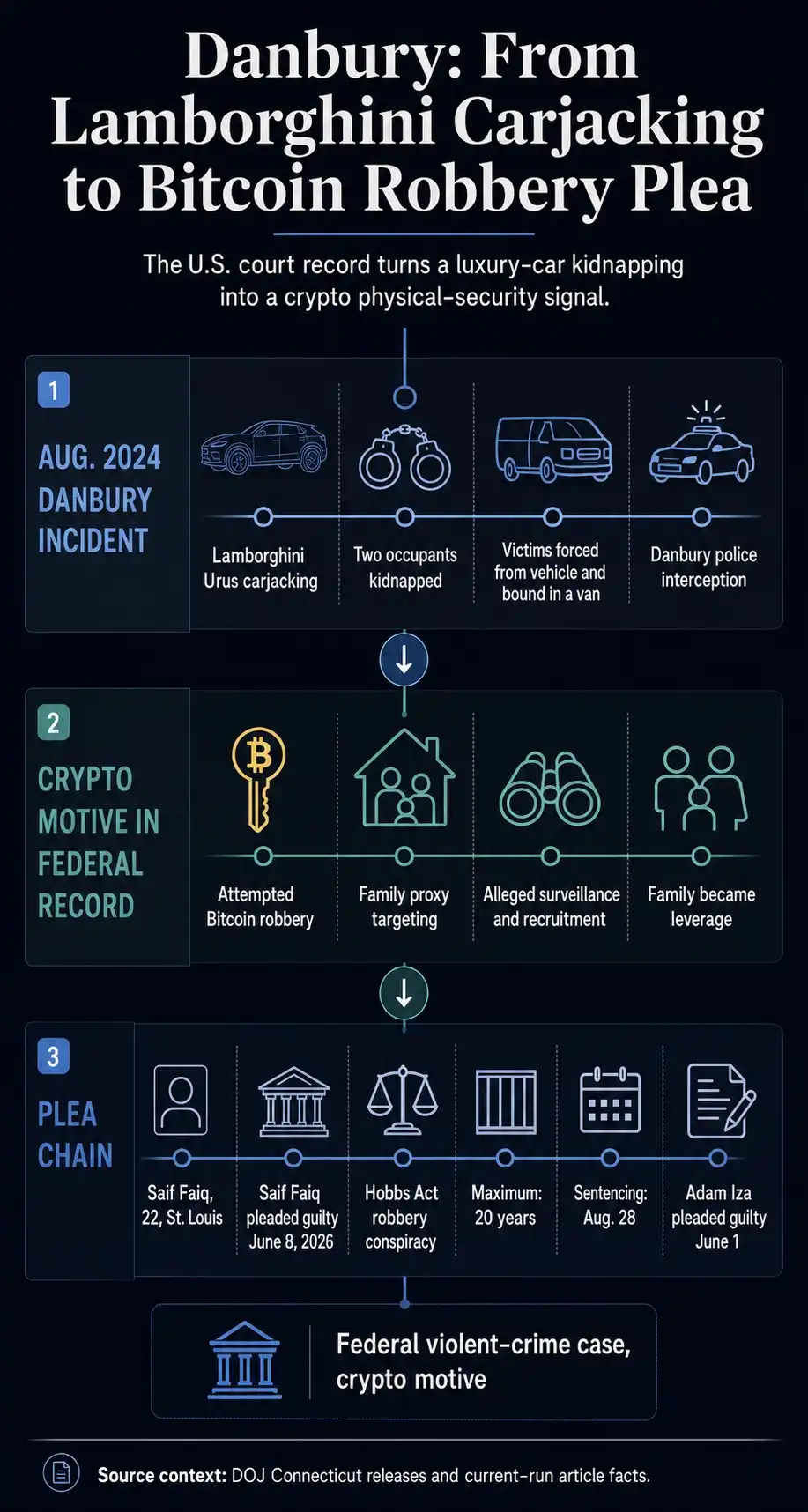
This infographic details a 2024 violent incident in Danbury, USA, involving a Lamborghini carjacking and kidnapping aimed at seizing Bitcoin, disclosing plot details and the 2026 guilty pleas and pending sentencing of two suspects.

The Attack Vector is Always the Human Element

In security research, a 'wrench attack' is defined as a crime involving physical violence or coercion to force a victim to reveal passwords, private keys, or access to digital assets.

CertiK's "2025 SkyNet Wrench Attack Report" categorizes such crimes as attacks on the 'human endpoint,' reporting 72 verified cases in 2025, a 75% year-on-year increase.

This is crucial for Bitcoin holders: the security of the blockchain protocol and the holder's personal safety are two separate systems. Even if the blockchain code is virtually unbreakable and Bitcoin cannot be stolen remotely, the individual controlling the assets is highly vulnerable to physical coercion.

Once criminals believe hardware wallets, seed phrases, exchange accounts, mobile devices, or a target's relatives can lead to transferable crypto assets, all become potential pressure points.

In the Danbury case, the pressure point was the victims' relatives. The US DOJ explicitly stated the two kidnapped parents were not involved in the Bitcoin theft.

They were targeted because their child was involved in the multi-hundred-million-dollar Bitcoin theft case. This also makes it a case of 'indirect target' hostage-taking for robbery.

Similar cases in France prove this is now a widespread personal safety hazard. A March report by this publication noted that victims of violent attacks in France are no longer limited to industry insiders or corporate executives; criminals are increasingly targeting ordinary individuals and private residences.

The Danbury case brings this established modus operandi into US court records. Conspicuous luxury cars are wealth markers, family is leverage, and the ultimate target asset is Bitcoin.

The criminals' core logic: find a person to physically coerce in order to access crypto assets.

The Danbury case clearly demonstrates that relatives can become indirect hostages in crypto-related crimes. The series of cases in France shows that as such attacks become recurrent, local public safety guidelines, travel and protection habits of industry executives, and self-protection methods for ordinary holders are all forced to adapt.
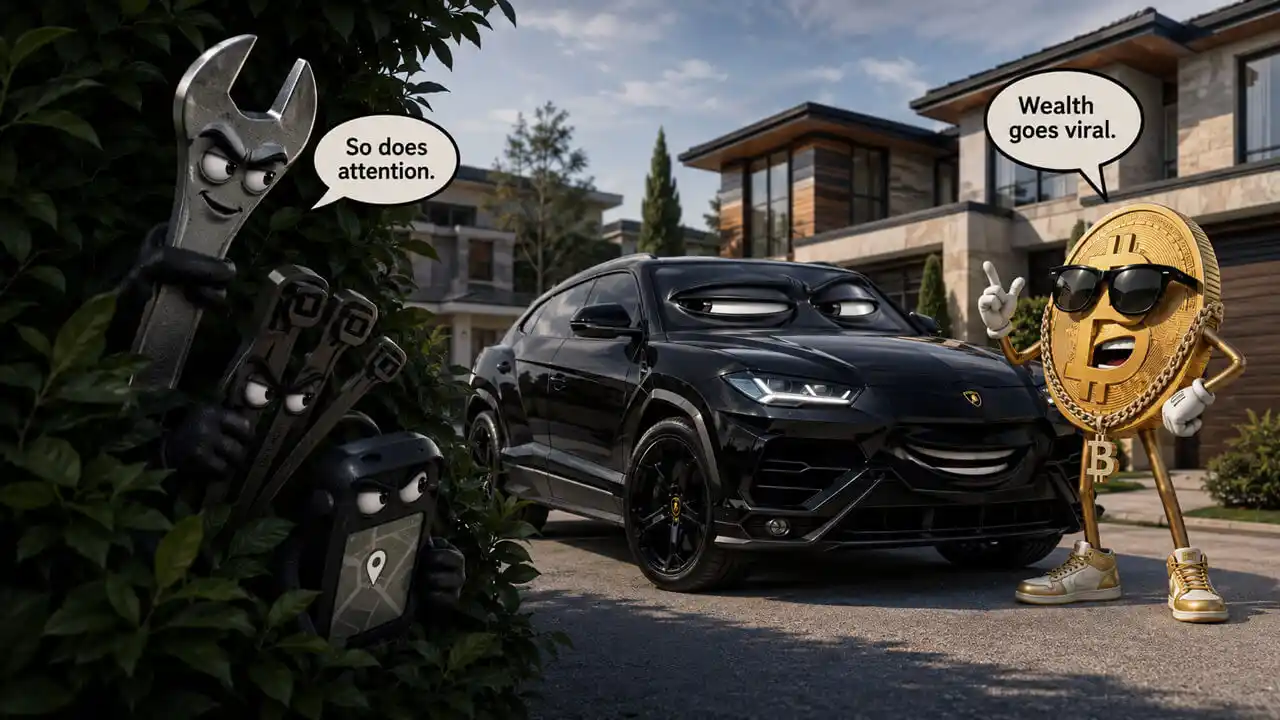
Europe Remains the Core Hotspot for Wrench Attack Cases

Apart from the Danbury guilty plea, overall case data shows Europe remains the concentrated epicenter for 'wrench attack' crimes.

CertiK's "2026 Wrench Attack Overview Report" states that 34 attack cases were verified from January to April 2026, with estimated total losses of approximately $101 million.

Of these 34 cases, 28 occurred in Europe, accounting for 82% of all recorded cases, with France having the highest number of incidents.

A May CryptoSlate special analysis on wrench attacks reached the same conclusion: the wave of offline violent extortion targeting crypto holders continues to accelerate, with the core region still being Europe, particularly France.
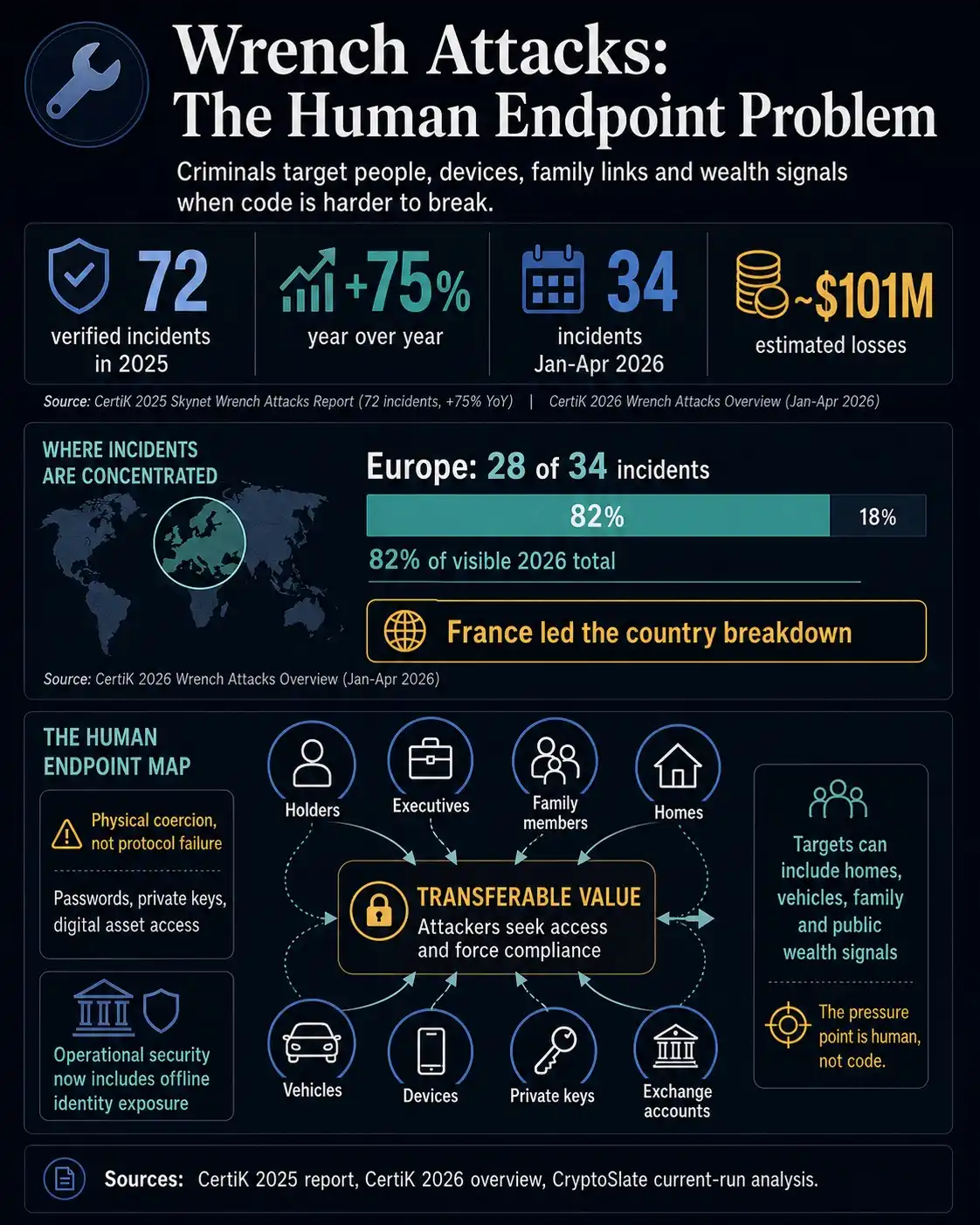
CertiK data shows that crypto 'wrench attacks' targeting holders, family, devices, and other physical endpoints confirmed 72 incidents in 2025, a 75% year-on-year increase. Of 34 cases in the first 4 months of 2026, 82% occurred in Europe, with estimated total losses of ~$101M. The core risk lies in the human/physical endpoint, not code vulnerabilities.

The Danbury case confirms that this attack model against crypto holders is now a judicial challenge for US prosecutors and federal courts.

Court records fully illustrate how the offline safety crisis sparked by crypto assets integrates into standard violent crime enforcement: gang recruitment, cross-regional operations, surveillance, hostage-taking of family, luxury car target identification, and hostage coercion for Bitcoin—the entire criminal chain is clearly documented.

For crypto asset holders and industry businesses, the scope of operational security has broadened significantly. Beyond online risks like phishing, wallet theft, exchange account breaches, and smart contract vulnerabilities, offline exposure risks related to identity, home addresses, electronic devices, and family must be seriously addressed.

The next key judicial signal will be the sentencing outcome. Saif Faiq's August 28th hearing will demonstrate how federal courts define and punish his culpability in this robbery conspiracy.

Long-term, all cases warranting close attention share a commonality: criminals identify crypto holders through offline clues like family, residences, vehicles, and public social profiles. It is precisely these cases that are transforming a safety crisis once concentrated in France into a societal issue that law enforcement across the US must confront—each court filing serves as a risk warning.


Trend Kriptolar

İlgili Sorular

QWhat is a 'wrench attack' in the context of cryptocurrency, as described in the article?

AA 'wrench attack' is a type of crime where physical violence or coercion is used to force a victim into surrendering passwords, private keys, or access to their digital assets.

QAccording to the article, what was the primary target of the assailants in the Danbury, Connecticut case?

AThe primary target was Bitcoin. The assailants planned to kidnap the parents of an individual involved in a separate Bitcoin theft case to coerce that individual into handing over the cryptocurrency.

QBased on the data from CertiK's reports cited in the article, which region is identified as the core hotspot for 'wrench attacks'?

AEurope, specifically France, is identified as the core hotspot for 'wrench attacks'. Data shows 82% of recorded attacks in early 2026 occurred in Europe.

QWhat role did the Lamborghini Urus play in the Danbury kidnapping case, according to the prosecutors?

AThe Lamborghini Urus served as a visible marker of wealth, signaling to the criminals that the target likely held significant Bitcoin and was worth targeting for robbery.

QWhat broader security lesson does the Danbury case highlight for cryptocurrency holders?

AIt highlights that while blockchain protocols themselves may be secure, the human holders are vulnerable. Physical security is crucial, as family members, luxury possessions, and public displays of wealth can make holders and their loved ones targets for violent coercion aimed at seizing crypto assets.

İlgili Okumalar

Will the Fed Definitely Raise Interest Rates in September? How Will Crypto and U.S. Stocks Withstand the Pressure?

The market's expectation for a September Fed rate hike surged dramatically in early August, jumping from under 50% to over 80% within a week. This shift followed a contentious July FOMC meeting, where a 9-3 vote to hold rates revealed growing dissent from hawkish members advocating for an immediate hike to combat persistent inflation. The primary catalyst for this repricing is rising oil prices, driven by renewed geopolitical tensions around the Strait of Hormuz, which threaten global supply. Energy costs directly influence inflation metrics, making the upcoming July CPI report (due August 12th) a critical data point. If it shows inflation reaccelerating, the probability of a September hike will solidify. For Bitcoin and crypto assets, this is typically bearish news. Bitcoin continues to behave as a high-beta, liquidity-sensitive risk asset. A rate hike raises the opportunity cost of holding non-yielding assets and could drive capital toward money markets, pressuring crypto prices in the short term. However, historical patterns suggest that if a hike is perceived as the end of a tightening cycle rather than the start, any negative price impact may be brief. U.S. stocks, particularly crypto-linked equities like Coinbase and growth-oriented tech stocks, are also vulnerable. Higher rates increase discount rates in valuation models, putting pressure on high-multiple companies. This coincides with a pivotal tech earnings season where investor focus has shifted from massive AI capital expenditure to tangible revenue and cash flow generation. Companies with negative cash flow and weak growth narratives could face heightened volatility if borrowing costs rise in September. In summary, a September Fed hike has evolved into a mainstream market scenario. Key factors to watch are oil prices, the July CPI report, and Fed communications, which will determine the final decision and its impact on volatile crypto and equity markets.

marsbit5 dk önce

Will the Fed Definitely Raise Interest Rates in September? How Will Crypto and U.S. Stocks Withstand the Pressure?

marsbit5 dk önce

A 'Overlooked' Market Event: Joint US-Japan-South Korea Intervention, Rare US Treasury Involvement, and Bessent's Quiet 'Market Rescue'?

Summary: The United States, Japan, and South Korea executed their largest coordinated foreign exchange intervention in nearly 30 years. The action targeted depreciation pressure on the Japanese yen and South Korean won. This move is seen as a significant effort by the US to stabilize the financial markets of its key allies and prevent the spillover of risks. Key details: * Japan reportedly intervened on July 30 using approximately 8.45 trillion yen (about $52.8 billion). South Korean authorities also intervened that day, selling dollars to support the won. * Notably, the US Treasury Department intervened directly in yen markets for the first time in roughly 30 years. The New York Fed, reportedly acting on behalf of the Treasury, sold euros to buy yen via Goldman Sachs and Morgan Stanley on July 31. Analysts view the use of the euro-yen pair as a way to alleviate yen pressure without adding selling pressure to the US dollar. * Prior to the action, the New York Fed conducted "rate checks" on both USD/JPY and EUR/JPY, a newer signaling tool that falls between verbal and physical intervention. The intervention is interpreted as going beyond traditional currency stabilization. Analysts, such as Michael Hartnett of Bank of America, suggest it resembles a "Price Keeping Operation" for the AI era. The core US objectives are perceived to be: 1. Preventing rapid yen depreciation from triggering a sharp rise in Japanese government bond yields. 2. Containing financial stress from spreading across Asian markets like South Korea and Japan. 3. Reducing the risk of disorderly capital flows impacting the US bond market. This coordinated action underscores the importance of Japan and South Korea as critical partners in the US semiconductor and AI supply chain. Stabilizing their financial markets is seen as vital to mitigating risks to the broader tech industry and the US market itself. The intervention coincides with market pressures, including the KOSDAQ index hitting a low since October 2022. While seen as a move to control volatility, some analysts caution it may not fundamentally reverse existing market trends.

marsbit8 dk önce

A 'Overlooked' Market Event: Joint US-Japan-South Korea Intervention, Rare US Treasury Involvement, and Bessent's Quiet 'Market Rescue'?

marsbit8 dk önce

Will the Federal Reserve Definitely Raise Interest Rates in September? How Will Cryptocurrencies and US Stocks Bear the Pressure?

In early August 2024, market expectations for a September Federal Reserve rate hike surged dramatically, from below 50% to over 80%, driven by renewed inflation concerns. This shift followed a contentious July FOMC meeting where a 9-3 vote to hold rates revealed a growing hawkish faction advocating for an immediate hike, citing prolonged above-target inflation. The key catalyst is escalating conflict near the Strait of Hormuz, which has pushed oil prices up approximately 20% in July, threatening to reignite inflation. The next critical data point is the July CPI report on August 12th; a hot reading could solidify hike expectations. For crypto assets, particularly Bitcoin, this represents near-term pressure. Bitcoin continues to exhibit high-beta, risk-on characteristics, making it sensitive to tightening liquidity and higher opportunity costs. However, historical precedent suggests that if a hike is perceived as the cycle's end rather than its start, the negative impact may be brief, with markets quickly pivoting to anticipate future rate cuts. U.S. stocks, especially crypto-linked equities like Coinbase and high-valuation tech stocks, face amplified volatility. Higher rates increase discount rates in valuation models, pressuring growth stocks. This coincides with a pivotal tech earnings season where investor focus has shifted from massive AI capital expenditures to demonstrable revenue and cash flow generation. Companies with negative cash flows and weak growth narratives could see severe pressure if a September hike materializes, as financing costs would rise. Key indicators to watch include oil prices, upcoming inflation data, and Fed commentary at events like the Jackson Hole symposium.

Odaily星球日报8 dk önce

Will the Federal Reserve Definitely Raise Interest Rates in September? How Will Cryptocurrencies and US Stocks Bear the Pressure?

Odaily星球日报8 dk önce

İşlemler

Spot

Popüler Makaleler

QUICK Nasıl Satın Alınır

HTX.com’a hoş geldiniz! Quickswap (QUICK) satın alma işlemlerini basit ve kullanışlı bir hâle getirdik. Adım adım açıkladığımız rehberimizi takip ederek kripto yolculuğunuza başlayın. 1. Adım: HTX Hesabınızı OluşturunHTX'te ücretsiz bir hesap açmak için e-posta adresinizi veya telefon numaranızı kullanın. Sorunsuzca kaydolun ve tüm özelliklerin kilidini açın. Hesabımı Aç2. Adım: Kripto Satın Al Bölümüne Gidin ve Ödeme Yönteminizi SeçinKredi/Banka Kartı: Visa veya Mastercard'ınızı kullanarak anında Quickswap (QUICK) satın alın.Bakiye: Sorunsuz bir şekilde işlem yapmak için HTX hesap bakiyenizdeki fonları kullanın.Üçüncü Taraflar: Kullanımı kolaylaştırmak için Google Pay ve Apple Pay gibi popüler ödeme yöntemlerini ekledik.P2P: HTX'teki diğer kullanıcılarla doğrudan işlem yapın.Borsa Dışı (OTC): Yatırımcılar için kişiye özel hizmetler ve rekabetçi döviz kurları sunuyoruz.3. Adım: Quickswap (QUICK) Varlıklarınızı SaklayınQuickswap (QUICK) satın aldıktan sonra HTX hesabınızda saklayın. Alternatif olarak, blok zinciri transferi yoluyla başka bir yere gönderebilir veya diğer kripto para birimlerini takas etmek için kullanabilirsiniz.4. Adım: Quickswap (QUICK) Varlıklarınızla İşlem YapınHTX'in spot piyasasında Quickswap (QUICK) ile kolayca işlemler yapın.Hesabınıza erişin, işlem çiftinizi seçin, işlemlerinizi gerçekleştirin ve gerçek zamanlı olarak izleyin. Hem yeni başlayanlar hem de deneyimli yatırımcılar için kullanıcı dostu bir deneyim sunuyoruz.

151 Toplam GörüntülenmeYayınlanma 2024.12.11Güncellenme 2026.06.02

QUICK Nasıl Satın Alınır

Tartışmalar

HTX Topluluğuna hoş geldiniz. Burada, en son platform gelişmeleri hakkında bilgi sahibi olabilir ve profesyonel piyasa görüşlerine erişebilirsiniz. Kullanıcıların QUICK (QUICK) fiyatı hakkındaki görüşleri aşağıda sunulmaktadır.

活动图片












