Lost the 75,000 Mark, Is Bitcoin About to Experience Its Final Drop?

marsbit2026-05-28 tarihinde yayınlandı2026-05-28 tarihinde güncellendi

Özet

Bitcoin fell below the $75,000 support level on May 28th, trading near $74k amid a broader market correction. Major altcoins like ETH, NEAR, WLD, and ONDO also declined, with the market fear index dropping to 34. Over $470 million in liquidations occurred in 24 hours, mostly long positions. The downturn is linked to external pressures. Geopolitical tensions flared as the US conducted new strikes on an Iranian military base, impacting risk assets. Simultaneously, US spot Bitcoin ETFs shifted to consistent net outflows in May, indicating institutional profit-taking, with funds potentially rotating into outperforming AI and tech stocks. Analysts note BTC's long-term fundamentals remain sound. However, short-term price action depends on capital flows, which are currently negative. Key support is identified between $75k-$76k; a break below could lead to a test of $70k-$72k. On-chain data suggests short-term trading activity has plummeted to levels typical of bear market bottoms, signaling either a bottoming phase or a potential final decline before a reversal. Experts advise a diversified strategy as Bitcoin appears to be in a bottoming area.

Original Author: Ma He, Foresight News

On May 28, after repeated battles around the $75,000 mark, the price of Bitcoin finally lost its footing, now sliding to around $74,000. ETH is oscillating repeatedly around $2,000. Previously strong performers like NEAR, WLD, and ONDO have all seen pullbacks.

The market fear and greed index has currently fallen back to 34, indicating a state of panic.
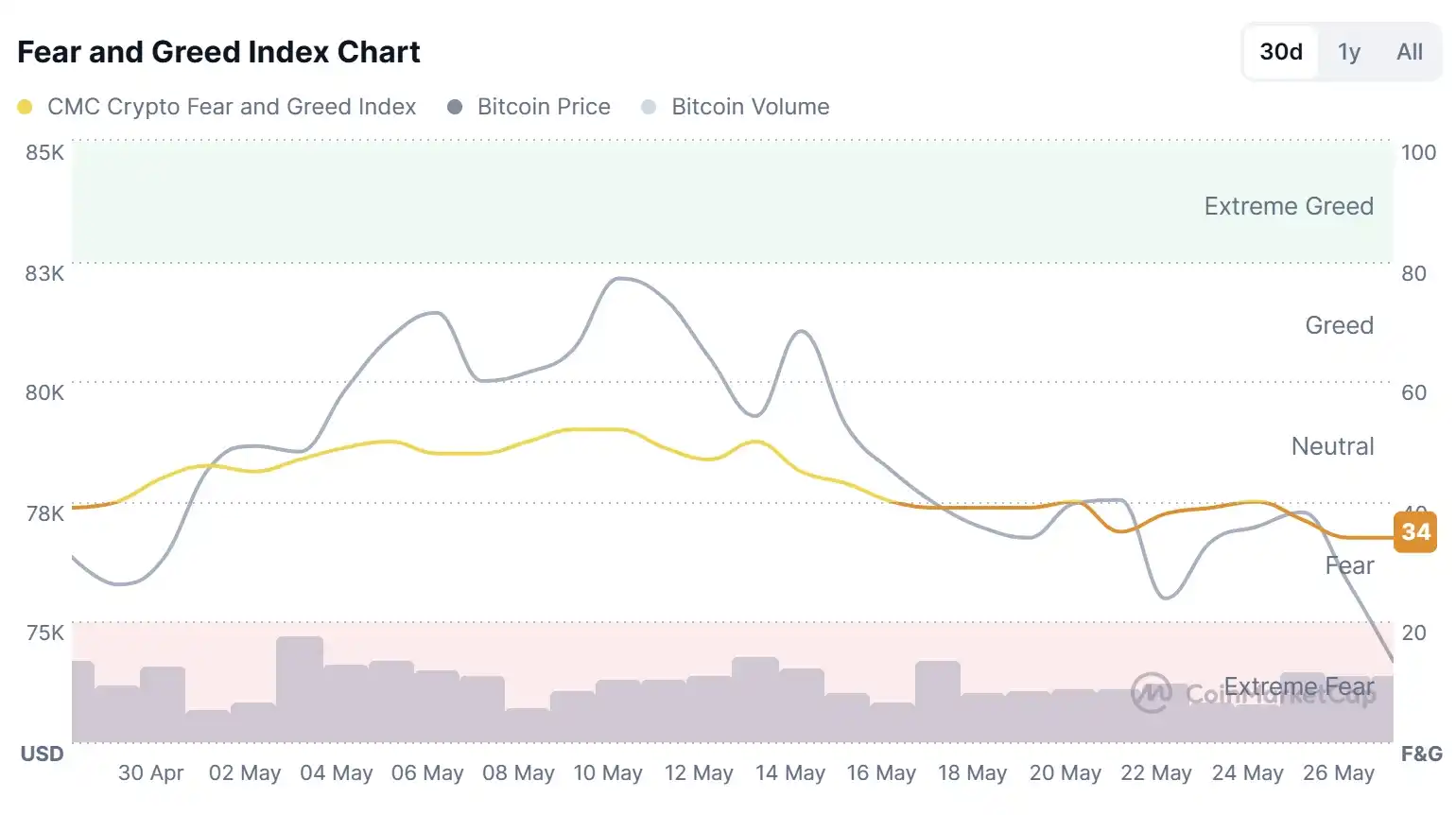
Data from Coinglass shows that in the past 24 hours, $470 million worth of open interest contracts were liquidated across the network, with long positions accounting for $420 million of that.

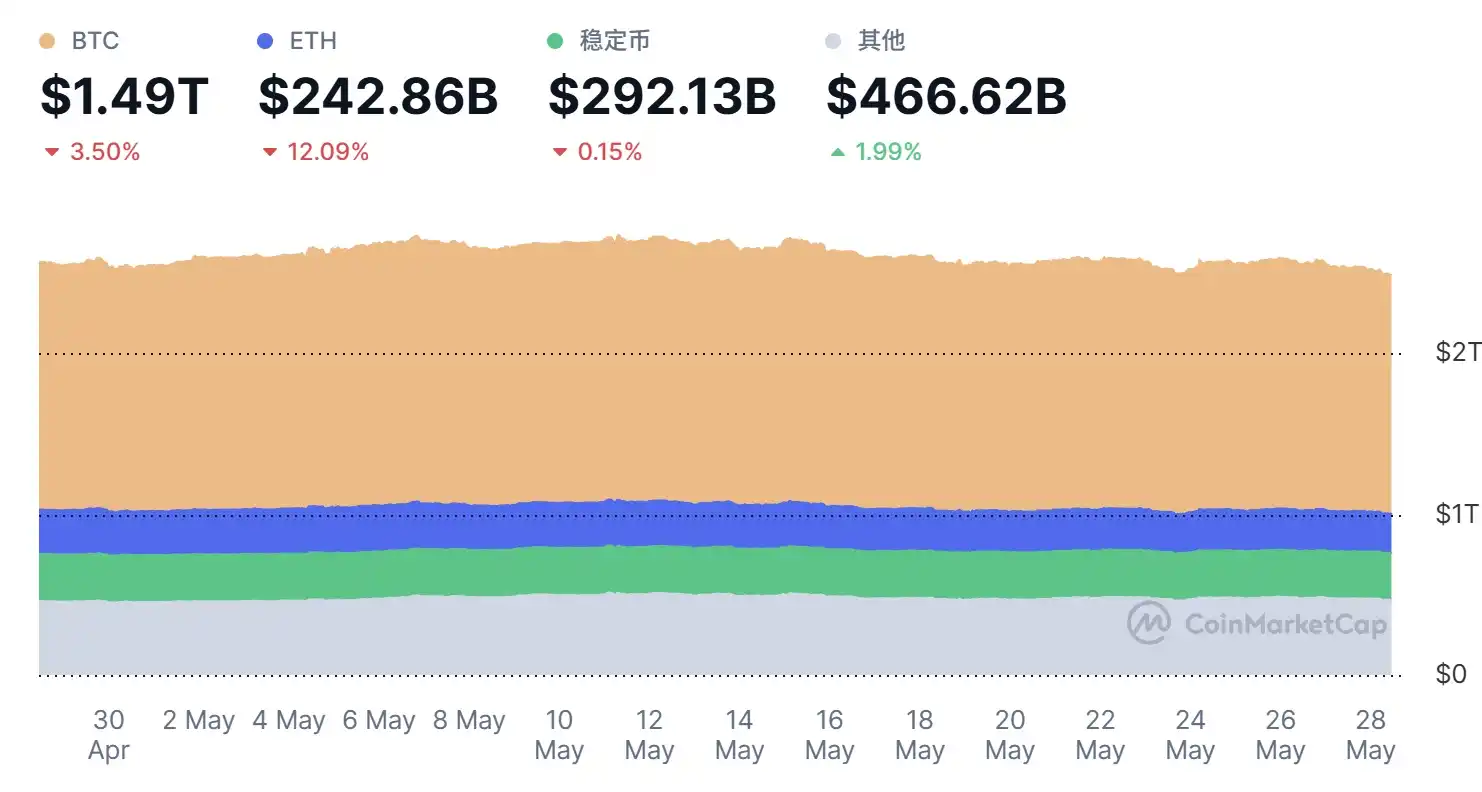
Over the past several weeks, Bitcoin has been oscillating repeatedly between $75,000 and $80,000. It briefly attempted to break above $78,000 but failed to hold. In the past 30 days, BTC has fallen by 3.5%, ETH by about 12%, and stablecoins have also declined by 0.15%.
Regarding macro data, Brent crude oil rose slightly to $97 per barrel, silver fell slightly to $73, the Dow Jones Industrial Average rose 182.60 points (+0.36%) to a new record high. The S&P 500 index rose 1.24 points (+0.02%). The Nasdaq Composite Index stood at 26,674.73 points, up 18.55 points (+0.07%). Spot gold fell below $4,400 per ounce, the first time since March 27, losing over $50 intraday, a drop of 1.25%.

US-Iran Conflict "Reignites"

Geopolitical risks in the Middle East have become another significant external variable. Since 2026, tensions between the US, Iran, and related parties over issues like Iran's nuclear facilities and shipping security in the Strait of Hormuz have repeatedly escalated and eased. In recent months, the US has adopted a strategy combining military action with diplomatic pressure, accompanied by airstrikes, port blockade rumors, and repeated ceasefire negotiations.

Even during windows of ceasefire or diplomatic progress, market pricing for the risk of "reignition" has not completely subsided.

Early on May 28, US President Trump stated that the United States would continue to control Iran's assets. Iran has begun to provide us with what we want. If things don't go well, US Secretary of Defense Hagesse will finish the job. We can end the war with Iran very quickly, and perhaps we must do so. However, I don't think we need to.

Around 5:00 AM Beijing Time, according to reports from Iranian media Fars News, local residents said explosions were heard at Bandar Abbas port in southern Iran.

A US official told Reuters that the US military conducted new strikes on an Iranian military base posing a threat to US forces and commercial navigation in the Strait of Hormuz. US forces also intercepted and shot down multiple Iranian drones posing a threat to US forces and commercial maritime traffic.

Renewed tensions related to the Strait of Hormuz have come into focus, intensifying oil price volatility and putting pressure on global risk assets. In this environment, Bitcoin has exhibited more risk-asset characteristics rather than the traditional "digital gold" safe-haven function—geopolitical uncertainty boosts demand for the US dollar and US Treasuries while suppressing risk appetite, leading to capital outflows from the crypto market.

ETF Net Outflows Reveal Institutional Profit-Taking

Since their launch in early 2024, US spot Bitcoin ETFs have seen cumulative net inflows once exceeding $57 billion, becoming a major channel for institutional Bitcoin allocation. However, a clear reversal in flows has emerged since May 2026.
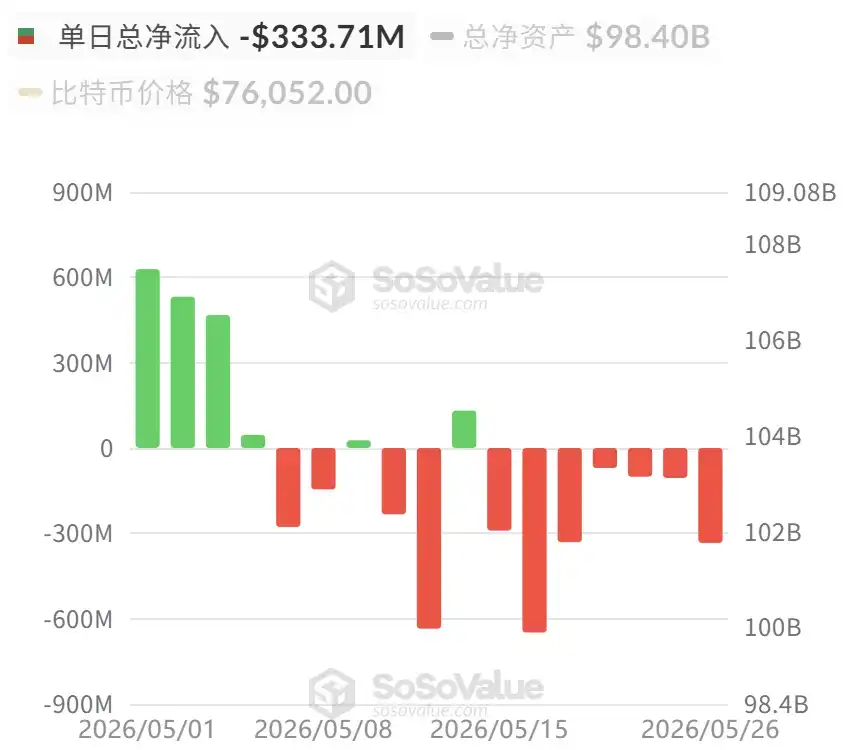
According to tracking data from SoSoValue, between May 5 and 26, US Bitcoin ETFs recorded consecutive net outflows, with daily outflow amounts ranging from tens of millions of dollars to a peak of $600 million, occurring twice.

The situation for spot Ethereum ETFs is similarly pessimistic, mirroring Bitcoin with substantial net outflows since early May.
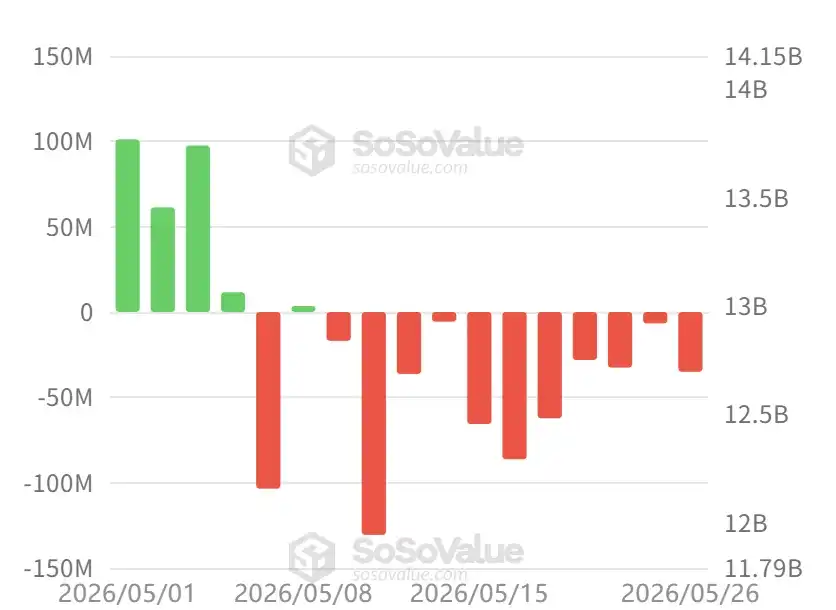
This may not be simple "panic selling," but more likely systematic profit-taking by earlier gainers. ETF holders include traditional asset managers, family offices, and hedge funds, who have chosen to lock in profits via the redemption mechanism after Bitcoin's recovery from lows to the $75,000-$80,000 range. Some funds may have rotated into better-performing AI-related tech stocks—the S&P 500 and Nasdaq indices hitting new highs during the same period, while the crypto market underperformed overall, highlighting capital reallocation within risk assets.

Subsequent Trends

Wintermute published a post stating that BTC's consecutive two weeks of over $1 billion in ETF outflows (following six weeks of inflows) indicate institutions are capitalizing on strength to realize some recent positive returns. More noteworthy is AI. Nvidia delivered a textbook-level performance exceeding expectations, but there was almost no post-market movement. Incremental beats are no longer moving the needle. If the AI momentum fades, the macro picture (record-low consumer confidence, sticky inflation, a hawkish Fed under Governor Waller) will gain more weight, and cryptocurrencies will not be immune.

BTC's long-term structure remains sound (reserves at multi-year lows, long-term holders continue accumulating, CLARITY progressing, HYPE doing what major tokens should do early on). But short-term price is driven by capital flows, and currently, they are negative. The $75,000 to $76,000 range is a key line for BTC. Holding here, BTC will reattempt to assault $80,000; breaking below this range could lead to a quick slide towards $70,000 to $72,000.

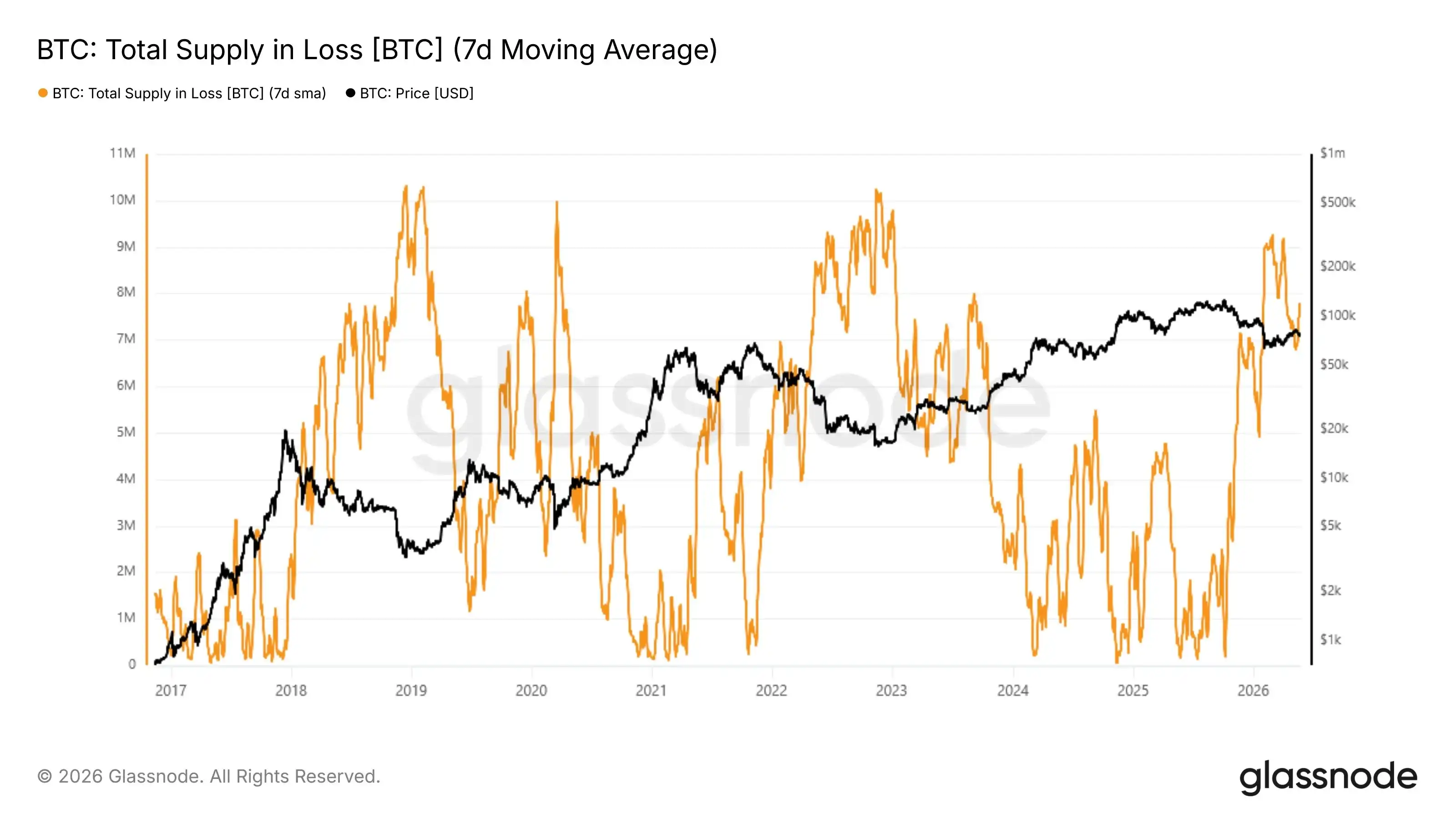
glassnode tweeted that at a price of $76,000, approximately 7.75 million BTC are in a loss position. This supply overhang is a structural feature of bear markets and is typically only resolved when weak hands capitulate.
BIT tweeted that, regarding Bitcoin, the sustained rally over the past period largely depended on the interplay between institutional demand and market supply available for sale. Over the past year, Bitcoin spot ETFs and Strategy have been significant sources of such demand. When ETF inflows accelerated and Strategy continuously increased Bitcoin holdings, Bitcoin prices typically continued to rise.
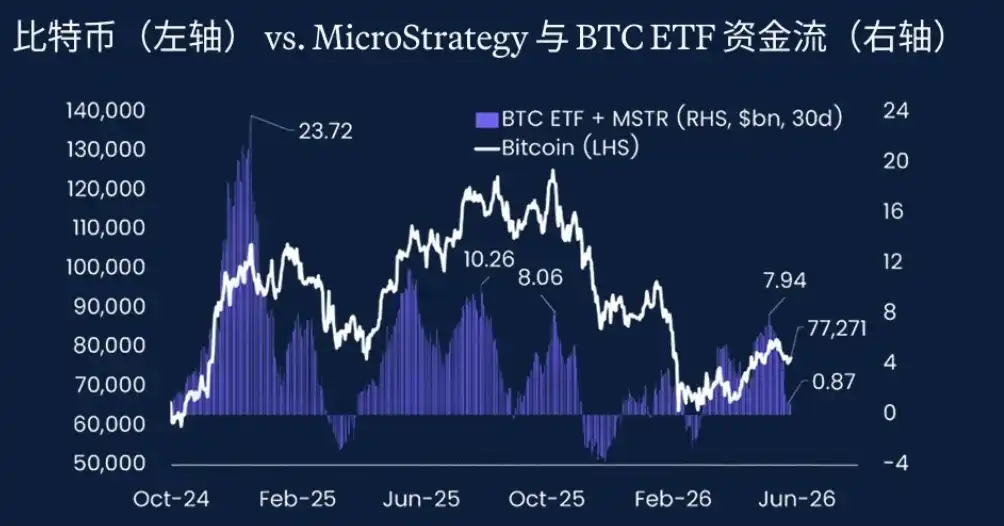
BIT stated that the combined net purchases of ETFs and Strategy have now fallen to only $870 million, primarily due to significant ETF outflows, shifting from net buying to net selling. Before ETF inflows stabilize and rebound, Bitcoin may remain in a consolidation phase in the short term.

Analyst Murphy stated that using the on-chain indicator "Weight of Short-Term Capital Activity" (i.e., the USD value proportion represented by short-term coin turnover), one can observe the current state of the BTC market. This indicator reflects the latest short-term trading behaviors like speculation, arbitrage, profit-taking, or panic selling. Currently, this weight has fallen to historically extreme lows, only seen at the absolute bottom of bear markets in the past 15 years. This means short-term turnover has significantly cooled down, economic value is sedimenting towards long-term holdings, and the market is in a phase of low volatility, accumulation, or with pronounced bottoming characteristics.
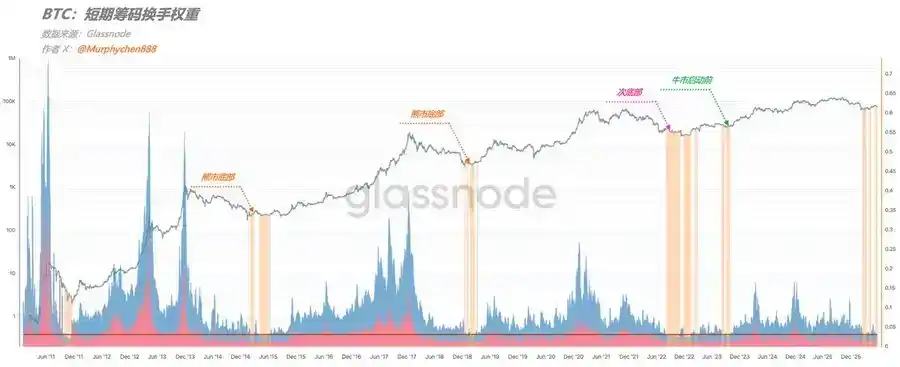
Murphy's judgment, based on this, is that the current market might be in one of three phases: the bottom of a bear market; a sub-bottom, possibly with one last drop; or accumulation before a bull market launch. However, rational judgment can temporarily rule out pre-bull accumulation. It's currently not advisable to fully bet on a single scenario; a diversified portfolio strategy to cope with different outcomes is recommended. The relative position on the long-term macro direction indicates Bitcoin is near a bottom.


İlgili Sorular

QAccording to the article, what happened to Bitcoin's price on May 28th and what is a key support level mentioned?

AOn May 28th, the Bitcoin price failed to hold above the $75,000 level and slipped to around $74,000. The article mentions that the $75,000 to $76,000 range is a critical line for Bitcoin; holding here could allow it to rechallenge $80,000, while breaking below could lead to a quick slide toward $70,000 to $72,000.

QWhat are the two main external factors cited in the article as contributing to the recent market pressure on cryptocurrencies?

AThe two main external factors are: 1) Renewed geopolitical tensions in the Middle East, specifically between the US and Iran, which increases risk-off sentiment and strengthens the US dollar. 2) Sustained net outflows from US Bitcoin and Ethereum spot ETFs, indicating profit-taking by institutional investors.

QWhat does the analysis from Wintermute suggest about the relationship between the AI sector and cryptocurrency markets in the current context?

AWintermute suggests that the AI sector has been attracting capital. They note that if the momentum in AI stocks (exemplified by Nvidia) fades, the broader negative macro picture would gain more weight, and cryptocurrency markets would not be immune to the resulting pressure.

QAccording to analyst Murphy's on-chain indicator, what are the three possible market stages Bitcoin could currently be in?

ABased on the 'short-term fund activity weight on-chain' indicator, analyst Murphy suggests the current market could be in one of three stages: 1) The bottom of a bear market. 2) A secondary bottom, possibly before one final drop. 3) Accumulation before a bull market launch. However, he rationally excludes the bull market pre-accumulation scenario for now.

QWhat is the reported state of the market fear and greed index, and what does the data from Coinglass show about liquidations in the past 24 hours?

AThe market fear and greed index has fallen to 34, indicating a state of 'fear'. Coinglass data shows that over the past 24 hours, $470 million worth of contracts were liquidated across the network, with long positions accounting for $420 million of that total.

İlgili Okumalar

55TB to 28TB? The Rumor and Panic Behind Rubin's Memory Being Halved

Title: 55TB to 28TB? The Rumor and Panic Behind the Potential Halving of Rubin's Memory. On June 4th, a report from SemiAnalysis suggested NVIDIA's next-gen Vera Rubin NVL72 AI rack may ship with roughly 28TB of SOCAMM DRAM per rack instead of the anticipated 55TB, primarily using 96GB modules. This sparked a market panic, causing Micron's stock to drop over 10% on fears of halved memory demand. However, the article argues this panic is misguided for several key reasons. First, SOCAMM modules are socketed and upgradeable, not soldered. Lower initial configuration doesn't mean permanent demand loss. Second, the primary driver is a severe 2026 LPDDR5X supply shortage, not diminished need. NVIDIA is likely prioritizing rack shipments with available components. Third, with fixed total LPDDR5X supply, using less per rack could allow NVIDIA to ship *more* racks, not necessarily reducing overall memory orders. Micron's sharp drop was also attributed to a broader semiconductor sell-off triggered by Broadcom's earnings, with the SemiAnalysis report providing a convenient narrative for profit-taking after Micron's massive rally. In summary: the report on lower default configurations is likely accurate, but interpreting it as a demand collapse is wrong. The real risk for Micron lies in its reportedly minimal HBM4 share for Rubin, not in potentially flexible SOCAMM demand. The sell-off appears more like a correction amplified by coinciding negative catalysts.

marsbit16 dk önce

55TB to 28TB? The Rumor and Panic Behind Rubin's Memory Being Halved

marsbit16 dk önce

Exclusive from Yingke | Tang Wenbin's 'Yuanli Lingji' Merges with Logistics Robotics Company, and Secures Investment from Zhipu, SenseTime, Jieyue, and Others

Exclusive report: Embodied AI company "Yuanli Lingji" recently completed a new round of financing from major AI model firms including Zhipu AI, Stepfun, and SenseTime, alongside continued investments from industrial backers like Huaqin and SAIC Hengxu. Founded in March 2025 by Tang Wenbin, former co-founder and CTO of Megvii, Yuanli Lingji is a general-purpose embodied AI model company. In a notable move, the company has merged with logistics robotics firm "Atomix" (formerly known as Yuanli Juhe) through a share acquisition. Atomix, which originated from Megvii's logistics robotics business led by Tang in 2016 and was spun off in July 2024, has grown to become the world's second-largest supplier of pallet shuttle robots, with annual revenue nearing 1 billion RMB and over 500 projects globally for clients like Uniqlo and CATL. This merger aims to break the industry's "data deadlock" by combining Atomix's extensive real-world operational data from more than 20 countries with Yuanli Lingji's model training capabilities. The company's embodied AI model "DM0" utilizes a cross-domain training approach, integrating internet semantics, autonomous driving rules, and robotics data to achieve hardware-agnostic, precise manipulation even with a compact 2.4B parameter size. The collective investment from key AI players and the strategic merger signal a shift in the competitive landscape, as major model companies pivot from language tokens to physical actions ("from Token to Action"). The industry is entering a consolidation phase where hardware, AI models, data, and application scenarios converge to scale embodied intelligence, a trend mirrored by recent moves from giants like ByteDance and Skild AI.

marsbit24 dk önce

Exclusive from Yingke | Tang Wenbin's 'Yuanli Lingji' Merges with Logistics Robotics Company, and Secures Investment from Zhipu, SenseTime, Jieyue, and Others

marsbit24 dk önce

U.S. Stock Market Trends: Dow Hits New High, Nasdaq Falls, Whom Did Broadcom's Slap Wake Up?

U.S. Stocks Split: Dow Hits Record High as Nasdaq Slips; Broadcom's Plunge Sparks Rotation On June 4, the U.S. stock market saw a sharp divergence. The Dow Jones surged 875 points (+1.73%) to a record high of 51,561.93, while the Nasdaq Composite edged down 0.09%. The S&P 500 rose 0.41%. The primary catalyst was a sharp sell-off in AI-related chip stocks, led by Broadcom (AVGO). Despite reporting a 143% year-over-year jump in AI semiconductor revenue to $10.8 billion, the company's shares plunged about 14%. This was triggered by its maintained long-term AI revenue target, which failed to meet heightened expectations for a stock that had gained 55% this quarter and traded at a high P/E ratio. The slide dragged down the broader semiconductor sector and the technology板块. Conversely, money rotated into sectors like Healthcare (+3.14%), Financials (+2.67%), and Real Estate (+1.87%). UnitedHealth and Goldman Sachs were major contributors to the Dow's gains. The rotation was attributed to a search for value outside overheated tech names and a slight dip in Treasury yields. In other major news, SpaceX confirmed its IPO for June 12, targeting a record $75 billion raise at a ~$1.75 trillion valuation. Additionally, initial jobless claims rose to a four-month high, adding nuance to the labor market narrative ahead of the key May non-farm payrolls report. The day's action signaled that while the AI growth story remains intact, excessive valuations are prompting a market reassessment. Funds are moving, at least temporarily, from high-flying tech to more defensive and value-oriented sectors. The sustainability of this rotation hinges on upcoming economic data, particularly the jobs report, and the market's absorption of the massive SpaceX IPO.

marsbit27 dk önce

U.S. Stock Market Trends: Dow Hits New High, Nasdaq Falls, Whom Did Broadcom's Slap Wake Up?

marsbit27 dk önce

From 'Old Dogs' to 'New Darlings': How AI is Revaluing Old Infrastructure, from Dell to Nokia

"Old Dogs" Become AI's New Darlings: Revaluing Legacy Infrastructure The AI investment narrative is shifting. Beyond the spotlight on core chipmakers like Nvidia, a new wave of interest is rising for legacy tech companies—Dell, HPE, Nokia, Cisco, Corning, Western Digital—once labeled as slow-growth, outdated stories. This resurgence stems from AI's evolution from model development to real-world deployment, creating massive demand for physical infrastructure. As AI moves into data center construction and enterprise adoption, the focus turns to who can actually build and deliver complex systems. These established players hold decades of experience in supply chains, integration, networking, and enterprise delivery—assets now critical for scaling AI. The revaluation can be grouped into three key infrastructure areas: 1. **Servers & Integration (e.g., Dell, HPE):** They are becoming essential system integrators, transforming GPUs into full-scale AI servers with networking, power, and cooling, then delivering them to clients. Strong recent earnings and AI-specific revenue/order growth for Dell and HPE underscore this shift. 2. **Networking & Connectivity (e.g., Corning, Nokia, Cisco):** As AI clusters grow, high-speed data transfer becomes paramount. Corning benefits from fiber demand for data center links, Nokia is exploring AI-integrated wireless networks (AI-RAN), and Cisco sees surging orders for data center switches—all critical for efficient AI operations. 3. **Storage (e.g., Western Digital, Seagate):** The AI data explosion requires vast capacity. Beyond high-speed memory (HBM), there's growing need for high-capacity HDDs to store training data, logs, video, and cold/archival data cost-effectively. This revaluation, however, is not a blanket endorsement. True reassessment requires concrete proof: AI-driven orders and revenue growth, upward revisions to company guidance, and sustainable improvements in profit quality, not just top-line sales. In essence, AI is not turning all old tech firms into high-growth stocks; it is selectively re-pricing the "old assets" of companies that are mission-critical for building the new AI infrastructure, transforming their legacy capabilities into renewed growth engines.

marsbit36 dk önce

From 'Old Dogs' to 'New Darlings': How AI is Revaluing Old Infrastructure, from Dell to Nokia

marsbit36 dk önce

İşlemler

Spot
Futures
活动图片




