Losses of $1.2 Billion: 'Squeeze' Strategy in the Bitcoin Market Profits Again

cryptonews.ru2026-08-21 tarihinde yayınlandı2026-08-21 tarihinde güncellendi

Özet

Bitcoin surged past $79,000 on Friday morning, marking a gain of over $15,000 since August 17. This rally, fueled by concerns over the U.S. national debt exceeding $40 trillion, boosted Bitcoin's market cap past $1.55 trillion. The sharp rise led to significant short position liquidations, exceeding $1.22 billion over three consecutive days. Michael Saylor's company, Strategy, saw its 840,447 BTC holdings, acquired at an average of $75,385 per coin, return to profitability as prices exceeded $75,000. Saylor reiterated his belief in Bitcoin's perpetual growth. U.S. Treasury Secretary Scott Bessent's comments on bond buybacks were criticized by economist Peter Schiff as a "panic button" move that could worsen market instability, though Schiff affirmed his preference for gold and silver over Bitcoin. Market sentiment remains bullish, with 71% of users on prediction platforms expecting Bitcoin to surpass $80,000.

On Friday morning, Bitcoin broke through the $79,000 mark, resulting in a gain of over $15,000 in dollar terms since August 17. The cryptocurrency's steady rise comes amid concerns over the U.S. national debt, which has exceeded $40 trillion and poses a serious threat to the country's financial well-being. These concerns have significantly increased the appeal of alternative assets like Bitcoin, whose limited supply mechanism reinforces arguments against the fiat currency system.

Market data shows the cryptocurrency added over $5,000 during a sharp surge that briefly offset the unrealized losses of Strategy, a Bitcoin management company. As of 5:00 AM Eastern Standard Time (EST), Bitcoin was trading just below the session high of over $79,461. In a rally that spread to altcoins, Bitcoin's market capitalization momentarily exceeded $1.55 trillion, and the total market capitalization of the cryptocurrency economy grew to $2.65 trillion.

For the third consecutive day, Bitcoin's parabolic rise has been particularly brutal for short sellers. Data from Coinglass shows that approximately $154 million worth of short positions were liquidated in one hour and $295 million over four hours. These liquidated positions pushed the 24-hour Bitcoin short liquidation volume to $764 million. For the third day in a row, the total liquidation volume across the crypto market exceeded $1 billion, with short liquidations alone accounting for over $1.22 billion.

While the price surge has emboldened many crypto enthusiasts, Strategy's Executive Chairman Michael Saylor likely felt the greatest relief: Bitcoin breaking above the $75,000 mark meant his company's $BTC holdings became profitable again for the first time in nearly three months. According to the latest report filed with the SEC, the company owned 840,447 $BTC, acquired for $63.36 billion at an average price of $75,385 per Bitcoin.

In his latest video on X, Saylor stated that Bitcoin will rise forever, adding: "But 98% of people are ready to accept this reality." Saylor noted that his company has created a "digital credit and pays dividends so people can benefit from Bitcoin."

Additionally, subsequent remarks by U.S. Treasury Secretary Scott Bessent about bond buybacks became a focal point of discussion, which economist and government critic Peter Schiff argued was tantamount to pressing the "panic button." Schiff, who claims the U.S. economy is in worse shape than when former President Joe Biden left office, warned that Bessent's statements may have worsened the situation.

"Now that the Trump administration has panicked and announced a Treasury rescue operation, investors who weren't yet aware there was a problem will understand the situation and start selling. If Bessent previously thought we had a bond market problem, his alarm signal has significantly worsened that problem," Schiff wrote on X.

Nevertheless, opposing Bessent's intervention, Schiff insisted he would not buy Bitcoin as he already holds gold and silver.
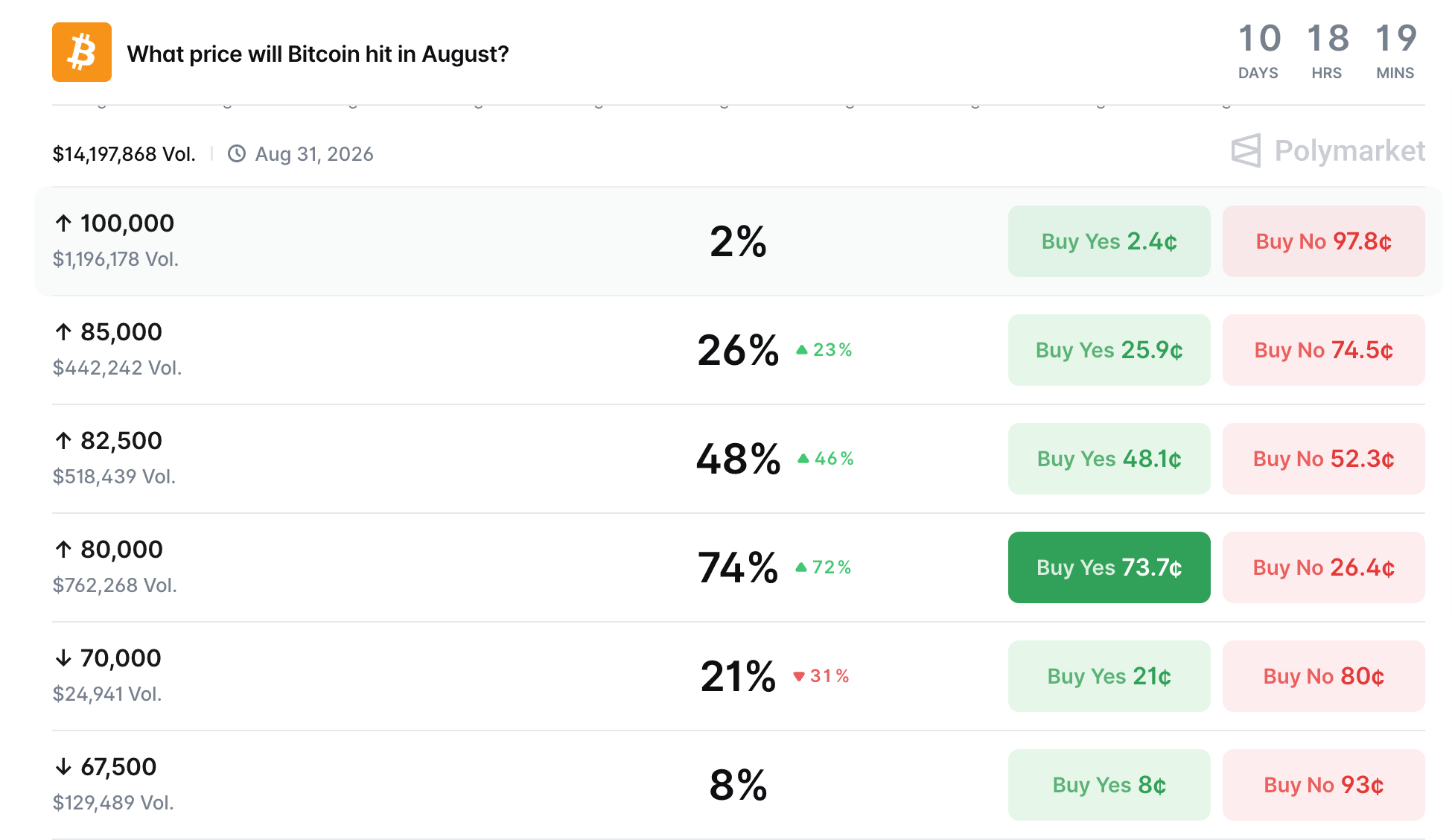
Meanwhile, on prediction markets, 71% of users expect Bitcoin to surpass the $80,000 mark, while only 23% predict it will fall back to $70,000. Such market sentiment is reflected in the Crypto Fear & Greed Index, which reached a score of 72 on Friday morning.

end-content

İlgili Sorular

QWhat was the approximate total value of short position liquidations over 24 hours during the recent Bitcoin rally, and what key price level did Bitcoin break that restored profitability to Strategy's holdings?

AThe 24-hour short liquidation volume for Bitcoin reached approximately $764 million. The key price level was above $75,000; breaking this level meant that Strategy's Bitcoin holdings, purchased at an average price of $75,385, became profitable again for the first time in nearly three months.

QAccording to the article, what are the two main market factors contributing to Bitcoin's recent surge in price and appeal?

AThe two main factors are: 1) Concerns over the U.S. national debt exceeding $40 trillion, which is seen as a serious threat to the country's financial well-being, and 2) Bitcoin's fixed supply mechanism, which reinforces arguments against the fiat currency system and increases its attractiveness as an alternative asset.

QWho is Michael Saylor, and what did he claim about Bitcoin's future and public perception in his recent statement on X?

AMichael Saylor is the Executive Chairman of Strategy, a company that manages Bitcoin holdings. In his recent video on X, he claimed that 'Bitcoin will grow forever,' but added that '98% of people are ready to accept this reality.' He also stated that his company created 'digital credit and pays dividends so people can benefit from Bitcoin.'

QWhat was Peter Schiff's primary criticism regarding U.S. Treasury Secretary Scott Bessent's remarks about bond buybacks, and what was Schiff's stated personal investment preference?

APeter Schiff, an economist and government critic, argued that Bessent's remarks were equivalent to pressing a 'panic button.' He warned that by signaling alarm about bond market problems, Bessent likely made the situation worse. Schiff insisted he would not buy Bitcoin despite this, stating his personal preference is for gold and silver, which he already owns.

QWhat does the current sentiment on prediction markets and the Crypto Fear & Greed Index suggest about trader expectations for Bitcoin's near-term price movement?

AThe sentiment suggests strong bullish expectations. On prediction markets, 71% of users expect Bitcoin to surpass the $80,000 mark, while only 23% predict a fall back to $70,000. This bullish sentiment is reflected in the Crypto Fear & Greed Index, which reached a score of 72 on Friday morning, indicating a state of 'Greed.'

İlgili Okumalar

You'll Be Surprised How Much WeChat's Architecture Differs from Telegram's

An article compares the core architectural philosophies of WeChat and Telegram, highlighting fundamental differences in data storage, monetization, and developer ecosystems. **Data Storage:** Telegram offers unlimited, synchronized cloud storage for seamless access across all devices. In contrast, WeChat stores chat history locally on each device, requiring a manual migration process for transfer and tethering desktop sessions to an active smartphone. **Features & Ecosystem:** Telegram's open Bot API allows for easy, free bot creation, while WeChat's massive ecosystem of over 4.8 million "mini-programs" operates within a closed, curated, and more regulated platform. Commenting also differs: Telegram uses integrated discussion threads for channels, whereas WeChat relies on pre-moderated comments for official accounts and separate chats for interaction. **File Sharing & Payments:** Telegram supports large file transfers (up to 4GB for Premium), while WeChat limits most files to 200MB. A key divergence is in payments: WeChat Pay is deeply integrated into daily life and commerce in China, whereas Telegram lacks a comparable built-in fiat payment system, focusing instead on third-party bots and crypto. **Analysis:** The comparison reveals two distinct models: WeChat is a tightly integrated, closed ecosystem deeply embedded in the real economy, while Telegram prioritizes open protocols, flexible data handling, and low barriers for developers. An added perspective notes that WeChat's fusion of messaging and payments in a single interface without end-to-end encryption for chats potentially broadens the attack surface, raising security questions as more functions converge.

cryptonews.ru2 saat önce

You'll Be Surprised How Much WeChat's Architecture Differs from Telegram's

cryptonews.ru2 saat önce

İşlemler

Spot
活动图片