Looking Back at Prediction Markets by the End of 2025: Scale, Players, and the Watershed Moment

比推2025-12-29 tarihinde yayınlandı2025-12-29 tarihinde güncellendi

Özet

By the end of 2025, prediction markets have fundamentally shifted from being event-driven tools reliant on black swan events to platforms sustained by structural trading demand. The total monthly trading volume has grown from under $100 million in early 2024 to over $1 billion by late 2025, indicating a phase of explosive growth and consistent liquidity. The industry has evolved into five distinct segments: 1. **Compliant Markets**: Kalshi (CFTC-regulated, exchange-like) and Polymarket (globally liquid, later US-compliant) lead with institutional and high-frequency trading, especially in sports contracts. 2. **Crypto-Native Experiments**: Platforms like Opinion explore high-risk, crypto-policy, and speculative events, driving innovation but facing regulatory uncertainty. 3. **High-Frequency Trading Platforms**: Limitless shortens contract cycles, blurring lines between prediction markets and derivatives trading. 4. **Embedded Markets**: Myriad Markets integrates prediction features into wallets and super-apps, reducing user acquisition costs and making participation more casual. 5. **Native Information Markets**: Platforms like predict.fun and media integrations use incentives and community mechanisms to blend prediction with content and social interaction. Regulation in 2025 has not meant full liberalization but rather the establishment of boundaries—predictive contracts are recognized as financial instruments, yet state-level gambling laws remain a friction point. Th...

If we were to summarize prediction markets in 2025 in one sentence, it might be:

This is the first year prediction markets no longer rely on black swan events but instead begin to rely on structural trading demand.
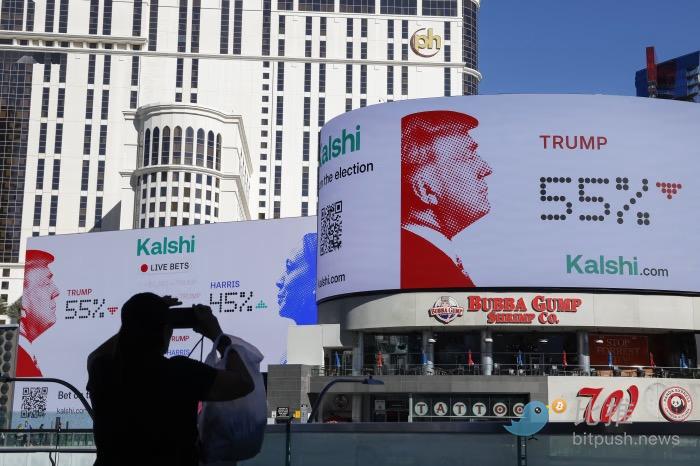
This was almost unimaginable in the past. For a long time, prediction markets were more like "event tools": they only became briefly active during major uncertainties like elections, pandemics, or wars, then quickly cooled down. But this year, high-frequency events such as sports matches, macroeconomic data, and policy changes provided prediction markets with a stable trading rhythm, making them exhibit, for the first time, operational characteristics close to those of financial exchanges—sustained liquidity, frequent trading, and clear settlements.

On the surface, this is a change in scale; but more importantly, it is a change in role.
Prediction markets are shifting from "betting on whether something will happen" to "how the market prices uncertainty." In other words, probabilities are no longer just personal opinions but are beginning to be treated as price signals that can be repeatedly referenced, much like interest rates, exchange rates, or stock prices.

The True Scale of Prediction Markets in 2025

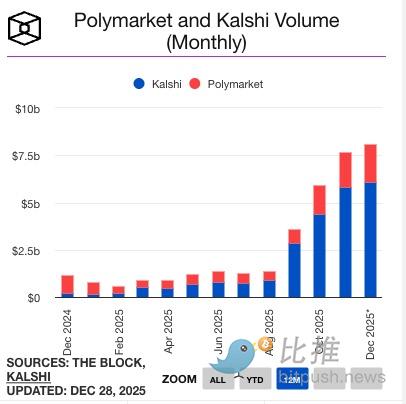
The overall trading volume of prediction markets has grown by an order of magnitude over the past two years. According to industry data from Dune & Keyrock, the monthly trading volume of prediction markets has increased from less than $100 million in early 2024 to stabilize in the range of over $1 billion by the end of 2025, showing explosive growth.

Taking leading platforms as an example, data from The Block shows that Kalshi approached a trading volume of nearly $6 billion in November 2025, with sports contracts contributing the vast majority of the transactions;

Meanwhile, on-chain data and platform disclosures from Polymarket indicate that it also maintained monthly trading volumes in the tens of billions of dollars during several peak months in 2025.

The message behind these numbers is clear: prediction markets no longer rely on "occasional major events" but have entered a stage where they can operate sustainably in everyday environments.

The Industry Gradually Forms "Five Major Camps"

If we only look at trading volume, it is easy to overlook the most critical change in 2025—platforms have embarked on completely different development paths.

For the average reader, it can be simply understood as: some platforms are striving to "become like exchanges," some are trying to "make predictions lighter and more frequent," and others are exploring "whether predictions can be embedded into everyday products."

These differences determine the form prediction markets will take in the future.

First Camp: The Mainstream of Compliant Prediction Markets—Parallel Competition of Two Paths
In 2025, the true marker of prediction markets entering mainstream finance was not the growth in trading volume but the clear differentiation of compliance paths.

One path is the "local compliance, exchange-oriented route" represented by Kalshi. Kalshi chose from the outset to operate entirely within the regulatory framework of the U.S. Commodity Futures Trading Commission (CFTC), defining prediction contracts as standardized event derivatives. In 2025, with the large-scale launch of sports contracts, its trading structure evolved significantly toward high frequency and short cycles, and its product form increasingly resembled that of traditional financial exchanges.

The other path is represented by Polymarket. This is a more challenging route: after initially building scale by leveraging global liquidity, Polymarket completed a compliance restructuring in 2025, acquiring a licensed entity and gaining regulatory approval to officially return to the U.S. market. This made it one of the few platforms in the industry with both a global user base and U.S. compliance status.

The difference between the two lies not in "whether they are compliant" but in the accumulation before compliance. Kalshi's advantage lies in institutional certainty and local distribution capabilities; Polymarket's advantage lies in the global liquidity it has already formed and broader event coverage. They represent two different evolutionary directions for prediction markets within the regulatory framework.

Second Camp: Crypto-Native Experimental Platforms

Outside the mainstream compliance path, there remains a category of platforms that serve the function of trial and error and innovation.
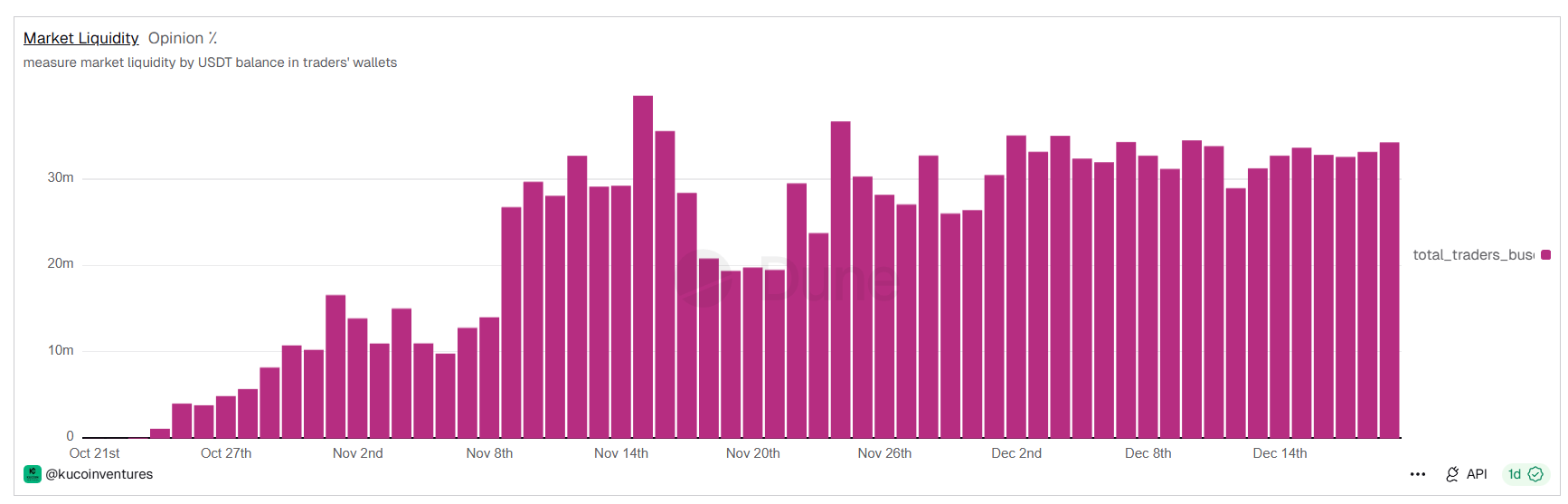
Represented by platforms like Opinion, this camp leverages the native liquidity and community diffusion capabilities of the crypto ecosystem to achieve rapid growth. They are more aggressive in event selection, often covering crypto policies, extreme hypotheses, or highly controversial issues that mainstream platforms have not yet addressed.

The significance of these platforms lies not in short-term scale but in being the first to price highly uncertain questions. However, their trading data often comes from platform displays or third-party statistics and has not yet entered a clear compliance framework, so long-term sustainability remains to be verified.

Third Camp: High-Frequency, Exchange-Thinking Prediction Markets

Platforms represented by Limitless are pushing prediction markets in a new direction.

Here, prediction is no longer an act of "waiting for results" but a trading behavior of high-frequency entry and exit of positions. Contract cycles are deliberately shortened, settlement frequencies are continuously increased, and user behavior resembles that of short-term traders rather than event analysts.

This model blurs the line between prediction markets and derivative trading, also hinting that regulators may need to address new product definitions in the future.

Fourth Camp: The Wallet and Super-Entry Embedded Route

The value of Myriad Markets lies not in trading volume but in its path choice.

Through integration with mainstream wallets, prediction markets are embedded into users' daily asset management processes. Users do not "enter a prediction market" but participate casually while viewing assets or completing interactions.

The long-term significance of this model is its extremely low customer acquisition cost and highly natural user conversion, indicating that prediction markets are shifting from "high-participation-cost behavior" to "everyday light decision-making behavior."

Fifth Camp: Information Markets Native to Public Chains and Content Ecosystems

Platforms represented by predict.fun attempt to treat prediction markets as a native information application.

They rely on public chain ecosystems for diffusion, use incentive mechanisms to drive participation, and deeply integrate prediction behavior with content and communities. At the same time, traditional media are exploring similar directions, using prediction markets as interactive supplements to news content rather than mere trading tools.

Although this camp may struggle to compete with compliant platforms in terms of trading scale in the short term, the product forms and participation mechanisms they explore could influence the usage methods and content organization structures of prediction markets in the medium to long term.

Compliance Is Not Deregulation but Setting Boundaries

In 2025, prediction markets were not "fully liberalized."

A more accurate description is: regulators explicitly acknowledged for the first time that prediction contracts can exist as financial instruments but did not relinquish control over their boundaries. Federal-level attitudes gradually clarified, while state-level gambling regulations became new sources of friction. This inconsistency means prediction markets will remain in a state of "expandable but not uncontrollable."

For the average user, the most important cognitive shift in 2025 is: prediction markets are no longer just about "betting on right or wrong" but about "trading the market's pricing of uncertainty."

Price reflects consensus rather than fact; liquidity is often more important than opinion; profit comes from judgment differences, not the final result itself; and the biggest risk often comes from rule changes, not misjudgment.

Conclusion

Looking back at 2025, the real change in prediction markets is not which platform is more lively, but that a more fundamental question began to be taken seriously:

Who has the right to price uncertainty?
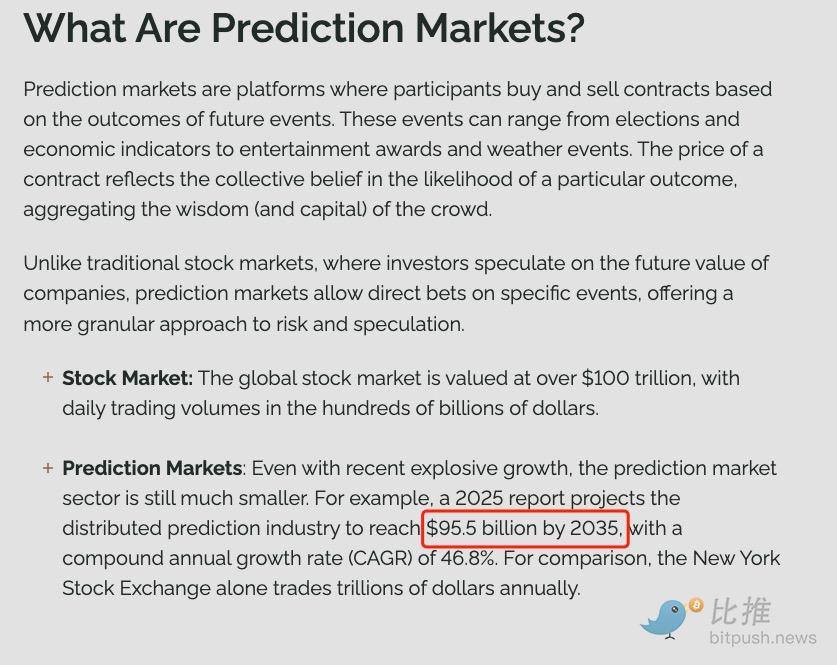
Compliant platforms are setting boundaries, experimental platforms are exploring possibilities, and the true winners may not emerge until after 2026. What is certain is that prediction markets are no longer just gambling but are becoming a tool to help people understand uncertainty. A report released by Certuity predicts that by 2035, the prediction market size could reach $95.5 billion, with a compound annual growth rate of 46.8%.

2025 is just the beginning.

Author: Bootly


Twitter:https://twitter.com/BitpushNewsCN

Bitpush TG Discussion Group:https://t.me/BitPushCommunity

Bitpush TG Subscription: https://t.me/bitpush

Original link:https://www.bitpush.news/articles/7599007

İlgili Sorular

QWhat is the key shift in prediction markets highlighted for 2025?

APrediction markets shifted from relying on black swan events to depending on structural trading demand, moving towards pricing uncertainty like traditional financial instruments.

QWhat was the approximate monthly trading volume of prediction markets by the end of 2025?

AThe monthly trading volume stabilized above $1 billion by the end of 2025, up from less than $100 million in early 2024.

QName the two main compliance paths for prediction markets as described in the article.

AThe two main compliance paths are represented by Kalshi (domestic compliance and exchange-like structure under CFTC regulation) and Polymarket (global liquidity with later U.S. compliance through regulatory approval).

QWhat is the significance of the 'wallet and super entry embedded route' exemplified by Myriad Markets?

AIt embeds prediction markets into daily asset management workflows, reducing user acquisition costs and transforming prediction participation into a light, everyday decision rather than a high-cost activity.

QWhat is the article's conclusion about the fundamental question prediction markets began to address in 2025?

AThe fundamental question is 'Who has the right to price uncertainty?', with prediction markets evolving from mere betting tools into instruments for understanding and pricing uncertainty.

İlgili Okumalar

Has Hook Summer Really Arrived? sato, Lo0p, FLOOD Ignite the New Narrative of Uniswap v4

"Hook Summer" Arrives? Sato, Lo0p, FLOOD Ignite Uniswap v4 Narrative Amidst a slight market recovery, attention within the Ethereum ecosystem has shifted to Meme coins built on Uniswap v4's Hook protocol. Following ASTEROID, tokens like sato, sat1, Lo0p, and FLOOD have become market focal points, with market caps ranging from millions to tens of millions, bringing concentrated liquidity to a narrative-dry market. Uniswap v4 Hooks are "plugin smart contracts" that allow developers to inject custom logic at key points in a liquidity pool's lifecycle (initialization, adding/removing liquidity, swaps, etc.), making the AMM programmable. Recent representative projects include: * **sato**: Market cap peaked over $38M; uses a v4 curve mechanism for minting/burning, locking ETH as reserve. * **sat1**: Market cap briefly exceeded $10M, positioning as an "optimized sato," but later declined significantly. * **Lo0p**: Market cap neared $6.6M; a "lending AMM protocol" allowing users to borrow ETH against deposited LO0P tokens without immediate selling pressure. * **FLOOD**: Market cap approached $6M; channels trading reserves into Aave v3 to generate yield, which is retained in the pool. The emergence of these Hook-based tokens could drive long-term growth for the Uniswap ecosystem by attracting users and liquidity to v4 pools. Combined with Uniswap's activated fee switch (partially used to burn UNI), the long-term outlook for UNI appears positive. However, short-term UNI price appreciation is not directly guaranteed. Factors include the sustainability and lifecycle of these new tokens, their price volatility, overall market conditions, and regulatory pressures. Currently, Uniswap v4's TVL ($595M) lags behind v3 and v2, indicating Hook adoption still requires time to mature. In summary, the Hook ecosystem serves as "long-term nourishment" for UNI, but acts more as a "catalyst" than a direct "booster" in the short term. Note: These are early-stage experimental tokens and may carry unknown risks.

marsbit9 dk önce

Has Hook Summer Really Arrived? sato, Lo0p, FLOOD Ignite the New Narrative of Uniswap v4

marsbit9 dk önce

Has Hook Summer Truly Arrived? sato, Lo0p, FLOOD Ignite the New Uniswap v4 Narrative

With the broader market showing signs of recovery, a new wave of interest has emerged around Ethereum-based meme coins. Following ASTEROID, tokens like sato, sat1, Lo0p, and FLOOD, built upon the Uniswap v4 Hook protocol, are capturing market attention. Their market capitalizations range from millions to tens of millions of dollars, injecting much-needed focused liquidity into a market lacking narratives. This article explores whether this trend signifies an incoming "Hook Summer" and its potential impact on UNI's price. Hooks are essentially plug-in smart contracts for Uniswap v4 liquidity pools, allowing developers to inject custom logic at key points in a pool's lifecycle (like initialization, adding/removing liquidity, swaps). This transforms the AMM into programmable building blocks. Key highlighted projects include: * **sato**: Peaked over $38M market cap. It utilizes a v4 curve for minting/burning; buying locks ETH as reserve to mint new tokens, while selling redeems ETH from the reserve and burns tokens. * **sat1**: Market cap briefly exceeded $10M, promoted as an "optimized sato," but later declined significantly. * **Lo0p**: Reached nearly $6.6M. It's a lending AMM protocol where buying LO0P tokens locks them as collateral, allowing users to borrow ETH from the pool reserve at 40% LTV, aiming to improve capital efficiency for idle ETH in LPs. * **FLOOD**: Peaked near $6M. Its mechanism directs asset reserves from buys into Aave v3 to generate yield, with fees and interest retained in the pool to potentially influence the token's price long-term. In the long term, the development of the Hook ecosystem can attract users and liquidity to Uniswap v4, benefiting UNI's fundamentals—especially combined with the recent activation of the protocol fee switch, where a portion of fees is used to burn UNI. However, in the short term, these Hook-based tokens are unlikely to directly drive significant UNI price appreciation. Their impact is moderated by factors like token sustainability, price volatility, and broader market and regulatory conditions. Currently, Uniswap v4's TVL ($595M) still trails behind v2 and v3, indicating adoption and growth will take time. The article concludes that while the Hook ecosystem provides long-term "nourishment" for UNI, its short-term role is more of a "catalyst" than a "booster." Readers are cautioned that these are early-stage experimental tokens and may carry unknown risks.

Odaily星球日报21 dk önce

Has Hook Summer Truly Arrived? sato, Lo0p, FLOOD Ignite the New Uniswap v4 Narrative

Odaily星球日报21 dk önce

Interview with Michael Saylor: I Did Say I Would Sell Bitcoin, But Never a Net Sale

Interview with Michael Saylor: I Said We'd Sell Bitcoin, But Never Be a Net Seller In a recent podcast, MicroStrategy Executive Chairman Michael Saylor clarified the company's stance on potentially selling Bitcoin. Following MicroStrategy's earnings call statement about being prepared to sell BTC to fund dividends for its STRC (Strategic) credit product, Saylor emphasized the distinction between selling and being a "net seller." Saylor explained the core business model: MicroStrategy sells credit instruments like STRC and uses the proceeds to buy Bitcoin, which is viewed as "digital capital" expected to appreciate around 30-40% annually. A portion of these capital gains can then be used to pay the dividends on the credit products. He stressed that even if the company sells some Bitcoin for dividends, it simultaneously buys much more with new credit issuance. For example, after raising $3.2 billion from STRC sales in April, the dividend obligation was only $80-90 million, making the company a net buyer. The clarification aims to counter market narratives questioning the value of Bitcoin on MicroStrategy's balance sheet if it were never sold, and to dismiss claims of a "Ponzi scheme." Saylor reiterated his personal philosophy for investors: "Don't be a net seller of bitcoin" and ensure your Bitcoin holdings increase each year. Saylor also discussed Bitcoin's role as the foundation for "digital credit," noting that STRC has become the largest and most liquid preferred stock issue in the U.S., offering high risk-adjusted returns (Sharpe ratio). He highlighted Bitcoin's deep liquidity, stating that even large purchases by MicroStrategy do not move the market significantly, which is driven by macro factors, geopolitical tensions, and capital flows from ETFs and credit products. Finally, Saylor reflected on his early inspiration from sci-fi books, which motivated his path to MIT, and maintained his fundamental thesis on Bitcoin remains unchanged: it is superior digital capital enabling superior digital credit.

链捕手25 dk önce

Interview with Michael Saylor: I Did Say I Would Sell Bitcoin, But Never a Net Sale

链捕手25 dk önce

Beaten SK Hynix Employees in China: Year-end Bonus Less Than 5% of Korean Staff's

"SK Hynix Chinese Staff Hit Hard: Bonuses Less Than 5% of Korean Counterparts" Driven by the AI boom, South Korea's SK Hynix is experiencing record performance, with media reports predicting massive year-end bonuses for its employees, making them highly desirable in the matchmaking market. However, this prosperity starkly contrasts with the situation for the company's Chinese employees. According to reports, SK Hynix operates under a rule allocating 10% of operating profit for employee bonuses. While projections suggest Korean employees could receive bonuses reaching millions of RMB, a Chinese employee with over a decade of technical experience revealed the disparity: "If they get 3 million, Chinese staff get less than 5% of that." After adjustments based on KPI ratings, this employee's highest bonus was slightly over 100,000 RMB. Bonuses are paid annually in Korea but semi-annually in China. During the industry downturn in 2023-2024, Chinese employees received no bonus at all. The gap extends beyond bonuses. Recruitment posts for SK Hynix's Chinese factories (in Wuxi, Dalian, Chongqing) show engineer monthly salaries ranging from 10,000 to 35,000 RMB, with a 13th-month salary promised. Chinese employees also receive standard benefits like annual leave but lack stock incentives, which are reportedly unavailable to them. Furthermore, management positions in China are predominantly held by Korean personnel, though industry observers note a gradual increase in local middle managers over time. SK Hynix has confirmed the 10% bonus rule but cautioned that specific future bonus amounts remain unpredictable. The company forecasts strong demand for HBM and other high-value enterprise products for the next 2-3 years, driven by AI infrastructure investment. This focus on business-to-business markets may continue to constrain supply for consumer products, potentially prolonging price increases for components like memory.

链捕手39 dk önce

Beaten SK Hynix Employees in China: Year-end Bonus Less Than 5% of Korean Staff's

链捕手39 dk önce

İşlemler

Spot
Futures

Popüler Makaleler

ONE Nasıl Satın Alınır

HTX.com’a hoş geldiniz! Harmony (ONE) satın alma işlemlerini basit ve kullanışlı bir hâle getirdik. Adım adım açıkladığımız rehberimizi takip ederek kripto yolculuğunuza başlayın. 1. Adım: HTX Hesabınızı OluşturunHTX'te ücretsiz bir hesap açmak için e-posta adresinizi veya telefon numaranızı kullanın. Sorunsuzca kaydolun ve tüm özelliklerin kilidini açın. Hesabımı Aç2. Adım: Kripto Satın Al Bölümüne Gidin ve Ödeme Yönteminizi SeçinKredi/Banka Kartı: Visa veya Mastercard'ınızı kullanarak anında Harmony (ONE) satın alın.Bakiye: Sorunsuz bir şekilde işlem yapmak için HTX hesap bakiyenizdeki fonları kullanın.Üçüncü Taraflar: Kullanımı kolaylaştırmak için Google Pay ve Apple Pay gibi popüler ödeme yöntemlerini ekledik.P2P: HTX'teki diğer kullanıcılarla doğrudan işlem yapın.Borsa Dışı (OTC): Yatırımcılar için kişiye özel hizmetler ve rekabetçi döviz kurları sunuyoruz.3. Adım: Harmony (ONE) Varlıklarınızı SaklayınHarmony (ONE) satın aldıktan sonra HTX hesabınızda saklayın. Alternatif olarak, blok zinciri transferi yoluyla başka bir yere gönderebilir veya diğer kripto para birimlerini takas etmek için kullanabilirsiniz.4. Adım: Harmony (ONE) Varlıklarınızla İşlem YapınHTX'in spot piyasasında Harmony (ONE) ile kolayca işlemler yapın.Hesabınıza erişin, işlem çiftinizi seçin, işlemlerinizi gerçekleştirin ve gerçek zamanlı olarak izleyin. Hem yeni başlayanlar hem de deneyimli yatırımcılar için kullanıcı dostu bir deneyim sunuyoruz.

266 Toplam GörüntülenmeYayınlanma 2024.12.12Güncellenme 2025.03.21

ONE Nasıl Satın Alınır

Tartışmalar

HTX Topluluğuna hoş geldiniz. Burada, en son platform gelişmeleri hakkında bilgi sahibi olabilir ve profesyonel piyasa görüşlerine erişebilirsiniz. Kullanıcıların ONE (ONE) fiyatı hakkındaki görüşleri aşağıda sunulmaktadır.

活动图片













