Long Queue at Tencent's Door to Receive "Lobster", an Heavily Advertised Exchange Accused of Being a Scam?!

比推2026-03-07 tarihinde yayınlandı2026-03-07 tarihinde güncellendi

Özet

BitPush News reported on several trending topics in the crypto and tech space. A notable event involved a large gathering at Tencent’s headquarters, where nearly a thousand developers and AI enthusiasts queued to install OpenClaw (also referred to as “Lobster”), an AI agent framework, with assistance from Tencent Cloud engineers. Attendees received “Lobster birth certificates,” leading to online commentary comparing the event to past promotional campaigns and speculating about Tencent’s underlying testing motives. Another topic discussed the efficiency of AI in trading, with a sarcastic post highlighting automated trading tools that facilitate rapid financial losses. The article also addressed allegations against a heavily advertised cryptocurrency exchange, accused of being a potential scam or internal manipulative platform (“内盘”). Critics claimed the platform promotes fake pre-IPO equity opportunities and described the crypto influencer landscape as an echo chamber with little genuine investor participation. Finally, the piece mentioned U.S. labor market data which showed a loss of 92,000 jobs in February and a rise in the unemployment rate to 4.4%, sparking discussions about economic health and a possible wave of layoffs.

Hello dear readers~

What have the KOLs in the crypto circle been talking about in the past 24 hours?

Note: The following content is compiled from the X platform and represents personal opinions. It does not represent the stance of this platform and should not be considered as investment advice.

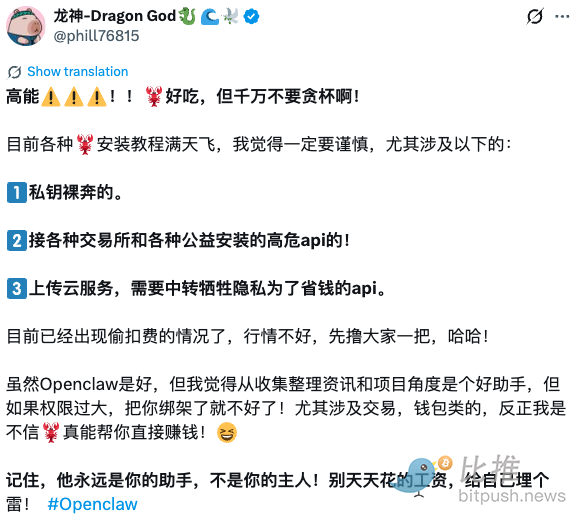
OpenClaw Tencent Free Installation Event: Every Generation Has Its Own Eggs to Receive

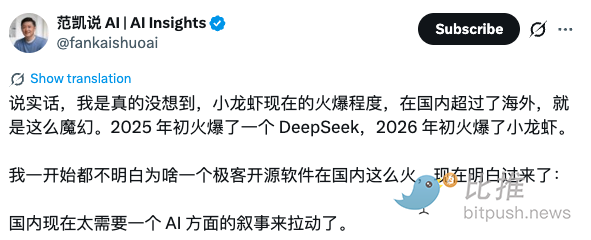
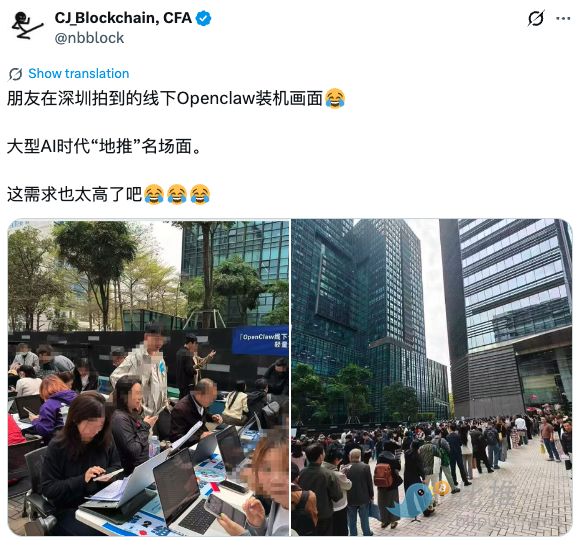
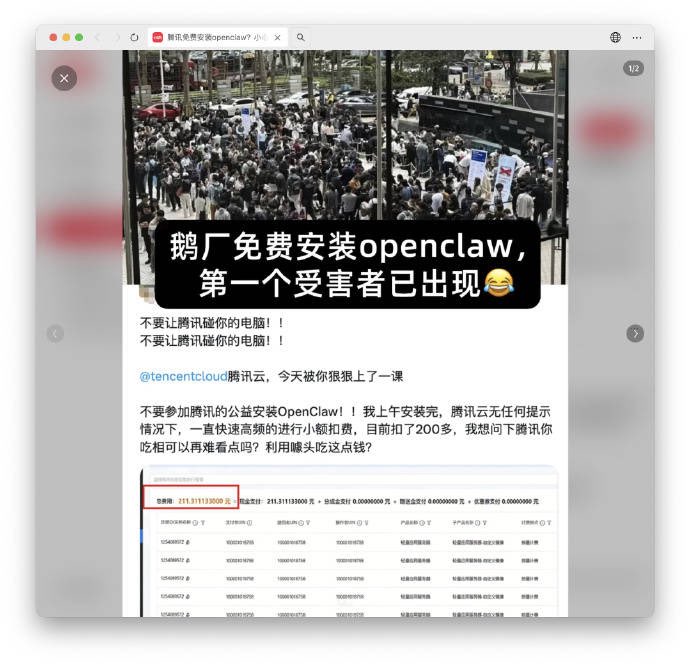
On February 6th, a long queue formed at the door of Tencent (鹅厂): Nearly a thousand developers and AI enthusiasts reportedly came to Tencent Tower and, with the assistance of Tencent Cloud engineers, completed the cloud installation of OpenClaw (commonly known as "Lobster"), collectively becoming "cloud lobster farmers." Some Tencent employees said the last time such a large scene occurred was during the New Year's red envelope distribution.
极速赛车开奖官网历史记录

Popular Comments:

Install it first. You might not use it, but you must have it!

I feel like they installed the Tencent Cloud version. It's said that小龙虾 (little lobster) birth certificates were also handed out on site, clearly stating Tencent Cloud. Tencent doesn't do this for no reason; it feels like a form of灰度测试 (gray scale testing).

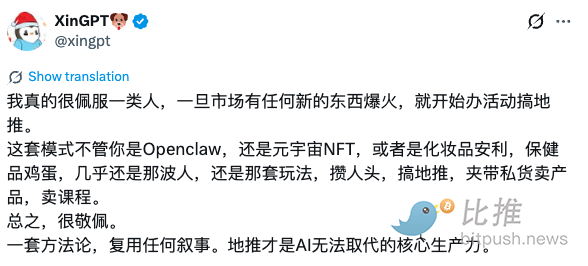
In 2023, it was ground promotion for Web3; in 2024, for大模型API (large model APIs); in 2025, for Agent frameworks. The salespeople in Shenzhen's Huaqiangbei are always at the forefront of the times, just reprinting flyers with a different logo each time.

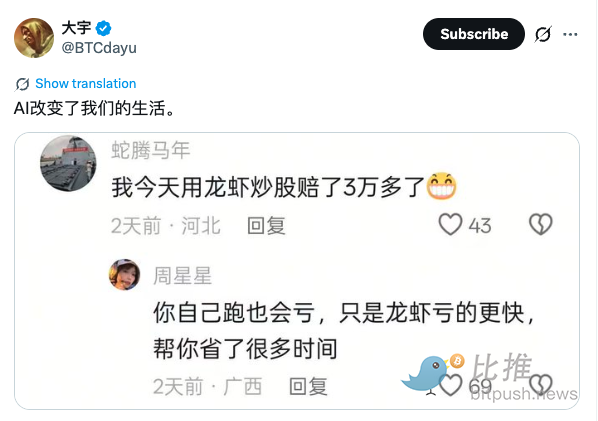
AI Makes Our Lives Better??

Well, losing money also requires efficiency.
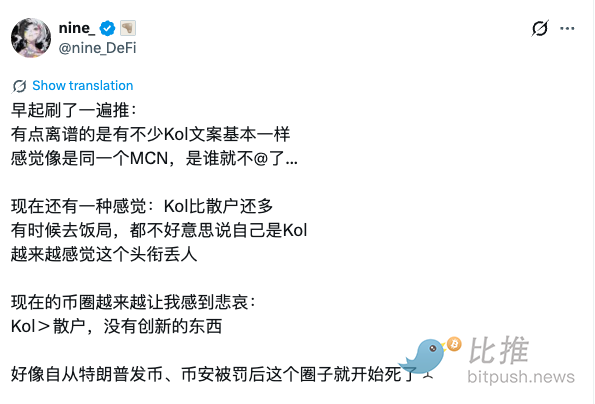
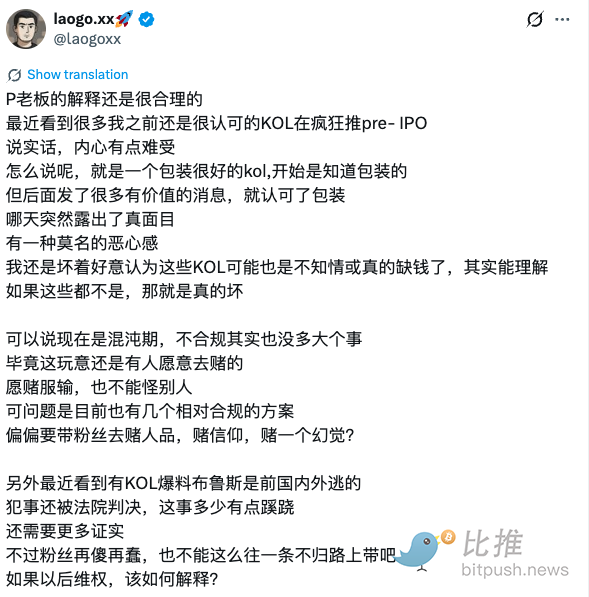
More Crypto KOLs Than Retail Investors? Is a Certain Exchange an Inside Job?
Popular Replies:

Ads are just copy-pasting and sending it once, with minor changes, haha.

The current crypto circle has indeed become a self-indulgent scene for KOLs; everyone is copying each other's homework, while真正的散户 (real retail investors) have become rare.

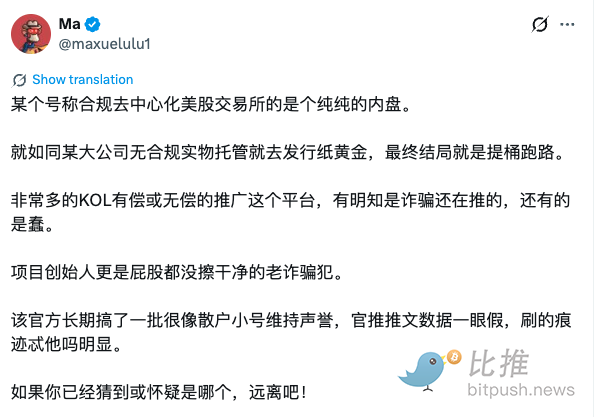
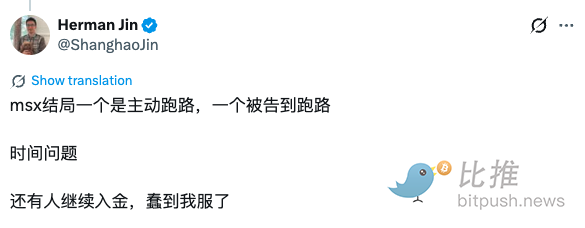
If this isn't a scam, what is? Because the essence is that MSX claims to sell you pre-IPO equity opportunities, but in reality, you are buying air, equity that can never be兑现 (cashed out).

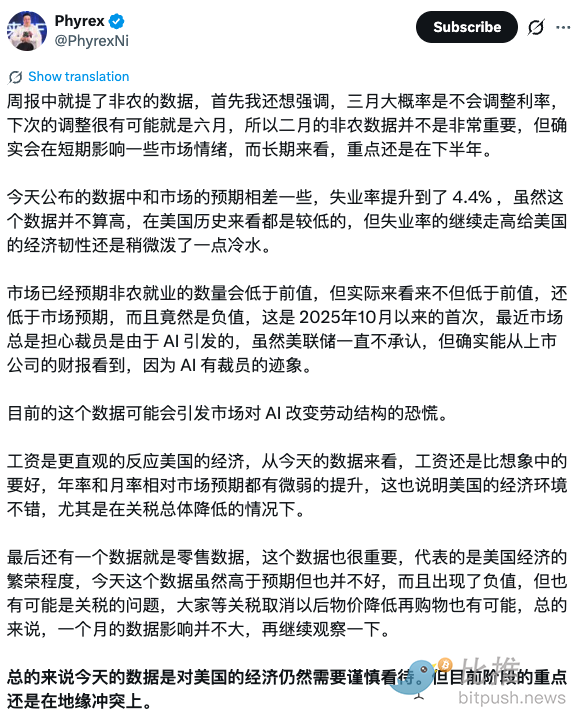
Non-Farm Payroll Data Interpretation and Market Impact

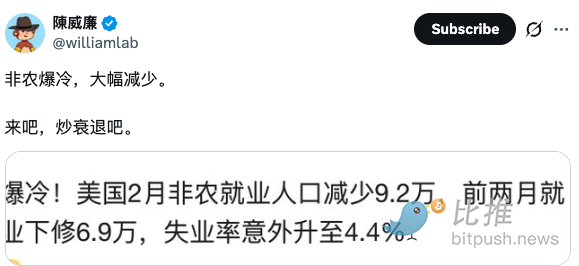
Data shows that U.S. employers surprisingly cut jobs in February, and the unemployment rate rose, raising questions about the health of the labor market. According to data released by the Bureau of Labor Statistics (BLS) on Friday, non-farm payrolls decreased by 92,000 last month, after a strong start to the year. The unemployment rate climbed to 4.4%.

Extended reading:Is It the End for Workers? The 2026 Layoff Wave Has Just Begun...


Twitter:https://twitter.com/BitpushNewsCN

Bitpush TG Discussion Group:https://t.me/BitPushCommunity

Bitpush TG Subscription: https://t.me/bitpush

Original article link:https://www.bitpush.news/articles/7617605

İlgili Sorular

QWhat was the main event that took place at Tencent's headquarters on February 6th?

ANearly a thousand developers and AI enthusiasts queued up at Tencent's headquarters to have OpenClaw (commonly known as 'Lobster') installed on the cloud with the assistance of Tencent Cloud engineers, collectively becoming 'cloud lobster farmers'.

QWhat is OpenClaw, and what did participants receive during the event?

AOpenClaw, colloquially referred to as 'Lobster,' is an AI agent framework. Participants received assistance in installing it on the cloud and were also given a 'lobster birth certificate' that clearly stated it was from Tencent Cloud.

QAccording to the article, what is a major criticism of a certain cryptocurrency exchange?

AThe exchange is accused of being a scam or an internal盘 (internal trading盘), where KOLs are heavily promoting it, but it is suggested that users are essentially buying 'air'—non-existent equity that can never be兑现 (realized or cashed out).

QWhat was the unexpected data from the US Bureau of Labor Statistics (BLS) regarding non-farm payrolls?

AThe data showed that US employers unexpectedly cut 92,000 jobs in February, and the unemployment rate rose to 4.4%, which raised questions about the health of the labor market.

QWhat historical comparison did a Tencent employee make regarding the scale of the OpenClaw event?

AA Tencent employee stated that the last time there was such a large commotion was during the New Year when红包 (red envelopes containing money) were distributed.

İlgili Okumalar

The King of Blind Date Attire in Korea: How SK Hynix Made a Comeback Against Samsung?

In South Korea's dating scene, SK Hynix employees are now highly sought after, a status shift fueled by the company's astronomical profits and employee bonuses, projected to reach up to 6.1 million RMB per person by 2027. This marks a dramatic reversal for the long-time second-place player in memory semiconductors, which has now surpassed its rival Samsung in annual operating profit. The turnaround story began in 2008 when a struggling Hynix, emerging from bankruptcy restructuring, took a risky bet by agreeing to develop High Bandwidth Memory (HBM) with AMD. At the time, HBM had no clear market beyond high-end graphics cards and was a costly, complex technology. Major players like Samsung, pursuing its own HMC technology, declined. For Hynix, with only memory as its core business, it was a gamble born of necessity. The pivotal moment came in 2012 when SK Group Chairman Chey Tae-won acquired Hynix. Defying industry downturns, he invested heavily in R&D and fabrication, sustaining the HBM project through over a decade of commercial uncertainty and internal challenges. A key break occurred around 2016-2017 when Samsung faced production issues supplying HBM2 for Google's TPU, allowing SK Hynix to gain a crucial foothold in the data center market. The AI explosion post-ChatGPT in 2022 was the catalyst, turning HBM into a critical bottleneck for AI accelerators like NVIDIA's GPUs. By 2025, SK Hynix captured 62% of the global HBM market, leaving Samsung at 17%. For the first time, its annual operating profit exceeded Samsung's. Analysts point to the "innovator's dilemma" to explain Samsung's miss: its vast, successful business portfolio made it risk-averse, preventing an all-in bet on the initially niche HBM technology. In contrast, SK Hynix, as a challenger with its back against the wall, had no choice but to commit fully. The story highlights how Korea's chaebol system allows for ultra-long-term bets beyond quarterly pressures. However, SK Hynix's lead isn't guaranteed. Samsung is aggressively catching up on HBM4, and challenges like customer concentration (heavy reliance on NVIDIA) and technical hurdles in advanced packaging remain. The narrative underscores a market truth: the greatest alpha often comes from betting on uncertain, long-term directions others dismiss, much like HBM in 2008.

marsbit23 dk önce

The King of Blind Date Attire in Korea: How SK Hynix Made a Comeback Against Samsung?

marsbit23 dk önce

Understanding Hash in One Article: The "Browser Miner" on Ethereum

Hash is an Ethereum-based ERC-20 token described as a "browser-minable post-quantum token." Its key features include enabling browser-based GPU mining without specialized hardware, a fixed supply cap of 21 million tokens, immutable and permissionless smart contracts with no team allocation or pre-mining, and an emphasis on post-quantum security using Keccak256 hashing. The mining mechanism is a simplified on-chain proof-of-work where miners solve unique challenges tied to their wallet address. Key design elements prevent answer theft, with epochs resetting every 100 blocks (~20 minutes) and a per-block minting limit. Emission follows a Bitcoin-like halving schedule every 100,000 mints, starting at 100 tokens per mint. Projections suggest all tokens could be mined within approximately 294 days if a target rate of one mint per minute is sustained. Hash emphasizes "post-quantum" security by leveraging hash-based primitives like Keccak256, which are considered more resistant to quantum attacks compared to elliptic-curve cryptography. While not a fully post-quantum asset, it aligns with Ethereum's broader post-quantum research narrative. The project completed its Genesis sale at $0.03 and began trading on Uniswap, with its price reaching around $0.19. The initial circulating supply is small, with 5% sold in Genesis and 5% allocated to liquidity. The majority (47.6% of total supply) is allocated to early-stage mining, leading to a front-loaded emission schedule. This structure, combined with low initial liquidity, makes Hash a high-volatility, high-risk project dependent on sustained miner participation and market demand to absorb new supply.

marsbit37 dk önce

Understanding Hash in One Article: The "Browser Miner" on Ethereum

marsbit37 dk önce

OpenAI's Largest Internal Wealth Creation: 600 People Cash Out a Total of $6.6 Billion, 75 Take Home the Maximum $30 Million Each

A Wall Street Journal report reveals OpenAI's unprecedented pre-IPO wealth creation. In a single employee stock sale last October, over 600 current and former employees sold shares, collectively cashing out approximately $6.6 billion. Due to high investor demand, the company tripled the individual sale cap to $30 million, with about 75 employees selling the maximum amount. This event represents the largest such transaction in tech industry history for a private company. OpenAI's valuation was $500 billion for this tender offer. Employees with over two years of tenure were eligible, allowing many post-ChatGPT hires their first liquidity event. The company's stock has reportedly grown over 100-fold in seven years. Following a restructuring, employees collectively hold about 26% of OpenAI. The scale of executive wealth is also staggering. In court testimony related to Elon Musk's lawsuit, President and co-founder Greg Brockman confirmed his OpenAI stake is worth around $30 billion. Analysis indicates about 165 current and former employees hold a combined ~$164.9 billion in equity, averaging nearly $1 billion per person in paper wealth. OpenAI's per-employee stock-based compensation is estimated to be 34 times the average of major tech firms before their IPOs. OpenAI continues its rapid ascent, closing a $122 billion funding round at an $852 billion valuation in March. With monthly revenue hitting $2 billion, over 900 million weekly ChatGPT users, and plans for a potential trillion-dollar IPO in late 2026, this wealth-creation engine shows no signs of stopping.

链捕手59 dk önce

OpenAI's Largest Internal Wealth Creation: 600 People Cash Out a Total of $6.6 Billion, 75 Take Home the Maximum $30 Million Each

链捕手59 dk önce

İşlemler

Spot
Futures
活动图片