Lighter TGE Imminent: Full Overview of Timeline, On-Chain Signals, and Market Pricing

Odaily星球日报2025-12-24 tarihinde yayınlandı2025-12-24 tarihinde güncellendi

Özet

Lighter, a perpetual contract trading platform built on Ethereum L2, is expected to undergo its Token Generation Event (TGE) soon, with market speculation pointing to a window between December 24 and January 1. Key signals include its recent addition to Coinbase's listing roadmap, a Binance perpetual futures pre-market listing, and on-chain movements of 250 million LIT tokens (25% of total supply) suspected to be for airdrop distribution. Data from DeFiLlama shows Lighter leading the Perp DEX sector with $232.3B in trading volume over the past 30 days and a TVL exceeding $1.4B. The project distinguishes itself by leveraging Ethereum's ecosystem rather than building an independent L1, aiming to combine CEX efficiency with DEX security. Pre-market trading on Binance values LIT at around $3.2, implying a fully diluted valuation (FDV) of approximately $3.2B. Market analysts project a range of potential valuations: a bear case of $1.5B FDV ($1.5 per token), a base case of $3B–$4.2B FDV, and a bullish scenario of $7.5B–$12.5B FDV. Users are advised to monitor official announcements closely, as the team is currently reviewing Sybil and wash-trading activities before final airdrop distribution.

Original | Odaily Planet Daily (@OdailyChina)

Author | Asher (@Asher_ 0210)
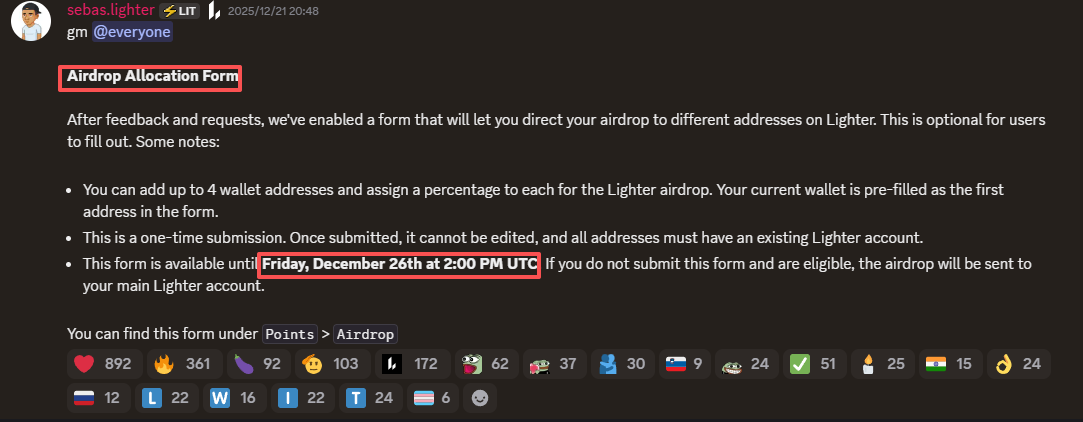
On December 13, Coinbase Markets announced on platform X that Lighter had been added to its listing roadmap; On December 21, Lighter officially announced on Discord, requiring users to complete airdrop address registration by December 26; On December 23, Binance launched Lighter (LIT) perpetual contract pre-market trading. With multiple key milestones landing in quick succession, market expectations for Lighter's imminent Token Generation Event (TGE) have rapidly heated up.
On-chain data further confirms this judgment. On December 20, the Lighter token contract transferred 250 million LIT to a new address (0x98e7769167194A8Cf272B649319676bE84052b5f); This morning, this address has already distributed varying amounts of tokens to 20 addresses, with the highest single transaction being approximately 3.1 million tokens and the lowest about 9,820 tokens. It currently still holds about 230 million LIT. Although the official use of this batch of tokens has not been disclosed, the community widely speculates it may be for airdrop-related distribution.

It is worth noting that 250 million LIT恰好 exactly accounts for 25% of the total token supply,高度 consistent with the community's previous猜测猜测 about "25% allocated for airdrops," further strengthening the market's judgment that Lighter is about to complete its TGE.

Lighter token contract transfers 250 million LIT to a new address

Regarding the timeline expectation, feedback from participants of the previous Lighter Japan AMA suggests the TGE might occur in the window from December 24 to January 1 next year; On the prediction event "When will Lighter conduct its TGE?" on Polymarket, December 29 has the highest probability, currently around 75%.
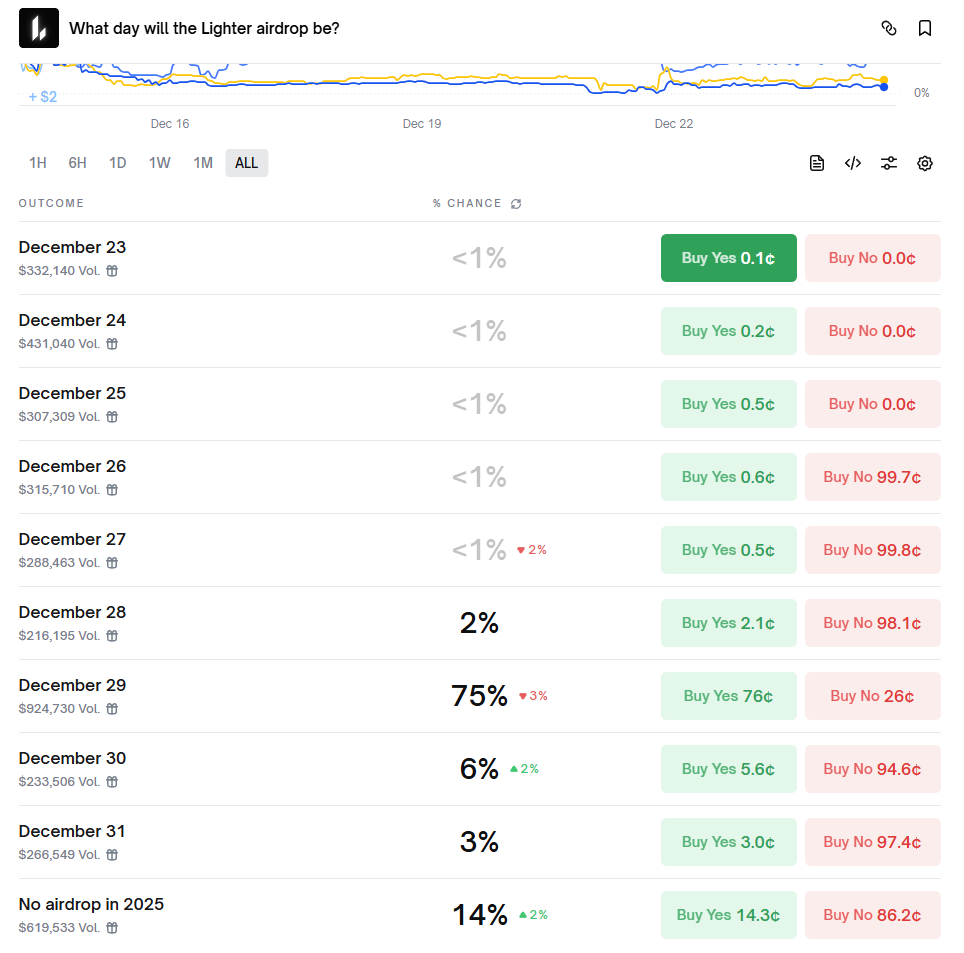
Polymarket prediction event: "On which day will Lighter conduct its TGE?"

Lighter Ranks First in Perp Dex Sector by Perpetual Contract Volume Over Past 30 Days

Lighter is a perpetual contract trading platform built on Ethereum Layer 2 (L2), aiming to combine the speed and liquidity of centralized exchanges (CEX) with the security and transparency of decentralized exchanges (DEX).

According to DeFiLlama data, over the past 30 days, Lighter led the Perp Dex sector with approximately $232.3 billion in perpetual contract trading volume, ahead of Aster ($195.5 billion) and Hyperliquid ($182 billion).

Perp Dex sector perpetual contract trading volume ranking

Furthermore, Lighter's TVL has continued to rise in recent months, currently surpassing $1.4 billion, exceeding Aster's ($1.27 billion).
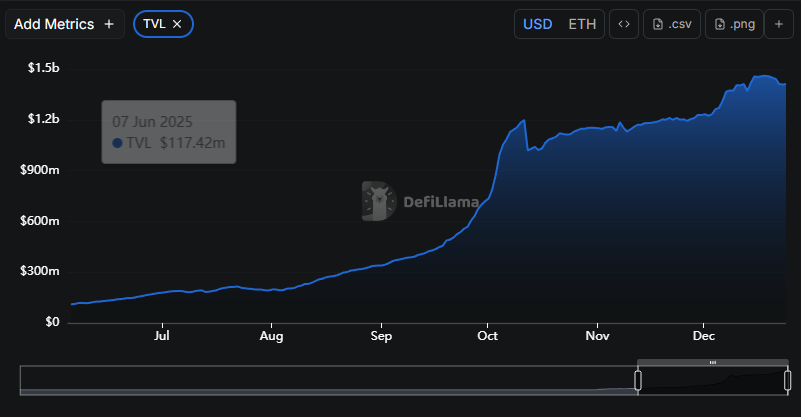
Lighter TVL Data

If Aster's backer is Binance, then Lighter's backer is Ethereum. As Lighter CEO Vladimir Novakovski previously commented on platform X, “Being an L1 is a bug, not a feature.”
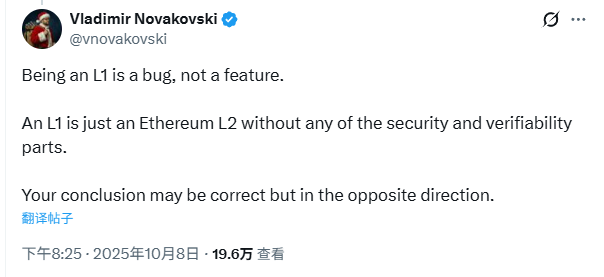
Lighter CEO comments on Lighter's choice of a modular L2 route

Instead of choosing a closed architecture like HyperLiquid's self-built L1, Lighter adopts a core route of "Ethereum-native composability": LLP Tokens can circulate on the mainnet and synergize with DeFi protocols like Aave, thus enjoying a low-cost, low-latency, verifiable execution environment within an open ecosystem. In other words, Lighter's goal is to allow any protocol to reuse its matching engine and capital system. Lighter is not meant to replace Ethereum, but to evolve with Ethereum, becoming the underlying engine for high-performance on-chain finance.

Lighter Valuation and Pre-Market Pricing

Based on Binance's perpetual contract pre-market trading, the LIT price has slowly declined from an initial $3.9 to a current quote of $3.2. At the current price, Lighter's Fully Diluted Valuation (FDV) is approximately $3.2 billion.

If 25% of the total token supply is entirely used for future airdrops, and given a total of 12 million points, then each point corresponds to approximately 20.8 LIT. Estimated at the current pre-market price, each point is worth about $66.

Market Participants' Valuation Range Estimates

Crypto KOL ingalvarez.sol (@ingalvarezsol) predicted Lighter's valuation by combining factors from Polymarket, OTC point prices, and the pre-market LIT token price:

  • $1.5 billion Minimum valuation under pessimistic conditions, corresponding to a token price of ~$1.5;
  • $3–4.2 billion: Bear market benchmark range, corresponding to a token price of ~$3 to $4;
  • $7.5–12.5 billion: Optimistic scenario, corresponding to a token price of ~$7.5 to $12.5;

Another early Lighter user, Chuk (@chuk_xyz), also made predictions based on Lighter's TVL, trading volume, revenue, and other data:

  • Bear Market Range ($1.5B–$4.2B FDV): If the price operates within this range post-TGE, it can be seen as an opportunity zone. The psychological pressure on airdrop holders is lowest, and the risk-reward ratio is clearest.
  • Benchmark Range ($4.2B–$7.5B FDV): If Lighter can stabilize its TVL and maintain a top-tier operational scale, this range can be considered fair value. After the price enters this range, it is suitable to take staged profits to break even while retaining some position.
  • Bull Market Range ($7.5B–$12.5B+ FDV): This range意味着 core catalysts have been fully priced in by the market, including strengthened RWA momentum and consensus formed around the distribution narrative (fintech/broker alignment). This stage is more suitable for continuously reducing positions during the upward trend.

On the Polymarket prediction event "Lighter FDV one day after opening," the probability of exceeding $1 billion FDV is as high as 88%, and the probability of exceeding $2 billion FDV is also 83%.
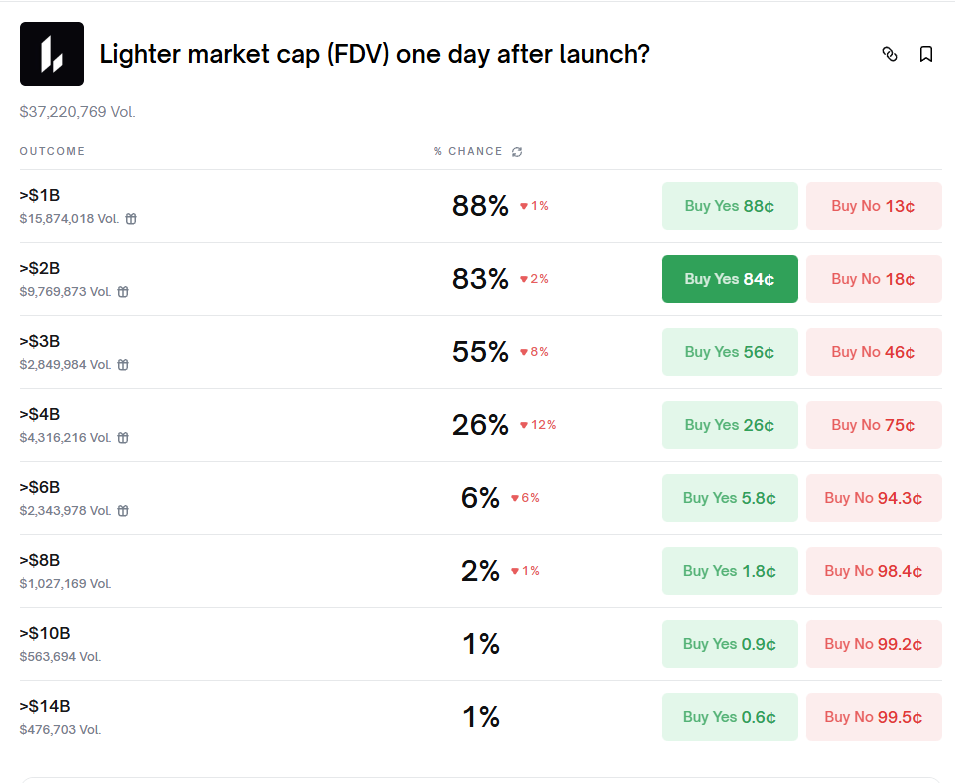
Polymarket event: "Lighter FDV one day after opening"

In summary, the market's minimum expectation for Lighter's opening valuation is an FDV of $1.5 billion, corresponding to a token price of $1.5. Therefore, if the opening price pulls back, $1.5 is an ideal short-term entry price.

Do Not "Celebrate at Halftime," Closely Monitor Official Announcements

Early participants in Lighter interactions must not "celebrate at halftime"; points cannot be considered profit until they are converted into actual LIT tokens. According to the latest announcement from Lighter on their official Discord, "We have entered the final stage of the second season points event. Data analysis is currently underway to remove points obtained by sybil addresses, self-trading, and wash trading. All slashed points (including portions already removed) will be redistributed to the community."

Latest announcement from Lighter on official Discord


İlgili Sorular

QWhat is the expected TGE (Token Generation Event) date for Lighter based on market predictions?

ABased on Polymarket predictions, the highest probability (around 75%) is for the TGE to occur on December 29th. Other community feedback suggests a window between December 24th and January 1st.

QWhat is the significance of the 250 million LIT tokens transferred to a new address on December 20th?

AThe transfer of 250 million LIT tokens, which is 25% of the total supply, is widely speculated by the community to be for airdrop distribution, aligning with previous rumors about the airdrop allocation.

QHow does Lighter's trading volume rank in the Perp DEX sector over the past 30 days?

AAccording to DeFiLlama data, Lighter ranked first in the Perp DEX sector for perpetual contract trading volume over the past 30 days, with approximately $232.3 billion, ahead of Aster and Hyperliquid.

QWhat is the current pre-market price of LIT on Binance and what is the corresponding Fully Diluted Valuation (FDV)?

AThe pre-market price of LIT on Binance is currently around $3.2, which corresponds to a Fully Diluted Valuation (FDV) of approximately $3.2 billion.

QWhat is the core architectural philosophy behind Lighter, as stated by its CEO?

ALighter's CEO, Vladimir Novakovski, stated that 'Being an L1 is a bug, not a feature.' Lighter is built as a modular Layer 2 on Ethereum, aiming to combine CEX-like speed and liquidity with DEX-like security and transparency, and to integrate natively with the Ethereum ecosystem.

İlgili Okumalar

The AI Agent Era Accelerates Its Arrival: Questflow Defines a New Paradigm of Financial Intelligence with On-Chain AI Brokerage

The AI Agent era is accelerating, with the CB Insights AI 100 list highlighting global investment confidence. The focus has shifted from whether AI works to its speed of deployment and ability to manage complex workflows, with autonomous AI Agents driving this transformation. At the forefront is Questflow, a Singapore-based startup redefining financial intelligence through its on-chain AI brokerage. Unlike tools that merely provide data dashboards, Questflow deploys AI Agents that proactively scan markets, form judgments, and execute trades via a conversational interface—operating 24/7 without requiring manual confirmation for each decision. This embodies the new AI paradigm of agents capable of executing multi-step workflows autonomously. Questflow's mission is to democratize institutional-grade trading intelligence. Historically reserved for the ultra-wealthy, this capability is now accessible starting from just $1 through Questflow's "AI Clone + Copy Trade" model. The platform charges only a 1% execution fee, aligning its incentives directly with users and eliminating traditional management or performance fees. The timing is opportune, aligning with key trends identified by CB Insights: the scalable deployment of AI Agents, accelerated AI adoption in financial services, and the maturation of on-chain infrastructure. With robust liquidity on platforms like Hyperliquid and Polymarket, alongside advancements in AI reasoning and non-custodial wallet security, Questflow is positioned to merge the roles of broker, fund, and exchange into a single, accessible platform for millions.

链捕手11 dk önce

The AI Agent Era Accelerates Its Arrival: Questflow Defines a New Paradigm of Financial Intelligence with On-Chain AI Brokerage

链捕手11 dk önce

Why Pricing Social Interactions is Doomed to Fail?

Titled "Why Putting a Price on Social Interaction Is Doomed to Fail," this article critiques attempts to monetize social networks directly through SocialFi models, arguing their inevitable failure stems from a fundamental misunderstanding of media dynamics. Using Marshall McLuhan's theory of "hot" and "cold" media, the author posits that social networks are inherently "cold" media. Their value isn't contained in individual posts but is co-created through user participation, interpretation, and fragmented, ongoing interaction (e.g., replies, shares). This ambiguity and need for user involvement are core to their function. The article asserts that SocialFi projects like Friend.tech failed because introducing real-time, tradable financial pricing (a definitive "hot" signal) into this "cold" environment doesn't add a layer—it replaces the medium's essence. The unambiguous price signal overshadows and nullifies the nuanced, participatory social signal. Users become traders, not participants, and when speculative profits vanish, the underlying social ecosystem—never genuinely cultivated—collapses entirely. This principle extends beyond crypto. The author argues platforms like Twitter have gradually "heated up" through metrics (likes, retweets counts, algorithmically defined value), shifting users from participants to performers and eroding organic engagement. The solution isn't to abandon capital but to manage its entry point. Successful models like Substack, Patreon, or Bandcamp allow capital to "condense" at specific, isolated nodes (e.g., subscriptions, one-time payments) without permeating and "heating" every social interaction. They preserve the core "cold," participatory medium while enabling monetization at designated boundaries. The NFT boom and bust serves as a stark parallel: the ancient "cold" medium of collecting (valued for story, community, gradual accumulation) was rapidly destroyed by platforms that introduced real-time floor prices, rarity scores, and trading dashboards, transforming collectors into speculators and vaporizing cultural value when prices fell. The core lesson: "Liquidity equals heat." Injecting high liquidity and definitive pricing into a "cold" participatory medium doesn't optimize it; it fundamentally alters and destroys its value-creating mechanism. The future lies not in pricing every social gesture but in finding precise, non-invasive points for capital to condense without overheating the entire ecosystem.

marsbit19 dk önce

Why Pricing Social Interactions is Doomed to Fail?

marsbit19 dk önce

Jensen Huang's CMU Speech: In the AI Era, Don't Just Watch, Build

Jensen Huang, CEO of NVIDIA and a first-generation immigrant, delivered the commencement address to Carnegie Mellon University's class of 2026. He shared his personal journey from a humble background to founding NVIDIA, emphasizing resilience, learning from failure, and the responsibility that comes with leadership. Huang framed the present moment as the dawn of the AI revolution, a shift he believes is more profound than previous computing waves. He described AI as fundamentally resetting computing—moving from human-written software to machines that understand, reason, and use tools. This will create a new industry for generating intelligence and transform every sector. While acknowledging AI's potential to automate tasks and displace some jobs, Huang distinguished between the *tasks* of a job and its core *purpose*. He argued AI will augment human capability, not replace humans. The real risk, he stated, is not AI itself, but people being left behind by those who effectively use AI. He presented AI as a generational opportunity for massive infrastructure investment—in chip factories, data centers, energy grids, and advanced manufacturing—that could re-industrialize nations like the U.S. and bridge the digital divide by making computing and intelligent tools accessible to all. Huang called for a balanced approach: advancing AI safely and responsibly, establishing prudent policies, ensuring broad access, and encouraging universal participation. He urged the graduates not to fear the future but to engage with optimism and ambition, reminding them of CMU's motto, "My heart is in the work." His core message was clear: this is their moment to actively build and shape the AI-powered future, not merely observe it.

marsbit1 saat önce

Jensen Huang's CMU Speech: In the AI Era, Don't Just Watch, Build

marsbit1 saat önce

İşlemler

Spot
Futures
活动图片




