Lighter jumps 11% as buybacks tighten supply: Is a breakout toward $1 next?

ambcrypto2026-04-02 tarihinde yayınlandı2026-04-02 tarihinde güncellendi

Özet

LIT (Lighter) surged 11.31% to $0.8818 as cumulative buybacks reached 9.55 million tokens, reducing circulating supply by nearly 4%. This consistent token removal, including over 606K LIT bought back recently, has tightened supply and supported price stability. The rebound from the $0.80 support level indicates weakening bearish momentum, with potential to challenge the $1.00 resistance. Open Interest rose 33.62% to $143 million, reflecting increased leveraged participation and trader confidence. Positive funding rates show longs are dominant, reinforcing structural recovery. Improved technicals and sustained demand suggest a breakout toward $1 is likely.

Lighter has surged 11.31% to $0.8818 as cumulative buybacks reached 9.55 million LIT, rising from 7.48 million earlier in March.

This steady accumulation reflects consistent demand from the protocol, which continues removing tokens from circulation. As a result, nearly 4% of supply now sits absorbed, reducing immediate sell-side availability.

Recent purchases, including over 606K LIT within a week, have reinforced this pattern of sustained accumulation. Lower average buyback prices between $0.80 and $0.95 further increased efficiency, allowing more tokens to exit the market per dollar spent.

This tightening supply condition is now aligned with LIT’s recovery, suggesting structural support continues strengthening beneath current levels.

LIT rebounds as channel weakens

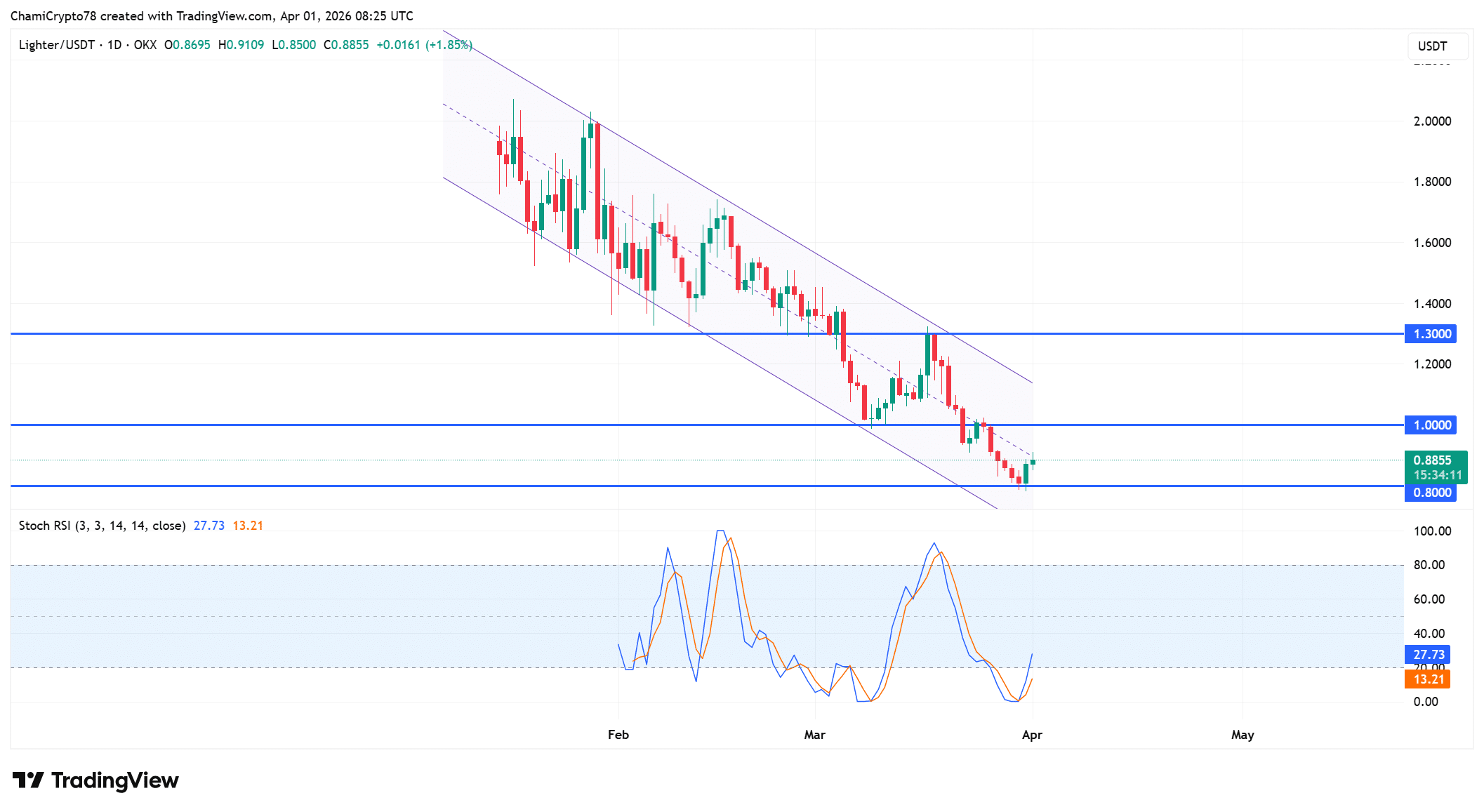
Lighter has rebounded from the $0.80 support zone after respecting the lower boundary of its descending channel. This reaction follows a series of lower lows, which had defined the broader downtrend since February.

However, recent candles showed reduced downside extension, indicating that bearish pressure was weakening near demand. At press time, LIT traded around $0.88 while attempting to reclaim short-term structure inside the channel.

The breakdown pace has slowed, which reflects a shift in seller control. If this recovery continues, price would likely challenge the $1.00 resistance, which aligns with previous consolidation zones.

Above that, $1.30 remains the next key level where prior rejection occurred. Stoch RSI has rebounded from deeply oversold conditions, with readings now at 27.73 and 13.21.

This shift follows a prolonged period of suppressed momentum, where price consistently printed lower lows. The indicator now shows a clear upward turn, reflecting renewed buying activity entering the market.
Source: TradingView

Open Interest expands with participation

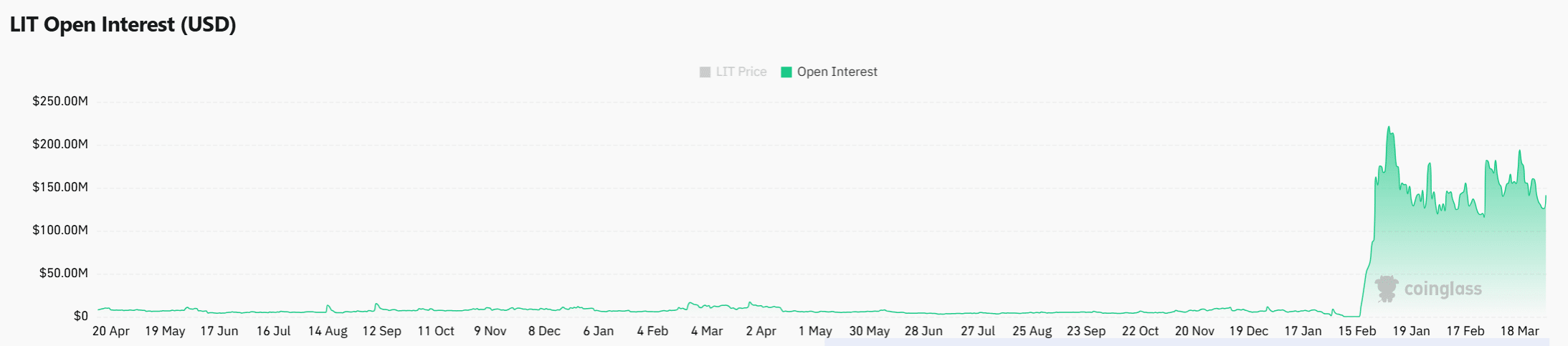
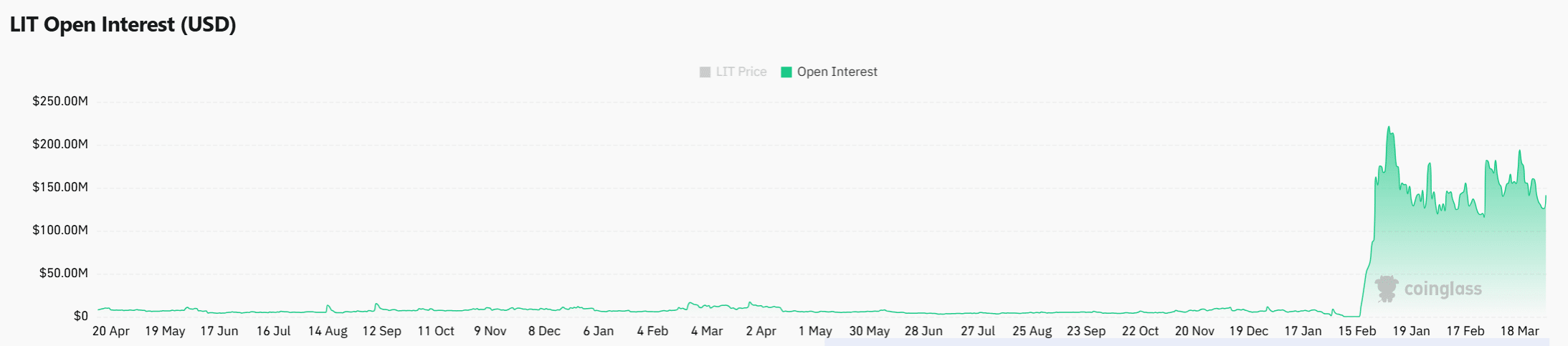
Open interest has surged 33.62% to $143 million, signaling a sharp increase in leveraged participation. This rise occurs alongside price recovery, which indicates that new positions are entering rather than closing out.

Traders now show growing interest in LIT, as capital flows into derivatives markets at a faster pace. This expansion reflects stronger engagement and rising conviction among participants.
Source: CoinGlass

Unlike declining Open Interest scenarios, which often signal uncertainty, this increase supports ongoing activity around current levels.

Funding stays positive as longs dominate

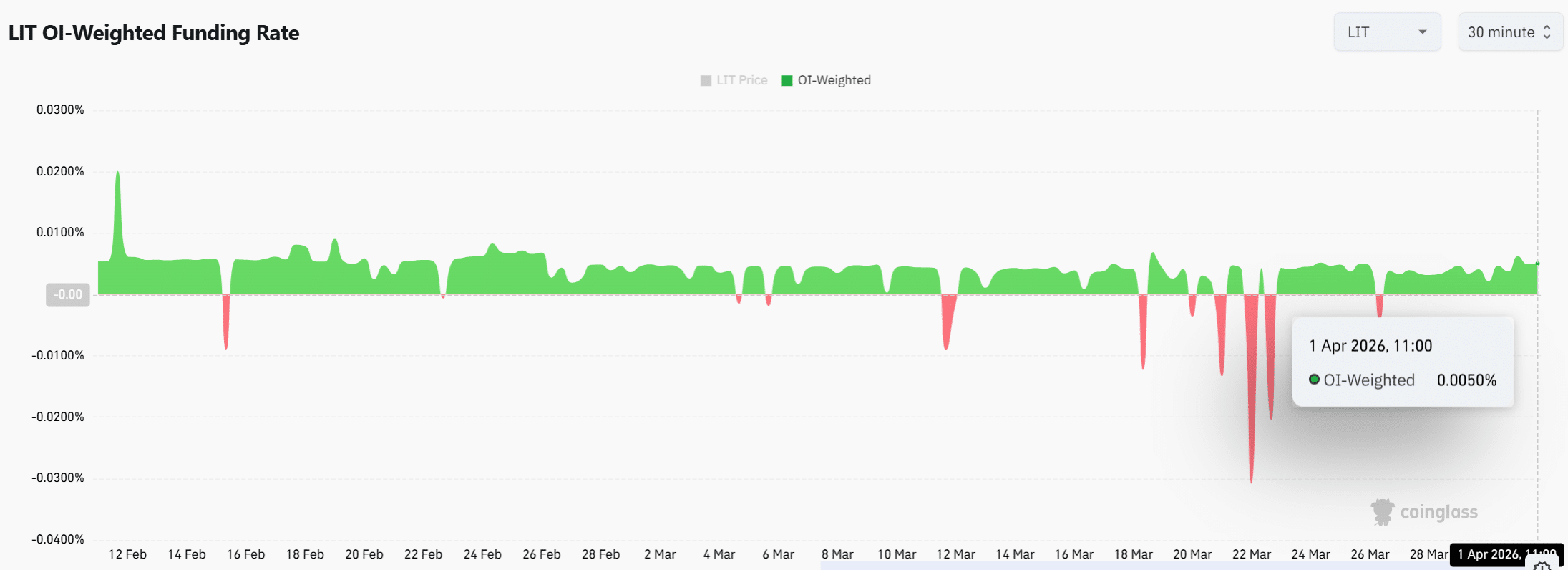
OI-Weighted Funding Rates sat at 0.0050% at the time of writing, maintaining positive positioning across derivatives markets. This sustained level indicated that long traders continued paying premiums to hold positions, reflecting confidence in upward price direction.

Earlier negative spikes had revealed aggressive short pressure, which often preceded liquidation events. However, current conditions show that sentiment has stabilized, with longs maintaining control.

This shift suggests that bearish conviction has weakened after repeated failures to push price lower. As funding remains positive, it reinforces the broader structure where buyers gradually regain dominance across leveraged markets.
Source: CoinGlass

LIT now shows strengthening structure as buybacks tighten supply while participation expands across derivatives markets. Price has stabilized above $0.80 and continues pushing higher with improving conditions.

This alignment suggests recovery remains supported, positioning LIT to challenge the $1.00 resistance zone.


Final Summary

  • Sustained buybacks continue tightening supply, which supports price stability.
  • Rising participation alongside improving structure suggests that buyers are regaining control, which could drive continuation toward higher resistance zones.


İlgili Sorular

QWhat is the main reason for LIT's 11.31% price surge to $0.8818?

AThe main reason is cumulative buybacks reaching 9.55 million LIT, which has tightened the token's circulating supply and reduced immediate sell-side availability.

QHow much of LIT's total supply has been absorbed by the buyback program?

ANearly 4% of LIT's total supply has been absorbed by the buyback program.

QWhat key resistance level is LIT positioned to challenge if its recovery continues?

AIf the recovery continues, LIT is positioned to challenge the $1.00 resistance level, with $1.30 being the next key level beyond that.

QWhat does the 33.62% increase in Open Interest to $143 million indicate?

AThe 33.62% surge in Open Interest indicates a sharp increase in leveraged participation and new positions entering the market, reflecting stronger trader engagement and rising conviction.

QWhat does the positive OI-Weighted Funding Rate of 0.0050% signify for market sentiment?

AThe positive funding rate signifies that long traders are paying premiums to hold their positions, reflecting confidence in an upward price direction and indicating that buyers are regaining dominance.

İlgili Okumalar

Qualcomm Chip Price Hike Deals a Blow to Android Phones

Qualcomm has officially announced a new round of price increases for its entire chip portfolio, effective September 1. The hikes, reaching up to 18% for the flagship Snapdragon 8 Elite Gen 6 Pro, follow similar moves by MediaTek, intensifying cost pressures on the already strained smartphone industry. CEO Cristiano Amon confirmed the plan, citing the need to offset rising industry-wide costs and restore declining profit margins. Qualcomm's Q3 FY2026 results showed a 25% drop in net profit, with mobile revenue plunging 20% year-over-year, hitting its lowest level since 2021. The surge in AI computing demand has led memory manufacturers to prioritize HBM production, creating a shortage in general-purpose DRAM and NAND Flash chips. Their prices soared by 93%-98% and 55%-60% respectively in Q1 2026, causing the memory cost share in smartphones to jump from 10%-15% to over 30%. Coupled with the soaring cost of advanced nodes like TSMC's 2nm and packaging, overall chip costs have reached historic highs. These upstream pressures are forcing downstream smartphone brands like Xiaomi, OPPO, and vivo to cut orders for mid-to-low-end models by up to 20% and use cost-saving measures like older chipsets. Reportedly, the Snapdragon 8E5 will be repurposed as a "long-lasting" chip for sub-brand phones in H2 2026. Amid this cost crisis, the Android market remains sluggish. Q2 2026 smartphone shipments in China fell 4.3% year-over-year, marking five consecutive quarters of decline. Major Android brands saw market share drop, while Huawei and Apple, with their in-house chip advantages, gained share. Qualcomm is diversifying into automotive and IoT sectors to reduce reliance on smartphones, but these new segments cannot yet fill the mobile revenue gap. Industry observers warn that the full impact of component cost hikes will hit in the second half of 2026, likely leading to higher-than-expected price increases for Android flagships and a further contraction in the Chinese smartphone market.

marsbit45 dk önce

Qualcomm Chip Price Hike Deals a Blow to Android Phones

marsbit45 dk önce

Breaking: GPT-5.6 Prices Slashed Effective Today

OpenAI has announced significant price cuts for its GPT-5.6 model API, effective immediately. The entry-level **GPT-5.6 Luna** sees the most drastic reduction, with input prices dropping 80% to $0.20 per million tokens and output prices falling to $1.20 per million tokens. The mid-tier **GPT-5.6 Terra** is reduced by 20%, now costing $2.00 (input) and $12.00 (output) per million tokens. The flagship **GPT-5.6 Sol** maintains its original price but introduces a new **Fast mode**, offering speeds up to 2.5 times faster for double the cost. The company attributes these price reductions to efficiency gains achieved through **GPT-5.6 Sol's own involvement in optimizing its production systems**. The model assisted in rewriting GPU kernels and improving speculative decoding, leading to a 20% reduction in end-to-end service costs and over 15% improvement in token generation efficiency. OpenAI emphasizes this process remained human-led. A key focus of the降价 is to lower the barrier for running **AI agent workflows**. By making the capable, tool-calling Luna model significantly cheaper, OpenAI aims to enable more frequent use in cost-sensitive, high-volume tasks like code review and monitoring. This creates a potential feedback loop: model-assisted efficiency gains lead to lower costs, which enables broader agent deployment, which in turn drives further optimization. The new pricing and features will also apply to Codex and ChatGPT Work subscriptions. The changes intensify competition in the large language model market, with OpenAI directly challenging rivals like Anthropic to respond.

marsbit1 saat önce

Breaking: GPT-5.6 Prices Slashed Effective Today

marsbit1 saat önce

İşlemler

Spot
活动图片