Less Than a Year in Office and Leaving Again: Why Are Core Figures of the Ethereum Foundation Departing Once More?

marsbit2026-02-14 tarihinde yayınlandı2026-02-14 tarihinde güncellendi

Özet

Tomasz Stańczak, the co-executive director of the Ethereum Foundation (EF), has announced his resignation, just 11 months after taking the role. He was appointed alongside Hsiao-Wei Wang in March 2025, replacing long-time leader Aya Miyaguchi amid community criticism that EF was too slow and disconnected. Stańczak, founder of core Ethereum client Nethermind, was brought in to make EF more decisive and execution-focused. During his tenure, he streamlined operations, refocused strategy on Layer-1 scaling, accelerated upgrade timelines, and pushed new initiatives in AI integration and privacy. His departure hints at internal tension. In his statement, Stańczak suggested his ability to operate independently within EF diminished as the leadership became more self-sufficient. He expressed a desire to return to hands-on product building, specifically in AI/blockchain convergence, echoing Ethereum’s early experimental spirit. He is replaced by Bastian Aue, a low-profile internal figure focused on "principled" decision-making aligned with "cypherpunk values," signaling a potential shift back towards a coordination-focused rather than execution-driven approach. This leadership change comes at a critical time. EF is preparing to release key proposals on "Lean Ethereum" and future roadmaps, while Ethereum faces intense competition, Layer-2 fragmentation, and market pressure—with its price risk falling below inflation-adjusted 2018 levels.

The Ethereum Foundation (EF) once again finds itself at a crossroads of personnel turmoil.

Tomasz Stańczak, the co-executive director of the Ethereum Foundation, has announced that he will step down at the end of this month. This comes just 11 months after he and Hsiao-Wei Wang jointly succeeded the long-standing leader Aya Miyaguchi in March last year to form a new leadership core.

He will be succeeded by Bastian Aue. There is very little public information about this individual; his X account was registered just eight months ago and has almost no record of posts. He will continue to co-lead this organization, which controls the core resources and direction of the Ethereum ecosystem, alongside Hsiao-Wei Wang.

This seemingly sudden personnel change is actually an inevitable result of the interplay of internal conflicts, external pressures, and strategic transformation within the Ethereum Foundation.

Stepping Up in a Crisis: A Turbulent Year

To understand Stańczak's departure, one must first return to the context of his appointment.

In early 2025, the Ethereum community was in a period of anxiety. At that time, the overall cryptocurrency market was rising after the U.S. election, with Bitcoin repeatedly hitting new highs, and competing chains like Solana gaining strong momentum. However, Ethereum's price performance was relatively weak, and the Ethereum Foundation itself became a target of criticism.

The criticism was directed squarely at then-Executive Director Aya Miyaguchi. The developer community complained that the Foundation was severely disconnected from frontline builders, had conflicting strategic interests, and was insufficiently promoting Ethereum. Some questioned whether the Foundation was too "passive," and in its gentle posture of acting as a "coordinator" rather than a "leader," was letting Ethereum lose its first-mover advantage.

As the "central bank" of Ethereum, the Foundation was being asked not to govern by inaction, but to strike out forcefully.

Amid this storm of public opinion, Miyaguchi stepped back into a board role. Stańczak and Wang were thrust into the spotlight to take charge.

Stańczak was not an outsider. He is the founder of Nethermind, a company that is one of the core execution clients of the Ethereum ecosystem, playing a key role in infrastructure construction. He understands technology, has entrepreneurial experience, and has a firsthand understanding of the community's pain points.

In his own words, the directive he received upon taking office was clear: "The community is calling out—you are too chaotic, you need to be a bit more centralized, a bit faster, to deal with this critical period."

What was done this year?

The combination of Stańczak and Wang did bring visible changes.

First, organizational efficiency. The Foundation laid off 19 employees, streamlined its structure, and attempted to shed its bureaucratic label. The strategic focus shifted from Layer 2 back to Layer 1 itself, with a clear statement prioritizing the scaling of the Ethereum mainnet over letting L2s operate independently. The upgrade pace noticeably accelerated, and the promotion of EIPs became more decisive than before.

Second, an adjustment in posture. The Foundation began publishing series of videos on social media, proactively explaining Ethereum's technical roadmap and development direction to the public. This "outreach" communication style contrasted with its previous relatively closed and mysterious image.

In terms of strategic layout, Stańczak promoted exploration in several new directions: privacy protection,应对量子计算威胁 (responding to quantum computing threats), and the integration of artificial intelligence with Ethereum. Particularly regarding AI, he explicitly stated he saw the trend of "agentic systems" and "AI-assisted discovery" reshaping the world.

Financially, the Foundation began discussing more transparent budget management and fund allocation strategies, attempting to address external doubts about the efficiency of treasury use.

Vitalik Buterin's evaluation of Stańczak was: "He helped greatly improve the efficiency of multiple departments within the Foundation, making the organization more agile in responding to the external world."

Reading Between the Lines of the Resignation Statement

Why leave after less than a year?
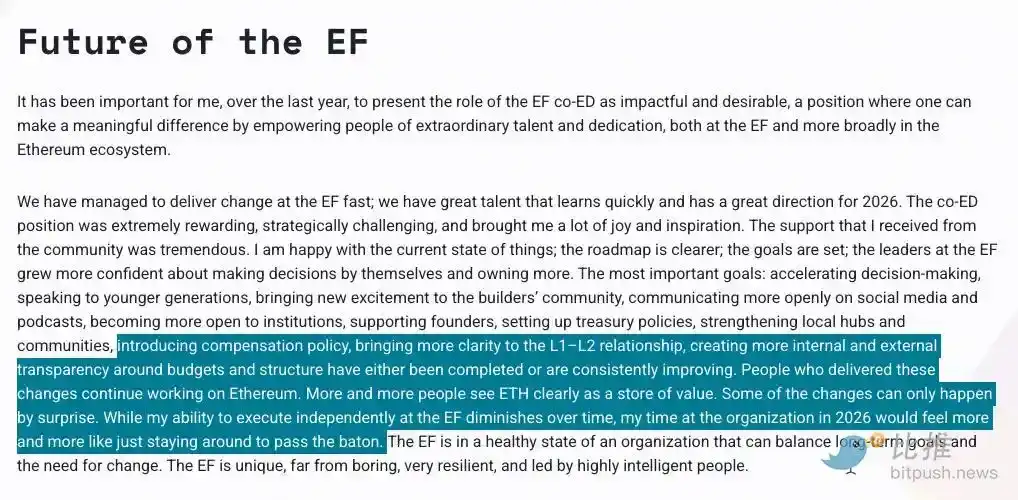
Stańczak's resignation statement was quite candid and somewhat thought-provoking. He provided several key points of information:

First, he believes the Ethereum Foundation and the entire ecosystem are "in a healthy state." The time for handing over the baton has come.

Second, he wants to return to being a "hands-on product builder," focusing on the combination of AI and Ethereum. He said his current mindset is similar to when he founded Nethermind in 2017.

Third, and most intriguingly: "The leadership layer of the Foundation is increasingly confident in making their own decisions and taking control of more matters. Over time, my ability to execute independently within the Foundation has diminished. If I stayed on, in 2026 I would mostly just be 'waiting to hand over the baton.'"

This sentence reveals two layers of meaning: first, the new leadership team has developed self-drive and no longer needs his involvement in everything; second, his actual sphere of influence may have been shrinking. For someone accustomed to getting hands-on and with a strong entrepreneurial temperament, this feeling was clearly not a good fit for him.

He also mentioned, "I know many current ideas about agentic AI might be immature, even useless, but it is this kind of playful experimentation that defined the innovative spirit of early Ethereum."

This statement carries a hint of implicit criticism of the status quo: as the organization becomes more "mature" and decisions become more "stable," will that wild, experimental spirit be lost?

Stańczak's departure,表面上 (on the surface) a personal choice,背后 (behind it) lies the long-standing dilemma faced by the Ethereum Foundation.

Since its inception, this organization has been in an awkward position. Theoretically, Ethereum is decentralized, and the Foundation should not be a command-and-control power center. But in practice, it controls significant funds, core developer resources, and has a coordinating voice in the ecosystem, objectively承担着 (bearing) the dual roles of "central bank" and "economic planning agency."

This identity paradox has long placed the Foundation in a double bind: doing too much draws accusations of centralization; doing too little invites criticism for inaction. The Miyaguchi era leaned towards a "coordinator"定位 (positioning), resulting in criticism of weakness; Stańczak attempted to shift towards an "executor" role, efficiency did improve, but the internal distribution of power within the organization naturally became more concentrated.

Stańczak's resignation statement恰恰暴露了 (precisely exposes) this tension: as the organization became more efficient and decisions more decisive, the personal maneuvering room for founding team members was反而压缩 (instead compressed). For an ecosystem that needs to balance "decentralized spirit" and "market competition efficiency," this internal friction is almost unavoidable.

What kind of person is Bastian Aue, who is replacing Stańczak?

There is extremely little public information. His own description on X is that he was previously responsible for "work that is difficult to quantify but crucial" at the Foundation: assisting management decision-making, communicating with team leaders, budget considerations, strategic梳理 (sorting), priority setting. This low-key style contrasts with Stańczak's distinct entrepreneurial气质 (temperament).

Aue said in his acceptance statement: "My basis for making decisions is a principled insistence on certain properties of what we are building. The mission of the Foundation is to ensure that truly permissionless infrastructure—the core is the cypherpunk spirit—can be built."
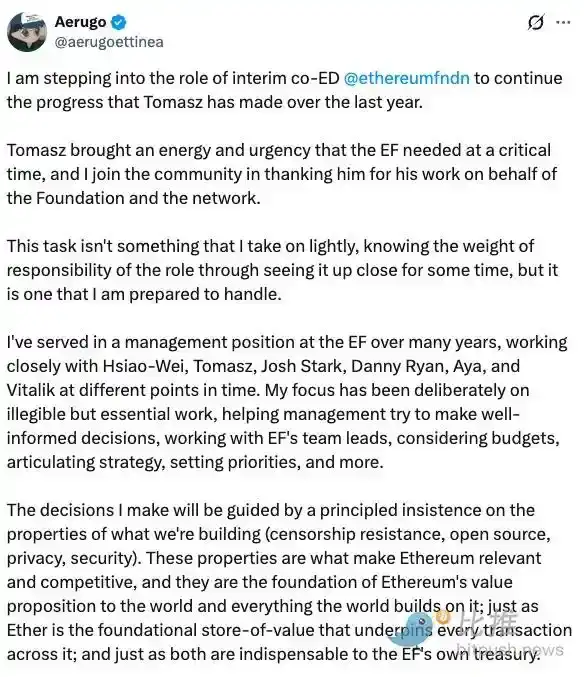
This language sounds more like the style of the Miyaguchi era: emphasizing principles, emphasizing spirit, emphasizing coordination rather than leadership.

Does this mean the Foundation will rebalance its direction, dialing back from "aggressive execution" to "principled coordination"? This remains to be seen.

Ethereum's Confusion

Stańczak's departure comes at a time when Ethereum is discussing a series of major proposals. According to him, the Foundation is about to release several key documents, including specific plans for "Lean Ethereum," the future development roadmap, and DeFi coordination mechanisms.

Among them, the "Lean Ethereum" proposal has been jokingly called "Ethereum's weight loss era" by some community members—intending to simplify the protocol, reduce burdens, and make the mainnet run more efficiently.

These directional documents will profoundly影响 (affect) Ethereum's evolution path in the coming years. Changing the core executive负责人 (person in charge) at this moment undoubtedly adds uncertainty to the implementation of these proposals.

The broader context is that Ethereum is facing challenges from multiple fronts: competition from high-performance chains like Solana, the fragmentation issue with Layer 2s, the new narrative window of AI and blockchain integration, and the impact of overall crypto market sentiment fluctuations on ecosystem funding and attention.

On the same day Stańczak announced his departure, ETH一度跌入 (once fell into) the $1800 range. If it continues to break below this level, an awkward fact will emerge: the comprehensive return on holding ETH may fall below the dollar cash interest rate.

Do the math for a more painful realization: In January 2018, ETH first stood above $1400. That $1400, adjusted for U.S. CPI inflation with compound interest, would be equivalent to approximately $1806 by February 2026.
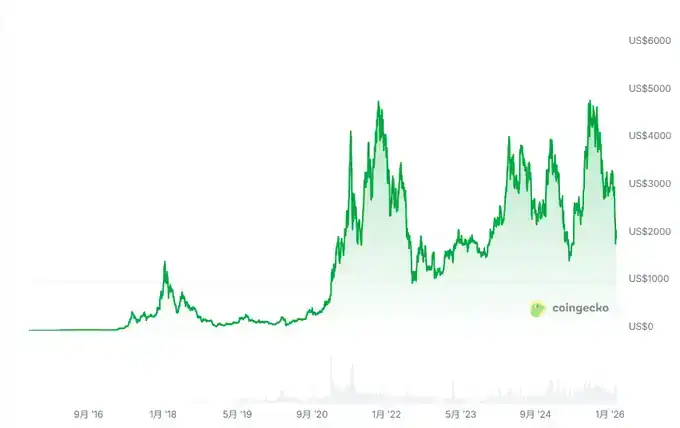
In other words, if an investor bought ETH in 2018 and held it裸持 (naked, meaning without staking) until now, after eight years, they not only made no money but even underperformed U.S. dollars left in a bank earning interest.

For the "Ethereum Guards" (E 卫兵, loyal supporters) who have believed all along, the real拷问 (questioning) might not be "who won the路线之争 (route dispute)," but rather: how much longer can this last?

The only certainty is: this core organization, which controls one of the most important ecosystems in the crypto world, is still searching for its定位 (positioning) in a rapidly changing industry, and this path is注定 (destined) not to be平静 (calm).


İlgili Sorular

QWho is leaving the Ethereum Foundation (EF) and after how long in the role?

ATomasz Stańczak, the EF's co-executive director, is leaving after just 11 months in the position.

QWhat were some of the key changes implemented during Tomasz Stańczak's tenure?

AKey changes included organizational streamlining with 19 employees laid off, a strategic refocus on Layer 1 scaling over Layer 2, faster upgrade cycles, more proactive public communication, and exploration of new areas like AI integration and quantum resistance.

QWhat reason did Tomasz Stańczak give for his departure from the Ethereum Foundation?

AHe stated he wanted to return to being a hands-on product builder, focusing on AI and Ethereum. He also implied his ability to execute independently within the foundation was diminishing as the leadership team became more self-sufficient.

QWho is replacing Tomasz Stańczak and what is known about his approach?

ABastian Aue is replacing him. Public information is scarce, but his statements suggest a leadership style that emphasizes principle-based decisions and a focus on 'cryptopunk spirit' and coordination, which contrasts with Stańczak's more execution-focused, entrepreneurial approach.

QWhat broader challenge for Ethereum is highlighted by the ETH price comparison from 2018?

AThe article highlights a significant performance challenge: an ETH bought in January 2018 and held without staking would be worth less in real terms (adjusted for inflation) than if the same amount of USD had been kept in a bank account earning interest, raising questions about long-term value retention for passive holders.

İlgili Okumalar

Polymarket's "2028 Presidential Election" Volume King Is... LeBron James???

An article from Odaily Planet Daily, authored by Azuma, discusses a peculiar phenomenon observed on the prediction market platform Polymarket regarding the "2028 US Presidential Election" event. Despite having a real-time probability of less than 1%, unlikely candidates such as NBA star LeBron James (with $48.41 million in trading volume), celebrity Kim Kardashian ($33.84 million), and even ineligible figures like Elon Musk ($23.14 million) and New York City Mayor Zohran Mamdani ($18.39 million) account for approximately 70% of the total trading volume. In contrast, high-probability candidates like Vice President JD Vance ($10.58 million), California Governor Gavin Newsom ($15.71 million), and Secretary of State Marco Rubio ($9.32 million) have significantly lower trading activity. The article explains that this counterintuitive trend is not driven by irrational speculation but by rational strategies. Polymarket offers a 4% annualized holding reward for certain markets, including the 2028 election, to maintain long-term pricing accuracy. This yield exceeds the current 5-year US Treasury rate (3.98%), attracting large investors ("whales") to hold "NO" shares on low-probability candidates for risk-free returns. Additionally, some users utilize a platform feature that allows converting a set of "NO" shares into corresponding "YES" shares for better liquidity or pricing efficiency, rather than directly buying "YES" shares for their preferred candidates. Thus, the seemingly absurd trading activity is strategically motivated.

marsbit1 saat önce

Polymarket's "2028 Presidential Election" Volume King Is... LeBron James???

marsbit1 saat önce

Dialogue with ViaBTC CEO Yang Haipo: Is the Essence of Blockchain a Libertarian Experiment?

"ViaBTC CEO Yang Haipo: Blockchain as a Hardcore Libertarian Experiment" In a deep-dive interview, ViaBTC CEO Yang Haipo reframes the essence of blockchain, arguing it is not merely a new technology or infrastructure but a hardcore libertarian experiment. This experiment, born from the 2008 financial crisis and decades of cypherpunk ideology, tests a fundamental question: to what extent can freedom and self-organization exist without centralized trust? The discussion highlights the experiment's verified outcomes. On one hand, it has proven its core value of censorship resistance, providing critical financial lifelines for entities like WikiLeaks and individuals in hyperinflationary or sanctioned countries via tools like stablecoins. However, Yang points out a key paradox: the most successful product, USDT, is itself a centralized compromise, showing users prioritize a less-controlled pipeline over pure decentralization. On the other hand, the experiment has exposed the severe costs of this freedom—a "dark forest" without safeguards. Events like the collapses of LUNA, Celsius, and FTX, resulting in massive wealth destruction and prison sentences for founders, underscore the system's fragility and the inherent risks of an unregulated environment. Yang observes that despite decentralized protocols, human nature inevitably recreates centralized power structures, speculative frenzies, and narrative-driven cycles (from ICOs to Meme coins), where emotion and belonging often trump technological substance. Looking forward, he believes blockchain's future is significant but niche. Its real value lies in serving specific, real-world needs for financial sovereignty and bypassing traditional controls, not as a universal infrastructure replacing all centralized systems. For the average participant, Yang's crucial advice is to cultivate independent judgment. True freedom is not holding a crypto wallet, but possessing a mind resilient to groupthink and narrative hype in a high-risk, often irrational market.

marsbit1 saat önce

Dialogue with ViaBTC CEO Yang Haipo: Is the Essence of Blockchain a Libertarian Experiment?

marsbit1 saat önce

İşlemler

Spot
Futures

Popüler Makaleler

ETH 2.0 Nedir

ETH 2.0: Ethereum için Yeni Bir Dönem Giriş ETH 2.0, Ethereum 2.0 olarak da bilinir, Ethereum blok zincirinde önemli bir yükseltmeyi işaret eder. Bu geçiş yalnızca bir yüz değiştirme değil; ağın ölçeklenebilirliğini, güvenliğini ve sürdürülebilirliğini temelinden geliştirmeyi hedeflemektedir. Enerji yoğun Proof of Work (PoW) konsensüs mekanizmasından daha verimli olan Proof of Stake (PoS) mekanizmasına geçişle birlikte, ETH 2.0 blok zinciri ekosistemine dönüştürücü bir yaklaşım vaat etmektedir. ETH 2.0 Nedir? ETH 2.0, Ethereum'un yeteneklerini ve performansını optimize etmeye odaklanmış özel, birbirine bağlı güncellemelerin bir derlemesidir. Yenileme, mevcut Ethereum mekanizmasının karşılaştığı kritik zorlukları, özellikle işlem hızı ve ağ tıkanıklığı ile ilgili sorunları ele almak üzere tasarlanmıştır. ETH 2.0'ın Amaçları ETH 2.0'ın ana amaçları, üç temel unsuru geliştirmeye odaklanmaktadır: Ölçeklenebilirlik: Ağın saniye başına işleyebileceği işlem sayısını önemli ölçüde artırmayı hedefleyen ETH 2.0, mevcut yaklaşık 15 işlem/saniye sınırlamasını aşmayı ve potansiyel olarak binlerce işleme ulaşmayı planlamaktadır. Güvenlik: Geliştirilmiş güvenlik önlemleri, özellikle siber saldırılara karşı daha iyi direnç sağlama ve Ethereum'un merkeziyetsiz görünümünü koruma açısından ETH 2.0 için hayati öneme sahiptir. Sürdürülebilirlik: Yeni PoS mekanizması, sadece verimliliği artırmakla kalmayıp aynı zamanda enerji tüketimini de önemli ölçüde azaltma hedefiyle tasarlanmış olup, Ethereum'un operasyonel çerçevesini çevresel kaygılarla uyumlu hale getirmektedir. ETH 2.0'ın Yaratıcısı Kimdir? ETH 2.0'ın yaratılması Ethereum Vakfı'na atfedilebilir. Ethereum'un gelişimini destekleme konusunda kritik bir rol oynayan bu kar amacı gütmeyen kuruluş, dikkat çekici kurucu ortağı Vitalik Buterin tarafından yönetilmektedir. Daha ölçeklenebilir ve sürdürülebilir bir Ethereum vizyonu, bu yükseltmenin arkasındaki itici güç olmuştur ve protokolü geliştirmek için kendini adamış küresel bir geliştici ve meraklı topluluğunun katkılarını içermektedir. ETH 2.0'ın Yatırımcıları Kimlerdir? ETH 2.0 yatırımcıları ile ilgili detaylar kamuoyuna açıklanmamış olsa da, Ethereum Vakfı'nın blok zinciri ve teknoloji alanında çeşitli kuruluşlar ve bireyler tarafından desteklendiği bilinmektedir. Bu ortaklar arasında merkeziyetsiz teknolojilerin ve blok zinciri altyapısının geliştirilmesine karşılıklı ilgi duyan girişim sermayesi şirketleri, teknoloji firmaları ve hayır kurumları yer almaktadır. ETH 2.0 Nasıl Çalışır? ETH 2.0, onu öncüsünden ayıran bir dizi önemli özelliği tanıtmasıyla dikkat çekmektedir. Proof of Stake (PoS) PoS konsensüs mekanizmasına geçiş, ETH 2.0'ın en belirgin değişikliklerinden biridir. İşlem doğrulama için enerji yoğun madenciliğe dayanmak yerine, PoS kullanıcıların ağa yatırdıkları ETH miktarına göre işlemleri doğrulayıp yeni bloklar oluşturmalarına olanak tanır. Bu, enerji verimliliğinin artırılmasına yol açarak tüketimi yaklaşık %99,95 oranında azaltmakta ve Ethereum 2.0'ı önemli ölçüde daha çevre dostu bir alternatif haline getirmektedir. Shard Zincirleri Shard zincirleri, ETH 2.0'ın diğer bir kritik yeniliğidir. Bu daha küçük zincirler, ana Ethereum zinciri ile paralel olarak çalışarak birden fazla işlemin aynı anda işlenmesine olanak tanır. Bu yaklaşım, ağın genel kapasitesini artırarak Ethereum'u rahatsız eden ölçeklenebilirlik sorunlarını ele alır. Beacon Zinciri ETH 2.0'ın temelinde, ağı koordine eden ve PoS protokolünü yöneten Beacon Zinciri yer almaktadır. Bu, bir tür organizatör olarak işlev görür: doğrulayıcıları denetler, shard'ların ağa bağlı kalmasını sağlar ve blok zinciri ekosisteminin genel sağlığını izler. ETH 2.0 Zaman Çizelgesi ETH 2.0'ın yolculuğu, bu önemli yükseltmenin evrimini gösteren birkaç önemli dönüm noktası ile tanımlanmıştır: Aralık 2020: Beacon Zinciri'nin başlatılması, PoS'un tanıtımını işaret etmiş ve ETH 2.0’a geçiş için sahneyi hazırlamıştır. Eylül 2022: "The Merge" tamamlanması, Ethereum ağının başarılı bir şekilde PoW'den PoS çerçevesine geçiş yaptığı kritik bir anı temsil etmekte ve Ethereum için yeni bir dönemi müjdelemektedir. 2023: Shard zincirlerinin beklenen dağıtımı, Ethereum ağının ölçeklenebilirliğini daha da artırmayı hedeflemekte ve ETH 2.0'ı merkeziyetsiz uygulamalar ve hizmetler için sağlam bir platform haline getirmeyi pekiştirmektedir. Ana Özellikler ve Faydalar Geliştirilmiş Ölçeklenebilirlik ETH 2.0'ın en önemli avantajlarından biri, geliştirilmiş ölçeklenebilirliğidir. PoS ve shard zincirlerinin kombinasyonu, ağın kapasitesini artırarak, eski sistemle kıyaslandığında çok daha fazla işlem hacmi karşılayabilmesini sağlamaktadır. Enerji Verimliliği PoS'un uygulanması, blok zinciri teknolojisinde enerji verimliliği yönünde büyük bir adım teşkil etmektedir. Enerji tüketimini ciddi şekilde azaltarak, ETH 2.0 yalnızca işletme maliyetlerini düşürmekle kalmaz, aynı zamanda küresel sürdürülebilirlik hedefleriyle daha yakın bir uyum sağlar. Geliştirilmiş Güvenlik ETH 2.0'ın güncellenmiş mekanizmaları, ağ genelinde güvenliğin artırılmasına katkıda bulunmaktadır. PoS'un uygulanması ve shard zincirleri ile Beacon Zinciri aracılığıyla geliştirilen yenilikçi kontrol önlemleri, potansiyel tehditlere karşı daha yüksek bir koruma sağlar. Kullanıcılar için Düşük Maliyetler Ölçeklenebilirlik geliştikçe, işlem maliyetleri üzerindeki etkiler de belirgin hale gelecektir. Artan kapasite ve azalan tıkanıklığın, kullanıcılar için düşük ücretler anlamına gelmesi beklenmekte ve Ethereum'u günlük işlemler için daha erişilebilir hale getirmektedir. Sonuç ETH 2.0, Ethereum blok zinciri ekosisteminde önemli bir evrimi işaret etmektedir. Ölçeklenebilirlik, enerji tüketimi, işlem verimliliği ve genel güvenlik gibi temel sorunları ele alırken, bu güncellemenin önemi abartılamaz. Proof of Stake'e geçiş, shard zincirlerinin tanıtımı ve Beacon Zinciri'nin altyapı çalışmaları, Ethereum'un merkeziyetsiz piyasalarının artan taleplerini karşılayabileceği bir geleceği göstermektedir. Yenilik ve ilerleme ile şekillenen bir sektörde, ETH 2.0, blok zinciri teknolojisinin daha sürdürülebilir ve verimli bir dijital ekonomi için yol açmadaki yeteneklerinin bir kanıtıdır.

170 Toplam GörüntülenmeYayınlanma 2024.04.04Güncellenme 2024.12.03

ETH 2.0 Nedir

ETH 3.0 Nedir

ETH3.0 ve $eth 3.0: Ethereum'un Geleceği Üzerine Derinlemesine Bir İnceleme Giriş Hızla evrilen kripto para ve blok zinciri teknolojisi ortamında, ETH3.0, sıklıkla $eth 3.0 olarak adlandırılmakta, önemli bir ilgi ve spekülasyon konusu haline gelmiştir. Bu terim, netleştirilmesi gereken iki temel kavramı kapsamaktadır: Ethereum 3.0: Bu, mevcut Ethereum blok zincirinin yeteneklerini artırmayı hedefleyen olası bir gelecekteki güncellemeyi temsil eder, özellikle ölçeklenebilirlik ve performansı iyileştirmeye odaklanmaktadır. ETH3.0 Meme Token: Bu ayrı kripto para projesi, Ethereum blok zincirini kullanarak meme merkezli bir ekosistem oluşturmayı amaçlamakta ve kripto para topluluğu içinde etkileşimi artırmaktadır. ETH3.0'ün bu yönlerini anlamak, yalnızca kripto meraklıları için değil, aynı zamanda dijital alandaki daha geniş teknolojik trendleri gözlemleyenler için de hayati öneme sahiptir. ETH3.0 Nedir? Ethereum 3.0 Ethereum 3.0, zaten kurulmuş olan Ethereum ağına önerilen bir güncelleme olarak duyurulmaktadır; bu ağ, kuruluşundan bu yana birçok merkeziyetsiz uygulamanın (dApp'ler) ve akıllı sözleşmelerin belkemiği olmuştur. Tasarlanan iyileştirmeler, esasen ölçeklenebilirlik üzerine yoğunlaşmakta – shardlama ve sıfır bilgi kanıtları (zk-proofs) gibi ileri teknolojileri entegre etmektedir. Bu teknolojik yenilikler, saniyede eşi benzeri görülmemiş sayıda işlem (TPS) gerçekleştirmeyi kolaylaştırmayı amaçlamakta olup, muhtemelen milyonlara ulaşarak mevcut blok zinciri teknolojisinin karşılaştığı en büyük sınırlamalardan birine çözüm getirmektedir. İyileştirme yalnızca teknik değil, aynı zamanda stratejiktir; Ethereum ağını, merkeziyetsiz çözümlere olan artan talep ile belirginleşen bir geleceğe hazırlamak için tasarlanmıştır. ETH3.0 Meme Token Ethereum 3.0'ın aksine, ETH3.0 Meme Token, internet meme kültürünü kripto para dinamikleriyle birleştirerek daha hafif ve eğlenceli bir alanda hareket etmektedir. Bu proje, kullanıcıların Ethereum blok zincirinde meme alım, satım ve ticaret yapmalarına izin vererek, yaratıcılık ve ortak ilgi alanları aracılığıyla topluluk etkileşimini teşvik eden bir platform sunmaktadır. ETH3.0 Meme Token, blok zinciri teknolojisinin dijital kültürle nasıl kesişebileceğini göstererek, hem eğlenceli hem de finansal olarak sürdürülebilir kullanım senaryoları oluşturmayı hedeflemektedir. ETH3.0'un Yaratıcısı Kimdir? Ethereum 3.0 Ethereum 3.0'a yönelik girişim, esas olarak Ethereum topluluğundaki bir geliştirici ve araştırmacı konsorsiyumu tarafından yönlendirilmektedir ve bunlar arasında Justin Drake de bulunmaktadır. Ethereum'un evrimine yönelik içgörüleri ve katkılarıyla tanınan Drake, Ethereum'u “Beam Chain” olarak adlandırılan yeni bir konsensüs katmanına geçirme konusundaki tartışmalarda öne çıkan bir figür olmuştur. Geliştirmeye yönelik bu iş birliği yaklaşımı, Ethereum 3.0'ın tek bir yaratıcının ürünü olmadığını, aksine blok zinciri teknolojisini ilerletmeye odaklanmış kolektif bir dehanın tezahürü olduğunu göstermektedir. ETH3.0 Meme Token ETH3.0 Meme Token'ın yaratıcısına dair detaylar şu anda izlenemez durumdadır. Meme tokenların doğası, genellikle daha merkeziyetsiz ve topluluk odaklı bir yapıya yol açmakta olup, bu da spesifik bir atıf eksikliğini açıklayabilir. Bu durum, yeniliğin genellikle iş birliği yerine bireysel çabalardan ortaya çıktığı kripto topluluğunun genel felsefesiyle uyumludur. ETH3.0 Yatırımcıları Kimlerdir? Ethereum 3.0 Ethereum 3.0'a olan destek, esasen Ethereum Vakfı ve hevesli bir geliştirici ve yatırımcı topluluğu tarafından sağlanmaktadır. Bu temel birliktelik, yıllar süren ağ operasyonlarıyla inşa edilen güven ve itibarından yararlanarak önemli bir meşruiyet sağlamaktadır. Kripto para dünyasının hızla değişen ikliminde, topluluk desteği, gelişim ve benimsemeyi yönlendirmede kritik bir rol oynamakta ve Ethereum 3.0'ı gelecekteki blok zinciri ilerlemeleri için ciddi bir rakip haline getirmektedir. ETH3.0 Meme Token Mevcut kaynaklar, ETH3.0 Meme Token'ı destekleyen yatırım temelleri veya kuruluşları hakkında net bilgiler sağlamasa da, bu durum meme tokenlar için tipik olan finansman modelini göstermektedir; bu model genellikle tabandan destek ve topluluk katılımına dayanır. Bu tür projelerdeki yatırımcılar genellikle toplum odaklı yenilik potansiyeli ve kripto topluluğunda bulunan iş birliği ruhuyla motive olmuş bireylerden oluşmaktadır. ETH3.0 Nasıl Çalışır? Ethereum 3.0 Ethereum 3.0'ın ayırt edici özellikleri, önerilen shardlama ve zk-proof teknolojisinin uygulanmasında yatmaktadır. Shardlama, blok zincirini daha küçük, yönetilebilir parçalara veya “parçalara” ayırma yöntemidir; bu parçalar işlemleri ardışık değil, eşzamanlı olarak işleyebilir. Bu işlem yükünün merkeziyetsizliği, tıkanıklığı önlemeye yardımcı olur ve ağın yoğun yük altında bile yanıt verebilir olmasını sağlar. Sıfır bilgi kanıtı (zk-proof) teknolojisi, işleme katılan temel verileri ifşa etmeden işlem doğrulaması sağlamasıyla başka bir sofistike katman ekler. Bu yön, sadece gizliliği artırmakla kalmaz, aynı zamanda ağın genel verimliliğini de artırır. Bu güncellemeye, ağın yeteneklerini ve faydasını daha da artırarak sıfır bilgi Ethereum Sanal Makinesi (zkEVM) entegrasyonunun da eklenmesi gündeme gelmektedir. ETH3.0 Meme Token ETH3.0 Meme Token, meme kültürünün popülaritesinden yararlanarak kendini farklılaştırmaktadır. Kullanıcıların sadece eğlence için değil, aynı zamanda potansiyel ekonomik kazançlar için meme ticareti yapmalarına olanak tanıyacak bir pazar yeri oluşturur. Stake etme, likidite sağlama ve yönetim mekanizmaları gibi özelliklerin entegrasyonu sayesinde, proje topluluk etkileşimini ve katılımını teşvik eden bir ortam oluşturur. Eğlence ve ekonomik fırsatların eşsiz bir karışımını sunarak, ETH3.0 Meme Token, kripto tutkunlarından gündelik meme meraklılarına kadar çeşitli bir kitleyi çekmeyi hedeflemektedir. ETH3.0 Zaman Çizelgesi Ethereum 3.0 11 Kasım 2024: Justin Drake, ölçeklenebilirlik iyileştirmeleri etrafında şekillenen yaklaşan ETH 3.0 güncellemesine işaret ediyor. Bu duyuru, Ethereum'un gelecekteki mimarisi hakkında resmi tartışmaların başlangıcını simgeliyor. 12 Kasım 2024: Ethereum 3.0'a yönelik beklenen önerinin, Bangkok'taki Devcon'da açıklanması planlanıyor ve bu, daha geniş topluluk geri bildirimi ve gelişim için olası sonraki adımların zeminini hazırlıyor. ETH3.0 Meme Token 21 Mart 2024: ETH3.0 Meme Token, CoinMarketCap'ta resmi olarak listeleniyor, bu da kamusal kripto alanına adım atarak meme merkezli ekosisteminin görünürlüğünü artırıyor. Ana Noktalar Sonuç olarak, Ethereum 3.0, gelişmiş teknolojiler aracılığıyla ölçeklenebilirlik ve performansla ilgili sınırlamaların üstesinden gelmeye odaklanan Ethereum ağındaki önemli bir evrimi temsil etmektedir. Önerilen güncellemeleri, gelecekteki talepler ve kullanılabilirlik için proaktif bir yaklaşımı yansıtmaktadır. Öte yandan, ETH3.0 Meme Token, kripto para alanındaki topluluk odaklı kültürün özünü kapsamakta, meme kültürünü kullanarak kullanıcı yaratıcılığını ve katılımını teşvik eden etkileşimli platformlar oluşturmayı hedeflemektedir. ETH3.0 ve $eth 3.0'un farklı amaçlarının ve işlevlerinin anlaşılması, kripto alanındaki gelişmeleri takip eden herkes için hayati öneme sahiptir. Her iki girişim de benzersiz yollar çizerek, blok zinciri yeniliğinin dinamik ve çok yönlü doğasını birlikte vurgulamaktadır.

171 Toplam GörüntülenmeYayınlanma 2024.04.04Güncellenme 2024.12.03

ETH 3.0 Nedir

ETH Nasıl Satın Alınır

HTX.com’a hoş geldiniz! Ethereum (ETH) satın alma işlemlerini basit ve kullanışlı bir hâle getirdik. Adım adım açıkladığımız rehberimizi takip ederek kripto yolculuğunuza başlayın. 1. Adım: HTX Hesabınızı OluşturunHTX'te ücretsiz bir hesap açmak için e-posta adresinizi veya telefon numaranızı kullanın. Sorunsuzca kaydolun ve tüm özelliklerin kilidini açın. Hesabımı Aç2. Adım: Kripto Satın Al Bölümüne Gidin ve Ödeme Yönteminizi SeçinKredi/Banka Kartı: Visa veya Mastercard'ınızı kullanarak anında Ethereum (ETH) satın alın.Bakiye: Sorunsuz bir şekilde işlem yapmak için HTX hesap bakiyenizdeki fonları kullanın.Üçüncü Taraflar: Kullanımı kolaylaştırmak için Google Pay ve Apple Pay gibi popüler ödeme yöntemlerini ekledik.P2P: HTX'teki diğer kullanıcılarla doğrudan işlem yapın.Borsa Dışı (OTC): Yatırımcılar için kişiye özel hizmetler ve rekabetçi döviz kurları sunuyoruz.3. Adım: Ethereum (ETH) Varlıklarınızı SaklayınEthereum (ETH) satın aldıktan sonra HTX hesabınızda saklayın. Alternatif olarak, blok zinciri transferi yoluyla başka bir yere gönderebilir veya diğer kripto para birimlerini takas etmek için kullanabilirsiniz.4. Adım: Ethereum (ETH) Varlıklarınızla İşlem YapınHTX'in spot piyasasında Ethereum (ETH) ile kolayca işlemler yapın.Hesabınıza erişin, işlem çiftinizi seçin, işlemlerinizi gerçekleştirin ve gerçek zamanlı olarak izleyin. Hem yeni başlayanlar hem de deneyimli yatırımcılar için kullanıcı dostu bir deneyim sunuyoruz.

3.3k Toplam GörüntülenmeYayınlanma 2024.12.10Güncellenme 2025.03.21

ETH Nasıl Satın Alınır

Tartışmalar

HTX Topluluğuna hoş geldiniz. Burada, en son platform gelişmeleri hakkında bilgi sahibi olabilir ve profesyonel piyasa görüşlerine erişebilirsiniz. Kullanıcıların ETH (ETH) fiyatı hakkındaki görüşleri aşağıda sunulmaktadır.

活动图片