LayerZero Breaks Silence On $290 Million KelpDAO Crypto Exploit

bitcoinist2026-04-20 tarihinde yayınlandı2026-04-20 tarihinde güncellendi

Özet

LayerZero has addressed the $290 million exploit affecting KelpDAO's rsETH, asserting it was not a protocol failure but a result of KelpDAO's decision to use a single-DVN (Decentralized Verifier Network) configuration. The company claims the attack was isolated to this specific setup and confirms no contagion risk to other assets or applications. Preliminary analysis suggests the attack was executed by a sophisticated state actor, likely North Korea's Lazarus Group. The method involved poisoning RPC infrastructure used by the LayerZero Labs DVN, swapping binaries on compromised nodes, and using DDoS attacks to force traffic to the malicious infrastructure. However, LayerZero states its least-privilege principles prevented a direct compromise. The exploit was only possible due to KelpDAO's 1-of-1 verifier setup, which contradicts LayerZero's recommended multi-DVN redundancy model. A properly configured system with multiple independent DVNs would have prevented the attack. LayerZero has deprecated affected nodes, restored its DVN, and will no longer support 1/1 configurations. Aave has frozen rsETH and WETH reserves on its platforms as a precaution while confirming rsETH on Ethereum mainnet remains fully backed.

KelpDAO’s $290 million rsETH exploit has moved into a new phase, with LayerZero and Aave now publicly outlining how the incident unfolded, why the damage appears contained, and what it could mean for crypto cross-chain security standards going forward.

The central claim from LayerZero is that the exploit was not a failure of the protocol itself, but the result of KelpDAO’s decision to run rsETH with a single-DVN configuration. That matters because the latest statements shift the market narrative away from generalized contagion risk across LayerZero-integrated assets and toward a narrower question: how much risk was concentrated in one application’s security design.

LayerZero Links KelpDAO Crypto Exploit To RPC Attack

In an incident statement from April 20, LayerZero said the April 18 attack targeted KelpDAO’s rsETH setup and was “isolated entirely to KelpDAO’s rsETH configuration as a direct consequence of their single-DVN setup.” The company added that it had conducted “a comprehensive review of active integrations” and could confirm “with confidence that there is zero contagion to any other asset or application.”

LayerZero framed the episode as a state-linked crypto infrastructure attack rather than a protocol exploit. According to the statement, “preliminary indicators suggest attribution to a highly-sophisticated state actor, likely DPRK’s Lazarus Group, more specifically TraderTraitor.”

It said the attack did not compromise the protocol, key management, or the DVN instances directly. Instead, the attacker allegedly poisoned downstream RPC infrastructure used by the LayerZero Labs DVN, swapped binaries on compromised op-geth nodes, and then used DDoS pressure on uncompromised RPCs to force failover toward the poisoned infrastructure.

That sequence is central to LayerZero’s argument. “Because of our least-privilege principles, they were unable to compromise the actual DVN instances,” the company wrote. “However, they used this pivot point to execute an RPC-spoofing attack.

Their malicious node used a custom payload designed explicitly to forge a message to the DVN with minimal warnings.” LayerZero said the manipulated node presented false data only to the DVN while returning truthful responses to other IPs, including its own monitoring infrastructure, in what it described as a deliberately stealthy effort to avoid detection.

Even so, LayerZero argues the exploit should have been stopped at the application layer had rsETH not relied on a 1-of-1 verifier setup. “The affected application was rsETH, issued by KelpDAO,” the statement said. “Their OApp configuration at the time of this incident relied on a 1-of-1 DVN setup, with LayerZero Labs as the sole verifier — a configuration that directly contradicts the multi-DVN redundancy model that LayerZero has consistently recommended to all integration partners.”

It added that “a properly hardened configuration would have required consensus across multiple independent DVNs, rendering this attack ineffective even in the event of any single DVN being compromised.”

The company said its DVN is live again, that affected RPC nodes have been deprecated and replaced, and that it will no longer sign or attest messages for applications using a 1/1 configuration. It also said it is working with law enforcement and industry partners, including Seal911, to track funds.

Aave said in an X update on late The protocol said its analysis shows “rsETH on Ethereum mainnet is fully backed,” but added that “out of an abundance of caution, rsETH remains frozen across Aave V3 and V4 and exposure to the incident is capped.” WETH reserves also remain frozen across the affected markets on Ethereum, Arbitrum, Base, Mantle, and Linea while the team continues to validate information and assess possible resolutions.

At press time, the total crypto market cap stood at $2.5 trillion.
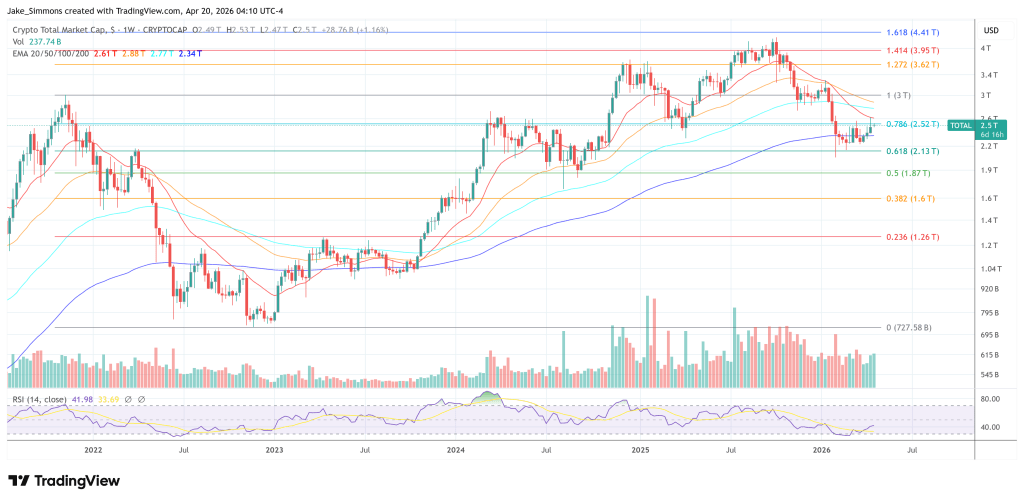
Total crypto market cap must overcome the 0.786 Fib, 1-week chart | Source: TOTAL on TradingView.com

İlgili Sorular

QWhat was the main reason for the $290 million KelpDAO crypto exploit according to LayerZero?

ALayerZero stated that the exploit was not a failure of its protocol but was the result of KelpDAO's decision to run its rsETH with a single-DVN (Decentralized Verifier Network) configuration, which contradicted LayerZero's recommended multi-DVN redundancy model.

QWhich sophisticated state actor is LayerZero preliminarily attributing the attack to?

ALayerZero's preliminary indicators suggest the attack is attributed to a highly-sophisticated state actor, likely the Lazarus Group from the Democratic People's Republic of Korea (DPRK), and more specifically, the subgroup known as TraderTraitor.

QHow did the attacker execute the RPC-spoofing attack without compromising the DVN instances directly?

AThe attacker poisoned downstream RPC infrastructure used by the LayerZero Labs DVN, swapped binaries on compromised op-geth nodes, and then used DDoS pressure on uncompromised RPCs to force failover toward the poisoned infrastructure, allowing them to forge a message to the DVN.

QWhat action has LayerZero taken regarding applications using a 1-of-1 DVN configuration after the incident?

ALayerZero announced that it will no longer sign or attest messages for any applications using a 1-of-1 DVN configuration, reinforcing its stance that a multi-DVN setup is necessary for security.

QWhat is the current status of rsETH on Aave V3 and V4 markets following the exploit?

AAave has stated that, out of an abundance of caution, rsETH remains frozen across its Aave V3 and V4 markets, and exposure to the incident is capped, although their analysis shows that rsETH on Ethereum mainnet is fully backed.

İlgili Okumalar

Qualcomm and Arm Fall Together: The Bill for Memory Price Hikes Finally Arrives at Mobile Chip Companies

After posting Q2 FY2026 results, Qualcomm and Arm both saw their shares decline, reflecting the impact of memory price increases on the smartphone chip sector. Qualcomm's revenue of $9.95B slightly beat expectations, but EPS of $2.21 fell short. More concerning was its guidance for next quarter, with EPS projections below analyst estimates. The company directly attributed a >$1.50 per share annual EPS headwind to rising memory costs and supply constraints in Android phones, prompting planned price hikes. While automotive revenue grew 61% and is approaching one-third of phone revenue, the mobile segment declined 20%. Qualcomm also confirmed a significant reduction in its modem share for the upcoming iPhone and outlined a plan for data center revenue to replace all Apple-related income by FY2027. Arm's results surpassed expectations with revenue of $1.29B and EPS of $0.45, and its guidance was also strong. However, its stock fell. Key concerns included royalty revenue failing to set a new record and a downward revision to full-year royalty growth guidance from ~20% to the high-teens, citing weak smartphone demand and high memory prices. Despite robust growth in its data center business, Arm's premium valuation (over 100x forward P/E) means even beating expectations isn't enough to push the stock higher, as any sign of uncertainty is magnified. Ongoing global antitrust investigations add another risk factor. The situation highlights a broader shift. Memory price surges, which boosted Samsung's profits, are now pressuring chip designers. Meanwhile, the semiconductor sector saw significant corrections in July, with the hardest-hit stocks often being those with the biggest AI-driven gains year-to-date. Qualcomm, lacking such a premium, was an exception.

marsbit14 dk önce

Qualcomm and Arm Fall Together: The Bill for Memory Price Hikes Finally Arrives at Mobile Chip Companies

marsbit14 dk önce

13 Business Lines Surpass $100 Million in Annualized Revenue, Robinhood Moves Toward a 'Super Financial App'

Robinhood Q2 2026 Earnings: Record Revenue and a Push Towards a "Super Financial App" Robinhood (HOOD) reported strong Q2 2026 results, with net revenue reaching $1.308 billion, up 32% year-over-year, and net income hitting $561 million, a 45% increase. The company now has 13 distinct business lines each generating over $100 million in annualized revenue. Key drivers included a 44% surge in transaction-based revenue to $776 million, led by a more than 10x growth in "event contracts" (prediction markets) and strong performance in stocks and options. User metrics also grew, with funded accounts rising to 28.4 million and total assets under custody reaching $369 billion. The Robinhood Gold subscription service hit a record 4.8 million users. The report highlights a strategic shift for Robinhood. Moving beyond its core as a zero-commission trading platform for retail investors, it is actively building a broader financial ecosystem. This includes expanding into wealth management (Robinhood Strategies), payments (Robinhood Credit Card), and next-generation infrastructure like AI-powered "Agentic Trading" and its own Ethereum Layer 2 blockchain, Robinhood Chain. The company's goal is to evolve from a trading app into a comprehensive "super financial app," offering a one-stop shop for investing, cash management, and future on-chain finance.

Odaily星球日报44 dk önce

13 Business Lines Surpass $100 Million in Annualized Revenue, Robinhood Moves Toward a 'Super Financial App'

Odaily星球日报44 dk önce

13 Business Lines Surpass $100 Million in Annualized Revenue, Robinhood Advances Toward a 'Super Financial App'

On July 30th, Robinhood (HOOD) reported its Q2 2026 financial results, showcasing significant growth with record revenue and profits. The company achieved a net revenue of $1.308 billion, a 32% year-over-year (YoY) increase, and a net income of $561 million, up 45% YoY. This strong performance was driven by robust trading activity and expansion into new financial services. A key highlight was the surge in transaction-based revenue, which rose 44% YoY to $776 million. Notably, income from event contracts (prediction markets) skyrocketed over 10x to $156 million, emerging as a major new growth driver alongside strong gains in stock and options trading. However, crypto trading revenue declined by 38%. Beyond trading, Robinhood is successfully diversifying its revenue streams. User assets grew 32% to $369 billion, and the subscription service Robinhood Gold reached a record 4.8 million users. The company revealed that 13 of its business lines now generate over $100 million in annualized revenue, including its new credit card, prediction markets, and Gold subscriptions. Looking forward, Robinhood is strategically investing in AI and blockchain to build a comprehensive financial ecosystem. It has launched AI-powered "Agentic Trading" and the "Robinhood Chain," a layer-2 blockchain network. The company's vision is evolving from a retail trading platform into a "super financial app" that integrates trading, wealth management, payments, and next-generation digital asset services, though regulatory hurdles remain for some new ventures.

marsbit44 dk önce

13 Business Lines Surpass $100 Million in Annualized Revenue, Robinhood Advances Toward a 'Super Financial App'

marsbit44 dk önce

İşlemler

Spot
活动图片