Large Models Devour Word

marsbit2026-04-14 tarihinde yayınlandı2026-04-14 tarihinde güncellendi

Özet

On April 10, 2026, Anthropic integrated Claude into Microsoft Word, completing its integration into the core Office suite (Word, Excel, PowerPoint). This allows Claude to operate directly within Word’s interface, offering features like contract review with tracked changes—red for deletions, green for insertions—without altering user habits. Microsoft’s strategy is to prioritize interface ownership over model ownership, believing distribution channels matter more as AI models commoditize. By hosting Claude via Azure, Microsoft retains users rather than risk losing them to external platforms. The integration has disrupted legal tech firms; companies like Thomson Reuters and RELX saw significant stock drops, as Claude offers advanced legal review at a fraction of the cost. While some legal tech firms resist, others, like LexisNexis, have incorporated Claude into their offerings. Anthropic’s approach represents a new form of disruption: rather than building a competing platform, it embeds itself inside dominant software, offering superior functionality at lower cost. This forces incumbents into a dilemma—blocking better tools may drive users away, while allowing them cultivates internal competitors.

By | Jinduan

On April 10, 2026, Anthropic officially integrated Claude into the Microsoft Word sidebar, completing its full penetration of the Excel, PowerPoint, and Word trifecta.

In fact, Microsoft had already handed over the "key" to Word in the cooperation agreement last November.

This landmark event may signify that as model capabilities surpass platform loyalty, and as the best tenants begin to challenge the authority of landlords, the enterprise software world is undergoing a power shift concerning technological generations.

A Quiet Entry

On April 10, Anthropic announced the beta launch of Claude for Word, available to Team and Enterprise subscribers. This is an intelligent assistant residing in the Word sidebar; it reads contracts, marks deletions in red and insertions in green, and directly presents the modification results in Word's native revision pane.
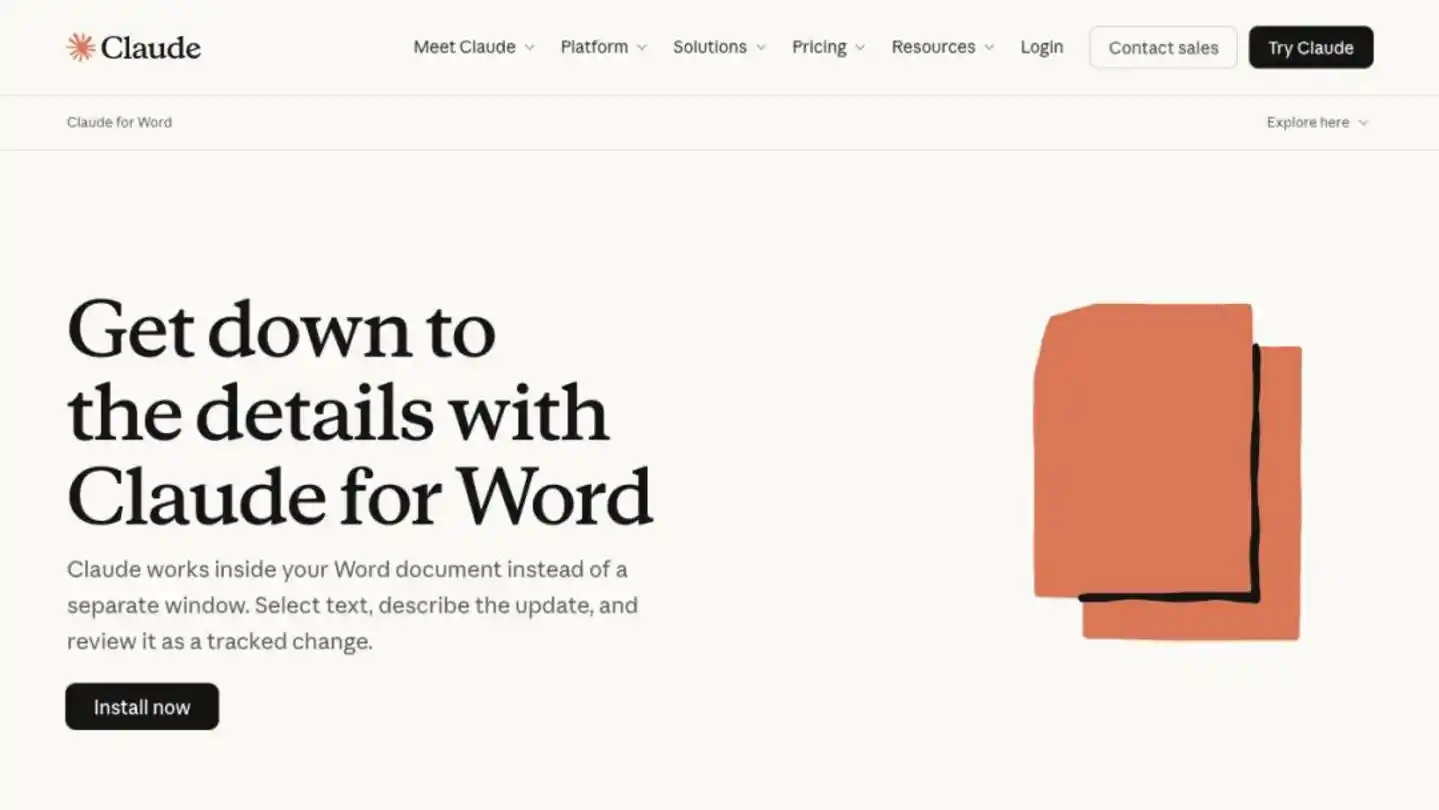
The first example prompt on the Claude for Word product page precisely reveals the target user group: "Mark clauses that deviate from market standard terms, sorted by severity." This is a typical work scenario for junior lawyers. Anthropic did not attempt to build a new legal tech platform but directly entered the space where lawyers already operate.

Prior to this, Claude for Excel was launched in October 2025, followed by Claude for PowerPoint in February 2026. With the addition of Word, Claude has achieved comprehensive coverage of the core Office trio.

More importantly, the context between these three applications is interconnected: conversations started in Excel can directly import data into Word documents without copy-pasting; contract analysis in Word can generate PowerPoint summary slides with one click.

Anthropic first built a cross-application context layer and then filled in the applications one by one. This sequence itself speaks to the strategic intent.

The technical implementation of Claude for Word is worth examining. Every modification it generates is a Word-native "tracked change": deletions in red, insertions in green, and comments anchored to specific clauses. Reviewers can accept or reject each item one by one, exactly as partners have reviewed junior lawyers' work for forty years.

A practitioner named Stephen Smith, after actual use, commented that Claude's revision functionality is "cleaner and more reliable than the current version of Copilot." He was comparing Anthropic's beta with Microsoft's officially released product.

This comment touches the core of the issue: Microsoft has fifteen years of AI integration experience in Word, yet Anthropic, on its first entry into this application, surpassed the native player in core functionality.

Claude for Word does not attempt to change lawyers' work habits but precisely integrates into them. It does not require users to learn new tools or migrate to a new platform; it simply makes existing workflows more efficient. The migration cost is zero, drastically lowering the threshold for willingness to switch.

Why Microsoft Opened the Door

On the surface, Microsoft's stance is the most puzzling.

Claude for Word runs inside Microsoft's application, is distributed through Microsoft's AppSource, and relies on Microsoft's management tools for deployment. Microsoft is the landlord, Anthropic is the tenant. But Microsoft not only allowed this tenant to move in but also proactively handed over the keys in last November's cooperation agreement.

The answer lies in Microsoft's strategic judgment: owning the interface is more important than owning the model.

This judgment did not come out of thin air. In September 2025, Microsoft began integrating Claude Sonnet 4 into Word, Excel, Outlook, and PowerPoint, presented under the Copilot brand. Internal testing found that Claude outperformed OpenAI's model in automating Excel financial functions and was also clearer in drafting memorandum prose.

Microsoft deemed this gap significant enough to be willing to pay its cloud competitor Amazon Web Services, just to provide Claude to its own customers.

In November of the same year, the cooperation was formalized. Sonnet 4.5, Haiku 4.5, and Opus 4.1 entered Microsoft Foundry. Excel's Agent Mode listed Claude as an optional model. Claude powers the Researcher agent within Copilot.

Microsoft's bet is: models will commoditize, distribution channels will not.

GitHub Copilot already allows developers to freely choose models from OpenAI, Anthropic, Google, and xAI. Office 365 is evolving in the same direction. If Claude is the best model for a specific task, Microsoft would rather host it and collect Azure fees than lose the entire user. The latter might be taken by a competitor that completely removes the user from Word.

For now, this is a rational strategy. But it implies a risk that Microsoft may not have fully assessed: when the tenant's service quality significantly surpasses the landlord's own product, users will begin to question why they need to pay for both.

Winners and Losers

When Anthropic released the legal plugin for Claude Cowork in February 2026, the market's reaction was violent. Thomson Reuters fell 16% in a single day, RELX dropped 14%, and Wolters Kluwer declined 13%. Three legal data and tech giants lost approximately $285 billion in market value in one trading day.

The investors' message was unmistakable: a general AI with strong legal skills poses an existential threat to professional service providers who have charged lawyers for decades.

Claude for Word is the sequel to this logic. The plugin proved the capability; the plugin *is* the capability; and the significance of the Word plugin lies in distribution. The February event was a warning; the April release is the formal landing.

The reaction in the legal tech sphere is intriguing. Harvey (which itself runs on Claude), valued at around $8 billion, saw its CEO Winston Weinberg state this week that Anthropic "remains one of the models Harvey's customers benefit from using."

This is a nuanced phrasing: someone who just noticed the landlord opening a competing lemonade stand next to theirs hasn't yet decided how angry to be. Harvey and Legora both stated they would not adopt this Word plugin.

LexisNexis made a more peculiar choice: it packaged Anthropic's legal plugin into its own Protégé product, rather than fighting it. One could call it cooperation, or one could call it being co-opted.

When core document review and drafting capabilities are commoditized at a price of $25 per month, the operating logic is vastly different.

The short-term winners are clear. Anthropic gains a direct channel to all document-intensive professionals in the English-speaking world without building its own platform. Microsoft gets the Azure consumption from the Claude workloads it was going to host anyway. Small and medium-sized law firms get junior lawyer-level contract review capability for $25 a month without switching applications.

The losers are equally clear. Pure legal tech vendors whose core selling point was "we are good at document review" lose their core argument. They need to find things Claude in Word cannot do, and they need to do it fast. Harvey and Legora can fall back on deep workflow and firm-specific training, but second-tier players lack this buffer.

OpenAI is another loser. Its cloud partnership with Microsoft long protected its position at the top of the Office stack. That position is now being eroded in real-time. Copilot, despite its vast number of licenses, must explain to its own customers why they should retain a product rated lower by users than the beta version next to it.

Three groups, three sentiments, the temperature felt by each party in the room is different.

Conclusion: What Disrupts You Is Never the Next You

Claude for Word offers a perspective that transcends specific business analysis. It demonstrates a specific form of disruption: not building a replacement, but entering the existing system and becoming a tenant better than the native inhabitant.

Traditionally, challenging a monopolist required building an alternative platform. You needed to persuade users to leave their familiar environment, migrate to a new interface, and learn new habits. This migration cost was the incumbent's strongest moat.

But Anthropic chose a different path. It did not build a Word replacement. It rented space within the application every knowledge worker already uses, then provided service at a lower price and better quality. Users don't need to leave Word. They just need to switch from Copilot to Claude.

This strategy poses a prisoner's dilemma for the platform: if you don't allow the better tenant in, you are depriving users of access, and they will find another way to leave your platform. If you allow the better tenant in, you are cultivating a replacement on your own turf. Either choice puts you in a bind.

Anthropic did not build a Word competitor. It rented space inside the application every knowledge worker already uses and set a new standard with better service. Clearly, the way to break a monopoly is not necessarily to build a replacement externally. Sometimes, the way is to stand inside it, offer a better service at a lower price, and wait for users to make the choice themselves.


İlgili Sorular

QWhat is the significance of Anthropic integrating Claude into Microsoft Word's sidebar on April 10, 2026?

AIt marks the completion of Claude's full integration into the core Office suite (Word, Excel, PowerPoint), representing a potential power shift in enterprise software where superior model capabilities challenge platform loyalty and the authority of the incumbent 'landlord' (Microsoft).

QHow does Claude for Word technically function and integrate with the user's workflow?

AIt operates as a sidebar assistant within Word. It reads documents, marks changes using Word's native 'tracked changes' feature (red for deletions, green for insertions), and presents results directly in the native revision pane. This requires no change to the user's existing habits or workflow.

QWhy did Microsoft, the 'landlord,' agree to open its platform to Anthropic, a potential competitor?

AMicrosoft's strategic bet is that the user interface and distribution channel (the platform) are more valuable and defensible than the AI models themselves. They would rather host a superior model like Claude and collect Azure fees than risk losing users to a competitor that might take them completely away from the Microsoft ecosystem.

QWhat was the immediate market reaction to Anthropic's earlier legal-focused AI capabilities, and what does it indicate?

AThe announcement of Claude's legal plugin in February 2026 caused a massive sell-off in legal tech giants like Thomson Reuters, RELX, and Wolters Kluwer, erasing approximately $285 billion in market value in a single day. This indicates investors believe a powerful, general-purpose AI poses an existential threat to specialized, high-cost professional service providers.

QWhat unique form of market disruption does the Claude for Word integration exemplify?

AIt demonstrates disruption from within, not by building a replacement platform. Instead of asking users to migrate to a new tool, the superior 'tenant' (Claude) moves into the existing, widely-used platform (Word), offers a better service at a lower cost, and lets users choose, putting the platform owner in a difficult strategic position.

İlgili Okumalar

Can DeepSeek Save China One Trillion Dollars?

"DeepSeek and the $1 Trillion Infrastructure Question" The article examines whether DeepSeek's AI optimization breakthroughs could potentially save China $1 trillion in future AI infrastructure costs. The analysis begins with Nvidia's upcoming Vera Rubin AI platform, costing ~$7.8 million, where memory (HBM4/LPDDR5X) constitutes $2 million—a 435% cost increase in one year, highlighting how AI hardware spending is shifting toward expensive memory components. DeepSeek's approach works in the opposite direction. Through three key technical innovations showcased in DeepSeek V4, the company dramatically improves hardware efficiency: 1. **Memory Compression (MLA)**: Re-engineers the attention mechanism to compress long-context memory (KV Cache) by over 90%, drastically reducing expensive HBM usage. 2. **Selective Activation (MoE)**: Employs Mixture-of-Experts architecture where only a small fraction of parameters (e.g., 49B out of 1.6T in V4-Pro) are activated per token, allowing most parameters to reside in cheaper memory/SSD. 3. **Computation Caching**: Reuses previously computed results via cache hits, replacing expensive GPU computations with cheap memory reads. Combined, these optimizations allow the same hardware to produce approximately 4x more tokens, effectively reducing required hardware investment by 75%. DeepSeek's pricing reflects this: a 10-billion token workload costs ~$522 monthly versus ~$9,000-$10,000 for competitors. The $1 trillion savings projection stems from McKinsey's estimate that global AI infrastructure will require ~$5.2 trillion investment by 2030. As China's daily token consumption grows toward quadrillions, even marginal efficiency gains scale massively. With a conservative 4x throughput improvement, China could avoid building tens of thousands of AI data centers equivalent to ~7 trillion RMB ($1 trillion) in saved investment. Critically, this strategy shifts dependency from scarce, expensive GPU/HBM—where China lags—toward more accessible storage, caching, and systems engineering where domestic suppliers like CXMT are gaining strength. Rather than "replacing Nvidia," DeepSeek rebalances AI's value chain away from monolithic hardware dependency. Ultimately, DeepSeek's technical breakthroughs could lower the barrier to AI adoption across Chinese industries by making advanced capabilities affordable at scale—transforming who can access next-generation AI.

marsbit42 dk önce

Can DeepSeek Save China One Trillion Dollars?

marsbit42 dk önce

Overturning the Mainstream Approach to Hallucinations: Metacognition is the New Solution for Large Models to Break the Hallucination Barrier

This paper, "Hallucinations Undermine Trust; Metacognition is a Way Forward," proposes a paradigm shift in combating AI hallucination. It argues that the current mainstream approaches—striving for omniscience by scaling data/models or having AI abstain from uncertain answers—are fundamentally flawed. The former has inevitable knowledge gaps, while the latter imposes a crippling "utility tax," requiring the rejection of many correct answers to achieve high accuracy, due to models' poor "discrimination" (the ability to distinguish correct from incorrect answers internally). The core contribution is redefining hallucination not as "being wrong," but as "expressing false information with unwarranted certainty." The proposed solution is **Faithful Uncertainty** or **Metacognition**: enabling AI to accurately perceive its internal uncertainty and honestly express it in its language (e.g., using hedging phrases when unsure). This creates a more reliable assistant that provides useful information while signaling its confidence, minimizing harm from errors. The paper emphasizes that metacognition is critical for the era of AI Agents. Without it, Agents cannot intelligently decide when to use tools like search engines, leading to inefficiency and misuse. Key implementation challenges are highlighted: the "bootstrapping paradox" of training with static uncertainty data, the "alignment distortion signal" where human preference training suppresses internal uncertainty cues, and the difficulty of causally evaluating true metacognition vs. its superficial imitation. The paper concludes that the goal should not be an infallible AI, but one that is honest about the limits of its knowledge, thereby building user trust through transparent communication of its certainty.

marsbit46 dk önce

Overturning the Mainstream Approach to Hallucinations: Metacognition is the New Solution for Large Models to Break the Hallucination Barrier

marsbit46 dk önce

Hedge by Buying Gold and Oil, Chase Soaring Returns with AI. ‘Dated’ Bitcoin Enters a Bear Market

Bitcoin has recently declined, hitting a two-month low near $66,123, while Ethereum fell to a three-month low around $1,837. Analysts suggest the drop is not merely due to factors like ETF outflows or MicroStrategy's selling but reflects a deeper issue: Bitcoin is losing a broader asset competition. In a near-zero interest rate environment, Bitcoin previously thrived as an outlet for investor dissatisfaction with inflation and limited options. However, the market landscape has shifted. Bitcoin now occupies an "awkward middle ground," facing competition on three fronts. For inflation hedging, investors prefer gold, energy stocks, and commodity producers—assets with tangible backing and clearer pricing power. For growth exposure, AI-related companies with actual revenues and profits are more attractive. Even within crypto, investors can choose stablecoins, exchanges, or infrastructure firms tied directly to adoption, offering clearer business models and leverage. Thus, Bitcoin is no longer the top choice for hedging, growth, or crypto exposure. This shift is evident in market reactions: despite recent warnings about persistent inflation from a Fed official, Bitcoin did not rally as it might have in the past. Instead, capital flowed to assets with direct commodity or energy exposure. The recent ETF outflows and MicroStrategy sales are symptoms, not causes, of this new reality. Investors are becoming more selective, demanding clearer value propositions beyond mere scarcity. The emerging bear case for Bitcoin is not about it being a bubble or failed technology, but that scarcity alone is no longer sufficient.

华尔街日报49 dk önce

Hedge by Buying Gold and Oil, Chase Soaring Returns with AI. ‘Dated’ Bitcoin Enters a Bear Market

华尔街日报49 dk önce

İşlemler

Spot
Futures
活动图片